On this page
Verb + ようにする says that someone deliberately acts so a behaviour or result becomes the norm. 毎日歩くようにしています means “I make a habit of walking every day,” while 忘れないようにします means “I will make sure not to forget.”
The English word “try” is useful but incomplete. ようにする can describe sustained effort, a practical precaution, or a rule you set for yourself. It presents the way you manage the situation, not a guarantee that you always succeed.
Put a plain non-past verb before ようにする
The material before ように stays plain. The affirmative uses the dictionary form; the negative uses the ない-form.
| Aim | Pattern | Example | Natural meaning |
|---|---|---|---|
| do an action | V dictionary + ようにする | 毎日歩くようにする | make a point of walking every day |
| avoid an action | Vない + ようにする | 夜は食べないようにする | make a point of not eating at night |
| maintain the practice | V + ようにしている | 本を読むようにしている | make a habit of reading books |
| polite request | V + ようにしてください | 遅れないようにしてください | please make sure not to be late |
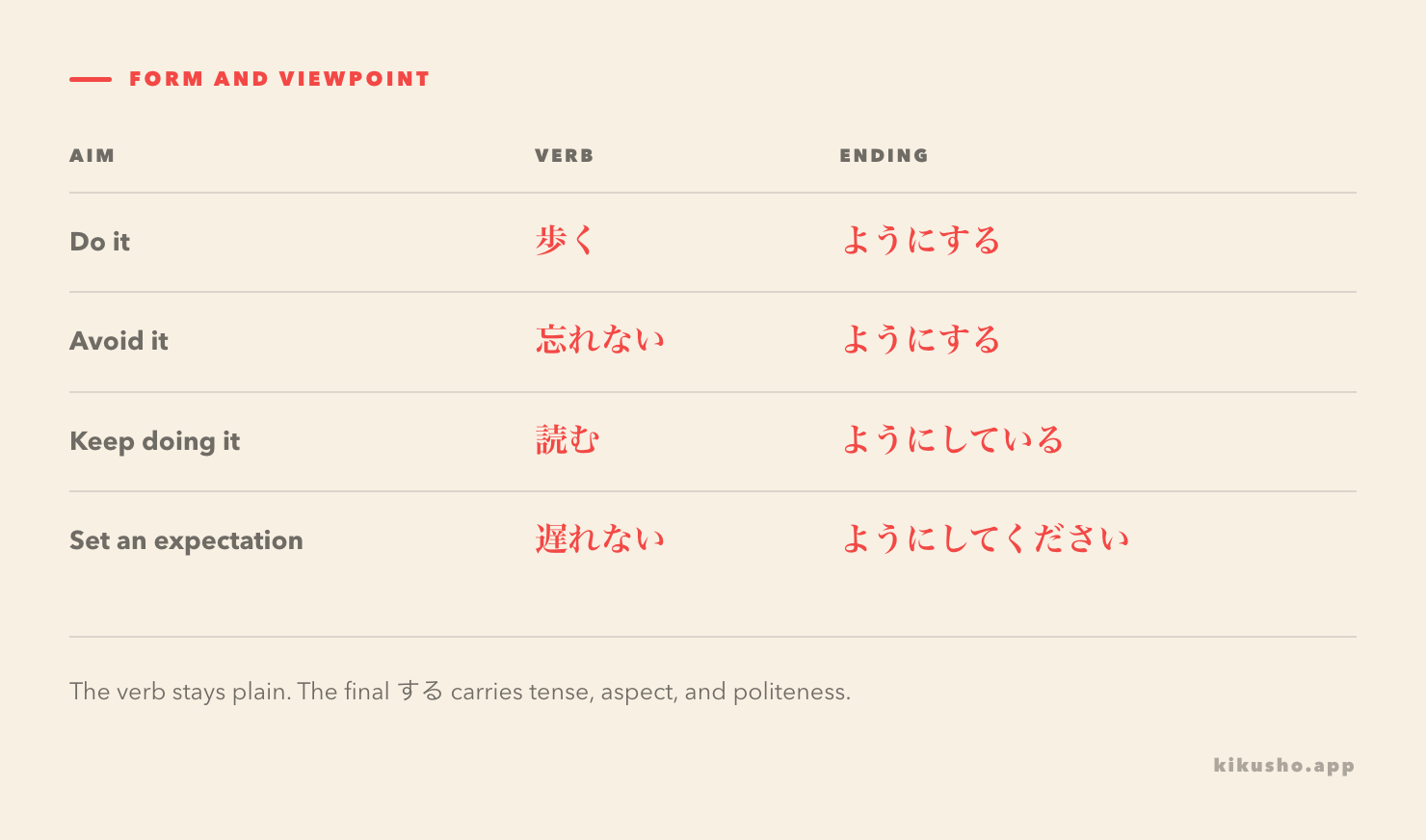
Use 歩くようにします, not 歩きますようにします. The verb inside the pattern does not take ます; politeness goes on the final する.
今日から、寝る前に本を読むようにします。
きょうから、ねる まえに ほんを よむ ように します。
Starting today, I will make a point of reading before bed.
大切な予定を忘れないようにします。
たいせつな よていを わすれない ように します。
I will make sure not to forget important appointments.
The negative sits inside the target behaviour: 忘れない is the result the speaker works to maintain. This differs from ようにしない, which negates making that effort. At N4, the clearest and most useful negative pattern is Vない + ようにする.
ようにする starts an effort; ようにしている sustains it
The tense and aspect of する tell you whether the speaker is setting a policy or describing an established practice.
| Ending | Viewpoint | Example |
|---|---|---|
| ようにする | a present choice or general policy | 甘い物を減らすようにする |
| ようにします | a polite commitment from now on | 毎朝七時に起きるようにします |
| ようにしている | an effort maintained over time | 毎日ニュースを読むようにしている |
| ようにしています | the same continuing effort, polite | 階段を使うようにしています |
明日から、朝ご飯を食べるようにします。
あしたから、あさごはんを たべる ように します。
From tomorrow, I will make a point of eating breakfast.
健康のために、毎朝、朝ご飯を食べるようにしています。
けんこうの ために、まいあさ、あさごはんを たべる ように しています。
For my health, I make a habit of eating breakfast every morning.
The first sentence establishes a new practice. The second looks at the practice as something the speaker keeps doing. ようにしています does not assert a flawless record. It says the speaker organizes their behaviour in that direction.
The Japan Foundation's account of よう describes ようにする as bringing about a state through effort or practical ingenuity. That is why the form suits both repeated habits and precautions. You change what you do so that the chosen outcome is more likely.
The result can be an action, an ability, or a protected state
Many beginner examples use voluntary actions such as 読む and 運動する. The construction can also place a controllable measure around a result that is not a simple action.
漢字が読めるように、毎日練習しています。
かんじが よめる ように、まいにち れんしゅうして います。
I practise every day so that I can read kanji.
That sentence uses purpose ように rather than the fixed ending ようにする: the practice appears after ように. Compare a sentence where する itself carries the practical arrangement:
小さい字も読めるようにします。
ちいさい じも よめる ように します。
I will arrange things so that even small print can be read.
Context must reveal the measure, such as enlarging the display or improving the lighting. The speaker is not promising instant ability. They are taking responsibility for making the result possible.
The negative commonly protects a state:
部屋が寒くならないように、窓を閉めます。
へやが さむく ならない ように、まどを しめます。
I close the window so that the room does not become cold.
Again, this is purpose ように followed by the concrete action 窓を閉めます. With 寒くならないようにします, the measure is left implicit: “I will make sure it does not get cold.”
ようになる reports the change, not the management
The paired verbs する and なる choose two viewpoints.
| Form | Focus | Example | Meaning |
|---|---|---|---|
| ようにする | deliberate measures | 毎日歩くようにした | I made a point of walking every day |
| ようになる | the resulting change | 毎日歩くようになった | I came to walk every day |
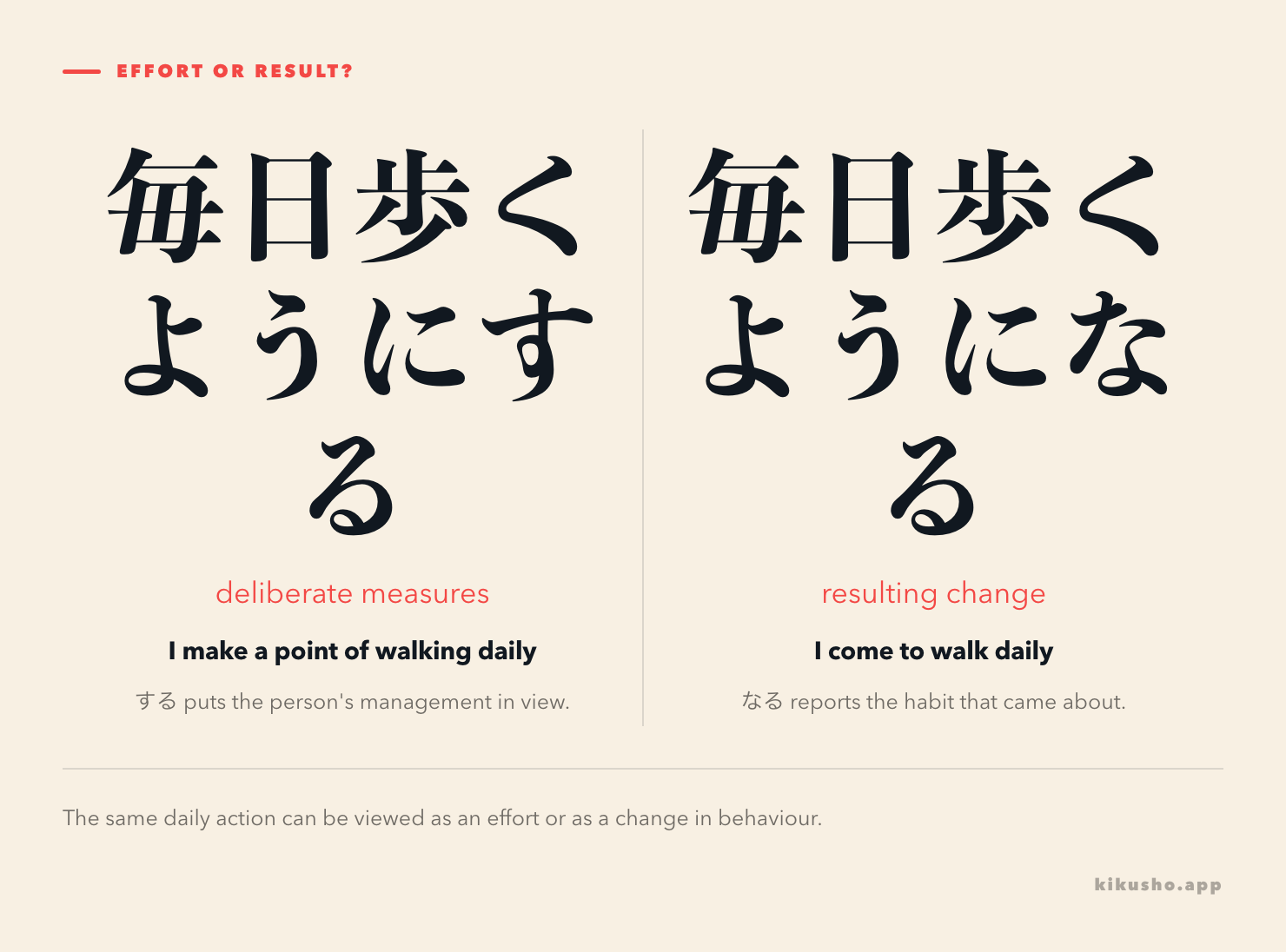
The ようになる lesson follows changes in ability and habit. A sentence with なる can be compatible with effort, but it does not grammatically present the effort as the cause.
日本語のニュースを読むようにしています。
にほんごの ニュースを よむ ように しています。
I make a practice of reading news in Japanese.
日本語のニュースが読めるようになりました。
にほんごの ニュースが よめる ように なりました。
I became able to read news in Japanese.
The first line tells you about the learner's chosen routine. The second tells you what ability emerged. A study habit may lead to an ability, but the two sentences do different work.
Three neighbouring “try” forms answer different questions
English often hides the distinction by translating several forms as “try.” Ask what kind of trying the sentence describes.
| Form | Question it answers | Example |
|---|---|---|
| V + ようにする | What practice or precaution will you maintain? | 毎日書くようにする |
| V + ことにする | What did you decide? | 毎日書くことにした |
| Vて + みる | What will you test by doing it once? | このペンで書いてみる |
| volitional + とする | What action is being attempted or about to begin? | 書こうとする |
ことにする marks a decision. It can introduce the same habit, but the decision itself is the news. ようにする keeps attention on carrying out the behaviour through effort or arrangement. The ことにする and ことになる comparison separates personal decisions from arrangements.
てみる is an experiment: do something and see what happens. 毎日読むようにしています describes a maintained reading practice; この本を読んでみます means you will try this book and see how it goes. The てみる lesson develops that one-time test.
ようとする contains the volitional ending よう plus と. It is a different construction from plain verb + ようにする. In ドアを開けようとした, the person tried or was about to open the door. The shape before よう tells them apart: 開けるようにする versus 開けようとする.
Requests with ようにしてください set a behavioural expectation
Changing the final する to してください asks the listener to take care that the result holds.
図書館では静かに話すようにしてください。
としょかんでは しずかに はなす ように して ください。
Please make sure to speak quietly in the library.
パスワードを人に見せないようにしてください。
パスワードを ひとに みせない ように して ください。
Please make sure not to show your password to other people.
This form is common in instructions, advice, and rules because it targets future conduct. It can sound more like an expectation than a request for one immediate physical act. If you simply want someone to close the door now, ドアを閉めてください is direct and sufficient. ドアを閉めるようにしてください asks them to adopt the practice or ensure that closing happens.
When a notice contains this pattern, save the behaviour with it. A card that keeps only ようにする loses the difference between 見せないようにする and 忘れないようにする. In Kikusho, you can capture the complete instruction from a photo, check the editable text and reading, and review the precaution as one recoverable sentence.
Practice
Work through all seven prompts before checking the answer block.
Question 1. Complete the routine with the right verb form: 毎朝、七時に__ようにしています。
- ア. 起きる
- イ. 起きます
- ウ. 起きて
- エ. 起きよう
Question 2. Which sentence means “I will make sure not to forget the key”?
- ア. 鍵を忘れないようにします。
- イ. 鍵を忘れますようにします。
- ウ. 鍵を忘れてみます。
- エ. 鍵を忘れるようになりました。
Question 3. Which form best describes an effort the speaker already maintains?
- ア. 毎日歩くようにしました。
- イ. 毎日歩くようにしています。
- ウ. 毎日歩くようになりません。
- エ. 毎日歩いてみました。
Question 4. Arrange the fragments into “From today, I will make a point of reading the news.”
- ようにします
- 今日から
- ニュースを
- 読む
Question 5. Choose the sentence that focuses on a resulting ability rather than deliberate management.
- ア. 日本語の新聞を読むようにしています。
- イ. 日本語の新聞が読めるようになりました。
- ウ. 日本語の新聞を読んでみます。
- エ. 日本語の新聞を読むことにしました。
Question 6. Complete the instruction naturally: 大切な書類をなくさない__。
- ア. ようにしてください
- イ. ことになりました
- ウ. ようになりました
- エ. てみてください
Question 7. Choose the pair that completes the short report.
健康のために、毎日階段を(甲)ようにしています。夜はコーヒーを(乙)ようにしています。
- ア. 甲: 使う/乙: 飲まない
- イ. 甲: 使います/乙: 飲みません
- ウ. 甲: 使って/乙: 飲まなくて
- エ. 甲: 使おう/乙: 飲もう
Answers and explanations
Answer 1. ア. 起きる. An affirmative action takes the dictionary form directly before ようにしています. 起きます places politeness inside the modifier, 起きて is the て-form, and 起きよう belongs to the distinct volitional + とする construction.
Answer 2. ア. 鍵を忘れないようにします. The ない-form names the protected result: not forgetting the key. イ is malformed, ウ says to try forgetting it, and エ reports a change toward forgetting.
Answer 3. イ. 毎日歩くようにしています. している views the deliberate practice as continuing. ア can announce that the speaker established it, ウ is negative and uses なる, and エ reports an experiment completed in the past.
Answer 4. 今日からニュースを読むようにします. 今日から sets the starting point, ニュースを is the object of 読む, and the dictionary-form verb attaches to ようにします.
Answer 5. イ. 日本語の新聞が読めるようになりました. Potential 読める plus ようになる reports the ability that came about. ア describes a maintained practice, ウ a trial, and エ a decision.
Answer 6. ア. ようにしてください. The negative target なくさない combines with ようにしてください to set a future precaution. The other endings report a decision, a change, or an experiment and do not fit this instruction.
Answer 7. ア. 甲: 使う/乙: 飲まない. The positive habit uses the dictionary form 使う; the avoidance habit uses the ない-form 飲まない. Both remain plain before ようにしています.
N4 placement and checked scope
JLPT Sensei labels ようにする N4 and records dictionary-form and ない-form verbs with ようにする and ようにしている. Bunpro independently places the point at N4 and supports the distinctions from ようになる, ことにする, てみる, and volitional + とする.
The Japan Foundation reference cited above supplies the central meaning of effort and ingenuity and shows ようにしてください in advice and instructions. A Tanos comparison list places the surface form at N3, so the inventory records a level disagreement. N4 is the editorial placement used here because two independent teaching references agree on it and because the lesson assumes plain verb forms, the ない-form, and ている as prerequisites. The JLPT itself does not publish an exhaustive official grammar list.
The assigned learning item is the deliberate-management construction ようにする. Purpose ように, change with ようになる, and volitional + とする appear only to mark its boundary; they are not claimed as additional coverage. The seven questions test attachment, negation, aspect, sentence order, contrast, requests, and short-context grammar without revealing any solution above this answer block.
The form becomes easiest to hear when you ask what the speaker is managing. A repeated action, an avoided mistake, and a protected result can all follow the same grammar because the effort lies in arranging one's behaviour around them.
Common questions
What does ようにする mean in Japanese?
Verb + ようにする means to take deliberate steps so that an action or result happens. Depending on context, it can mean “try to,” “make sure to,” or “make it a practice to.”
What is the difference between ようにする and ようにしている?
ようにする often announces a choice or effort from now on. ようにしている describes the continuing practice: for example, 毎日歩くようにしています means “I make a habit of walking every day.”
What is the difference between ようにする and ようになる?
ようにする focuses on somebody's deliberate effort or arrangement. ようになる reports that a state, ability, or habit has come about, without making the person's effort the grammatical focus.
Can a negative verb come before ようにする?
Yes. Use the ない-form directly before it: 忘れないようにします means “I will make sure not to forget,” and 夜はコーヒーを飲まないようにしています means “I make a habit of not drinking coffee at night.”