On this page
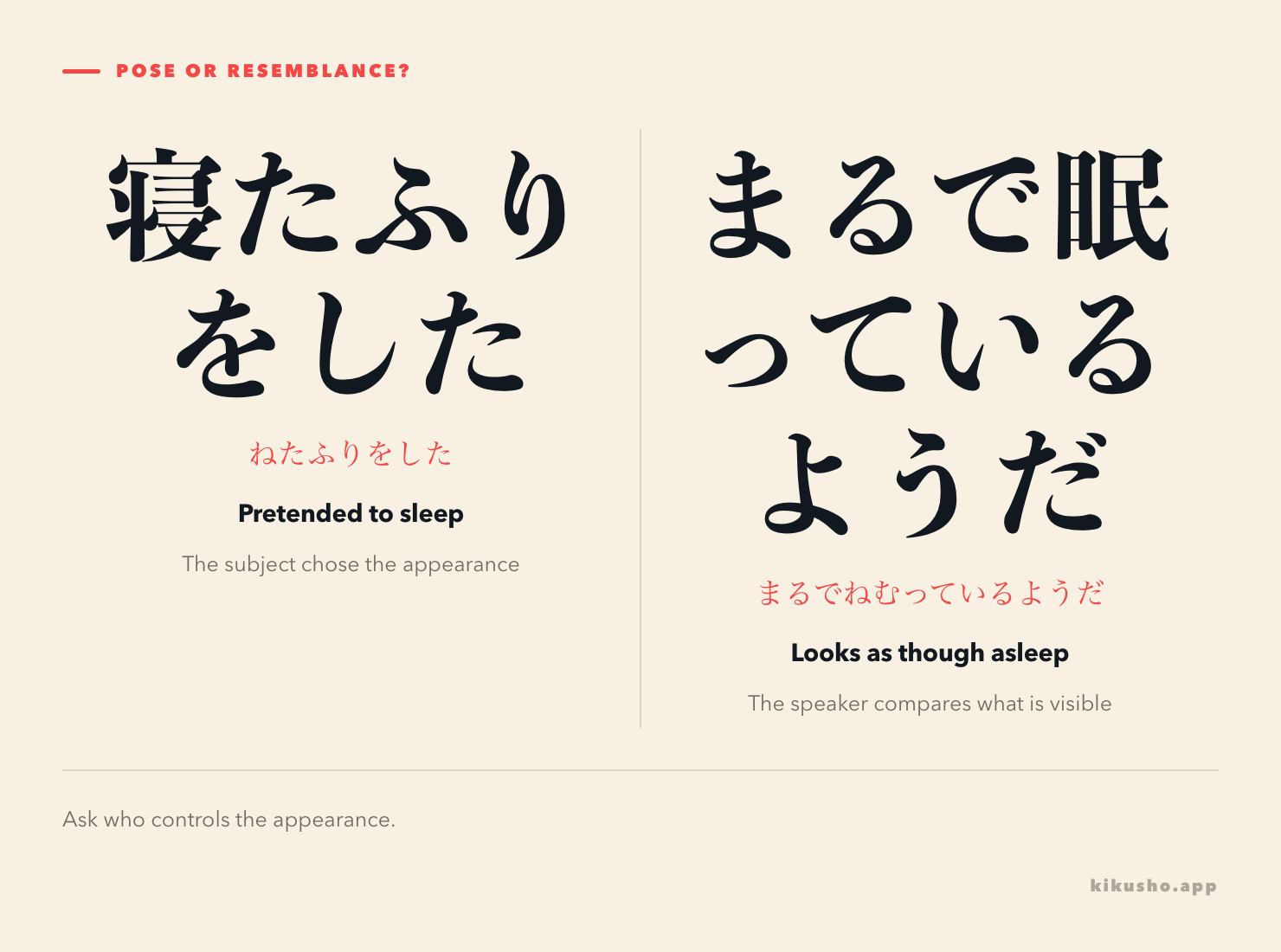
Someone closes their eyes and breathes evenly so that others will believe they are asleep: 寝たふりをする. Someone is so still that they merely look asleep: まるで眠っているようだ. The first describes a performed pose; the second makes a comparison.
That difference matters because ふりをする usually attributes control to the person. まるで does not expose a lie. It strengthens the resemblance expressed by ようだ, みたいだ or another comparison.
The test is whether the subject performs the appearance
Ask one question before translating “as if”: Is the subject deliberately presenting a false outward state? If yes, choose ふりをする. If the speaker is comparing what something looks, sounds or feels like, choose まるで~ようだ/みたいだ.
| Form | What it claims | Typical shape |
|---|---|---|
| ~ふりをする | A person or animal behaves as though A were true while reality differs | plain form + ふりをする |
| まるで~ようだ | A situation strongly resembles A | まるで + plain clause/Nの + ようだ |
| まるで~みたいだ | The same kind of resemblance in more conversational speech | まるで + plain clause/N + みたいだ |
The contrast is visible in one scene:
弟は起きていたが、寝たふりをした。
おとうとはおきていたが、ねたふりをした。
My younger brother was awake, but pretended to be asleep.
弟は静かで、まるで眠っているように見えた。
おとうとはしずかで、まるでねむっているようにみえた。
My younger brother was so still that he looked as though he were sleeping.
The first sentence tells us that the brother controlled the pose. The second reports the observer's impression. He may truly have been asleep.
ふりをする builds an outward role from an attributive form
ふり is a noun here, so the word before it takes the form used to modify a noun. The resulting noun phrase then takes をする. Bunpro's ふりをする entry describes this outward display and notes that what is visible may differ from the person's inner state. JapaneseNET independently gives the same four attachment groups and N3 placement.
| Before ふり | Attachment | Example |
|---|---|---|
| verb | plain form | 知らないふりをする, pretend not to know |
| い-adjective | adjective unchanged | 忙しいふりをする, pretend to be busy |
| な-adjective | な | 元気なふりをする, pretend to be well |
| noun | の | 店員のふりをする, pretend to be a shop employee |
The plain verb can be affirmative, negative, past or progressive because it describes the state being acted out. The final する locates the pretence in time:
答えを知らなかったが、分かっているふりをした。
こたえをしらなかったが、わかっているふりをした。
I did not know the answer, but pretended that I understood.
彼女は平気なふりをして、会議を続けた。
かのじょはへいきなふりをして、かいぎをつづけた。
She pretended to be fine and continued the meeting.
In 分かっているふりをした, 分かっている supplies the displayed state, while した says that the performance happened in the past. Changing it to 分かったふりをした presents having understood as the pose. The surrounding situation, rather than English tense alone, decides which state you mean.
The form can describe a small social performance without alleging an elaborate fraud. 興味があるふりをする may mean politely acting interested. It still says that the outward behaviour and the underlying reality do not match. That is why using ふり about someone else's sincere action can sound accusatory.
まるで strengthens a resemblance rather than creating a role
まるで is an adverb. In the assigned comparison use, it commonly anticipates ようだ or みたいだ and makes the likeness vivid: “just as if” or “just like.” JLPT Sensei's まるで lesson records the N3 placement and the verb and noun patterns. The Japan Foundation's account of よう distinguishes comparison from inference and notes that みたいだ is the more conversational counterpart.
雨上がりの道は、まるで鏡のように光っていた。
あめあがりのみちは、まるでかがみのようにひかっていた。
The road after the rain shone just like a mirror.
初めて見る町なのに、まるで前に来たことがあるみたいだった。
はじめてみるまちなのに、まるでまえにきたことがあるみたいだった。
Although it was my first time seeing the town, it felt as though I had been there before.
The material after まるで follows the ordinary attachment rules of よう and みたい:
| Comparison | よう | みたい |
|---|---|---|
| noun | まるで鏡のようだ | まるで鏡みたいだ |
| な-adjective | まるで静かなようだ | まるで静かみたいだ |
| verb clause | まるで時が止まったようだ | まるで時が止まったみたいだ |
| before a noun | まるで夢のような話 | まるで夢みたいな話 |
| before an action or quality | まるで鳥のように飛ぶ | まるで鳥みたいに飛ぶ |
This lesson assumes those ような/ように and みたいな/みたいに shapes are familiar. The full attachment and register system is covered in そう, よう, らしい and みたい.
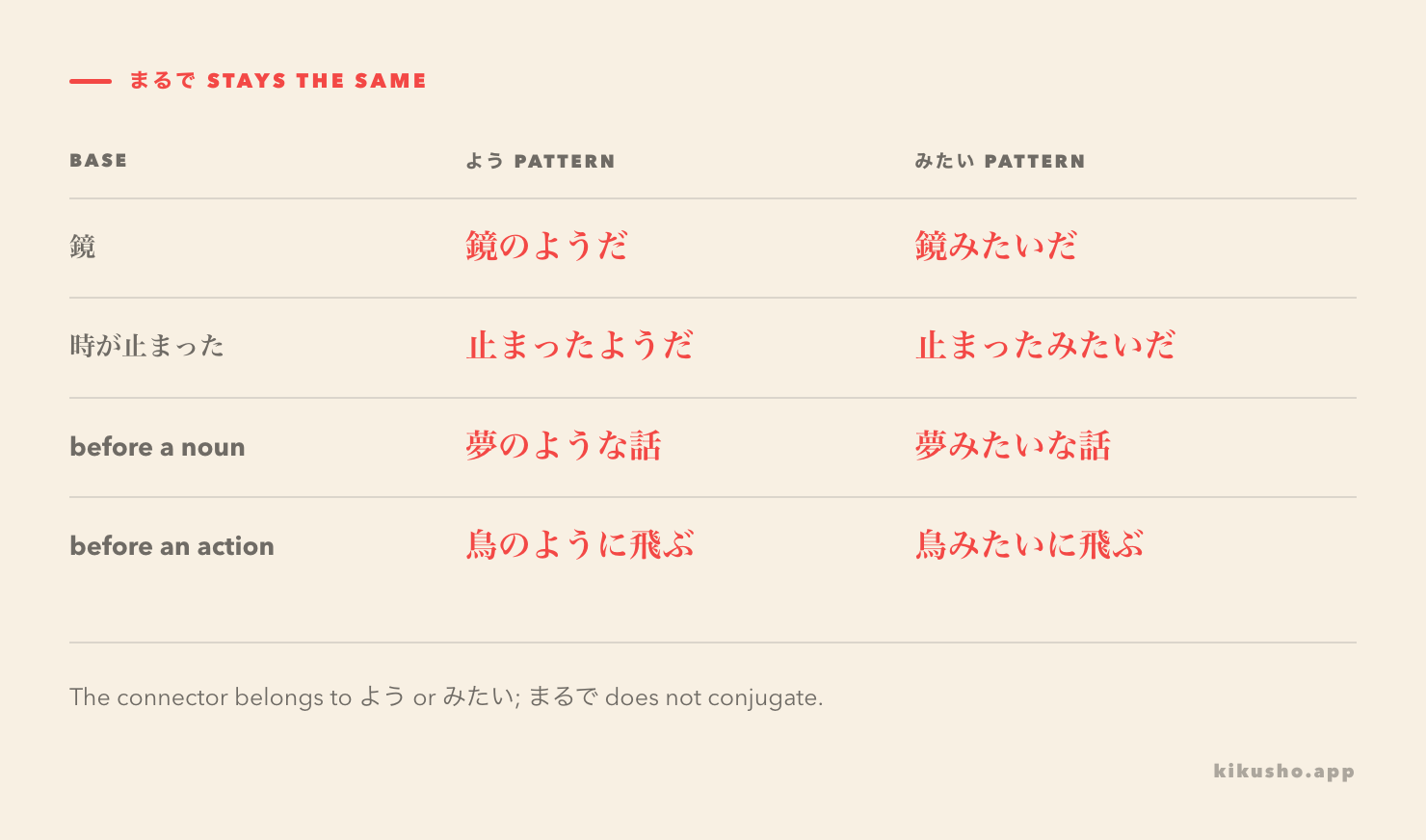
まるで is not a conjugating ending, and it need not always pair with よう or みたい. A direct metaphor such as まるで夢だ is possible. It also has a separate “completely” use with a negative expression:
説明を読んでも、意味がまるで分からなかった。
せつめいをよんでも、いみがまるでわからなかった。
Even after reading the explanation, I did not understand it at all.
The Digital Daijisen definition reproduced by Kotobank records both the resemblance sense and this negative-strengthening sense. There is no pretended role in まるで分からない.
The wrong choice changes who is responsible
Compare 彼は病気のふりをした with 彼はまるで病気のようだった. The first says he presented himself as ill although he was not. The second says his appearance resembled that of a sick person; he may really have been ill, and the sentence says nothing about deception.
That same boundary separates this N3 pattern from ぶる. Both can involve performed behaviour, but ぶる attaches to a role or trait and often conveys criticism, as in 専門家ぶる, “act like an expert.” ふりをする can instead build the exact false state needed by the context, including a whole clause. The N1 comparison of びる, ぶる and じみた explains that neighbouring family.
When saving an example in Kikusho, retain enough of the sentence to preserve the evidence. A card containing only “as if” cannot tell you whether someone chose the appearance. Keep 知らないふりをした or まるで知らない人のようだった as a unit, then use the editable nuance field to mark “performed” or “compared.”
Practice: decide whether the appearance is chosen
Complete all seven questions before consulting the explanations. Each answer is kept in the single section below Question 7.
Question 1 — grammar choice. Mika knows the answer but deliberately behaves as though she does not. Complete ミカは答えを__ふりをした.
- ア. 知らない
- イ. 知らないような
- ウ. まるで
- エ. 知らなくて
Question 2 — grammar choice. Choose the sentence that only compares the speaker's impression and does not accuse the man of pretending.
- ア. 彼は病気のふりをした。
- イ. 彼はまるで病気のようだった。
- ウ. 彼は病気なふりをした。
- エ. 彼はまるで病気のふりだった。
Question 3 — attachment. Choose the natural noun attachment for “pretend to be a customer.”
- ア. 客なふりをする
- イ. 客だふりをする
- ウ. 客のふりをする
- エ. 客にふりをする
Question 4 — sentence composition. Use all four chunks once to say “The wet floor shone like a mirror.”
- ぬれた床は
- まるで
- 鏡のように
- 光っていた
Question 5 — form choice. Complete the conversational comparison その話は、まるで映画__だった.
- ア. のふり
- イ. みたい
- ウ. なよう
- エ. にふり
Question 6 — meaning in context. In 彼は聞こえないふりをして歩き続けた, did the speaker merely compare his appearance with someone who could not hear, or claim that he acted as though he could not hear?
Question 7 — text grammar. Read the short passage and choose the two forms in order.
子供たちはまだ起きていたが、母が部屋に入ると、寝た( )。部屋は急に静かになり、( )誰もいないようだった。
- ア. ようだった/ふりをした
- イ. ふりをした/まるで
- ウ. みたいだった/まるで
- エ. ふりをした/知らない
Answers and explanations
Answer 1. ア, 知らない. A plain negative verb can modify ふり directly. The contrast says Mika knows, so 知らないふりをした names the false outward state and puts the actual performance in the past with した.
Answer 2. イ, 彼はまるで病気のようだった. This compares his appearance with illness and leaves the cause open. ア explicitly says he pretended. ウ uses な after a noun where の is required, and エ mixes the two constructions without producing the intended comparison.
Answer 3. ウ, 客のふりをする. A noun takes の before ふり. な belongs after a な-adjective, as in 元気なふり, while だ does not remain in this noun-modifying position.
Answer 4. ぬれた床はまるで鏡のように光っていた. 鏡 takes の before よう, and ように describes how the floor shone. The sentence makes a visual comparison; the floor cannot choose to perform a false role.
Answer 5. イ, みたい. まるで映画みたいだった is a conversational comparison. ア would introduce pretence and needs a performer; ウ wrongly uses な after the noun 映画 before よう.
Answer 6. The sentence claims that he acted as though he could not hear. 聞こえない is the displayed state and ふりをして links that performance to 歩き続けた. The speaker presents a mismatch between his behaviour and reality, rather than merely describing a resemblance.
Answer 7. イ, ふりをした/まるで. The children were awake, so closing down into the appearance of sleep is a deliberate pose: 寝たふりをした. The room then merely resembled an empty one: まるで誰もいないようだった.
Why both forms belong in this N3 sequence
JLPT Sensei places ふりをする and まるで at N3. Bunpro and JapaneseNET independently give ふりをする the same placement, and Bunpro teaches まるで~ようだ in its N3 sequence. The inventory records no level disagreement for these two rows.
Those labels describe a study sequence, not an official boundary. The JLPT FAQ explains why no exhaustive current grammar list is published. The assessable skill here is concrete: recognise the attachment, decide whether the subject controls the appearance, and avoid turning an observation into an accusation.
Codex performed the language and curriculum review as an AI reviewer. The check covered the two attachments, Japanese examples, translations, every option and all seven explanations; it was not a human review.
Common questions
What is the difference between ふりをする and まるで~ようだ?
ふりをする says that someone presents an outward behaviour or state that does not match the reality. まるで~ようだ compares one real appearance, action or situation with another; it does not by itself accuse anyone of pretending.
What comes before ふりをする?
Use a plain verb form, an い-adjective as it is, a な-adjective plus な, or a noun plus の: 知らないふり, 忙しいふり, 元気なふり, and 店員のふり.
Does まるで always need ようだ?
No. Resemblance commonly uses まるで~ようだ or the more conversational まるで~みたいだ, and direct metaphors such as まるで夢だ are also possible. A separate use strengthens negative expressions, as in まるで分からない.
Are both forms N3 grammar?
JLPT Sensei places both at N3, while Bunpro and JapaneseNET independently place ふりをする at N3. These are study estimates because the JLPT does not publish an exhaustive current grammar list.