On this page
Use どんなに~ても for an extreme degree, いくら~ても for an amount or repeated effort, and たとえ~ても for a specific hypothetical case. Each creates a concession: the condition changes, but the result in the second clause does not.
English often translates all three as “no matter how” or “even if.” Japanese makes the speaker choose what is being varied: a quality on a scale, a quantity or number of attempts, or one supposed circumstance.
One unchanged result, three ways to vary the condition
Suppose the result is 予定には間に合わない, “we will not make the schedule.” The opening tells the listener how to imagine the obstacle.
どんなに速く作業しても、予定には間に合わない。
どんなに はやく さぎょうしても、よていには まにあわない。
No matter how quickly we work, we will not meet the schedule.
いくら人を増やしても、予定には間に合わない。
いくら ひとを ふやしても、よていには まにあわない。
No matter how many people we add, we will not meet the schedule.
たとえ週末も働いても、予定には間に合わない。
たとえ しゅうまつも はたらいても、よていには まにあわない。
Even if we work over the weekend, we will not meet the schedule.
The first sentence raises the speed. The second increases a count. The third asks us to suppose one concrete measure. The unchanged result is what makes all three concessive.
| Cue | What varies | Useful question |
|---|---|---|
| どんなに | degree, intensity, state, or manner | How extreme could it become? |
| いくら | amount, time, money, frequency, or repeated effort | How much or how many times? |
| たとえ | a proposed circumstance | What if this case were true? |
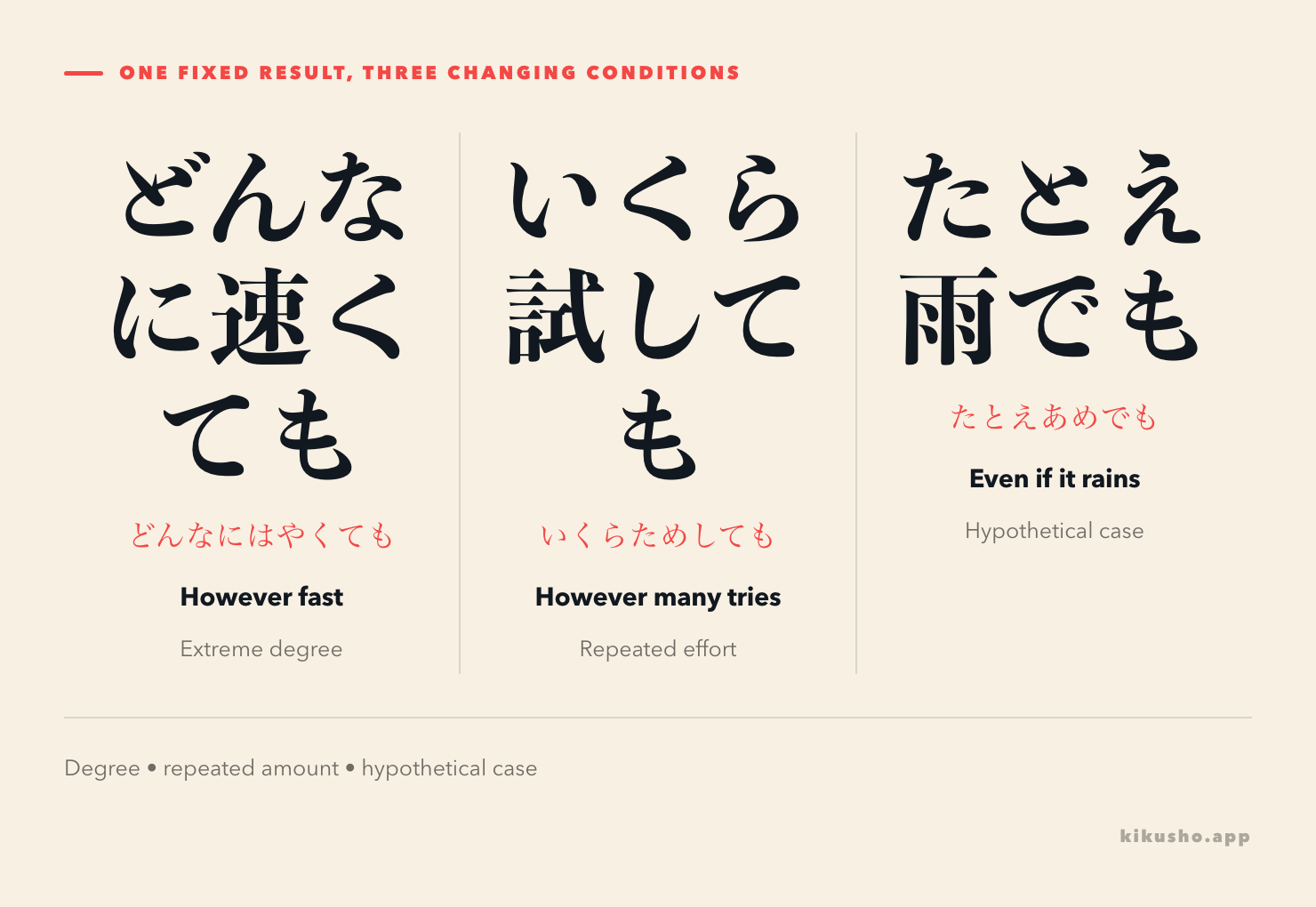
PassJapanese's comparison makes this division directly: いくら readily measures time, effort, and money; どんなに emphasizes a state or degree; たとえ foregrounds a hypothetical condition. The categories guide a choice, though natural overlap remains between the first two.
Build the same ても or でも ending after each cue
The three adverbs do not change how the predicate joins ても. Verbs and い-adjectives use their て-form. Nouns and な-adjective stems use でも.
| Predicate type | Concessive form | Example |
|---|---|---|
| verb 説明する | 説明しても | いくら説明しても |
| negative verb 分からない | 分からなくても | たとえ分からなくても |
| い-adjective 高い | 高くても | どんなに高くても |
| な-adjective 不便だ | 不便でも | たとえ不便でも |
| noun 初心者だ | 初心者でも | たとえ初心者でも |
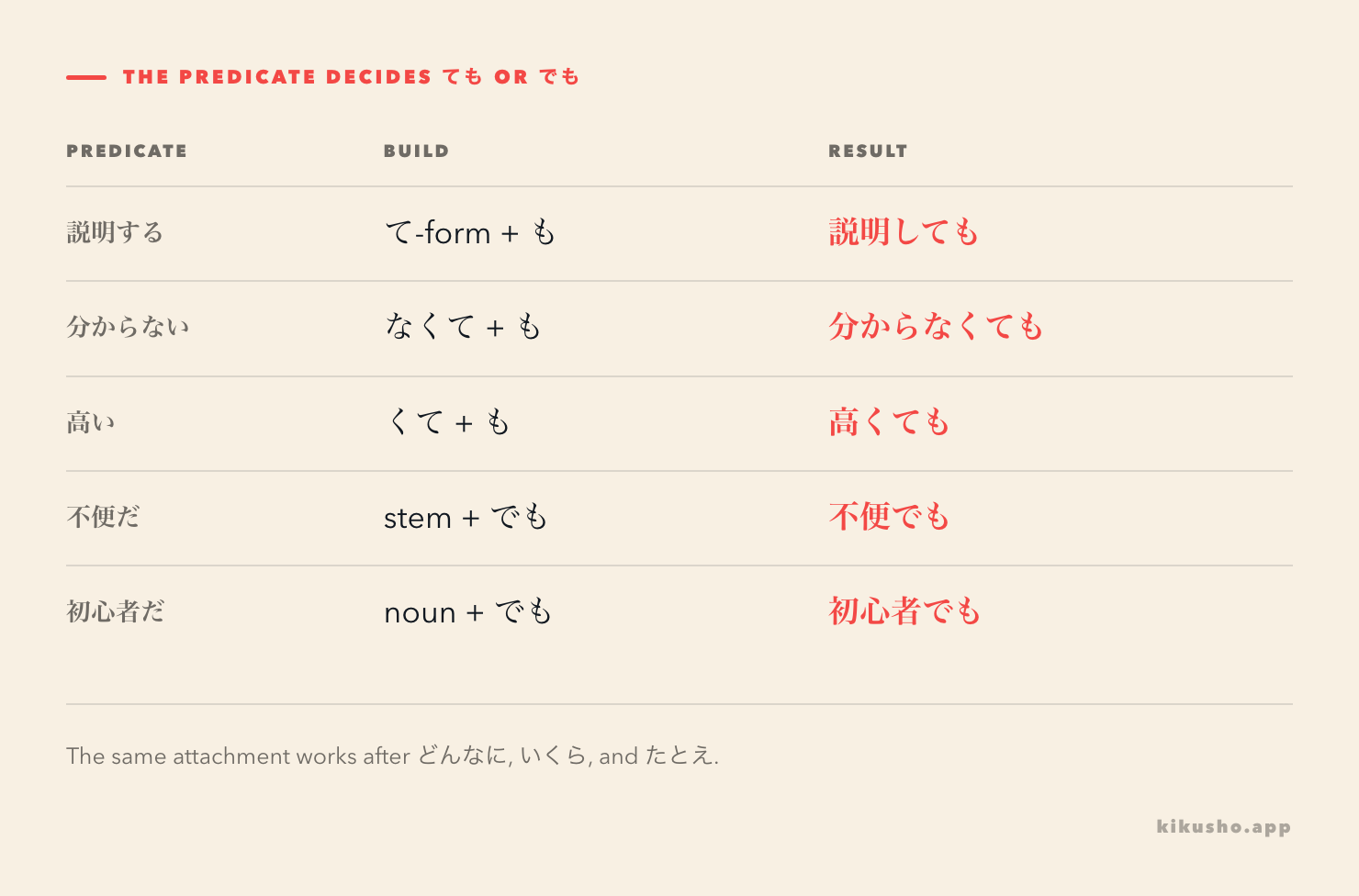
The basic ても and のに comparison develops this conjugation and the difference between a condition and an already accepted fact. This N3 lesson begins after that prerequisite and asks what どんなに, いくら, or たとえ contributes before ても.
JLPT Sensei's pages for どんなに, いくら, and たとえ all give this attachment and place the patterns at N3.
どんなに scans a scale of degree or state
どんなに asks the listener to stretch a quality, intensity, state, or manner toward an extreme. Adjectives make the scale especially visible.
どんなに忙しくても、昼ご飯は食べてください。
どんなに いそがしくても、ひるごはんは たべてください。
No matter how busy you are, please eat lunch.
この薬はどんなに苦くても飲まなければならない。
この くすりは どんなに にがくても のまなければ ならない。
No matter how bitter this medicine is, I have to take it.
With a verb, the scale can be the intensity or manner of the action:
どんなに丁寧に説明しても、納得してもらえなかった。
どんなに ていねいに せつめいしても、なっとくして もらえなかった。
No matter how carefully I explained, I could not convince them.
Bunpro's どんなに~ても account describes an extreme condition whose outcome remains fixed. The degree need not be numerically measurable. Busyness, bitterness, and carefulness can all be imagined on a scale.
いくら counts quantity or repeated effort
いくら is the better first choice when the sentence invites “how much?”, “how long?”, “how many?”, or “how many times?” It commonly accompanies repeated attempts followed by failure or another unchanged result.
いくら検索しても、必要な資料が見つからない。
いくら けんさくしても、ひつような しりょうが みつからない。
No matter how much I search, I cannot find the material I need.
いくら待っても、バスが来なかった。
いくら まっても、バスが こなかった。
No matter how long I waited, the bus did not come.
いくらお金があっても、時間は買えない。
いくら おかねが あっても、じかんは かえない。
No matter how much money you have, you cannot buy time.
Bunpro's いくら~でも lesson explicitly centers number, amount, and degree, and notes that a negative second clause is frequent but not required. いくら安くても買います, “I will buy it no matter how cheap it is,” has an affirmative result and remains grammatical.
When you save one of these sentences in Kikusho, include the second clause. いくら待っても does not reveal whether the bus never came, the speaker kept waiting, or another result followed. The full contrast is the memory cue.
どんなに and いくら overlap when effort has two readings
An action can be viewed as intensity and as accumulated attempts. This is why both forms may be natural without being identical.
どんなに練習しても、あの速さでは弾けない。
No matter how hard I practise, I cannot play at that speed.
いくら練習しても、同じ所で間違えてしまう。
No matter how much I practise, I keep making a mistake at the same place.
The first directs attention to the strength of the effort. The second readily suggests accumulated practice or repeated attempts. Context can weaken that contrast, so avoid treating the words as mutually exclusive labels. 毎日のんびり日本語教師 likewise notes that both emphasize degree, while いくら is especially comfortable when repetition is central.
The second clause often contains ない, できない, or 分からない because failed effort makes an unchanged result easy to notice. That is a usage tendency, not an attachment rule. A promise such as どんなに忙しくても行きます, “I will go no matter how busy I am,” has a positive result.
たとえ asks the listener to suppose one case
たとえ means “even supposing that.” It presents a possible circumstance and says the main result would still hold. It does not require a degree or a series of attempts.
たとえ一人でも、発表を続けます。
たとえ ひとりでも、はっぴょうを つづけます。
Even if there is only one person, I will continue the presentation.
たとえ反対されても、自分の考えを説明したい。
たとえ はんたいされても、じぶんの かんがえを せつめいしたい。
Even if people oppose me, I want to explain my view.
たとえ不便でも、この町に住み続ける。
たとえ ふべんでも、この まちに すみつづける。
Even if it is inconvenient, I will continue living in this town.
Bunpro's たとえ~ても lesson treats it as a standard-register supposition and distinguishes it from もし: もし introduces a condition whose result may follow, while たとえ foregrounds the fact that the stated result resists that condition.
The presence of ても does not always create concession. In 入ってもいいです, てもいい grants permission. Adding たとえ would not simply make that permission stronger. Read the relationship between both clauses before assigning the “even if” meaning.
The N3 adverb set containing たとえ contrasts it with 必ずしも, どうか, and まさか. The lesson here narrows the question to three concessive cues and the scale each one establishes.
A quick choice test
Use these questions in order:
- Is one particular “what if” case being proposed? Choose たとえ~ても.
- Is the amount, duration, money, or repetition central? Prefer いくら~ても.
- Is the extreme degree, state, or manner central? Prefer どんなに~ても.
- Could the action be understood both as hard effort and as many attempts? Either first word may work; choose the reading the context should foreground.
If the sentence expresses determination or inability without varying a scale or proposed condition, the どうしても and なるべく comparison separates a fixed result from a best-effort target.
The more formal concessions であれ and たりとも belong to a different register. At N3, these ても patterns work in ordinary speech and writing.
N3 is the supported study placement
JLPT Sensei and Bunpro assign the three target patterns to N3. PassJapanese and the independently authored 毎日のんびり日本語教師 lesson also teach the paired degree and quantity forms at N3. Their descriptions agree on the attachment and main distinction used here. Since the exam authority does not publish a complete grammar syllabus, N3 is Kikusho's supported study placement rather than a guarantee about one test paper.
Practice
All answers and explanations appear after the final question.
Question 1. The speaker varies the degree of busyness. Complete: __忙しくても、昼ご飯は食べます。
ア. たとえ
イ. どんなに
ウ. いくらの
エ. どんな
Question 2. The speaker emphasizes repeated attempts. Complete: __説明しても、彼は納得しなかった。
ア. いくら
イ. どんな
ウ. たとえば
エ. いくらの
Question 3. You want the listener to suppose one specific case: “Even if tomorrow is a holiday, the office will open.” Complete: __明日が休みでも、事務所は開きます。
ア. いくらに
イ. どんな
ウ. たとえ
エ. たとえば
Question 4. Choose the correct concessive form after the い-adjective 高い.
ア. 高いても
イ. 高いでも
ウ. 高くても
エ. 高くでも
Question 5. Arrange the chunks to mean “No matter how long I waited, the bus did not come”: バスは来なかった / いくら / 待っても
Question 6. Explain the difference in focus between どんなに練習しても上手にならない and いくら練習しても上手にならない.
Question 7. Read the plan and select the two cues that fit its logic.
金額を増やす案については、__お金をかけても成功するとは限らない。さらに、__専門家に反対されても、まず小さな実験は行う。
ア. 甲: どんなに / 乙: いくら
イ. 甲: たとえ / 乙: どんなに
ウ. 甲: いくら / 乙: たとえ
エ. 甲: いくらの / 乙: たとえば
Answers and explanations
Answer 1. イ. どんなに. Busyness is a state whose degree can become extreme: どんなに忙しくても. どんな without に normally modifies a noun, and the other choices do not build this degree expression.
Answer 2. ア. いくら. The context invites an accumulated or repeated reading of 説明しても: however much the speaker explained, the result did not change.
Answer 3. ウ. たとえ. The sentence proposes the specific circumstance 明日が休み and keeps the opening decision unchanged. たとえば means “for example,” so it does not build this concessive pair.
Answer 4. ウ. 高くても. Remove the final い from an い-adjective and add くても. でも attaches directly to noun and な-adjective stems instead.
Answer 5. いくら待っても、バスは来なかった. いくら frames the amount of waiting, 待つ becomes 待っても, and the unchanged result follows.
Answer 6. どんなに練習しても foregrounds the intensity or manner of practice, roughly “however hard I practise.” いくら練習しても readily foregrounds accumulated practice or repeated attempts, roughly “however much I practise.” The contexts overlap, so both can be natural while directing attention differently.
Answer 7. ウ. 甲: いくら / 乙: たとえ. The first clause varies the amount of money invested. The second asks the reader to suppose one concrete obstacle, opposition from experts, while the small experiment remains planned.
Common questions
What is the difference between どんなに~ても, いくら~ても, and たとえ~ても?
どんなに highlights the extreme degree or state of something. いくら readily measures amount, frequency, or repeated effort. たとえ presents a specific hypothetical case. In all three, the result stays unchanged despite the first clause.
Can どんなに and いくら be interchangeable?
They overlap when an action can be viewed as either intense effort or a repeated amount. どんなに is especially natural for degree or quality, while いくら is especially natural for quantity, repeated attempts, time, or money.
What form comes after たとえ?
The concessive predicate normally ends in ても or でも: verb て-form plus も, い-adjective stem plus くても, or a noun and な-adjective stem plus でも.
Does たとえ~ても say that the condition is true?
No. It asks the listener to suppose the condition and says the result would remain unchanged. A sentence can later establish that the condition is true, but たとえ itself does not assert it.