On this page
Use 一度に when several things happen at the same time or fit into one batch. Use ついでに when one main action gives you a convenient chance to do an extra action. Both can produce translations such as “at the same time” or “while,” but they describe different relationships.
十人が一度にエレベーターに乗った。
じゅうにんがいちどにエレベーターにのった。
Ten people got into the elevator at once.
銀行へ行くついでに、隣のコンビニで切手を買った。
ぎんこうへいくついでに、となりのコンビニできってをかった。
On my way to the bank, I took the opportunity to buy stamps at the convenience store next door.
The first sentence groups ten people into one event. The second has two errands with different weights: going to the bank was already planned, and buying stamps was added because the trip made it easy.
Ask whether there is one batch or one opportunity
| Form | The useful question | Core meaning | Typical shape |
|---|---|---|---|
| 一度に | How many things happen in one time or batch? | at once; all together; at a time | 一度に + amount/action |
| ついでに | Which main action creates the chance for the extra one? | while you are at it; on the occasion | A + ついでに + B |
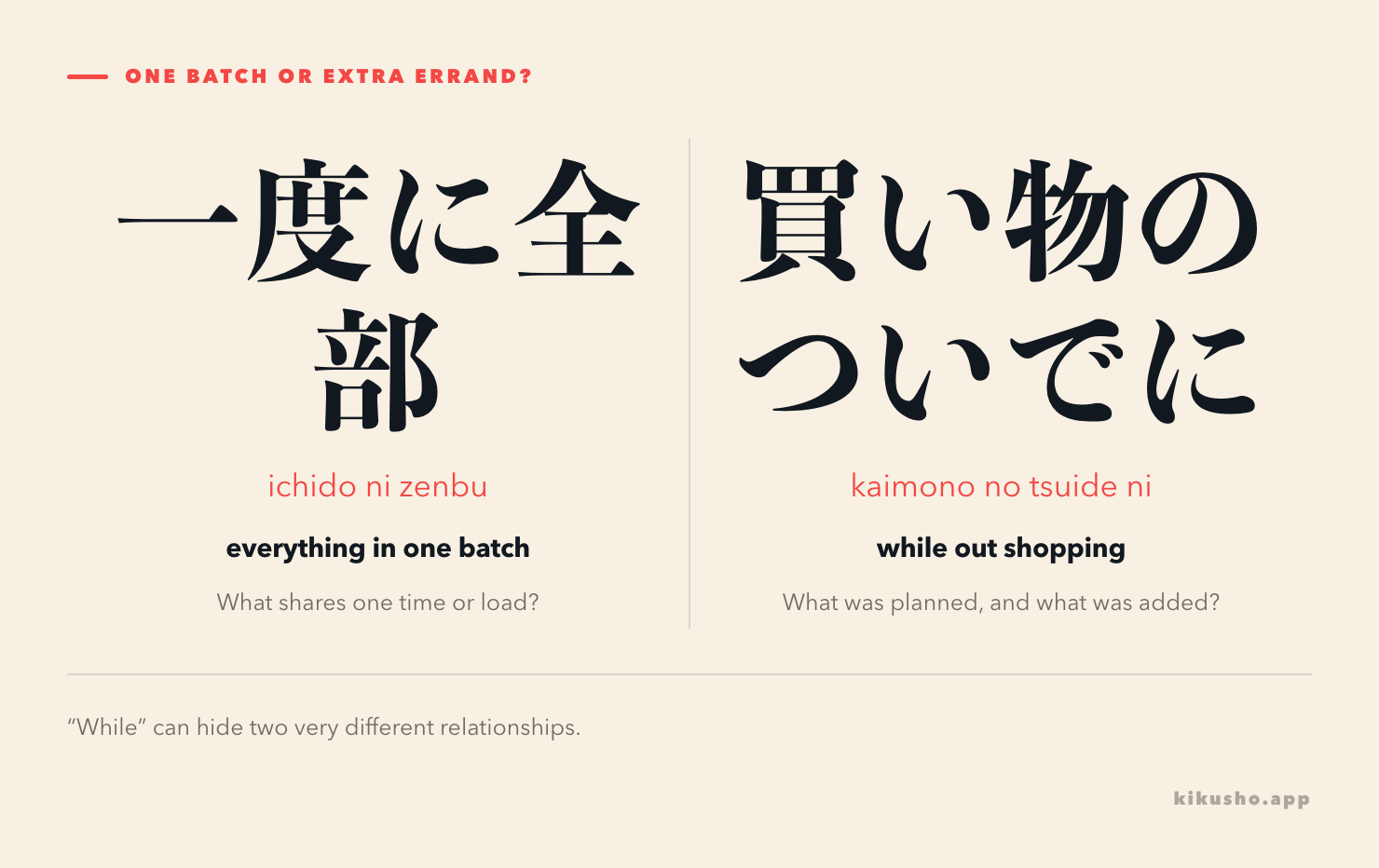
一度に does not connect two clauses. It works as an adverb inside a clause. ついでに does connect an occasion and an added action. Translation can hide that structural difference, so start with the scene rather than the English word “while.”
一度に puts things into one time or batch
一度に is read いちどに. It can describe simultaneous events, a capacity limit, or several items handled in one operation.
質問が一度に三つ来て、答えられなかった。
しつもんがいちどにみっつきて、こたえられなかった。
Three questions came at once, and I could not answer them.
この機械では、一度に二十枚までコピーできます。
このきかいでは、いちどににじゅうまいまでコピーできます。
With this machine, you can copy up to twenty sheets at a time.
全員が一度に話すと、何も聞き取れない。
ぜんいんがいちどにはなすと、なにもききとれない。
If everyone talks at the same time, I cannot make out anything.
JLPT Sensei places 一度に at N3 and records the “all at once” and “at a time” uses. Kotobank's dictionary entry independently defines it as an adverb for things occurring simultaneously or actions carried out together.
Keep 一度に separate from bare 一度:
| Expression | Reading | Meaning | Example |
|---|---|---|---|
| 一度 | いちど | once; one time | 一度行ったことがある |
| 一度に | いちどに | at once; in one batch | 一度に全部運ぶ |
In 京都へ一度行ったことがある, the speaker has been to Kyoto once. In 荷物を一度に運んだ, the speaker carried the luggage in one batch. The second sentence says nothing about whether the person has carried luggage on other occasions.
Do not automatically replace 一度に with 一気に. 一気に often highlights proceeding without a break, as in drinking something in one go or finishing a task in one push. 一度に can simply group simultaneous people, objects or events, including things that happen without anyone's effort.
ついでに adds a secondary action to a main occasion
The pattern is A ついでに B. A is the main action or occasion. B is an extra action that becomes convenient because A is happening.
図書館へ行くついでに、この本を返してくれる?
としょかんへいくついでに、このほんをかえしてくれる?
Since you are going to the library, could you return this book while you are at it?
出張したついでに、以前の同僚に会った。
しゅっちょうしたついでに、いぜんのどうりょうにあった。
While I was away on business, I took the opportunity to meet a former colleague.
散歩のついでに、郵便局に寄りました。
さんぽのついでに、ゆうびんきょくによりました。
While out for a walk, I stopped by the post office as well.
JLPT Sensei and Bunpro both place ついでに at N3 and verify the verb and noun attachments. Bunpro describes A as the instigator for B. Coto Academy's teacher-written explanation makes the ranking explicit: A is the main action, and B is performed in addition because it is related and convenient.
| Material before ついでに | Shape | Example |
|---|---|---|
| planned or current action | dictionary-form verb + ついでに | 駅へ行くついでに |
| completed occasion | past-form verb + ついでに | 駅へ行ったついでに |
| noun occasion | noun + の + ついでに | 買い物のついでに |
| already stated occasion | ついでに + sentence | ついでに薬も買おう |
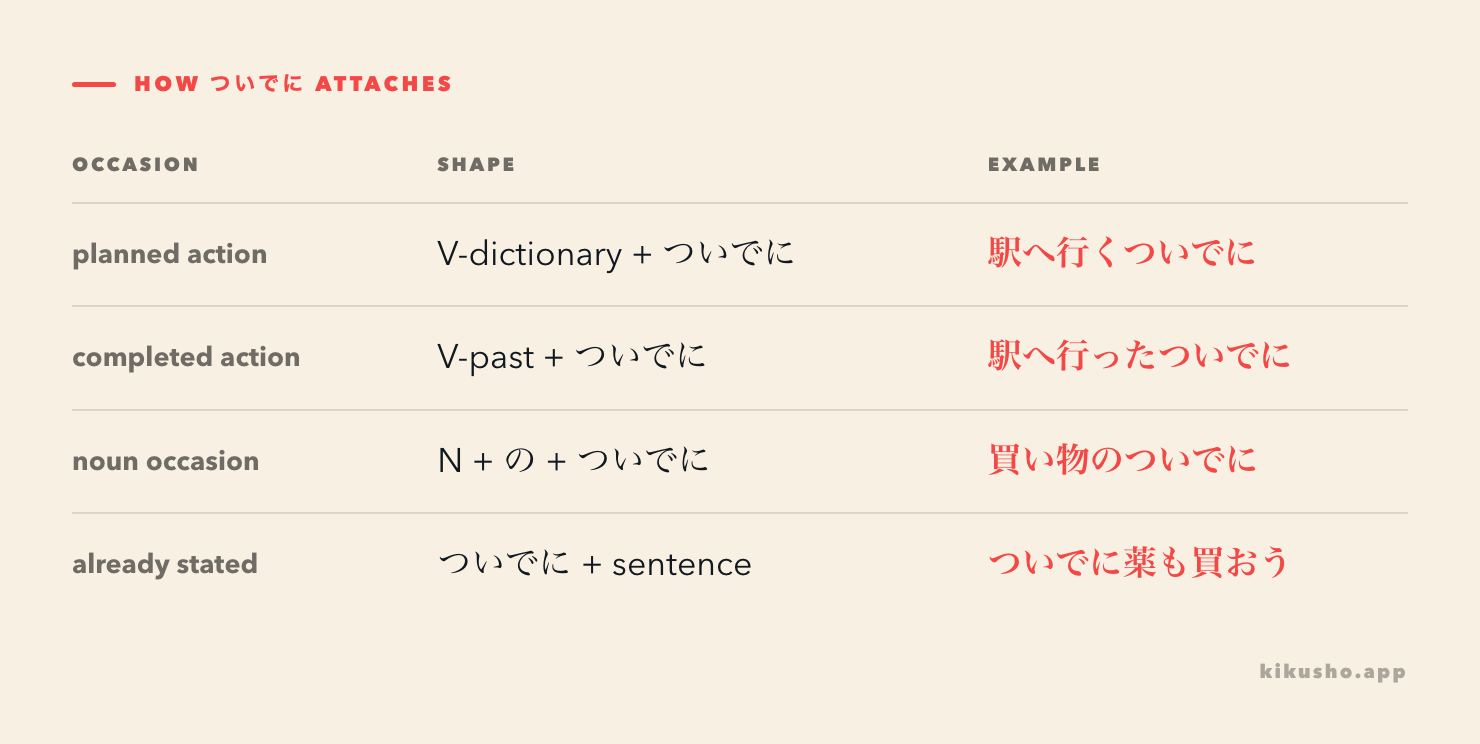
The dictionary form does not itself mean future. It presents the main action as the occasion from which B is planned: 会社へ行くついでに郵便物を出す. The past form looks back on a completed occasion: 会社へ行ったついでに郵便物を出した. In both cases, posting the mail is secondary.
You can also state the main errand first and use ついでに in a new sentence:
スーパーに行ってきます。ついでに、クリーニングも受け取ってきます。
スーパーにいってきます。ついでに、クリーニングもうけとってきます。
I am going to the supermarket. While I am out, I will pick up the dry cleaning too.
The second task should feel like a plausible addition to the first occasion. If both actions are equally central, a neutral connector may fit better. If B is actually the reason for the trip, putting it after ついでに misrepresents the plan.
ついでに does not require simultaneous movement
Compare three structures:
音楽を聞きながら料理した。
おんがくをききながらりょうりした。
I cooked while listening to music.
帰りに銀行へ寄るついでに、隣のコンビニで切手を買った。
かえりにぎんこうへよるついでに、となりのコンビニできってをかった。
When I stopped at the bank on my way home, I also bought stamps at the convenience store next door.
書類を一度に印刷した。
しょるいをいちどにいんさつした。
I printed the documents in one batch.
ながら marks overlapping actions by the same actor and puts the main action last. The dedicated ながら lesson explains that focus and same-actor rule. ついでに instead marks a main occasion plus a secondary opportunity; the bank visit and the stamp purchase may happen in sequence. 一度に groups the documents into one operation without ranking two errands.
The choice also differs from ごとに, たびに and ずつ. Those forms organize repetition across units, events or allotments. 一度に compresses things into one batch, while ついでに adds one practical action to another occasion.
If you save only “while” in Kikusho, these relationships disappear. Keep the whole clause pair for ついでに and the quantity or grouped subject for 一度に. Kikusho can turn captured speech or pasted text into a card for you to check before saving, then bring that context back during offline review.
Practice: identify the batch and the extra action
Complete all seven questions before reading the explanations.
Question 1 — grammar choice. A printer receives twenty jobs at the same moment. Complete 印刷の注文が二十件__来た.
- ア. のついでに
- イ. 一度に
- ウ. 一度
- エ. ながら
Question 2 — attachment. You are already going to the library and someone asks you to return a book. Complete 図書館へ__、この本も返してくれる?
- ア. 行くついでに
- イ. 行きついでに
- ウ. 行く一度に
- エ. 行きながらに
Question 3 — completed occasion. Which sentence means “While I was on a business trip, I also visited an old friend” and presents the trip as the main occasion?
- ア. 出張を一度に、古い友人を訪ねた。
- イ. 出張したついでに、古い友人を訪ねた。
- ウ. 出張しついでに、古い友人を訪ねた。
- エ. 出張の一度に、古い友人を訪ねた。
Question 4 — interpretation. In 買い物のついでに、薬局に寄った, which action was the established main occasion, and which was the added errand?
Question 5 — sentence composition. Arrange all chunks to say “While going to the supermarket, I mailed the letter too.”
- 手紙も
- スーパーへ行くついでに
- 出した
Question 6 — standalone use. A speaker says 駅前まで行きます。ついでに、銀行にも寄ります。 What does standalone ついでに tell you about the bank visit?
Question 7 — connected text. Choose the three forms that mean one printing batch, an extra errand created by a store visit, and one carrying batch, in that order.
資料を( )印刷すると、紙が詰まるかもしれません。文房具店へ行く( )、封筒も買います。帰ったら、箱を全部( )運ばず、二回に分けましょう。
- ア. 一度に/ついでに/一度に
- イ. ついでに/一度に/ついでに
- ウ. 一度/ながら/一度
- エ. ながら/ついでに/一度
Answers and explanations
Answer 1. イ, 一度に. The twenty orders arrive at the same moment, so they form one simultaneous event. Bare 一度 means once; it does not express the grouping required here.
Answer 2. ア, 行くついでに. A dictionary-form verb can introduce the planned main occasion. 行き is a ます-stem, but ついでに does not use that attachment.
Answer 3. イ, 出張したついでに、古い友人を訪ねた. The past form した presents the completed business trip as the occasion, and visiting the friend as the secondary action added to it.
Answer 4. 買い物 was the established main occasion. 薬局に寄った, stopping at the pharmacy, was the added errand made convenient by that outing. The sentence does not say that both actions had equal importance.
Answer 5. スーパーへ行くついでに、手紙も出した. Going to the supermarket supplies the occasion. Mailing the letter is the extra action, and も reinforces “also.”
Answer 6. The bank visit is an additional errand made convenient by the already stated trip to the station area. Standalone ついでに points back to that occasion; it does not say the two actions literally overlap.
Answer 7. ア, 一度に/ついでに/一度に. The first 一度に warns against sending all print jobs as one batch. The store visit creates the opportunity to buy envelopes, so the middle takes ついでに. The final 一度に warns against carrying every box in one load.
Both assigned items are placed at N3
JLPT Sensei places 一度に and ついでに at N3, and Bunpro independently places ついでに at N3. Kotobank verifies the dictionary meaning of 一度に without assigning a test level. These are teaching placements rather than an official point-by-point syllabus; the JLPT FAQ explains why current exhaustive item lists are not published.
OpenAI Codex performed the AI language review for this lesson. The check covered both meanings, every attachment, the ながら boundary, Japanese examples, kana, translations and the logic of all seven exercises. This record does not claim a human reviewer.
Common questions
What is the difference between 一度に and ついでに?
一度に says that several things happen at the same time or are handled in one batch. ついでに says that one planned action creates a convenient opportunity to do a secondary action as well.
What comes before ついでに?
Use a dictionary-form or past-form verb, or a noun plus の: 行くついでに, 行ったついでに and 買い物のついでに. It can also begin a new sentence after the main errand has already been stated.
Does 一度に mean once?
Not in this pattern. 一度 means once, while the adverb 一度に means at once, all together or in one batch. The に changes how the phrase works.
Is ついでに the same as ながら?
No. ながら describes overlapping actions by one actor. ついでに ranks the actions: the first is the main occasion and the second is an extra task made convenient by it, even if the actions happen one after another.