On this page
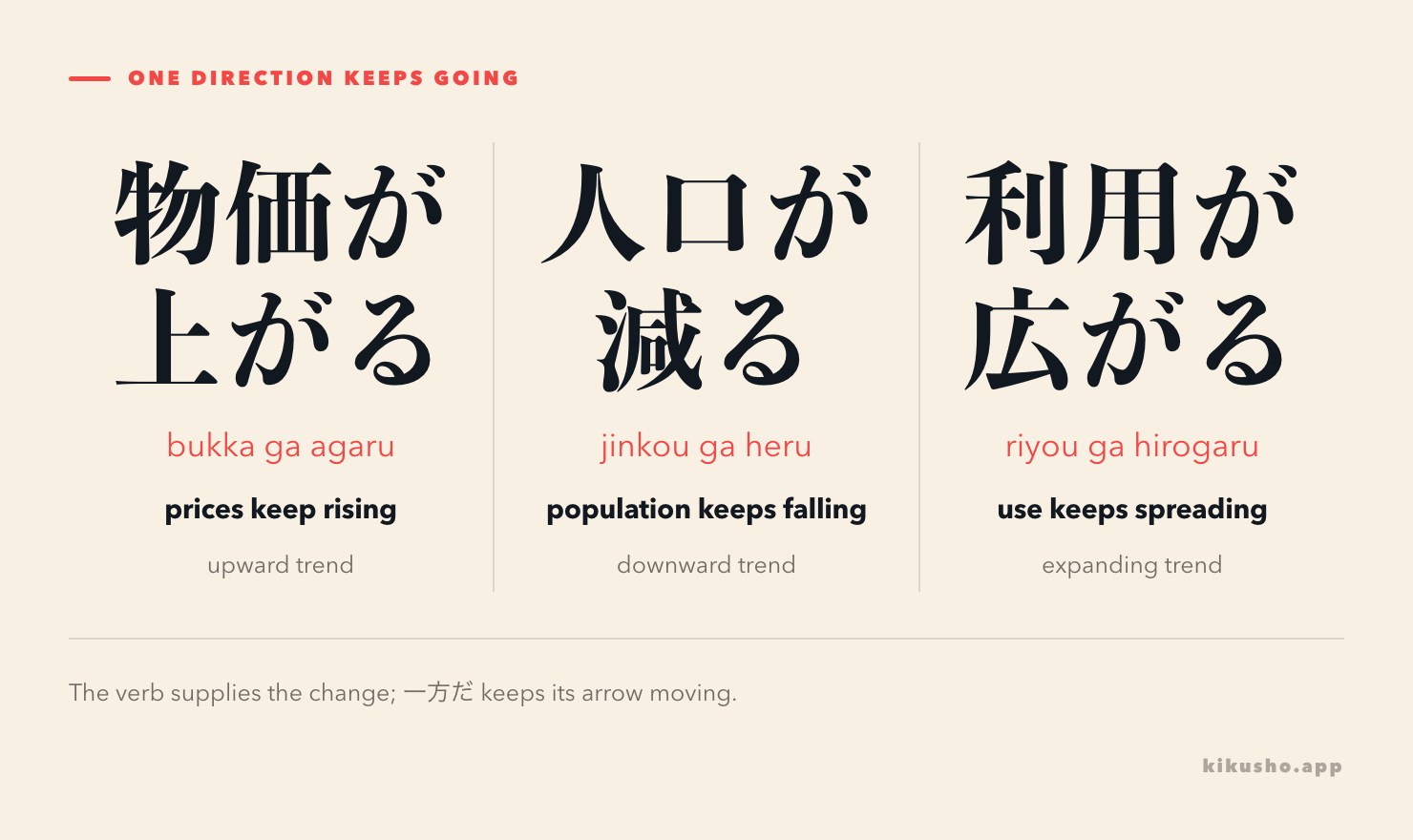
一方だ follows a change and says that it keeps moving in one direction. 物価は上がる一方だ means prices keep rising; 人口は減る一方だ means the population keeps falling. The pattern describes a developing trend, not a fixed state or any action that merely continues.
この町では、空き家が増える一方だ。
このまちでは、あきやがふえるいっぽうだ。
In this town, the number of vacant houses keeps increasing.
The key is the arrow inside the sentence. Something rises, falls, spreads, worsens or improves, and the speaker presents that direction as continuing.
一方だ needs a direction of change
The core pattern is:
| Material | Form | Example |
|---|---|---|
| change verb | dictionary form + 一方だ | 増える一方だ |
| polite ending | dictionary form + 一方です | 増える一方です |
| change noun | noun + の + 一方だ | 下落の一方だ |
JLPT Sensei places 一方だ at N3 and verifies the dictionary-form verb attachment. Bunpro independently places it at N3, describes its register as formal, and limits the basic pattern to verbs that express change.
原材料の価格は上がる一方です。
げんざいりょうのかかくはあがるいっぽうです。
The price of raw materials keeps rising.
若者の数は減る一方だ。
わかもののかずはへるいっぽうだ。
The number of young people keeps decreasing.
オンラインサービスの利用は広がる一方だ。
オンラインサービスのりようはひろがるいっぽうだ。
The use of online services continues to spread.
The tense sits in だ/です, not in the verb before 一方. A past viewpoint can use 一方だった, as in 当時、赤字は増える一方だった, “At the time, the deficit kept growing.” The change verb still stays in dictionary form.
A state is not yet a trend
高い, “is expensive,” names a state. 上がる or 高くなる names movement. That is why the following pair differs:
物価は高い。
ぶっかはたかい。
Prices are high.
物価は上がる一方だ。
ぶっかはあがるいっぽうだ。
Prices keep rising.
物価は高い一方だ does not express the intended trend. Repair it with a change: 高くなる一方だ or 上がる一方だ.
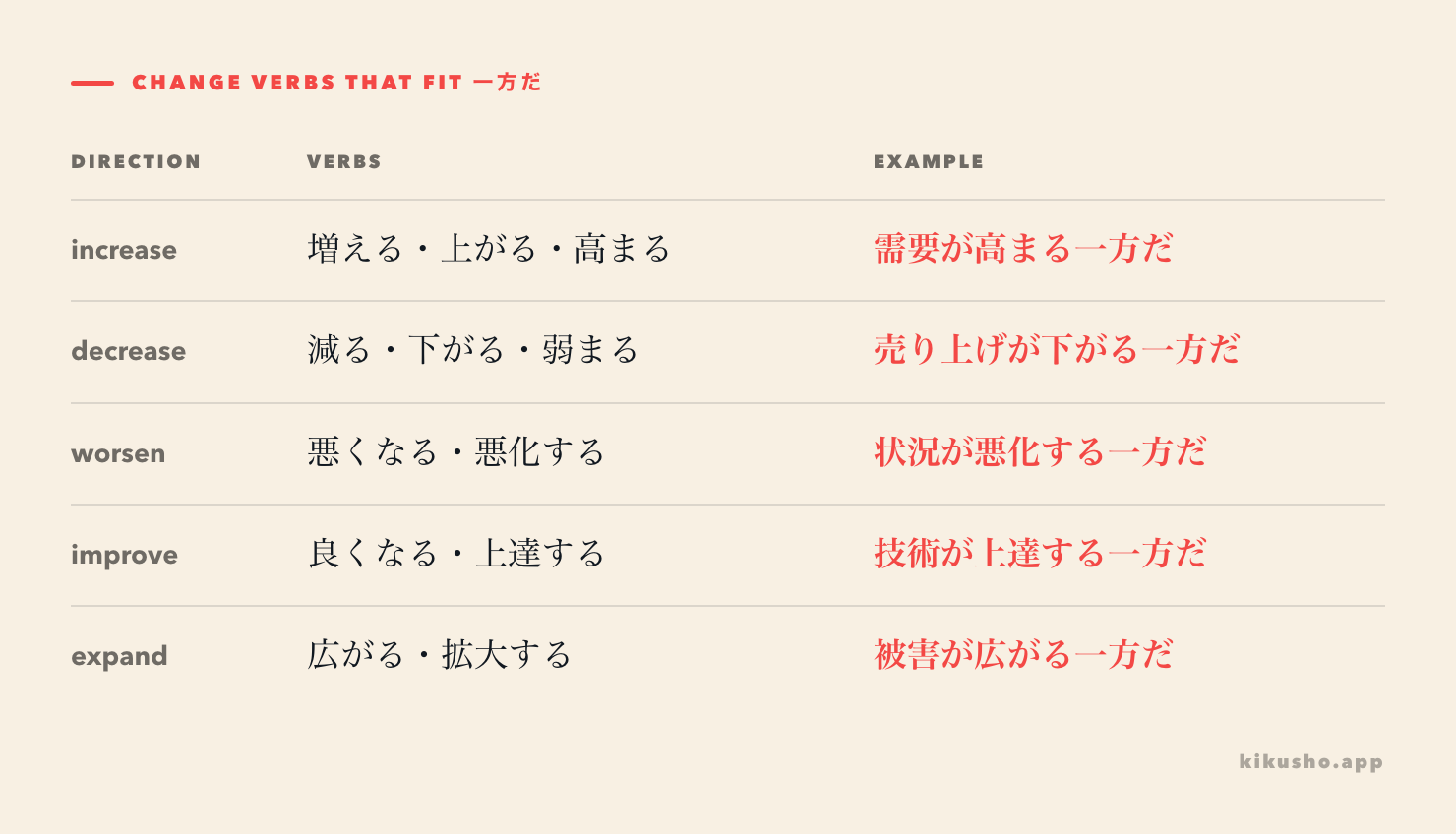
Useful partners include:
| Direction | Common change verbs | Example |
|---|---|---|
| increase | 増える, 上がる, 高まる | 需要が高まる一方だ |
| decrease | 減る, 下がる, 弱まる | 売り上げが下がる一方だ |
| deterioration | 悪くなる, 悪化する | 状況が悪化する一方だ |
| improvement | 良くなる, 上達する | 技術が上達する一方だ |
| expansion | 広がる, 拡大する | 被害が広がる一方だ |
The Japanese change verbs lesson explains the basic particle patterns in 値段が上がる, 人口が増える and related verbs. 一方だ builds on those complete clauses.
A small group of nouns that already name change can take の一方だ:
売り上げは減少の一方だ。
うりあげはげんしょうのいっぽうだ。
Sales remain on a downward trend.
その会社の業績は回復の一方だ。
そのかいしゃのぎょうせきはかいふくのいっぽうだ。
That company's performance continues to recover.
A Japanese-teacher reference records Vる + 一方だ, limited N + の一方だ, a slightly written style, and both positive and negative directions. The noun form is less productive, so learn it with established change nouns rather than attaching の一方だ to any noun.
Negative trends are common, but positivity is possible
News, reports and explanations often use 一方だ for a worrying trend:
対策を取らなければ、ごみは増える一方だ。
たいさくをとらなければ、ごみはふえるいっぽうだ。
Unless measures are taken, the amount of rubbish will keep increasing.
That frequency can make the pattern feel negative. The grammar itself does not require a bad outcome:
毎日の練習で、彼女の発音は良くなる一方だ。
まいにちのれんしゅうで、かのじょのはつおんはよくなるいっぽうだ。
With daily practice, her pronunciation keeps improving.
The Japanese-teacher reference above explicitly allows positive and negative developments, while noting that unwanted change is more common. Avoid memorising “keeps getting worse” as the entire meaning. The direction comes from the verb and context.
一方だ and 一方で point in different ways
The kanji 一方 literally suggests one direction or one side. Two N3 patterns build different ideas from it.
この町の人口は減る一方だ。
このまちのじんこうはへるいっぽうだ。
This town's population keeps decreasing.
都会は便利な一方で、生活費が高い。
とかいはべんりないっぽうで、せいかつひがたかい。
Cities are convenient, while on the other hand living costs are high.
The first sentence follows one arrow: population continues downward. The second places two sides in contrast: convenience against cost. A Japanese teacher's comparison confirms the one-direction versus two-side distinction and shows why 高い一方だ cannot replace a change verb.
Do not classify every 一方で by its ending alone. Context can continue a trend clause with further explanation. The safe test is semantic: is the sentence tracing one continuing change, or comparing two properties and situations?
Continued action and proportional change need other forms
勉強を続けている says someone continues studying. It does not say that a measurable condition moves steadily in one direction. 日本語が上達する一方だ describes improvement as a trend. 一方だ often sounds objective and suits reports, analysis and formal explanation better than casual narration of an ordinary repeated action.
The ば~ほど lesson expresses a proportional relationship:
練習すればするほど、上手になる。
れんしゅうすればするほど、じょうずになる。
The more you practise, the better you become.
That sentence links the amount of practice to the degree of improvement. 上手になる一方だ presents only the continuing direction of improvement; it does not state what variable causes it.
ばかりだ can also describe a continuing development, especially an unwanted one. It overlaps with 一方だ, but 一方だ foregrounds the single direction and often sounds more objective. Treat the forms as close options whose tone and surrounding collocations matter, rather than translating both as a fixed English phrase.
When saving an example in Kikusho, keep the changing subject and the verb together: 人口が減る一方だ, not only “一方だ = more and more.” Capture the sentence or paste it into Kikusho, then check the generated card before saving it for offline review. The full clause tells you which direction the sentence actually follows.
Practice: find the continuing direction
Complete all seven questions before checking the explanations.
Question 1 — grammar choice. Prices have continued to rise. Complete 物価は__.
- ア. 上がる一方だ
- イ. 高い一方だ
- ウ. 上がった一方だ
- エ. 上がり一方だ
Question 2 — change requirement. Which sentence correctly turns “the river is dirty” into a worsening trend?
- ア. 川は汚い一方だ。
- イ. 川は汚くなる一方だ。
- ウ. 川は汚かった一方だ。
- エ. 川は汚さの一方だ。
Question 3 — positive direction. Does 練習を始めてから、発音は良くなる一方だ describe improvement or deterioration? Is the pattern itself negative?
Question 4 — 一方で contrast. Which sentence compares two sides instead of tracing one trend?
- ア. 利用者は増える一方だ。
- イ. 状況は悪化する一方だ。
- ウ. この仕事は自由な一方で、収入が安定しない。
- エ. 需要は高まる一方だ。
Question 5 — sentence composition. Arrange all chunks to say “The number of vacant houses keeps increasing in this town.”
- この町では
- 空き家が
- 増える一方だ
Question 6 — meaning boundary. A person says 朝からずっと本を読んでいる. Does this sentence need 一方だ merely because the reading continues? Explain what kind of change would be required.
Question 7 — connected text. Choose the sequence that expresses a continuing upward trend, a two-side contrast, and a proportional relationship.
家賃は上がる( )。この地域は便利な( )、静かな場所が減っています。駅に近ければ近い( )、家賃も高くなります。
- ア. 一方だ/一方で/ほど
- イ. 一方で/一方だ/だけ
- ウ. ほど/一方だ/一方で
- エ. 一方だ/ほど/一方で
Answers and explanations
Answer 1. ア, 上がる一方だ. 上がる is a dictionary-form change verb. 高い names a state, 上がった is past, and 上がり is a stem; none supplies the required basic pattern.
Answer 2. イ, 川は汚くなる一方だ. 汚くなる converts the adjective state into a change, “become dirtier.” 一方だ can then present that worsening direction as continuing.
Answer 3. It describes improvement. 良くなる supplies a positive direction. Negative developments are common with 一方だ, but negativity is not built into the pattern.
Answer 4. ウ, この仕事は自由な一方で、収入が安定しない. It contrasts freedom with unstable income. The other three sentences end in 一方だ after change verbs and trace one continuing direction.
Answer 5. この町では空き家が増える一方だ. 空き家が増える identifies what changes and how; 一方だ says that increase keeps proceeding.
Answer 6. No. ずっと本を読んでいる is an action continuing through time, but reading itself does not create a one-direction change. 一方だ would need a changing condition, such as 読む本の数が増える一方だ, “the number of books being read keeps increasing.”
Answer 7. ア, 一方だ/一方で/ほど. Rising rent is a one-direction trend. Convenience and the loss of quiet places form two sides. 近ければ近いほど links greater proximity proportionally to higher rent.
N3 is a publisher placement
The Kikusho inventory, JLPT Sensei and Bunpro all place this use of 一方だ at N3, with no recorded disagreement. Independent Japanese-teacher references verify its change requirement, register and contrast with 一方で. These are study placements rather than an official exhaustive syllabus; the JLPT FAQ explains the test maker's position on item lists.
OpenAI Codex completed the AI language and curriculum review. It checked the change-verb restriction, verb and noun attachments, positive and negative directions, tense, register, every example and all seven exercise mappings. No human review is claimed.
Common questions
What does 一方だ mean in Japanese grammar?
After a change verb, 一方だ says that the change keeps moving in one direction: prices keep rising, a population keeps falling, or a skill keeps improving.
What form comes before 一方だ?
Use the dictionary form of a verb that expresses change, such as 増える, 減る, 上がる, 悪くなる or 広がる. A limited set of change nouns can also take の一方だ, as in 下落の一方だ.
Is 一方だ always negative?
No. Negative trends are common, but positive and neutral changes are possible. Context determines whether the speaker welcomes the direction.
What is the difference between 一方だ and 一方で?
Sentence-final 一方だ presents continued change in one direction. Contrastive 一方で sets two sides against each other, like “on the other hand.” Similar spelling does not give them the same function.