On this page
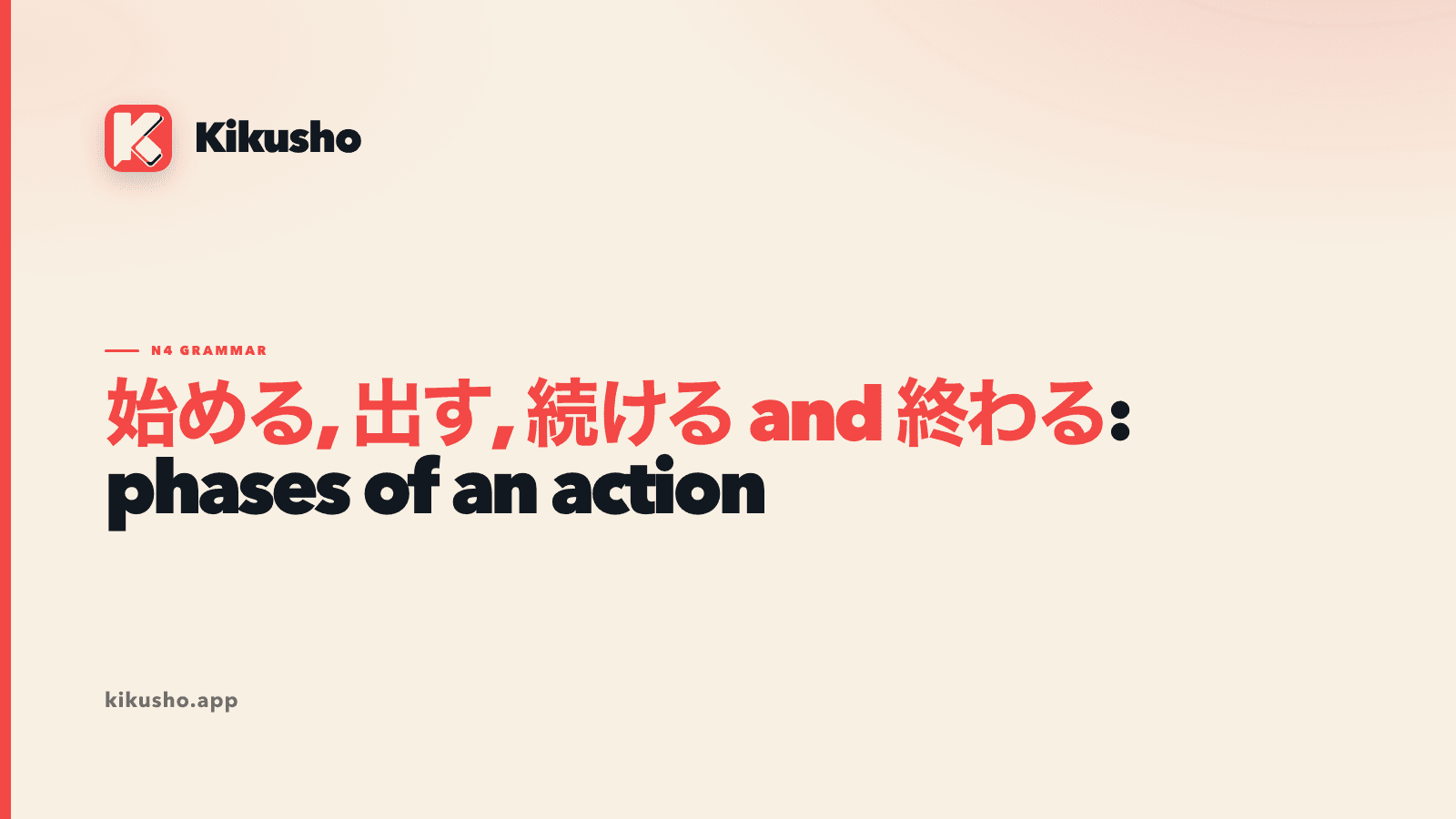
Attach one of these four verbs to a ます-stem: 始める marks a neutral beginning, 出す a sudden onset, 続ける an action maintained through time, and 終わる a completed process. The first verb names the action; the final verb selects its phase and carries the tense, politeness, and negation.
Choose the point on the action line
These forms belong together because they answer one question: where is the action on its timeline? They do not merely translate four English words. They make four different claims about the same action.
| Phase | Form | Core decision | Example |
|---|---|---|---|
| beginning | V-stem + 始める | the action begins, neutrally | 本を読み始める |
| sudden onset | V-stem + 出す | the action breaks out or gets moving | 急に泣き出す |
| continuation | V-stem + 続ける | the action is kept going | 日記を書き続ける |
| completion | V-stem + 終わる | the whole bounded action reaches its end | 本を読み終わる |
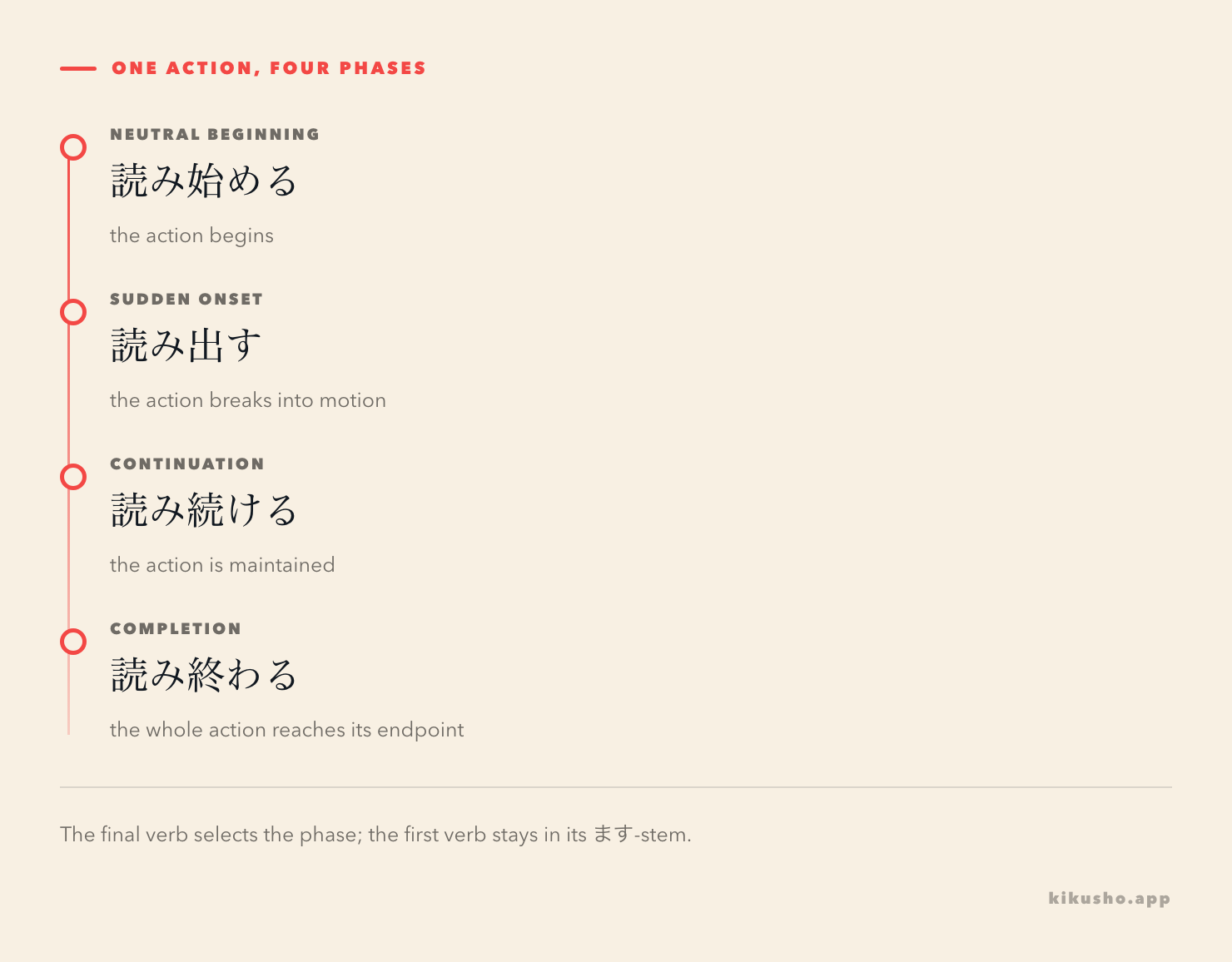
The useful test is not “Which one means start?” Begin by asking whether the sentence highlights a beginning, a burst into motion, persistence, or a completed endpoint. Only 始める and 出す compete for the same broad English translation, and their contrast depends on how the beginning is presented.
七時に宿題をし始めました。
しちじに しゅくだいを しはじめました。
I started doing my homework at seven.
外で急に雨が降り出しました。
そとで きゅうに あめが ふりだしました。
It suddenly started raining outside.
二時間、宿題をし続けました。
にじかん、しゅくだいを しつづけました。
I kept doing my homework for two hours.
九時に宿題をし終わりました。
くじに しゅくだいを しおわりました。
I finished doing my homework at nine.
The four sentences use the same compound-verb mechanism. The meaning changes because the second verb changes.
Build the compound from the ます-stem
Find the form immediately before ます: 読みます gives 読み, 食べます gives 食べ, and 話します gives 話し. Join the phase verb directly to that form, with no particle or て between the two parts.
| Dictionary form | ます-form | Stem | Four possible compounds |
|---|---|---|---|
| 読む | 読みます | 読み | 読み始める・読み出す・読み続ける・読み終わる |
| 食べる | 食べます | 食べ | 食べ始める・食べ出す・食べ続ける・食べ終わる |
| 話す | 話します | 話し | 話し始める・話し出す・話し続ける・話し終わる |
| する | します | し | し始める・し出す・し続ける・し終わる |
This is the same seam introduced in the N4 compound-verb lesson. Once the compound exists, the final verb does all the conjugating: 読み始めました, 読み出さない, 読み続けています, 読み終わりませんでした. The frozen stem 読み does not change again.
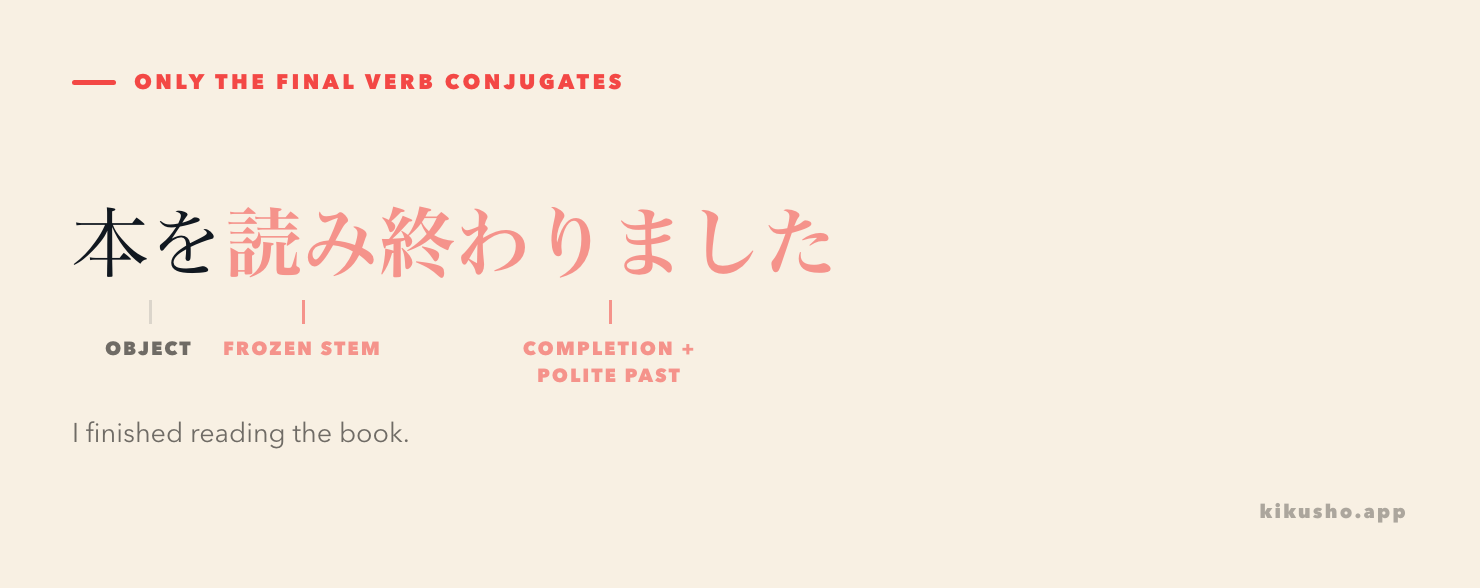
Do not confuse the compound with the same verb used independently. 勉強を始めました means “I began the study/activity,” with 勉強 as the direct object of 始める. 勉強し始めました means “I began studying,” with 始める attached to the stem of 勉強する. Likewise, 仕事が終わりました says the work ended; 仕事をし終わりました says someone finished doing the work.
始める gives the neutral beginning
Use V-stem + 始める when the point is simply that an action or change begins. It works especially well with plans, habits, gradual changes, and instructions because it does not add surprise by itself.
来月、日本語を勉強し始めます。
らいげつ、にほんごを べんきょうしはじめます。
I will start studying Japanese next month.
桜が咲き始めました。
さくらが さきはじめました。
The cherry blossoms have started blooming.
The second example matters because 始める is not restricted to deliberate human actions. Blossoms do not make a plan, and rain can 降り始める. The form is neutral enough for a natural change when the speaker simply notices its beginning. Intention may make 始める the natural choice, but intention is not its definition.
With a movement verb, the compound can start a repeated habit rather than one trip: 四月から自転車で学校に行き始めた means the person started going to school by bicycle from April. The calendar boundary starts the new routine.
出す makes the onset feel sudden
Use V-stem + 出す when the action begins abruptly, spontaneously, or with a sense that it has broken out into the scene.
赤ちゃんが泣き出しました。
あかちゃんが なきだしました。
The baby burst into tears.
止まっていた車が動き出しました。
とまっていた くるまが うごきだしました。
The stopped car started moving.
出す is therefore common with crying, laughter, speech, weather, and movement. It can describe a person too: 彼は突然走り出した presents the running as a sudden launch. What it resists is a carefully scheduled start. For “I will start studying at three,” 三時になったら勉強し始めます is the ordinary choice; 勉強し出します would impose an unexpected or forceful onset that the plan does not supply.
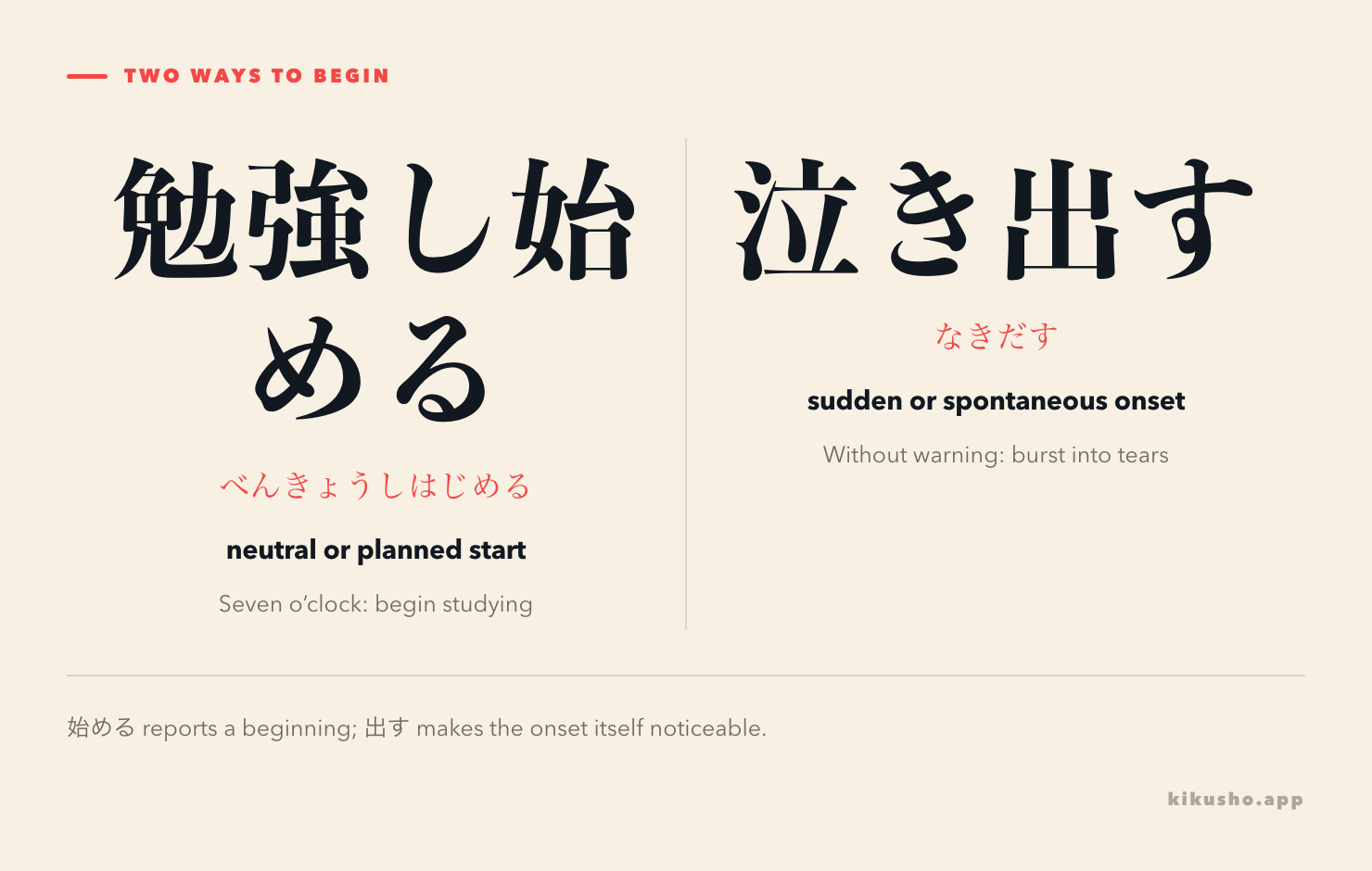
The difference is one of presentation, not an absolute property of the event. 雨が降り始めた neutrally reports that rain began. 雨が降り出した makes its onset salient, often because it was sudden or caught someone’s attention. Adding 急に makes that reading explicit, but 出す already points in that direction.
続ける keeps an action going
Use V-stem + 続ける when the subject maintains or repeats the action across a stretch of time.
毎日、日記を書き続けています。
まいにち、にっきを かきつづけています。
I have continued writing a diary every day.
雨が三日間降り続けました。
あめが みっかかん ふりつづけました。
The rain continued for three days.
The second example prevents a common overrule: a human subject does not have to intentionally sustain the action. The compound can present an event as uninterrupted or recurrent. Context decides whether continuation means one continuous activity or repeated instances across a period.
書いています can locate writing in progress now. 書き続けています adds that the writing has been maintained through time. The two can describe the same person, but 続ける asks the reader to notice persistence. It is also 続ける, the transitive ichidan verb, that forms the compound; do not replace it with intransitive 続く and write 書き続く.
終わる reaches a meaningful endpoint
Use V-stem + 終わる when a bounded action or process is completed.
この本を読み終わりました。
この ほんを よみおわりました。
I finished reading this book.
ご飯を食べ終わったら、皿を洗ってください。
ごはんを たべおわったら、さらを あらってください。
When you finish eating, please wash the dishes.
The action needs an endpoint that makes sense. Reading a book, eating a meal, writing a report, and using a tool can all be completed. State and existence verbs such as ある and いる do not normally supply a process to finish. A natural phenomenon may call for a more specific verb: rain normally 降りやむ, “stops falling,” rather than 降り終わる.
Do not confuse 読み終わる with standalone 読書が終わる. In the compound, the book remains the object of 読む: 本を読み終わる. 終わる supplies the endpoint but does not erase the first verb’s relationship to its nouns.
The N4 label is useful, not official
JLPT Sensei’s N4 index places 出す, 始める, 終わる and 続ける at N4. MIT’s Tobira grammar material groups all four after a verb stem, while Mango Languages independently confirms the shared stem rule and the 始める/出す contrast.
One comparison list places 始める at N3. That disagreement does not change the form or the examples; it shows why a JLPT level is a study estimate rather than an official exhaustive syllabus. For this curriculum, the four forms are taught together at N4 because the shared attachment rule makes the distinctions easier to learn as one system.
Practice: select the phase before the form
Question 1 — grammar choice. You planned to begin studying at seven. Complete: 七時になったので、日本語を勉強___。
① し出しました
② し始めました
③ し続けました
④ し終わりました
Question 2 — grammar choice. Complete the sudden event: 静かだった赤ちゃんが、急に___。
① 泣き始めました
② 泣き終わりました
③ 泣き出しました
④ 泣き続けました
Question 3 — sentence composition. Write “I finished reading the book yesterday” using 昨日, 本を, and 読む + 終わる.
Question 4 — grammar choice. Which sentence most clearly says that the rain was maintained for three hours?
① 雨が三時間降り始めました。
② 雨が三時間降り続けました。
③ 雨が三時間降り出しました。
④ 雨が三時間降り終わりました。
Question 5 — sentence composition. Turn 話します into a plain past compound meaning “suddenly started talking.”
Question 6 — text grammar. Read: 三時からレポートを書き始めました。夕食の後も書き続けて、十時に書き終わりました。 Match each compound to the time it identifies: 3:00, after dinner, or 10:00. What changed at each point?
Question 7 — text grammar. A person says: 空が暗くなって、雨が降り出しました。今も降り続けています。 Which form presents the onset as noticeable, and which says the event persists now?
Answers and explanations
Answer 1: ②, し始めました. The time and the stated plan call for a neutral beginning. ① would make the studying break out suddenly; ③ says it continued, and ④ says it was completed.
Answer 2: ③, 泣き出しました. 急に and the change from quiet to crying foreground an abrupt onset. ① can neutrally report that the crying began, but ③ carries the suddenness asked for. ② marks completion; ④ marks continuation.
Answer 3: 昨日、本を読み終わりました。 読み is the ます-stem of 読む, and 終わりました carries completion, politeness, and past tense. 昨日本を読み終わりました is also natural without the comma.
Answer 4: ②, 雨が三時間降り続けました. 続ける explicitly maintains the falling across the three-hour span. ① and ③ identify a beginning, so 三時間 cannot naturally measure their onset in the intended way. ④ incorrectly treats rain as a bounded task being finished.
Answer 5: 話し出した. Remove ます from 話します to get 話し, attach 出す, then put the final verb in the plain past: 出す → 出した. The first stem remains unchanged.
Answer 6: 書き始めました marks the beginning at 3:00. 書き続けて says the writing remained in progress after dinner and links to the next clause. 書き終わりました marks completion at 10:00. The paragraph moves from start through continuation to endpoint.
Answer 7: 降り出しました makes the onset noticeable as the sky darkens and rain breaks out. 降り続けています says the rain has persisted and is still falling now; 続ける carries the continuation, while ています places that continuation in the present situation.
When you meet one of these compounds, read from the seam outward: identify the frozen ます-stem, then let the final verb tell you the phase. That turns four similar translations into one visible timeline.
Common questions
What is the difference between 始める and 出す after a verb stem?
始める marks a neutral beginning and works naturally for planned actions. 出す presents the onset as sudden, spontaneous, or hard to control. Compare 勉強し始める, start studying, with 急に泣き出す, suddenly burst into tears.
How do you attach 始める, 出す, 続ける and 終わる to a verb?
Use the ます-stem: remove ます from the polite form and attach the phase verb directly. 読みます becomes 読み, giving 読み始める, 読み出す, 読み続ける and 読み終わる.
What is the difference between 続ける and ている?
V-stem + 続ける explicitly says the action is maintained or repeated across time. Vている can simply locate an action in progress and does not by itself emphasise persistence.
Can every verb take these four endings?
No. They fit actions, processes, and changes that can have the relevant phase. State and existence verbs such as ある and いる usually do not, and 終わる needs an action with a meaningful endpoint.