On this page
~ながら joins two actions that overlap and usually have the same actor: 友達と話しながら歩いた (ともだちと はなしながら あるいた) means “I walked while talking with a friend.” Walking is the sentence's main action; talking gives its background. Reverse the verbs to 歩きながら友達と話した (あるきながら ともだちと はなした), and the same scene now foregrounds the conversation.
This page teaches the assigned ながら simultaneous-action item, g-3f7908dea6db, in the Kikusho N4 grammar sequence. JLPT Sensei and Bunpro place this use at N4; those are study-guide estimates, since the JLPT organizers do not publish an exhaustive grammar list. If the verb base is unfamiliar, learn the ます-form and verb groups first.
Build ~ながら from the ます-stem
Take a verb's polite ます form, remove ます, then attach ながら to the part left behind. Japan Foundation Irodori Elementary 2 gives this formation for doing two things at once. The first verb stays in that stem shape; the final verb carries tense, negation and politeness for the sentence.
| Dictionary verb | ます form | Remove ます | With ながら |
|---|---|---|---|
| 読む (よむ, read) | 読みます | 読み | 読みながら |
| 食べる (たべる, eat) | 食べます | 食べ | 食べながら |
| 話す (はなす, talk) | 話します | 話し | 話しながら |
| する (do) | します | し | しながら |
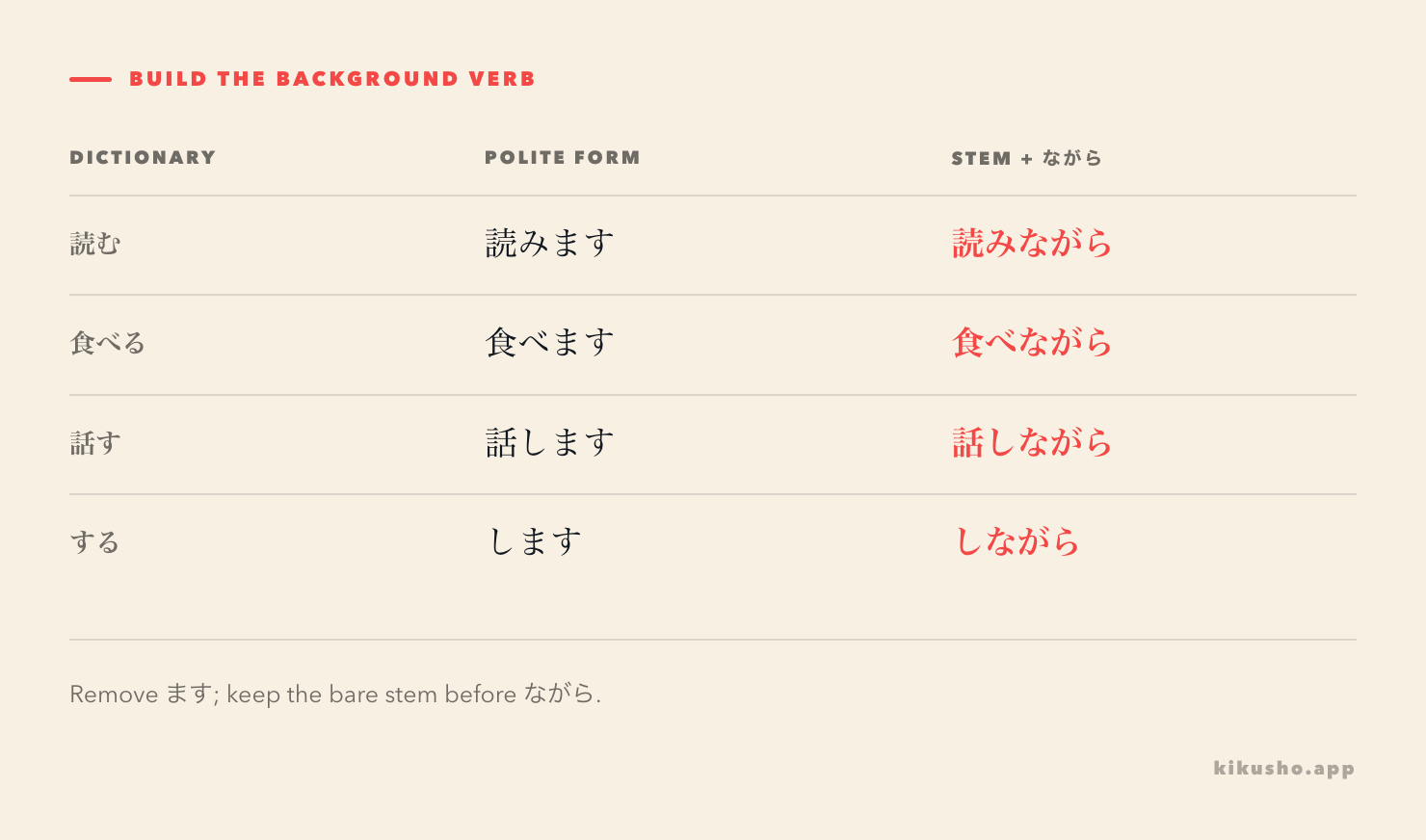
読みながら is right; 読むながら and 読んでながら do not follow this pattern. A Tofugu explanation of verb ~ながら independently confirms the ます-stem attachment. In 本を読みながら音楽を聞きました (ほんを よみながら おんがくを ききました), “I listened to music while reading a book,” 読み keeps that shape while 聞きました makes the whole sentence polite and past. Change the final verb to 聞いています and the sentence becomes 本を読みながら音楽を聞いています, “I am listening to music while reading a book.”
The final verb tells you what the sentence is about
Compare 友達と話しながら公園を歩いた (ともだちと はなしながら こうえんを あるいた), “I walked through the park while talking with a friend,” with 公園を歩きながら友達と話した (こうえんを あるきながら ともだちと はなした), “I talked with a friend while walking through the park.” Both are true descriptions of an overlapping scene. The verb after ~ながら changes the focus from walking to talking; ~ながら itself does not make its action unreal or unimportant.
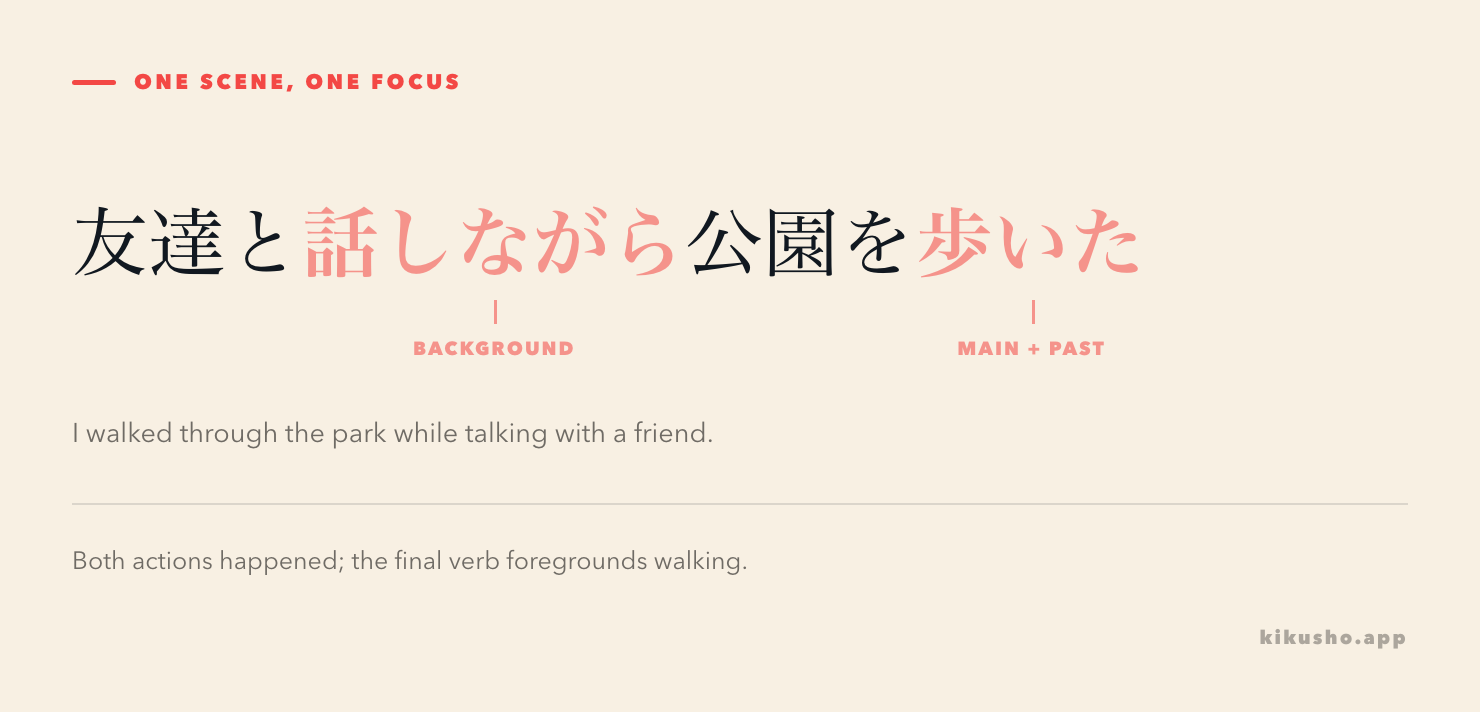
Tofugu demonstrates this focus change by reversing two actions, and Bunpro treats the second clause as the main one. When translating English “while,” decide first what you mean to tell someone: the walk or the conversation. Then put that action at the end. In speech, the final verb also tells your listener whether the scene happened, is happening, or will happen.
One actor, and a real overlap
In the basic two-action use, the person walking is also the person talking. 兄は音楽を聞きながら宿題をした (あには おんがくを ききながら しゅくだいを した) works because the older brother did both. 兄は音楽を聞きながら、妹は宿題をした does not express the intended scene cleanly: the second clause names a different actor. To say the brother listened while his younger sister did homework, say 兄が音楽を聞いている間に、妹は宿題をした (あにが おんがくを きいている あいだに、いもうとは しゅくだいを した). Tofugu's account identifies the same-subject limit for simultaneous ~ながら.
Overlap need not mean that two things occupy exactly the same second. 働きながら大学に通っている (はたらきながら だいがくに かよっている) means “I attend university while working”: the two commitments run in parallel over a longer period. Tofugu also gives this extended-overlap use. But 手を洗ってから夕食を食べた (てを あらってから ゆうしょくを たべた) means “I ate dinner after washing my hands.” Replacing the sequence with 手を洗いながら夕食を食べた would describe eating while washing, a different and implausible scene. ~ながら explicitly supplies overlap; て alone can connect actions in several ways, so context matters. If your sentence is about a condition and its result instead, と and たら distinguish predictable consequences from particular situations.
This is the everyday simultaneous-action pattern. You may later meet a concessive ~ながらも (“although”) or set phrases such as 残念ながら (“unfortunately”). Bunpro's ~ながら account notes the separate concessive use. Do not force those phrases into a two-verb “doing X while doing Y” reading.
If you catch 話しながら歩いた in a conversation, saving only “ながら = while” loses the sentence's two actions and its focus. Kikusho can capture the spoken line or its text as a card, let you check the example before saving, and bring it back in offline review. Keep the entire sentence; when it returns, ask which verb the speaker put last.
Practice: form and interpret ~ながら
Try all six questions before reading the answer block.
Question 1 — grammar choice. You want to tell a friend that tidying your room was your main action and you had the radio on as you tidied. Which sentence fits?
- A. ラジオを聞きながら部屋を片づけた。
- B. 部屋を片づけながらラジオを聞いた。
- C. ラジオを聞いてから部屋を片づけた。
Question 2 — grammar choice. Which sentence uses ~ながら for two overlapping actions by one actor?
- A. 兄は音楽を聞きながら宿題をした。
- B. 兄は音楽を聞きながら、妹は宿題をした。
- C. 兄は音楽を聞いてから宿題をした。
Question 3 — sentence composition. Say politely in the past that you walked while taking photographs. Use 写真を撮る (しゃしんを とる) for the background action and 歩く (あるく) for the main action.
Question 4 — sentence composition. Say politely in the past that you listened to the radio while cooking. Use 料理をする for the background action and ラジオを聞く for the main action.
Question 5 — text grammar. A diary says “I listened to music while reading a book on the train.” Complete the background verb from 読む: 電車で本を__、音楽を聞きました。
Question 6 — text grammar. Read 働きながら大学に通っています。 Which activity is presented as the main point, and must the work and university attendance occur in the same minute?
Answers and explanations
Answer 1. A, ラジオを聞きながら部屋を片づけた。 “I tidied my room while listening to the radio.” 聞き is the ます-stem of 聞く; 片づけた is the final, main action. B is also a possible overlapping scene, but its final 聞いた foregrounds listening. C uses てから to put tidying after listening, so it does not describe the intended overlap.
Answer 2. A, 兄は音楽を聞きながら宿題をした。 The brother both listens and does homework. B switches to the sister as the second clause's subject, so it does not cleanly join the brother's two actions. C has the brother do both things, but 聞いてから makes them successive rather than overlapping.
Answer 3. One model answer is 写真を撮りながら歩きました。 (しゃしんを とりながら あるきました), “I walked while taking photographs.” 撮る → 撮ります → 撮りながら supplies the background; 歩きました puts walking at the end and makes the sentence polite and past. You may add an explicit subject or destination without changing this relationship.
Answer 4. 料理をしながらラジオを聞きました。 (りょうりを しながら ラジオを ききました), “I listened to the radio while cooking.” 料理をする → 料理をします → 料理をしながら is the first verb's route. 聞きました is final, so listening is the point you report. ラジオを聞きながら料理しました would be a natural sentence, but it reverses the requested focus.
Answer 5. 読みながら completes 電車で本を読みながら、音楽を聞きました。 (でんしゃで ほんを よみながら、 おんがくを ききました). 読む → 読みます → 読みながら uses the bare ます-stem, not 読んで or 読む. The listener and reader are the same implied person; the final verb reports the listening.
Answer 6. 大学に通っています, “I attend university,” is the main point because it is the final verb. 働きながら supplies the parallel work commitment. The two activities can overlap across a semester or longer; the sentence does not require a job shift and a class to happen at the same minute.
Common questions
How do you form ~ながら with a Japanese verb?
Remove ます from the polite verb form and add ながら: 読みます becomes 読みながら, and 食べます becomes 食べながら. The verb after that clause supplies the sentence's tense and politeness.
Which action is the main one in a ~ながら sentence?
The action in the final clause is presented as the main point. In 話しながら歩いた, walking is foregrounded; in 歩きながら話した, talking is. Both actions still happen and overlap.
Can ~ながら join actions by two different people?
In the basic simultaneous-action pattern, one actor does both things. For a scene with two actors, use a time clause such as ている間に instead.
Does ~ながら always mean two actions at the same instant?
It marks overlapping actions. They may overlap during a short scene or across a longer period, as in working while studying. It does not mark two actions that happen one after the other.