On this page
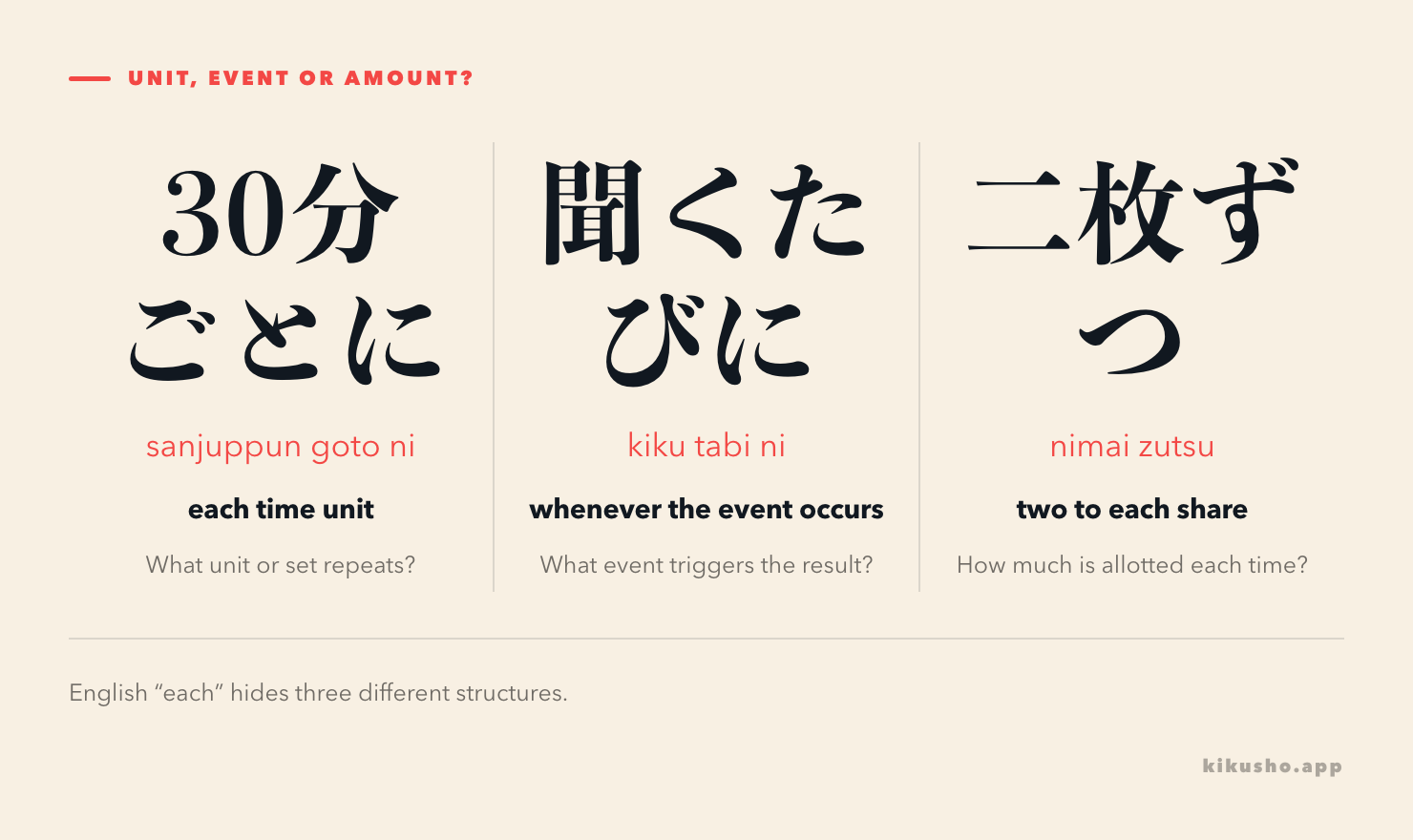
A nurse checks a monitor 30分ごとに, every thirty minutes. A song brings back the same memory 聞くたびに, every time it is heard. A teacher hands out worksheets 二枚ずつ, two to each person. All three expressions involve repetition, but they count different things.
Ask what supplies the repeating frame. ごとに selects each unit or member of a set. たびに uses one recurring event as the trigger for another. ずつ fixes the quantity assigned at each share, turn or step.
Three questions separate the forms
| Form | Ask this | Core shape | Example |
|---|---|---|---|
| ごとに | What unit or set repeats? | N + ごとに / V-dictionary + ごとに | 30分ごとに |
| たびに | What event triggers the next result? | V-dictionary + たびに / Nの + たびに | 会うたびに |
| ずつ | How much goes to each share or step? | quantity + ずつ | 二枚ずつ |
The English word “each” can translate all three, so translation alone cannot choose the Japanese form. Locate the unit, event or allotted amount first.
この機械は三十分ごとに温度を記録する。
このきかいはさんじゅっぷんごとにおんどをきろくする。
This machine records the temperature every thirty minutes.
この曲を聞くたびに、祖父の家を思い出す。
このきょくをきくたびに、そふのいえをおもいだす。
Every time I hear this song, I remember my grandfather's house.
資料を一人に二枚ずつ配ってください。
しりょうをひとりににまいずつくばってください。
Please hand out two sheets to each person.
ごとに creates units and sets
ごとに follows a noun directly. With a time or distance quantity, it marks each complete unit:
バスは十五分ごとに来ます。
バスはじゅうごふんごとにきます。
The bus comes every fifteen minutes.
この道には五百メートルごとに案内板がある。
このみちにはごひゃくメートルごとにあんないばんがある。
There is an information sign every five hundred metres along this road.
With a group noun, it treats every member or group as one unit:
クラスごとに代表を一人選んでください。
クラスごとにだいひょうをひとりえらんでください。
Please choose one representative from each class.
It also follows a dictionary-form verb. In that shape it can mean that a change advances on each repetition:
この町を訪れるごとに、新しい店が増えている。
このまちをおとずれるごとに、あたらしいみせがふえている。
Each time I visit this town, there are more new shops.
JLPT Sensei's ごとに lesson verifies the noun and dictionary-verb attachments and the “each, every, at intervals” meanings. Bunpro independently describes the same unit-based use and notes that noun phrases are especially common.
Do not treat ごとに and おきに as an arithmetic swap. 一日ごとに means on each one-day unit, while 一日おきに can mean act, leave one day between, then act again. The dedicated 頃, おきに and さっき lesson shows a full calendar and explains why short continuous units can still look identical in English.
たびに makes an event the trigger
たびに follows a dictionary-form verb or noun + の:
| Material | Attachment | Example |
|---|---|---|
| verb | dictionary form + たびに | 読むたびに |
| noun | noun + の + たびに | 旅行のたびに |
この本は、読むたびに新しい発見がある。
このほんは、よむたびにあたらしいはっけんがある。
Every time I read this book, I discover something new.
出張のたびに、その町の名物を買って帰る。
しゅっちょうのたびに、そのまちのめいぶつをかってかえる。
On every business trip, I buy a local specialty to take home.
The first part must recur. A single past event followed by one result needs an ordinary time connector, not たびに. 日本へ行ったたびに cannot mean “when I went to Japan that one time.”
JLPT Sensei and Bunpro both place たびに at N3 and verify the two attachments. Bunpro usefully frames it as an event or action rather than a bare amount of time: 三時間ごとに works directly, while たびに would need an event such as 三時間が経つたびに.
ごとに and たびに overlap after verbs, but their centers differ. ごとに can present an objective sequence divided into repeating instances; たびに foregrounds “whenever this happens, that follows,” often with a memory, feeling, discovery or habitual response. Enuncia's Japanese comparison documents this tendency while acknowledging the overlap.
会議を重ねるごとに、計画が具体的になった。
かいぎをかさねるごとに、けいかくがぐたいてきになった。
With each successive meeting, the plan became more concrete.
その写真を見るたびに、当時の緊張を思い出す。
そのしゃしんをみるたびに、とうじのきんちょうをおもいだす。
Whenever I see that photo, I remember how nervous I was then.
The first tracks development across units. The second makes seeing the photo the repeated trigger for a memory.
ずつ distributes an amount
ずつ sits directly after a quantity, counter or amount. It can divide items among recipients, set the amount handled in each turn, or show gradual change.
子どもたちにりんごを一個ずつ渡した。
こどもたちにりんごをいっこずつわたした。
I gave the children one apple each.
五人ずつ部屋に入ってください。
ごにんずつへやにはいってください。
Please enter the room five people at a time.
毎日、漢字を三つずつ覚えている。
まいにち、かんじをみっつずつおぼえている。
I learn three kanji each day.
空が少しずつ明るくなってきた。
そらがすこしずつあかるくなってきた。
The sky has gradually become lighter.
JLPT Sensei records the measurable-noun attachment and the “apiece, each, at a time” meanings. Bunpro independently specifies number-plus-counter, 少しずつ, and the idea of fixed allotments.
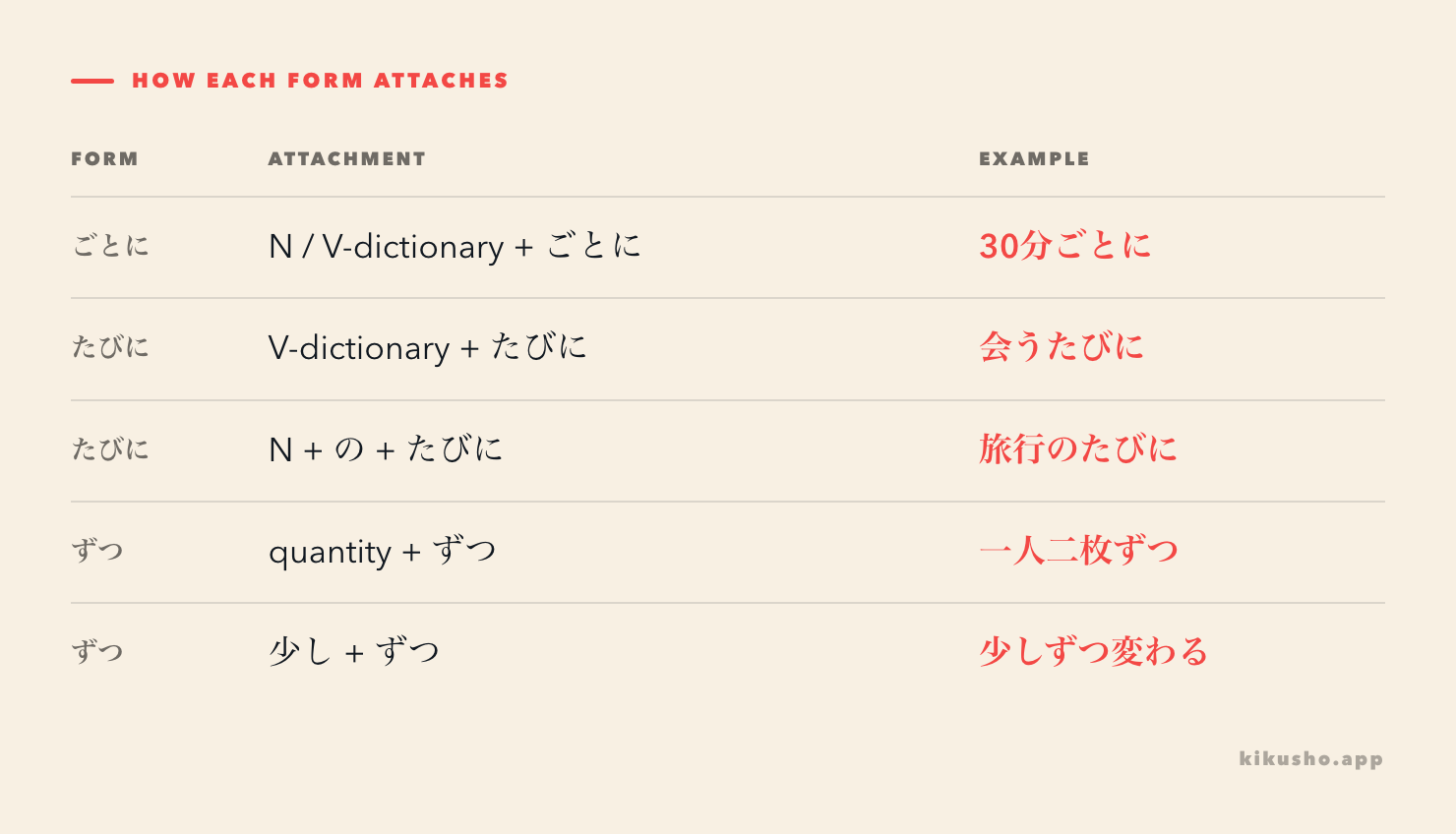
There is no に after ずつ in these patterns. In 一人に二枚ずつ, the に belongs to 一人に, the recipient “to each person”; 二枚ずつ is the allotted amount.
One scene can contain all three
Consider a language class:
授業は一週間ごとにあります。授業のたびに小テストをして、単語を五つずつ復習します。
じゅぎょうはいっしゅうかんごとにあります。じゅぎょうのたびにしょうテストをして、たんごをいつつずつふくしゅうします。
Class meets every week. At each class we take a quiz and review five words at a time.
一週間ごとに sets the interval. 授業のたびに turns each class meeting into a trigger for the quiz. 五つずつ sets the amount reviewed per round. None is a stylistic replacement for another.
This distinction matters when saving the sentence in Kikusho. Keep the counted material beside the form: 一週間ごとに, 授業のたびに, or 五つずつ. A card containing only “each” cannot recover whether the original sentence counted intervals, events or allotted items. Preserve the full clause and edit the nuance field to name the repeating frame.
Practice: identify the repeating frame
Complete all seven prompts before checking the explanations.
Question 1 — grammar choice. A sensor records a value every ten seconds. Complete センサーは十秒__数値を記録する.
- ア. のたびに
- イ. ずつ
- ウ. ごとに
- エ. ごと
Question 2 — attachment. Complete “every time I travel”: 旅行__、写真をたくさん撮る.
- ア. ごとずつ
- イ. のたびに
- ウ. にずつ
- エ. たびごと
Question 3 — distribution. A teacher gives three cards to every student. Complete 学生にカードを三枚__配った.
- ア. ごとに
- イ. のたびに
- ウ. ずつ
- エ. おきに
Question 4 — sentence composition. Arrange all chunks to say “Please enter two people at a time.”
- 二人ずつ
- 入って
- 部屋に
- ください
Question 5 — meaning in context. In この歌を聞くたびに、故郷を思い出す, does たびに count a fixed time interval, or make hearing the song the recurring trigger for a memory?
Question 6 — gradual amount. Which sentence means “My Japanese is improving little by little”?
- ア. 日本語が少しごとに上達している。
- イ. 日本語が少しのたびに上達している。
- ウ. 日本語が少しずつ上達している。
- エ. 日本語が少しおきに上達している。
Question 7 — connected text. Choose the three forms that assign an interval, a recurring occasion and an allotment, in that order.
健康相談は三か月( )あります。相談( )同じ質問票を使い、参加者に水を一本( )渡します。
- ア. ごとに/のたびに/ずつ
- イ. ずつ/ごとに/のたびに
- ウ. のたびに/ずつ/ごとに
- エ. おきに/ずつ/のたびに
Answers and explanations
Answer 1. ウ, ごとに. Ten seconds is the unit that structures the repeated measurement, so 十秒ごとに means every ten seconds. たびに would need an event, and ずつ would need a distributed quantity.
Answer 2. イ, のたびに. A noun requires の before たびに: 旅行のたびに. Each trip triggers the repeated act of taking photographs.
Answer 3. ウ, ずつ. 三枚ずつ fixes the allotment at three cards for each student. The recipient particle is already present in 学生に; ずつ itself takes no に.
Answer 4. 二人ずつ部屋に入ってください. 二人ずつ means two people at a time, 部屋に marks the destination, and 入ってください makes the request.
Answer 5. Hearing the song is the recurring trigger for a memory. The sentence means that the memory returns whenever the song is heard. It does not specify a schedule or measured interval.
Answer 6. ウ, 日本語が少しずつ上達している. 少しずつ divides the change into small increments and therefore means little by little. The other expressions do not take 少し in those shapes.
Answer 7. ア, ごとに/のたびに/ずつ. 三か月ごとに sets the three-month interval. 相談のたびに makes each consultation the occasion for the questionnaire. 一本ずつ allots one bottle to each participant.
The level labels differ for ごとに
JLPT Sensei places all three assigned items at N3. Bunpro also places たびに and ずつ at N3, but teaches ごとに in its N4 sequence. Kikusho records that disagreement rather than forcing the two publishers into one answer.
Publisher levels guide study order; they do not reproduce an official grammar syllabus. The JLPT FAQ explains the test's position on item lists. What can be checked directly is the learner's ability to identify a unit, trigger or allotment and attach each expression correctly.
This AI language review was completed by OpenAI Codex. It checked the three attachment systems, examples, readings, translations, level note, all distractors and the seven answer mappings; no human review is implied.
Common questions
What is the difference between ごとに, たびに and ずつ?
ごとに divides time, distance or a set into units such as every 30 minutes or each class. たびに means whenever an event occurs. ずつ follows a quantity and distributes that amount to each recipient or each step.
What comes before たびに?
Use a dictionary-form verb or a noun plus の: 会うたびに and 旅行のたびに. It presents the first event as a recurring trigger for what follows.
Does ずつ need the particle に?
No. Put ずつ directly after the quantity or amount: 一人二枚ずつ, one person two sheets each, or 少しずつ, little by little.
What JLPT level is ごとに?
JLPT Sensei places it at N3, while Bunpro teaches it at N4. These are publisher estimates because the JLPT does not publish an exhaustive current grammar list.