On this page
「ミドリ」という店 is a shop called Midori; 店が休みだという知らせ is a notice that the shop is closed. Japanese という links a name or stated content to what follows, so the noun after it tells you which relationship to read.
This N3 reading lesson connects six patterns: という, ということ, casual って, ということだ, というのは and というと. Some are earlier-level foundations. They share sounds, but their endings do different jobs.
A name goes directly before という and its category after it
駅の近くに「ミドリ」という店がある。
えきの ちかくに「ミドリ」という みせが ある。
There is a shop called Midori near the station.
The first part gives the name; 店 gives the category. ミドリという店 is one noun phrase. There is no だ between the name and という. The same pattern can name a person, book or game: レナという人(レナというひと), “a person called Rena.”
The name may be new to the listener, but do not make unfamiliarity an absolute grammatical requirement. You can discuss a known name when you need to identify or frame what it refers to. The naming use is explained independently in JLPT Sensei’s という lesson and Maggie Sensei’s naming section.
A clause supplies the content of the following noun
Now put a complete statement before という:
店が明日休みだという知らせを受け取った。
みせが あした やすみだという しらせを うけとった。
I received a notice that the shop is closed tomorrow.
The notice is not named “the shop is closed.” That is its content. A longer first clause still fits before the same small connector. Locate 知らせ, the head noun, then read back to what the notice says.
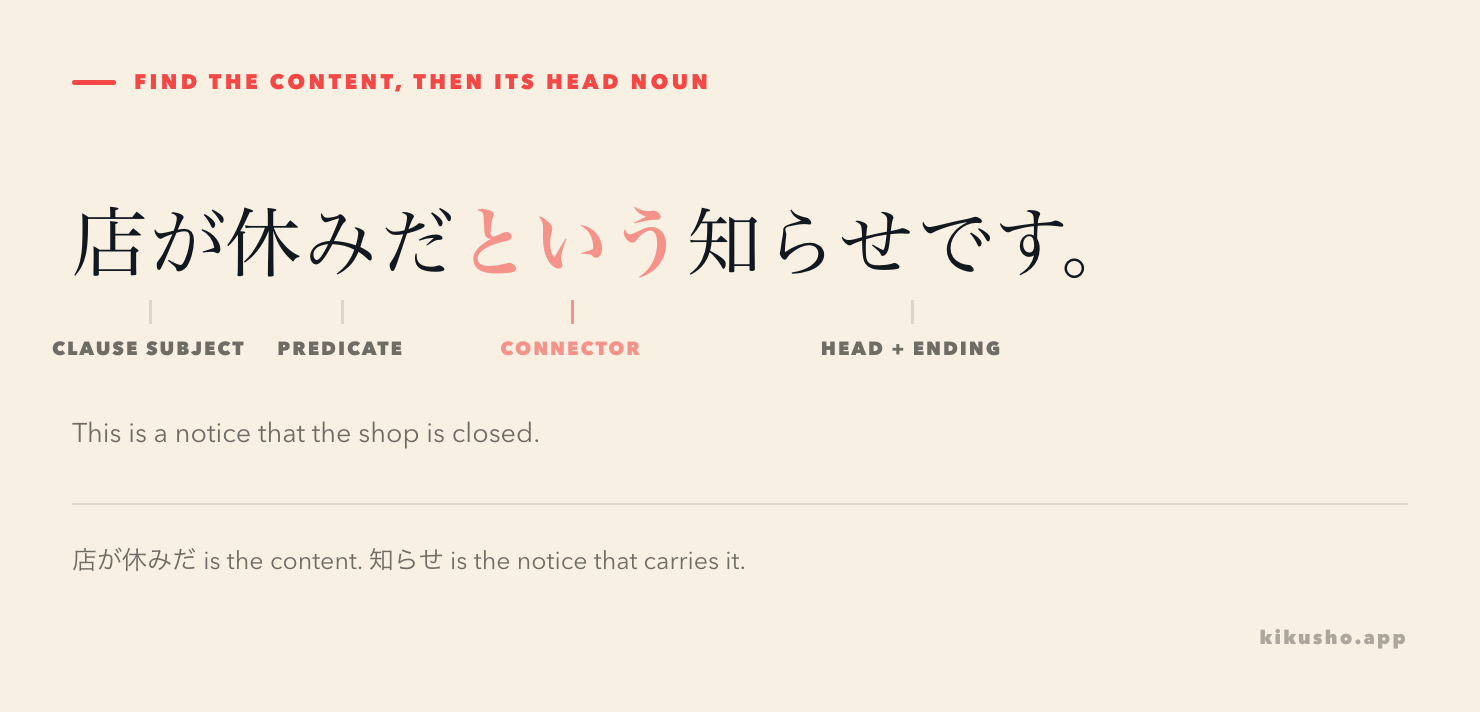
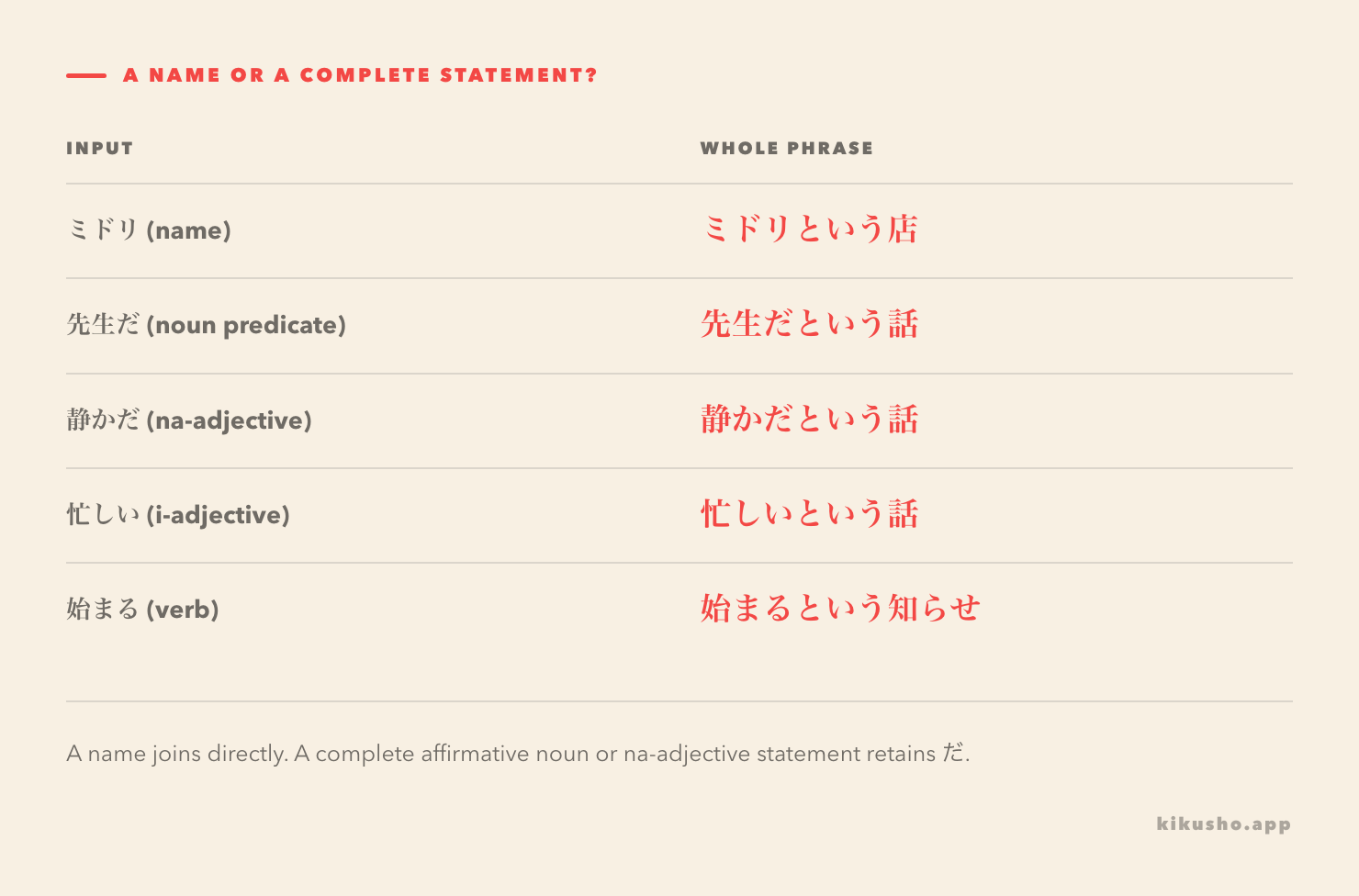
Use a plain-form clause for these content phrases. Nouns and na-adjectives keep だ in a complete affirmative present statement; i-adjectives do not acquire it.
| Input | Content phrase | Meaning |
|---|---|---|
| 彼は先生だ: he is a teacher | 彼が先生だという話 | a report that he is a teacher |
| 町は静かだ: the town is quiet | 町が静かだという話 | a report that the town is quiet |
| 彼は忙しい: he is busy | 彼が忙しいという話 | a report that he is busy |
| 会議は始まる: the meeting will start | 会議が始まるという知らせ | a notice that the meeting will start |
| 会議は終わった: the meeting ended | 会議が終わったという知らせ | a notice that the meeting ended |
The switch to が in this table gives the inner clause an explicit subject; it is not a rule that every embedded は must become が. Tense and negation remain inside that clause: 休みだったという話 reports that something was closed; 休みではないという話 reports that it is not closed.
Maggie Sensei’s clausal-content section shows whole statements before nouns such as messages and rumours. The JLPT Sensei formation table for ということ corroborates plain verbs, i-adjectives and noun/na-adjective predicates with だ.
Do not add という to every noun modifier. 昨日買った本(きのうかったほん)already means “the book I bought yesterday.” The following noun determines whether you are naming an object, giving the content of information, or simply describing it. Nor does という itself certify a rumour: 休みだという噂(やすみだといううわさ)can be an unverified rumour that something is closed.
ということ packages a statement so it can take a particle
私は、明日が休みだということを忘れていた。
わたしは、あしたが やすみだということを わすれていた。
I had forgotten that tomorrow is a day off.
Here こと turns the stated content into a noun phrase. を marks that whole phrase as what was forgotten. You can similarly attach が or は when the rest of the sentence requires them. The formation remains the same: 休みだ + ということ, not 休みなということ.
ということ can also check someone’s intended meaning: 私が一人で行くということですか。(わたしが ひとりで いくということですか。)“Do you mean that I’m going alone?” Bunpro’s ということ explanation and Tofugu’s nominalisation section distinguish this packaging and clarification from naming a concrete object.
Use っていう or って for casual naming
| Naming phrase | Register in this use |
|---|---|
| ミドリという店 | standard |
| ミドリっていう店 | conversational |
| ミドリって店 | shortened conversational form |
「ミドリ」って店、知ってる?
「ミドリ」って みせ、しってる?
Do you know the shop called Midori?
Both っていう and って can replace という in this naming phrase. JLPT Sensei’s naming って page gives the two forms; Maggie Sensei also supplies conversational っていう naming phrases.
A って elsewhere need not be naming anything. この店って、広いね。(このみせって、ひろいね。)means “This shop is spacious, isn’t it?” Here it introduces a topic, rather than joining a name to 店. Bunpro separates this topic use from casual quotation. Check what comes after って before expanding it mechanically into という. Avoid these conversational contractions in a formal written report. For other spoken choices that can sound vague or dismissive, the lesson on とか, なんて and なんか follows the register question.
ということだ can report information or give a conclusion
A source points to reporting
店長の話では、来月から営業時間が変わるということだ。
てんちょうの はなしでは、らいげつから えいぎょうじかんが かわるということだ。
According to the manager, the opening hours will change from next month.
The source 店長の話では identifies where the information came from. ということだ passes it on. It can end politely in ということです. In this reporting use, とのことだ/とのことです is also possible: 営業時間が変わるとのことです. Do not interpret the declarative ending as proof that the report is true.
A rule and its consequence point to a conclusion
この券は今日まで有効だ。明日は使えないということだ。
このけんは きょうまで ゆうこうだ。あしたは つかえないということだ。
This ticket is valid through today. That means it cannot be used tomorrow.
The second sentence interprets the first; it does not introduce a new unnamed source. JLPT Sensei’s ということだ lesson and Bunpro’s explanation cover reporting and interpretation. とのことだ is the reporting alternative, not a universal replacement for the conclusion use.
というのは sets up a definition or explanation
「徒歩」というのは、歩いて行くことです。
「とほ」というのは、あるいて いくことです。
“On foot” means going by walking.
The expression before というのは is what you explain; the following predicate gives the explanation. A complete clause can also become the topic: 店が休みだというのは、本当ですか。(みせが やすみだというのは、ほんとうですか。)“Is it true that the shop is closed?”
At the start of a new sentence, というのは can introduce the reason for what you just said:
今日は車で行きます。というのは、荷物が多いからです。
きょうは くるまで いきます。というのは、にもつが おおいからです。
I’m going by car today. The reason is that I have a lot of luggage.
JLPT Sensei and Bunpro both distinguish definition from further explanation. Its position helps: Xというのは… introduces X as a topic, while A。というのは… explains the preceding statement. It does not mean “because” in every occurrence.
というと brings up an association with a topic
冬というと、祖母の家のストーブを思い出す。
ふゆというと、そぼの いえの ストーブを おもいだす。
Speaking of winter, I remember the heater at my grandmother’s house.
This use takes a noun or topic expression and gives what it brings to mind. No head noun follows という as it did in ミドリという店. というと is the cue for the association. The JLPT Sensei というと lesson and Tofugu’s speaking-of section support this use. You may hear っていうと in conversation. This lesson covers the topic-association construction, not every literal conditional “when someone says…” or fixed phrase containing those sounds.
When a notice includes 延期(えんき), “postponement,” Kikusho can draft a vocabulary card from the word you highlight in its photo. Retain the notice’s context: 延期 names the change, while the surrounding clause tells you what was postponed. Check the editable card’s reading and explanation before saving it.
Reference levels differ by use
JLPT Sensei labels という, ということ and naming って N4, while it places ということだ, というのは and というと at N3. Bunpro labels naming という N3 and ということ N4. Its separate N1 という page concerns repeated-noun emphasis, not this basic naming use. Its って pages distinguish quotation at N5 from topic marking at N3. These matching spellings do not establish identical scopes. We revisit the foundations here for N3 reading; none is silently relabelled. The official JLPT FAQ explains the absence of an exhaustive official item list.
The previous published section lesson on ながらも concerns a different relation between clauses: concession. Here the reading task is finding where the stated content ends and the noun it belongs to begins.
Original practice
Eight questions cover the six patterns. All solutions are together after Question 8. These questions are written for this lesson, not copied from the JLPT.
Question 1 — grammar choice. Keep “he is a teacher” as a complete affirmative clause.
彼が先生( )という話を聞いた。
A. な
B. だ
C. の
D. に
Question 2 — grammar choice. Choose the ordinary content phrase: a report that he is busy.
彼が忙しい( )話を聞いた。
A. という
B. だという
C. なという
D. のという
Question 3 — grammar choice. Package the statement as what the speaker did not know.
明日は店が休みだ( )を知らなかった。
A. というのは
B. というと
C. ということだ
D. ということ
Question 4 — grammar choice. Which judgment is correct about these two casual naming phrases?
- ミドリっていう店
- ミドリって店
A. Both can mean a shop called Midori.
B. Only 1 can have that naming meaning.
C. Only 2 can have that naming meaning.
D. Neither can have that naming meaning.
Question 5 — sentence composition. Use all four pieces to make “I received a notice that the shop is closed tomorrow.” Which piece belongs at ★, the third position?
店が __ __ ★ __。
A. 知らせを
B. 受け取った
C. 明日休みだ
D. という
Question 6 — grammar choice. What is this speaker doing?
受付の人の話では、明日は予約が必要だということです。
A. Reporting information from the receptionist.
B. Defining the word 予約.
C. Calling the receptionist someone named 予約.
D. Saying that the speaker personally made a reservation.
Question 7 — grammar choice. Complete the definition of 徒歩, “on foot.”
「徒歩」というのは、( )。
A. 雨が降るそうです
B. 来月休みです
C. 歩いて行くことです
D. どこにありますか
Question 8 — text grammar. Keep the association between summer holidays and a remembered scene.
夏休みは毎年田舎に帰っていた。夏休み( )、祖母の家で食べたすいかを思い出す。
A. ということを
B. というと
C. という名前の
D. という知らせで
Helpful readings: 先生(せんせい), 忙しい(いそがしい), 知らせ(しらせ), 受け取る(うけとる), 受付(うけつけ), 予約(よやく), 必要(ひつよう), 徒歩(とほ), 田舎(いなか), 祖母(そぼ), 思い出す(おもいだす).
Answers and explanations
Answer 1. B: だ. 彼が先生だという話 contains the statement “he is a teacher.” Keep the noun predicate’s だ. な is an attributive join used with na-adjectives; の and に do not complete this affirmative statement. A name would attach differently, as in レナという人.
Answer 2. A: という. 彼が忙しいという話 keeps the i-adjective 忙しい intact. Do not add だ, な or の to make this content phrase. The full sentence means “I heard a report that he is busy.”
Answer 3. D: ということ. 明日は店が休みだということを知らなかった。 “I didn’t know that the shop is closed tomorrow.” The noun phrase ending in こと can take を. というのは has already introduced a topic with は; というと starts a different relation; ということだ has added a declarative ending rather than leaving a noun phrase for を.
Answer 4. A. Both ミドリっていう店 and ミドリって店 can mean “a shop called Midori.” They are conversational naming phrases. A rule allowing only one misses a documented shortened form. This does not mean that every って in every sentence is a naming connector.
Answer 5. A: 知らせを. The order is C → D → A → B: 店が明日休みだという知らせを受け取った。 The complete content clause ends in だ, という links it to 知らせ, and を marks the notice as what was received. The fixed opening 店が is the inner clause’s subject. Moving the head noun ahead of its content does not produce the requested sentence.
Answer 6. A. 受付の人の話では identifies the source. The speaker passes on the information that a reservation is necessary tomorrow; they do not define the term, give a person’s name or say they booked anything. The polite ending ということです does not remove the reporting function or prove that the information is accurate.
Answer 7. C: 歩いて行くことです. 徒歩 means going on foot. というのは introduces that term for a definition. A reports rain, B gives a day-off statement and D asks a location question; none defines 徒歩.
Answer 8. B: というと. The writer used to return to the countryside during summer holidays, and the topic recalls watermelon eaten at their grandmother’s house. 夏休みというと means “speaking of summer holidays” here. A gives を to a nominalised expression while the remembered scene already takes を; C turns 夏休み into a supposed name modifying what follows; D invents a notice. Those alternatives do not preserve the paragraph’s topic-association structure.
Common questions
What does という mean in Japanese?
Between a name and a noun, という means called or named: ミドリという店 is a shop called Midori. After a clause, it can introduce the content of a following noun: 店が休みだという知らせ is a notice that the shop is closed.
Why does だ sometimes appear before という?
A name joins directly, as in ミドリという店. A complete affirmative present clause with a noun or na-adjective normally retains its copula: 先生だという話 or 静かだという話. An i-adjective such as 忙しい does not take だ.
Does ということだ always report something someone said?
No. It can pass on information from a source, or state an interpretation or conclusion. A named source such as 店長の話では helps identify reporting; an explicit rule followed by its consequence helps identify a conclusion.