On this page
~ながらも means “although” or “despite”: the speaker grants A, then gives B against an expectation A creates. It joins verb stems, adjectives and nouns; も makes the concession explicit, but ながら without も can already mean “although.”
Take この机は小さいながらも、使いやすい。 The desk is small, yet it is easy to use. Reading も as a separate “also” misses the relationship between those two assessments.
Join the predicate directly to ながらも
For a verb, use the stem before ます. For an i-adjective, keep its final い. A na-adjective or noun goes directly before ながらも, without inserting な, だ or の.
| Base | Attachment | Meaning of the first clause |
|---|---|---|
| 知る(しる): know | 知りながらも | although knowing |
| 知っている(しっている): be aware | 知っていながらも | although being aware |
| 小さい(ちいさい): small | 小さいながらも | although small |
| 不便(ふべん): inconvenient | 不便ながらも | although inconvenient |
| 初心者(しょしんしゃ): beginner | 初心者ながらも | despite being a beginner |
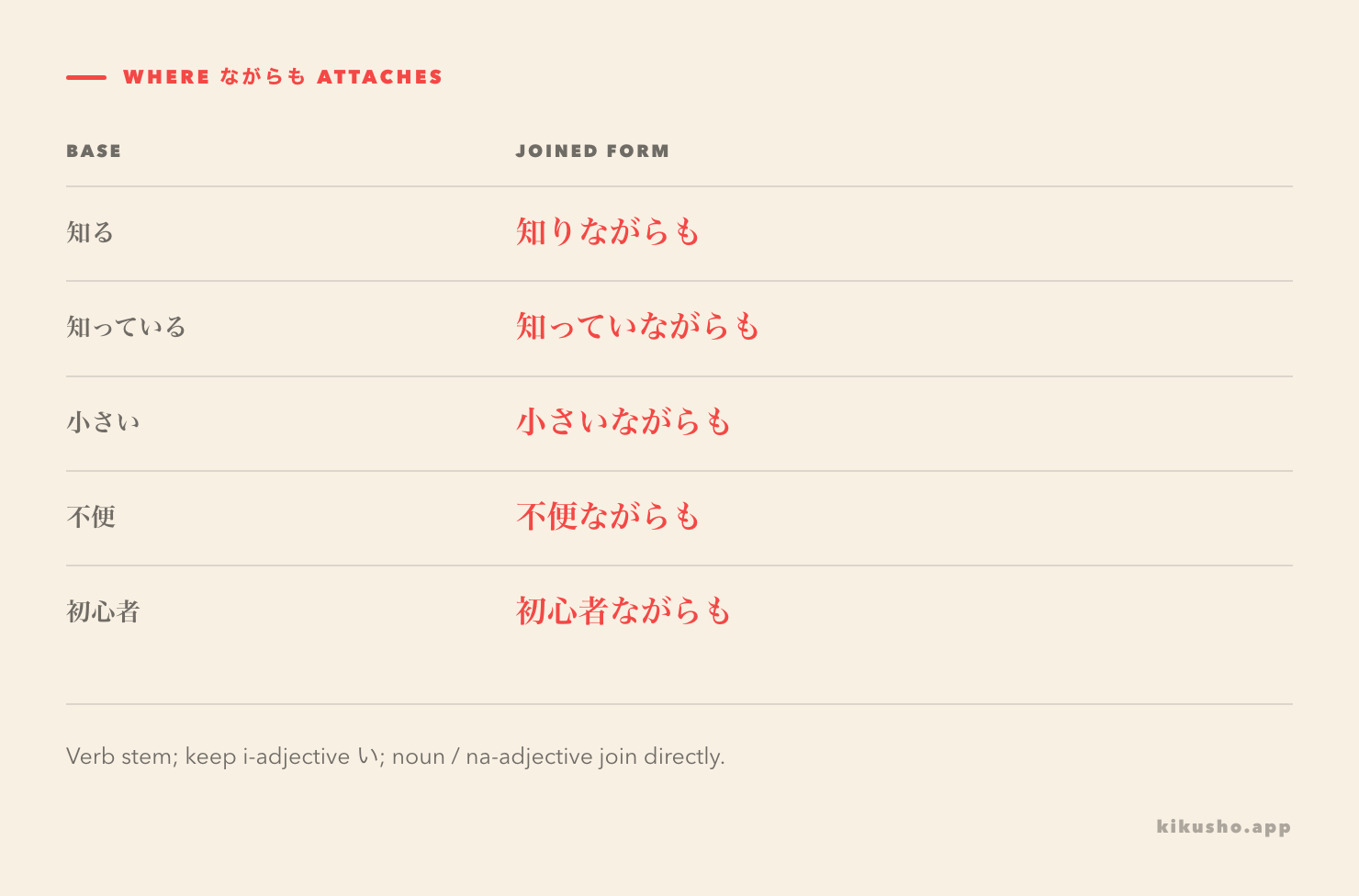
知っている becomes 知ってい, not 知っているながらも or 知っていてながらも. Its polite form is 知っています, so the same “remove ます” check works. If finding that stem is still slow, revisit the verb groups and ます-form.
The attachment table agrees with the authored lessons at JLPT Sensei and Bunpro. Knowing the join does not make every combination sensible: the continuation still needs to supply a concession.
Grant a fact, then challenge its expected consequence
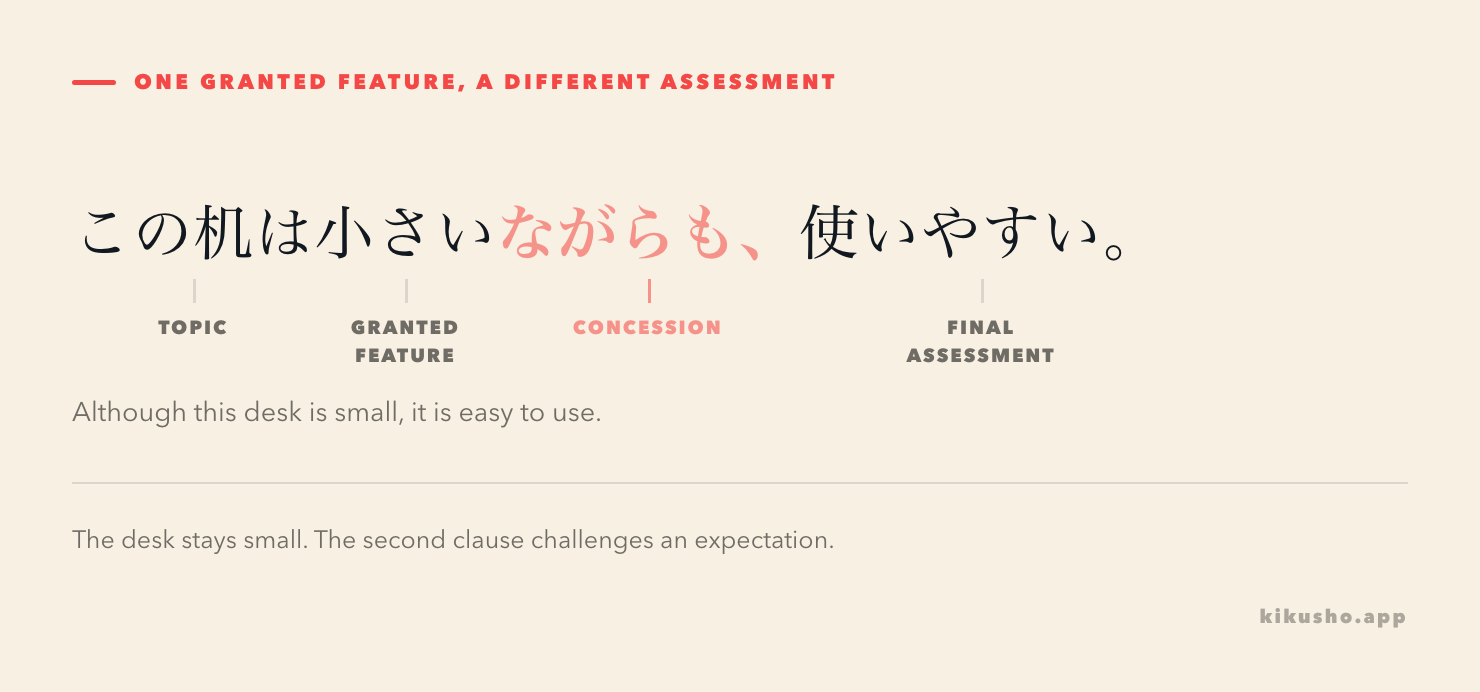
この机は小さいながらも、使いやすい。
このつくえは ちいさいながらも、つかいやすい。
Although this desk is small, it is easy to use.
Smallness might suggest an awkward workspace. The second clause gives a favourable assessment instead. Both facts remain true; the speaker is not correcting 小さい.
この町は不便ながらも、静かで住みやすい。
このまちは ふべんながらも、しずかで すみやすい。
Although this town is inconvenient, it is quiet and pleasant to live in.
Here the inconvenience is a disadvantage that does not settle the whole assessment. A good outcome can follow ながらも; the grammar does not require the second clause to be negative.
彼は初心者ながらも、落ち着いて話していた。
かれは しょしんしゃながらも、おちついて はなしていた。
Despite being a beginner, he was speaking calmly.
彼は規則を知っていながらも、守らなかった。
かれは きそくを しっていながらも、まもらなかった。
Although he knew the rules, he did not follow them.
The last example has an unfavourable outcome. Knowledge would normally support compliance, but his behaviour goes against that expectation. The past tense is carried by 守らなかった; there is no need to put 知っていた immediately before ながらも.
Bare ながら can already carry the contrast
Compare these original sentences:
| Sentence | Reading | Meaning |
|---|---|---|
| 彼は規則を知りながら、守らなかった。 | かれは きそくを しりながら、まもらなかった。 | Although he knew the rules, he did not follow them. |
| 彼は規則を知りながらも、守らなかった。 | かれは きそくを しりながらも、まもらなかった。 | Although he knew the rules, he did not follow them. |
The concession survives when も is absent. Shogakukan’s Digital Daijisen entry for ながら distinguishes its simultaneous and concessive uses; the latter is not defined as requiring も.
By contrast, 音楽を聞きながら絵を描いた。(おんがくを ききながら えを かいた。)means “I drew a picture while listening to music.” Those two actions overlap in time. There is no necessary conflict between them. The N4 lesson on simultaneous ながら covers that separate use.
Adding も to an overlap sentence introduces an “even while / although” interpretation. It does not merely add another activity. Ask what expectation the second clause challenges; if there is none, ordinary simultaneous ながら is usually the intended form.
States are common, but actions are not banned
Knowing, feeling and being a certain way often provide the background for concession. That makes 知りながらも and 知っていながらも useful models. It does not establish an absolute rule that an action verb cannot occur here:
毎日練習しながらも、まだ上手に弾けない。
まいにち れんしゅうしながらも、まだ じょうずに ひけない。
Even though I practise every day, I still cannot play well.
Practising is an action, but the sentence contrasts continued effort with a skill that has not developed as expected. In their study of Japanese concessive inferences, Kubota and colleagues explain that predicate type alone does not settle the reading of bare ながら (§2.2); they also use ながらも to make a concessive relation explicit (§3.2). Read the whole relation rather than applying a states-only filter.
Limits, register and a fixed expression
In the examples above, the first clause grants a fact. It does not mean “if A happens.” For an unfavourable consequence under a condition, the lesson on ~ては and ~たら in warnings addresses a different relationship.
Bunpro labels ながらも standard register. It can describe favourable or unfavourable contrasts without itself conveying an insult or politeness. The compact construction is useful in explanations; in a relaxed remark about the desk, 小さいけど、使いやすい。(ちいさいけど、つかいやすい。)is also natural: “It’s small, but easy to use.” For other written ways of granting a point, compare ものの and とはいえ.
Keep 残念ながら(ざんねんながら), “unfortunately,” as its own familiar expression:
残念ながら、今日は店が休みです。
ざんねんながら、きょうは みせが やすみです。
Unfortunately, the shop is closed today.
You do not need to add も to produce that everyday meaning. It is not the same teaching problem as contrasting two facts with ながらも.
Where this lesson sits
JLPT Sensei and Bunpro both estimate N3 for ながらも. Jonathan Waller’s Tanos also includes the surface form in its N1 grammar list, on the final page. That list gives no explanation establishing which particular use it intends. This lesson follows the N3 placement for concession while preserving the disagreement. The official JLPT FAQ explains why these reference labels should not be treated as an exhaustive official syllabus.
Original practice
Six questions test attachment, clause meaning and connected text. Choose before scrolling: every answer and explanation is together after Question 6. These are original study questions, not official JLPT items.
Question 1 — grammar choice. Choose what belongs in the blank.
この町は不便( )ながらも、静かで住みやすい。
A. な
B. だ
C. の
D. No added word
Question 2 — grammar choice. Complete the i-adjective.
忙し( )ながらも、毎日友達に電話している。
A. い
B. く
C. な
D. だ
Question 3 — grammar choice. Complete the “being aware” attachment.
彼は規則を知って( )ながらも、守らなかった。
A. いる
B. いて
C. い
D. いた
Question 4 — sentence composition. Use every piece once to make “Although he knew it was wrong, he remained silent.” Which piece goes at ★, the third position?
彼は __ __ ★ __。
A. 黙っていた
B. 知ってい
C. 間違いだと
D. ながらも
Question 5 — grammar choice. Which interpretation fits this sentence?
彼は約束を覚えていながら、何もしなかった。
A. He did nothing because he had forgotten the promise.
B. Although he remembered the promise, he did nothing.
C. He will remember the promise if he does nothing.
D. He made a promise after doing nothing.
Question 6 — text grammar. Choose the continuation that keeps the paragraph’s contrast and meaning.
私は毎日ピアノを練習している。こんなに練習すれば、もっと上手に弾けるはずだと思っていた。しかし、毎日練習しながらも、( )。だから、先生に相談することにした。
A. 今は練習を全くしていない
B. 毎日の練習はまだ始めていない
C. もうどんな曲でも上手に弾ける
D. まだ簡単な曲も上手に弾けない
Helpful readings: 約束(やくそく), 覚える(おぼえる), 黙る(だまる), 間違い(まちがい), 練習(れんしゅう), 弾く(ひく), 曲(きょく), 相談(そうだん). The paragraph’s speaker practises every day, expected better playing by now, and has decided to consult a teacher.
Answers and explanations
Answer 1. D: no added word. 不便ながらも attaches directly to the na-adjective. な belongs before a noun in forms such as 不便な町; だ is the plain copula; の is not the join used here. None should be inserted before ながらも.
Answer 2. A: い. The form is 忙しいながらも(いそがしいながらも), “although busy.” Keep the i-adjective’s final い. 忙しく is an adverbial form; 忙しな and 忙しだ are not valid alternatives for this attachment. The full sentence says the person calls friends every day despite being busy.
Answer 3. C: い. 知っている → 知っていながらも. いる retains the dictionary ending, いて adds the wrong て-form and いた adds a past ending where the stem is required. The past main predicate already places the rule-breaking in the past.
Answer 4. D: ながらも. The order is C → B → D → A: 彼は間違いだと知っていながらも、黙っていた。(かれは まちがいだと しっていながらも、だまっていた。)“Although he knew it was wrong, he remained silent.” 間違いだと supplies what he knew; 知ってい takes ながらも; 黙っていた completes the main clause. Putting the connector before its stem or splitting that attachment cannot produce the requested sentence.
Answer 5. B. 覚えていながら means “although remembering” here: remembering a promise would normally support acting on it, yet he did nothing. A reverses 覚えている into forgetting; C invents a future condition; D invents an event sequence. The concessive reading does not need も.
Answer 6. D: まだ簡単な曲も上手に弾けない. “I still cannot play even simple pieces well.” This preserves the contrast between daily practice and an expected improvement that has not happened. A contradicts current daily practice; B denies that daily practice has begun, contradicting the opening sentence; C reports complete success instead of the shortfall introduced by しかし and ながらも. The ending then gives the response: consulting a teacher.
Common questions
What does nagaramo mean in Japanese?
ながらも expresses concession: although or despite. It acknowledges one fact while giving another that challenges the expectation associated with it. For example, 小さいながらも使いやすい means small but easy to use.
Is も required for the although meaning?
No. ながら alone can also express concession, especially with states such as knowing. It can separately express simultaneous actions. Read the relation between the clauses; も makes the concessive reading explicit.
Is ながらも N3 or N1 grammar?
JLPT Sensei and Bunpro place it at N3, while Jonathan Waller’s Tanos N1 list also contains the written form. Kikusho teaches its concessive use here in the N3 sequence. These are reference estimates, not an official exhaustive JLPT syllabus.