On this page
うちに (uchi ni) often presents a continuing condition as a chance to act before it changes; 間に (aida ni) places an event within a period. Both can translate as “while,” and うちに also allows a change that arises as an activity continues.
This N3 grammar comparison teaches うちに and 間に, including the earlier-level foundation of 間に. The useful distinction is how you frame the time, rather than whether the English sentence happens to contain “while.”
Ask what the preceding situation contributes to the sentence
Find the part before the marker, then ask two questions:
- Does it describe a condition whose ending would matter to the action?
- Does it simply supply a stretch of time in which an event occurs?
For a photograph taken before daylight disappears, 明るいうちに makes the remaining light relevant. For a visit to the bank during a lunch break, 昼休みの間に identifies the period containing the visit. These are useful starting points, not a rule that divides every sentence into two exclusive boxes.
JLPT Sensei’s うちに explanation foregrounds using an opportunity. Its separate 間に explanation includes both deliberately using an interval and events outside the speaker’s control.
うちに makes a changing condition relevant to your action
空が明るいうちに、庭の写真を撮ろう。
そらが あかるいうちに、にわの しゃしんを とろう。
Let’s photograph the garden while the sky is still light.
The proposed action uses the light available now. When it gets dark, the situation for that photograph changes. There is no need to specify the minute at which daylight ends.
A quiet room supplies another opportunity:
部屋が静かなうちに、録音しましょう。
へやが しずかなうちに、ろくおんしましょう。
Let’s make the recording while the room is still quiet.
This is standard Japanese, suitable for a polite suggestion as well as a plain statement. The ending しましょう is polite; the inner modifier is 静かな, not 静かです. “While you still can” is a useful English paraphrase for this use, but it need not imply panic or imminent danger.
A negative verb can describe a condition that still holds:
売り切れないうちに、パンを買っておこう。
うりきれないうちに、パンを かっておこう。
Let’s buy the bread before it sells out.
売り切れる means “sell out.” Its negative 売り切れない supplies the not-yet-sold-out window. The context here is available bread that may run out, rather than a prediction that it will never sell out. Mango Languages’ section on negative うちに explains this “while the change has not happened” interpretation.
間に locates an event without making it accidental or instantaneous
昼休みの間に、銀行へ行った。
ひるやすみの あいだに、ぎんこうへ いった。
I went to the bank during my lunch break.
The trip belongs inside the break. You may have chosen it deliberately, and walking to the bank takes time. 間に does not require an accidental event or a mathematically instantaneous action.
It also works for an event nobody planned:
妹がシャワーを浴びている間に、停電した。
いもうとが シャワーを あびている あいだに、ていでんした。
The power went out while my younger sister was taking a shower.
Showering establishes the interval. The outage occurs within it. The sentence does not say which minute of the shower it happened, nor that showering caused it. Bunpro’s ている間に page explicitly allows events that are related only by their timing.
Think “an event inside the span.” That differs from insisting that an unchanged state lasted throughout the entire span, for which 間 without に is a common neighbouring pattern. This brief comparison does not teach every use of bare 間. Nor should “an event” become “exactly one indivisible instant”: the Japanese-language education encyclopedia’s discussion, printed pages 210–211, permits duration and repetition in appropriate 間に clauses.
The joins are shared, but the preceding clause must supply a span
| Input | Before うちに | Before 間に |
|---|---|---|
| Noun: 休み, a break | 休みのうちに | 休みの間に |
| Na-adjective: 元気, well | 元気なうちに | 元気な間に |
| I-adjective: 安い, inexpensive | 安いうちに | 安い間に |
| State verb: いる, be present | いるうちに | いる間に |
| Ongoing activity: 待っている, be waiting | 待っているうちに | 待っている間に |
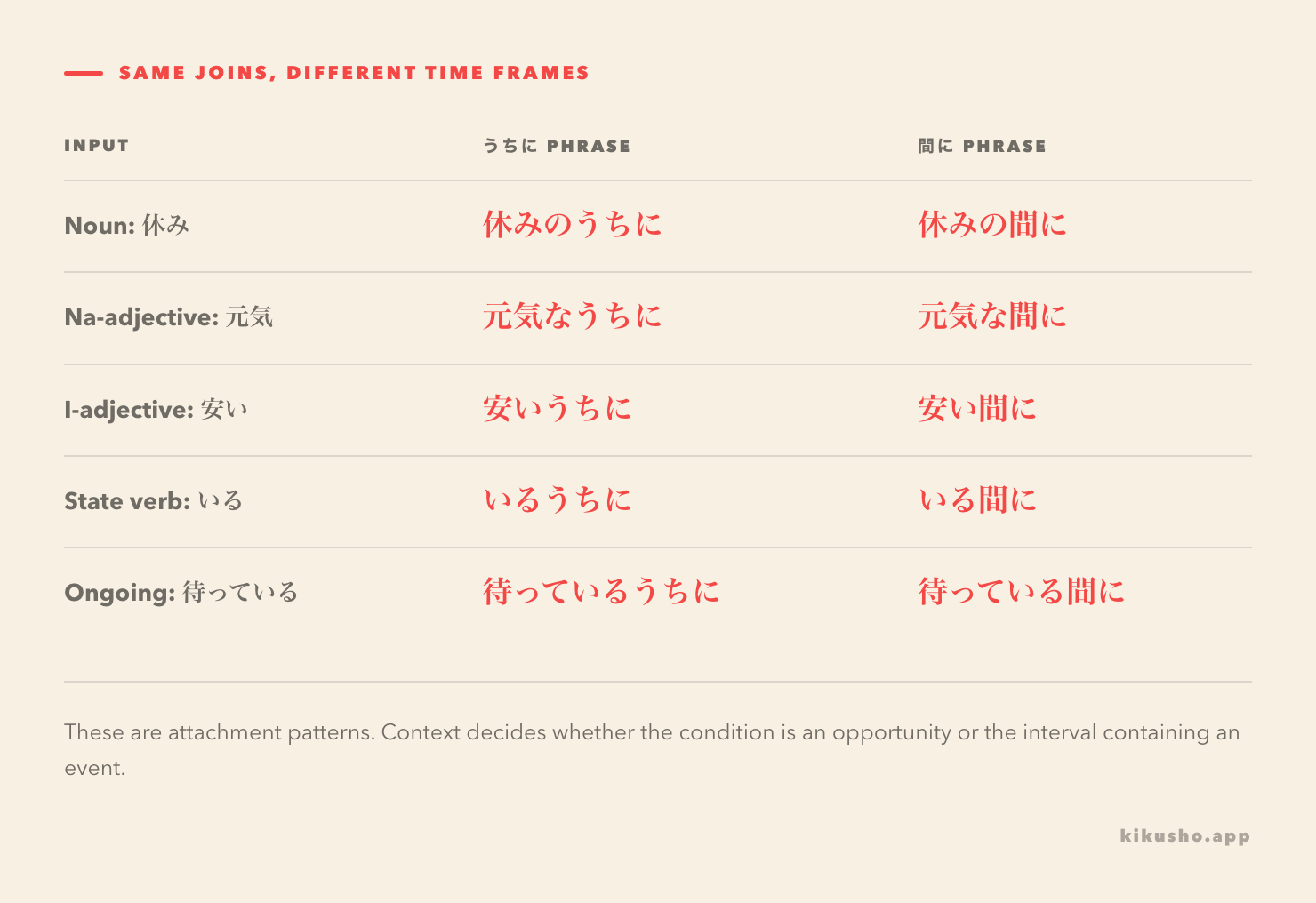
The table shows attachment, not a guarantee that every form fits every context equally well. A temporary low price, for example, can be an opportunity to buy before it rises or the period within which a purchase occurred.
These endings follow modifiers. Do not carry a noun’s sentence-final だ into 休みだ間に, or replace a na-adjective’s な with の in 静かのうちに. The previous section lesson on という and clause content uses a different join: 先生だという話 contains a complete statement. Here the noun connects through の and the na-adjective through な.
Use a verb that supplies duration or a continuing state. 待っている gives you an ongoing wait; a dictionary form such as いる already describes a state. Attaching a time-window marker to an isolated arrival does not automatically create a usable interval. If you mean “before arrival,” make that relation explicit rather than treating “while” as a universal connector.
The inner clause also need not switch mechanically to past tense because the final verb is past. In 妹がシャワーを浴びている間に、停電した, 浴びている describes the shower in progress at the point of the story, and 停電した reports the outage. Choose the form for the situation you describe. Bunpro’s general 間に formation and うちに formation corroborate the basic joins.
うちに also allows a change you did not set out to produce
説明を何度も聞いているうちに、少しずつ分かってきた。
せつめいを なんども きいているうちに、すこしずつ わかってきた。
As I kept listening to the explanation, I gradually began to understand.
Here the listener’s understanding develops while the listening continues. There is no instruction to seize a deadline. 少しずつ supplies “gradually”; うちに alone does not promise that every change is slow, inevitable or caused by the activity.
A shorter version exposes the parts:
話を聞いているうちに、分かってきた。
はなしを きいているうちに、わかってきた。
As I kept listening to the account, I began to understand.
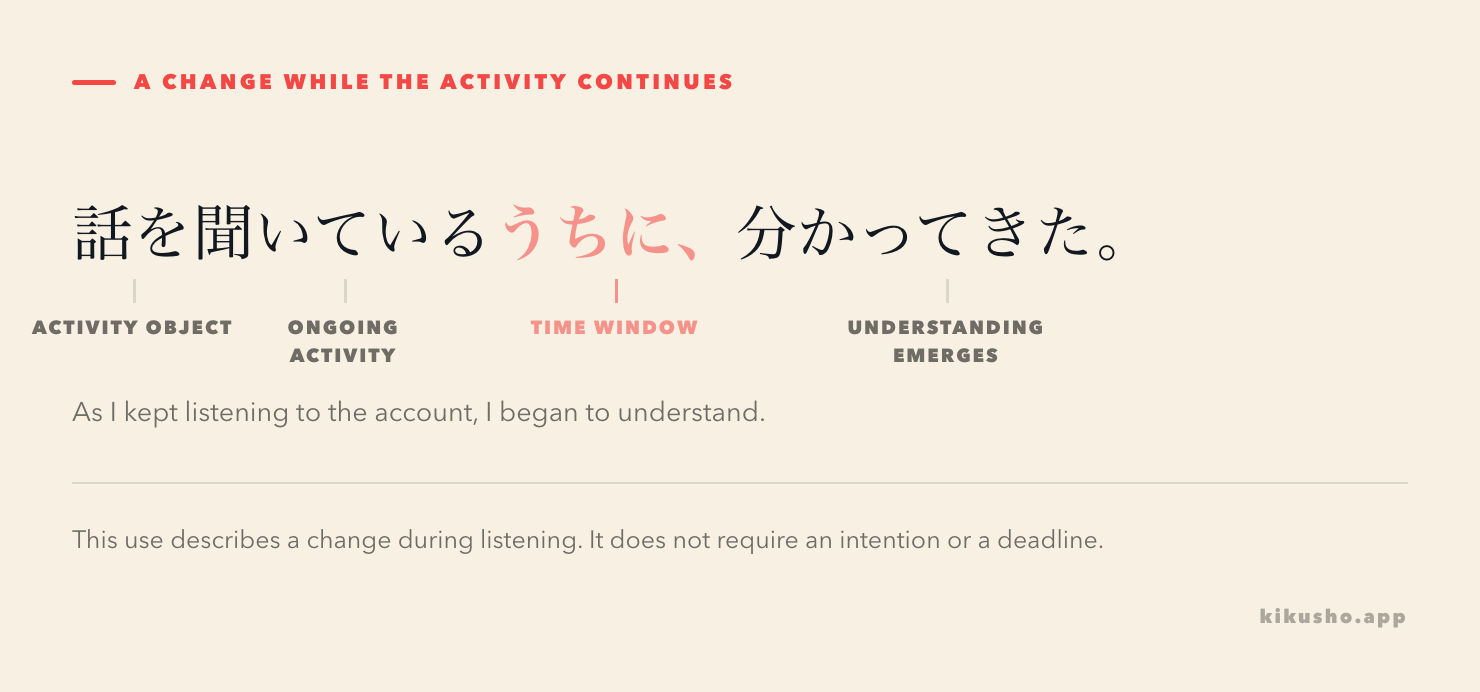
Hikari’s authored lesson includes growing feelings during a conversation. Bunpro also gives an unplanned change while eating. These examples prevent the useful opportunity explanation from becoming a false rule that the main clause must always express an intention.
Where both fit, preserve the event and notice the framing
Compare these in a context where the speaker took a short rest break:
休憩しているうちに、メールを送った。
きゅうけいしているうちに、メールを おくった。
I sent an email while taking a break.
休憩している間に、メールを送った。
きゅうけいしている あいだに、メールを おくった。
I sent an email during my break.
Both can describe the same voluntary act. うちに can present the break as the available chance before work resumes; 間に places the email within the break. It would be misleading to mark 間に wrong merely because sending an email was intentional.
Overlap extends to changes that occur during an activity. Shioiri Sumi’s encyclopedia section accepts both markers in a sentence about becoming sleepy while watching television. So “a change developed” is not, by itself, a test proving that 間に is impossible. Context and the speaker’s chosen frame still matter.
These patterns can also have different actors in the two clauses. They are not the same construction as simultaneous ながら. The two-action ながら lesson follows that distinction; do not impose its basic same-actor condition on every Japanese equivalent of “while.”
Keep the source levels visible
JLPT Sensei places うちに at N3 and 間に at N4. Bunpro’s うちに page is N3; its general の間に page is N3, while its narrower ている間に page is N4. The inspected bodies overlap in the basic interval use, but segment it differently. This lesson remains N3 and retains 間に as an N4 foundation in our inventory. The levels are reference estimates; the official JLPT FAQ explains why there is no exhaustive official item list.
The N4 time-word lesson supplies the vocabulary behind 内 and 間. Recognising their dictionary meanings helps, but it does not decide which sentence frame you need.
For 録音(ろくおん), “recording,” the quiet-room sentence gives the reason timing matters. If that word is new when you hear it, Kikusho’s voice capture can draft its card. Keep the room’s condition in your example, and inspect the editable reading and explanation before saving. A card headed only “recording” would lose the opportunity expressed by 静かなうちに.
Original practice
Try all six questions before the shared answer block. The exercises are original and demonstrate grammar choice, sentence composition and grammar in a connected passage.
Question 1 — grammar choice. Complete the ordinary modifier for “while the room is still quiet.”
部屋が静か( )うちに、録音しましょう。
A. の
B. な
C. だ
D. に
Question 2 — grammar choice. Link the noun 昼休み, “lunch break,” to 間に.
昼休み( )間に、銀行へ行った。
A. な
B. だ
C. の
D. で
Question 3 — grammar choice. The bread has not sold out yet. Choose the form that gives the chance to buy it before that changes.
売り切れ( )うちに、パンを買っておこう。
A. た
B. ない
C. ます
D. て
Question 4 — grammar choice. In the short-break context, compare 休憩しているうちに、メールを送った and 休憩している間に、メールを送った.
A. Only the first is possible because the email was intentional.
B. Only the second is possible because うちに cannot follow ている.
C. Both must describe a change that occurred without anyone acting.
D. Both can fit; the first can foreground the chance, the second the interval.
Question 5 — sentence composition. Use every piece to make “Let’s carry the luggage before it starts raining.” The ★ marks slot three. Select its fragment while preserving the given opening.
雨が __ __ ★ __。
A. 荷物を
B. 降らない
C. 運ぼう
D. うちに
Question 6 — text grammar. Follow the listener’s move from confusion to understanding. Complete the link within that development.
最初は店員の説明がよく分からなかった。何度も話を聞いている( )、少しずつ分かるようになった。
A. うちを
B. うちと
C. うちに
D. うちが
Readings used in these scenes: 静か(しずか), 録音(ろくおん), 昼休み(ひるやすみ), 銀行(ぎんこう), 売り切れる(うりきれる), 休憩(きゅうけい), 荷物(にもつ), 降る(ふる), 運ぶ(はこぶ), 最初(さいしょ), 店員(てんいん), 説明(せつめい), 何度も(なんども).
Answers and explanations
Answer 1. B: な. 部屋が静かなうちに、録音しましょう。 静か is a na-adjective, so 静かな modifies the time window. の would make it behave like a noun; だ would carry the clause’s declarative ending into this modifier; に does not create the required join. The suggestion uses the quiet that still holds.
Answer 2. C: の. 昼休みの間に、銀行へ行った。 A noun joins to 間 through の. な is the na-adjective connection, not the one for 昼休み. だ and で do not form this ordinary interval phrase. The trip occurred during the break and may have been quite deliberate.
Answer 3. B: ない. 売り切れないうちに、パンを買っておこう。 The negative form means the sell-out has not yet happened, leaving a chance to buy. 売り切れた would describe a completed sell-out and loses the requested available-bread condition. ます changes the clause to a polite form rather than supplying the requested negative; bare て does not give a complete predicate before うちに.
Answer 4. D. The clauses describe sending an email within a short break. The opportunity frame of うちに is available, and 間に can locate a voluntary action. A invents a ban on intentional action. B rejects a normal ている attachment. C contradicts the explicit action メールを送った; neither marker requires every event to be unplanned.
Answer 5. A: 荷物を. Order B → D → A → C: 雨が降らないうちに、荷物を運ぼう。 “Let’s carry the luggage before it starts raining.” 雨が belongs with 降らない; うちに marks the condition that still holds, and 荷物を supplies the object of 運ぼう. Putting the luggage inside the rain clause does not preserve that structure. The third position is 荷物を.
Answer 6. C: うちに. 何度も話を聞いているうちに、少しずつ分かるようになった。 The first sentence establishes an initial lack of understanding; the second describes a change during repeated listening. 少しずつ specifies its gradual nature. を, と and が do not mark the time window for this change in understanding. This choice does not mean that 間に would always be wrong in a comparable context; it was not one of the offered alternatives.
Common questions
What is the difference between うちに and 間に?
うちに often presents a continuing condition as a chance to act before it changes. 間に places an event within a period. They overlap in some contexts, and うちに also allows a change that arises while an activity continues.
Can 間に describe something done deliberately?
Yes. 昼休みの間に、銀行へ行った means that the speaker went to the bank during their lunch break. 間に locates the trip within that interval; it does not make the trip accidental.
What goes before うちに and 間に?
Use の after a noun, な after a na-adjective, and attach the marker directly to a plain i-adjective or verb predicate: 休みのうちに, 静かな間に, 安いうちに and 待っている間に. The preceding situation must provide a meaningful time span.