On this page
Use 代わりに(かわりに) when one person, thing or action fills another's place, or when one benefit balances a cost. Use Nに代わって/Nに代わり when someone takes over a role, speaks for a group, or a new system succeeds an old one. The forms overlap for a human proxy, but only 代わりに has the full range of “instead of,” “in exchange for” and “on the other hand.”
Start with the relationship, not the English gloss
Both patterns can translate as “instead of” or “in place of,” so the English phrase alone cannot choose for you.
| Intended relationship | Natural pattern | Example |
|---|---|---|
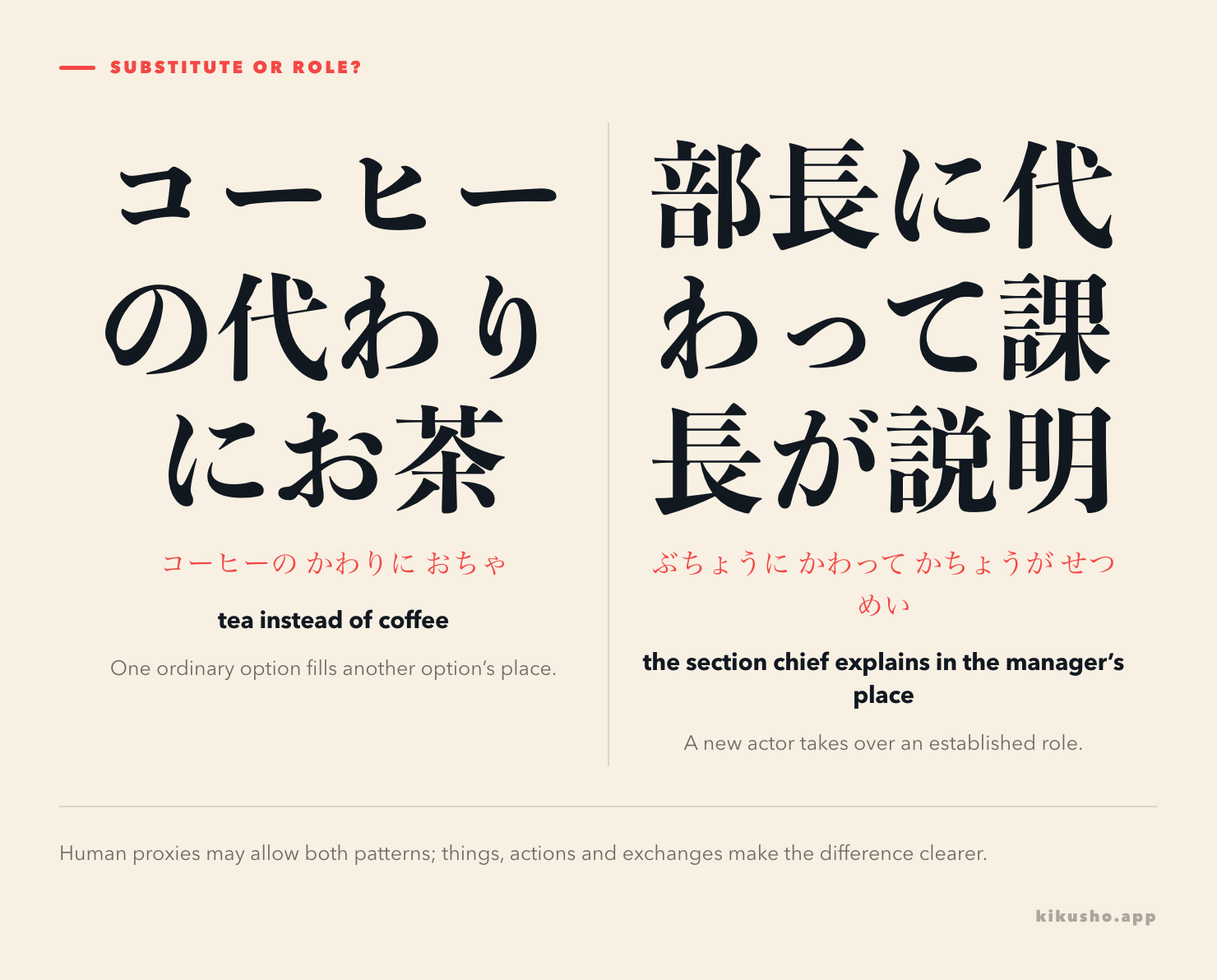
| ordinary substitute for a thing | Nの代わりに | コーヒーの代わりにお茶を飲む |
| alternative to an action | V代わりに | 電話する代わりにメールを送る |
| reciprocal return or trade-off | clause + 代わりに | 手伝ってもらう代わりに夕食をおごる |
| act in another person's role | Nに代わって | 部長に代わって説明する |
| represent a group | Nに代わって | クラスに代わって礼を言う |
| formal succession | Nに代わり | 紙の申請書に代わりオンライン申請を使う |
今朝はコーヒーの代わりに、温かいお茶を飲みました。
けさは コーヒーの かわりに、あたたかい おちゃを のみました。
This morning I drank hot tea instead of coffee.
欠席した部長に代わって、課長が計画を説明しました。
けっせきした ぶちょうに かわって、かちょうが けいかくを せつめいしました。
The section chief explained the plan in place of the absent department head.
The tea is simply the chosen substitute for another drink. The section chief takes over a role that normally belongs to the department head. That role-centered reading makes に代わって particularly common in announcements, meetings and formal service language.
代わりに accepts a complete attributive form
代わり is a noun, so the material before it modifies that noun. The attachment changes with the word class.
| Before 代わりに | Attachment | Example |
|---|---|---|
| noun | N + の + 代わりに | 電話の代わりにメールを使う |
| plain verb | V + 代わりに | 電話する代わりにメールを送る |
| い-adjective | Aい + 代わりに | 狭い代わりに家賃が安い |
| な-adjective | Aな + な + 代わりに | 静かな代わりに駅から遠い |
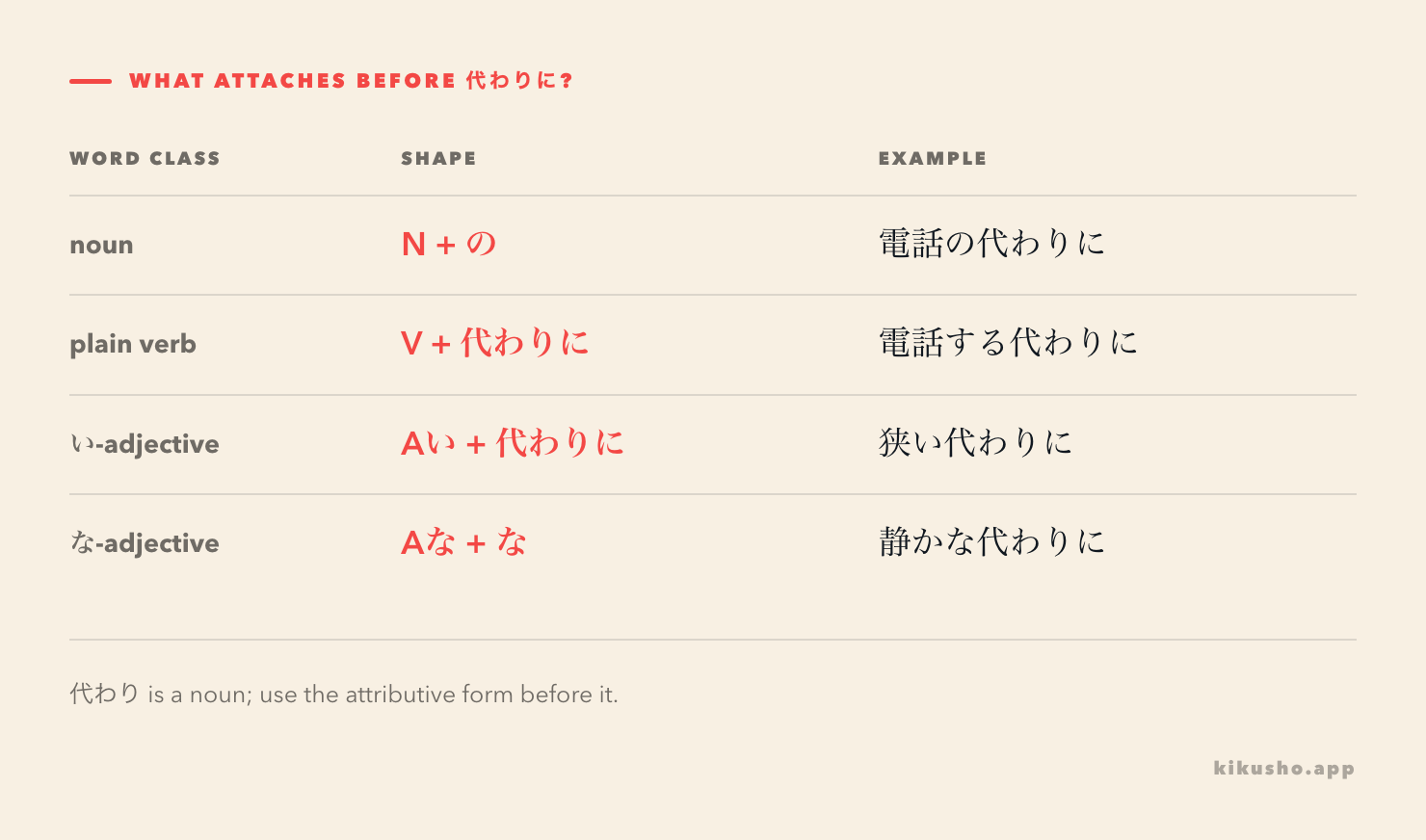
The noun row needs の: 部長の代わりに, not 部長代わりに for the ordinary pattern taught here. A verb attaches directly in plain form: 行く代わりに or 行った代わりに, depending on the relationship and time. A polite ending does not go inside the modifier: use 電話する代わりに, not 電話します代わりに.
JLPT Sensei's 代わりに entry divides the construction into substitution and return or compensation. Bunpro supplies the full verb, adjective and noun attachment set and describes the register as standard.
One substitute can replace a thing, person or action
The broad substitution use asks what would normally occupy the slot and what fills it now.
バターの代わりに、オリーブオイルを使いました。
バターの かわりに、オリーブオイルを つかいました。
I used olive oil instead of butter.
私の代わりに、荷物を受け取ってくれませんか。
わたしの かわりに、にもつを うけとって くれませんか。
Could you receive the package in my place?
車で行く代わりに、電車で行きましょう。
くるまで いく かわりに、でんしゃで いきましょう。
Instead of going by car, let's go by train.
The first replaces an ingredient, the second a person performing a task, and the third a planned action. に代わって cannot simply take over all three frames because it accepts a noun directly and focuses on succession or representation. For a routine choice such as tea instead of coffee, コーヒーの代わりにお茶を飲む is the safe form.
At the start of a new sentence, その代わりに can refer back to an earlier option or loss:
この部屋には庭がありません。その代わりに、大きなベランダがあります。
この へやには にわが ありません。その かわりに、おおきな ベランダが あります。
This room has no garden. Instead, it has a large balcony.
Exchange and trade-off belong to 代わりに
Replacement is not the only relationship. A favor, permission or advantage can be balanced by something given in return.
弟に引っ越しを手伝ってもらう代わりに、夕食をおごることにしました。
おとうとに ひっこしを てつだって もらう かわりに、ゆうしょくを おごる ことに しました。
In exchange for my brother helping me move, I decided to buy him dinner.
The two sides form an exchange: assistance on one side, dinner on the other. This differs from a chronological “after helping” relation. The point is the return or compensation.
Adjectives often create a related balance between an advantage and a disadvantage:
この部屋は狭い代わりに、家賃が安いです。
この へやは せまい かわりに、やちんが やすいです。
This room is small, but in return the rent is low.
このホテルは静かな代わりに、駅から少し遠いです。
この ホテルは しずかな かわりに、えきから すこし とおいです。
This hotel is quiet, but on the other hand it is a little far from the station.
These sentences weigh two sides of the same option. They do not say that “quiet” physically replaces “far.” The exchange logic also connects with favor direction: the あげる, くれる and もらう lesson helps identify who receives the help before 代わりに introduces the return.
に代わって places a new actor in a role
The attachment is simpler and narrower:
noun + に代わって
noun + に代わり
Do not insert の. Compare the overlapping proxy pair:
| Form | Sentence | Focus |
|---|---|---|
| Nの代わりに | 部長の代わりに私が出席します。 | ordinary substitution for the department head |
| Nに代わって | 部長に代わって私が出席します。 | taking the department head's role |
Both can describe the same meeting. The second sounds more role-conscious and formal. A Japanese-teacher comparison at Tanosuke likewise treats proxying, substitution and representation as the center of に代わって, and notes its harder register.
The noun need not be absent. A speaker can represent a whole group:
クラスのみんなに代わって、先生にお礼を申し上げます。
クラスの みんなに かわって、せんせいに おれいを もうしあげます。
On behalf of everyone in the class, I would like to thank the teacher.
No one claims that the classmates have vanished. The speaker is authorized to occupy their collective speaking role.
に代わり raises the register; に代わりまして raises it again
に代わり is the continuative form of 代わる and carries the same core meaning as に代わって. It is common in formal written or announced connections.
市長に代わり、副市長が祝辞を読み上げます。
しちょうに かわり、ふくしちょうが しゅくじを よみあげます。
In place of the mayor, the deputy mayor will read the congratulatory address.
The polite extension に代わりまして suits a formal service response:
山田に代わりまして、私が対応いたします。
やまだに かわりまして、わたしが たいおういたします。
I will assist you in place of Yamada.
These choices affect register, not the underlying identity of the person being replaced. The overview of Japanese politeness helps separate respectful vocabulary around the sentence from the replacement relationship itself.
Systems can succeed systems
に代わって and に代わり also present a new technology, method or system taking the old one's position.
紙の申請書に代わって、オンラインフォームが使われるようになりました。
かみの しんせいしょに かわって、オンラインフォームが つかわれる ように なりました。
Online forms came to be used in place of paper applications.
This is more than choosing one form on one occasion. It describes a shift in what normally occupies the role. A corpus-based teaching study from Bunka Institute of Language, 「代わって」と「代わる」の指導上の留意点, distinguishes this succession from the broader object and action substitutions available to 代わりに. It also shows that simple human proxy sentences can accept both patterns, which is why an absolute “people versus things” rule fails.
The kanji is 代, “substitute or represent,” not 変, “become different.” The 変わる and 変える lesson covers change of state and caused alteration. Here 代わる concerns one participant taking another's place.
When you capture one of these forms in Kikusho, keep both sides. 代わりに alone does not reveal whether the sentence substitutes tea, trades help for dinner or balances low rent against a small room. A full line such as 電話する代わりにメールを送る preserves the attachment and the alternative; 部長に代わって課長が説明する preserves the old role and its new holder. Check the drafted reading and meaning before saving the card.
Level labels are publisher estimates
JLPT Sensei places both assigned patterns at N3, and Bunpro also labels 代わりに and its に代わって comparison N3. Tanosuke teaches にかわって as N3. One current Nihongo Jouzu guide instead files it under N2.
This lesson follows the N3 curriculum placement and records the disagreement. According to the official JLPT FAQ, the organizers stopped issuing fixed vocabulary, kanji and grammar specifications for the revised test. A publisher's level label therefore remains a study estimate rather than an official item assignment.
Decide what occupies the other place
Answer all seven questions before opening the correction block.
Question 1: ingredient substitution. You used soy milk as an ordinary substitute for milk. Which line reports that choice correctly?
- A. 牛乳に代わって豆乳を使いました。
- B. 牛乳の代わりに豆乳を使いました。
- C. 牛乳を代わりに豆乳を使いました。
- D. 牛乳な代わりに豆乳を使いました。
Question 2: attachment. Complete “Instead of calling, I sent an email”: 電話__代わりに、メールを送りました。
- A. する
- B. します
- C. の
- D. に
Question 3: reciprocal meaning. Which sentence clearly presents an exchange?
- A. 先生に代わり、学生が説明した。
- B. 古い機械に代わって、新しい機械が使われている。
- C. 旅行を予約する代わりに、日程を確認した。
- D. 引っ越しを手伝ってもらう代わりに、夕食をおごった。
Question 4: build the proxy sentence. Arrange 欠席した社長, に代わって, 副社長, and 挨拶しました to mean “The vice president gave the greeting in place of the absent president.”
Question 5: repair the attachment. Correct this sentence while keeping the meaning “This apartment is convenient, but in return the rent is high”: このアパートは便利に代わって、家賃が高いです。
Question 6: register. Which form best fits a formal written program announcing that the deputy mayor will read a speech in place of the mayor?
- A. 市長に代わり、副市長が祝辞を読み上げます。
- B. 市長する代わりに、副市長が祝辞を読み上げます。
- C. 市長な代わりに、副市長が祝辞を読み上げます。
- D. 市長を代わって、副市長が祝辞を読み上げます。
Question 7: announcement analysis. Consider this notice: これまで紙の申請書を使っていましたが、来月から紙の申請書に代わってオンラインフォームを使います。操作が苦手な方には、受付の山田に代わり、佐藤が説明します。 Which summary is accurate?
- A. Online forms will succeed paper applications, and Sato will explain in Yamada's role.
- B. Paper applications are given to Yamada in exchange for a lesson from Sato.
- C. Sato will use paper forms instead of learning the online system.
- D. 山田に代わり describes a favorable and unfavorable side of one person.
Answers and explanations
Answer 1. B, 牛乳の代わりに豆乳を使いました. A noun takes の before 代わりに for an ordinary substitute. に代わって can describe a broader succession, but A is not the natural way to report this one choice of ingredient.
Answer 2. A, 電話する代わりに. A plain verb modifies 代わり directly. The polite form belongs at the end of the main clause; の is the noun attachment, and に belongs to a different pattern after a noun.
Answer 3. D. Help with the move and dinner are two reciprocal sides. A and B describe role or system replacement. C lists two actions but does not establish that one is given in return for the other.
Answer 4. 欠席した社長に代わって、副社長が挨拶しました。 The absent president is the role holder being replaced, so the noun phrase attaches directly to に代わって. 副社長 is the new actor marked by が.
Answer 5. このアパートは便利な代わりに、家賃が高いです。 便利 is a な-adjective, so its attributive form before the noun 代わり is 便利な. に代わって cannot attach to an adjective or express this balanced trade-off.
Answer 6. A. に代わり gives the formal connective suited to a written program. B and C apply verb or な-adjective attachment where 市長 is a noun; D uses the wrong particle before 代わって.
Answer 7. A. The first に代わって presents a system shift from paper applications to online forms. 山田に代わり、佐藤が説明します then puts Sato in Yamada's service role. Neither phrase expresses a reciprocal reward or an adjective-style trade-off.
Choose from the complete relationship: の代わりに offers a broad substitute, a plain clause before 代わりに can create an alternative or exchange, and に代わって/に代わり places a new actor or system in an established role.
Common questions
What is the difference between 代わりに and に代わって?
代わりに broadly replaces a person, thing or action and can also mark a reciprocal exchange or balancing trade-off. に代わって follows a noun and focuses on taking over a person's role, representing a group or succeeding an older system, often in more formal language.
Can 代わりに follow a verb?
Yes. Attach it to a plain verb, as in 電話する代わりにメールを送る. It can also follow an い-adjective directly, a な-adjective plus な, or a noun plus の.
What is the difference between に代わって and に代わり?
They express the same core replacement relationship. に代わり is the continuative form and sounds more formal or written; に代わって is the ordinary connective form. に代わりまして is a polite formal extension.
Is this grammar N3 or N2?
JLPT Sensei, Bunpro and Japanese-teacher references place these forms at N3, while at least one current teaching site places にかわって at N2. These are editorial estimates because the JLPT publishes no exhaustive grammar list.