On this page
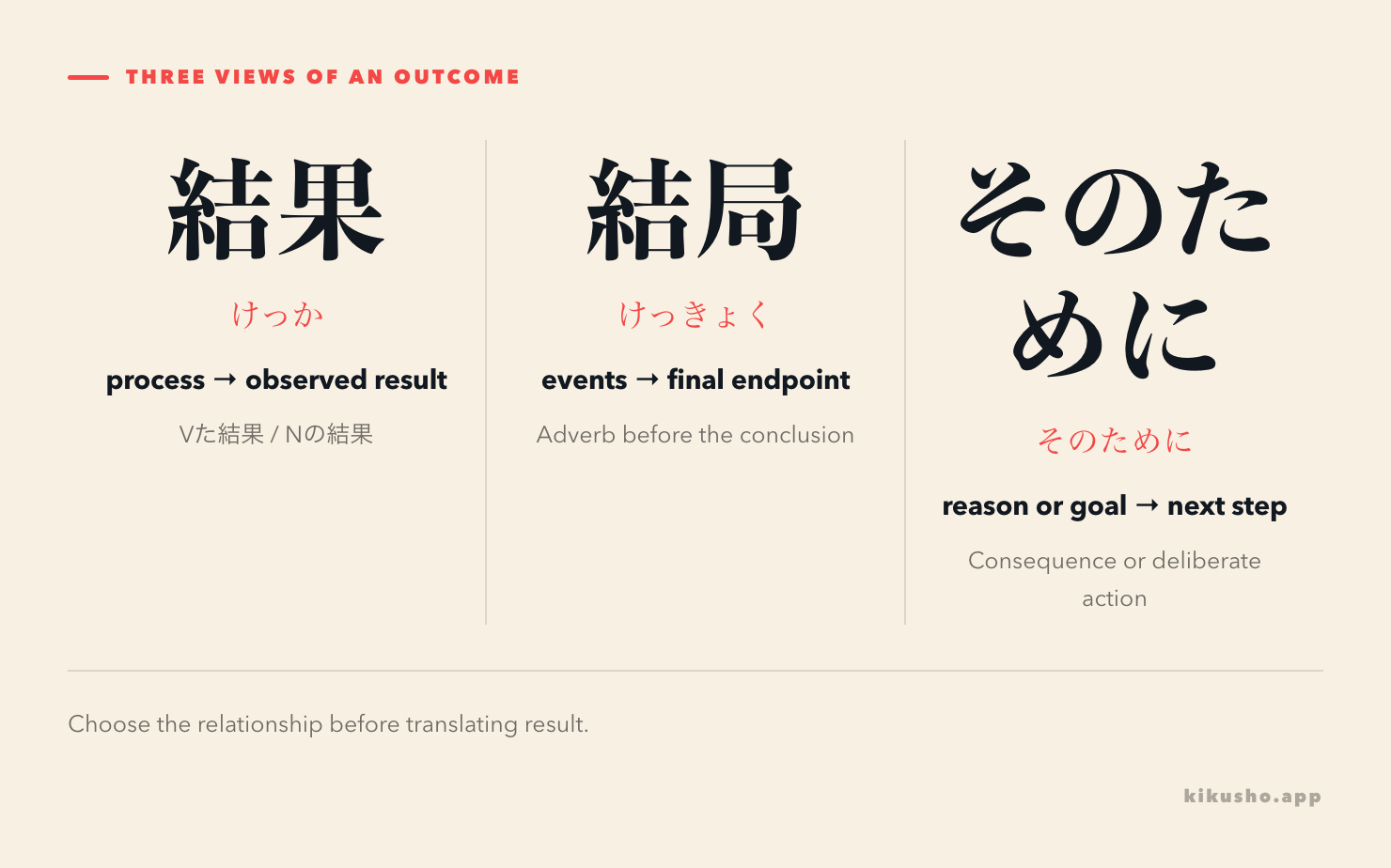
Use Vた結果/Nの結果 to name the process that produced an observed result. Use 結局(けっきょく) to say what finally happened after uncertainty or a series of events, and そのため(に) to carry an earlier reason or goal into the consequence or action that follows.
Three expressions, three views of an outcome
English translations such as “as a result,” “eventually” and “for that reason” overlap. The Japanese sentence structure reveals which relationship the speaker is building.
| What the sentence does | Pattern | Core question |
|---|---|---|
| presents evidence, a process or a decision and its result | Vた結果 / Nの結果 | What produced this result? |
| looks back and announces the final state of events | 結局(は) + conclusion | What happened in the end? |
| points back to a reason or goal and moves forward | そのため(に) + consequence/action | What follows because of, or in pursuit of, that? |
アンケートを分析した結果、利用者の多くが朝に勉強していることが分かりました。
アンケートを ぶんせきした けっか、りようしゃの おおくが あさに べんきょうしている ことが わかりました。
As a result of analysing the survey, we learned that many users study in the morning.
何度も予定を変えましたが、結局、旅行は中止になりました。
なんども よていを かえましたが、けっきょく、りょこうは ちゅうしに なりました。
We changed the schedule several times, but in the end the trip was cancelled.
来年、日本で働きたいです。そのために、毎日会話を練習しています。
らいねん、にほんで はたらきたいです。そのために、まいにち かいわを れんしゅうしています。
I want to work in Japan next year. To that end, I practise conversation every day.
The first sentence reports a finding and identifies its source. The second summarizes the endpoint of a changing situation. The third states a goal, then introduces the action chosen to reach it.
結果 attaches the result to a completed process
結果(けっか) is a noun meaning “result.” In this construction, the material before it identifies what was completed before the result became known.
| Source of the result | Attachment | Example |
|---|---|---|
| action or process | past plain verb + 結果 | 話し合った結果 |
| noun naming a process | noun + の + 結果 | 調査の結果 |
| whole preceding sentence | その結果 | 価格を下げた。その結果、注文が増えた。 |
二つの方法を試した結果、短い復習を毎日続けるほうが効果的でした。
ふたつの ほうほうを ためした けっか、みじかい ふくしゅうを まいにち つづける ほうが こうかてきでした。
After trying two methods, short daily review was more effective.
健康診断の結果、特に問題はありませんでした。
けんこうしんだんの けっか、とくに もんだいは ありませんでした。
The health examination found no particular problem.
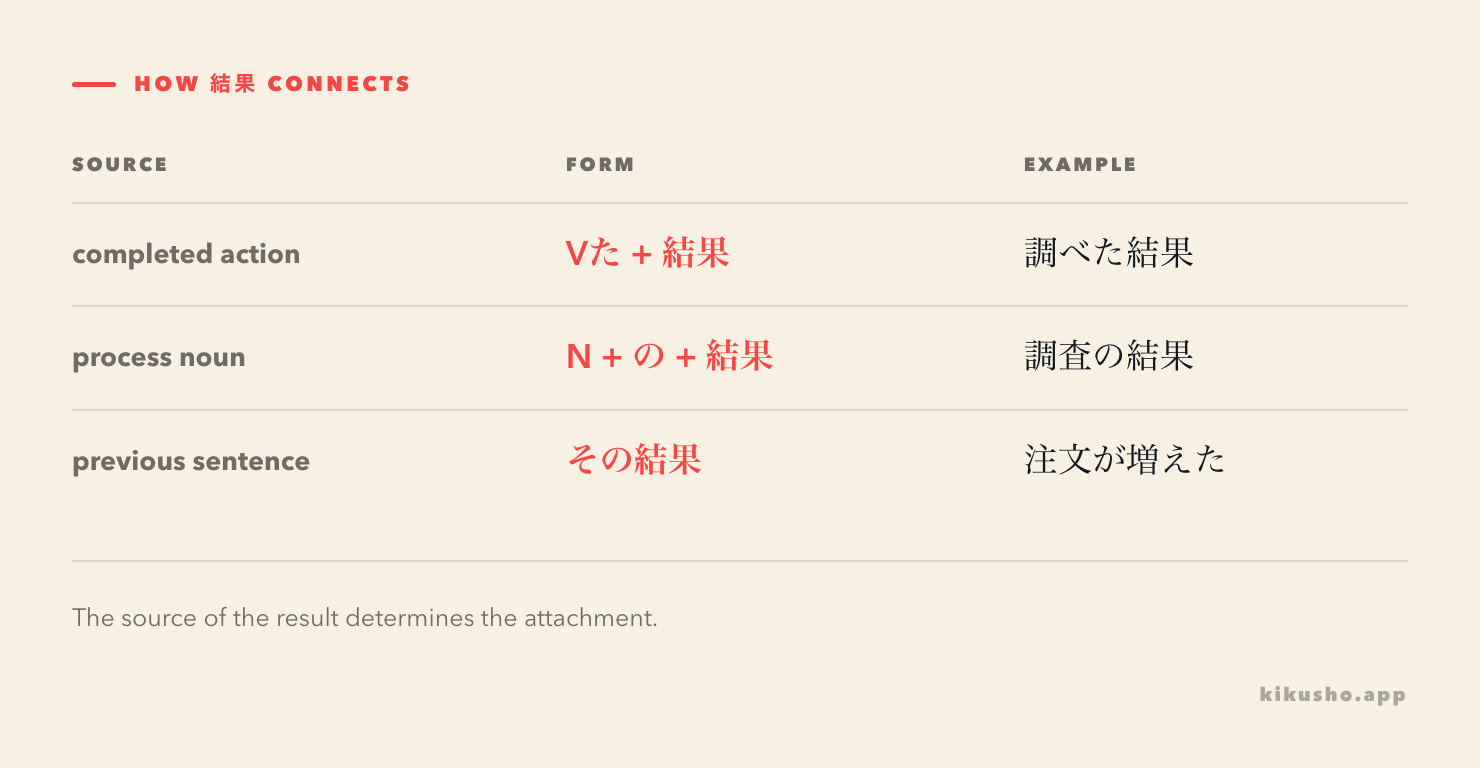
The verb is in the plain past form: 調べた結果, not 調べる結果 for this retrospective construction and not 調べました結果 inside the modifier. A noun needs の. The result itself can be positive, negative or neutral; 結果 does not judge it.
JLPT Sensei's 結果 reference records Vた結果, Nの結果 and sentence-initial その結果. That source places the pattern at N3. Bunpro's current grammar library instead labels 結果・の結果 N2, so the level boundary is an editorial disagreement rather than a difference in attachment.
結局 is the narrator's final endpoint
結局 is an adverb. It does not attach to a preceding verb or noun as 結果 does. It appears before the conclusion and asks the listener to view that conclusion against an earlier path: alternatives considered, attempts made, plans changed or expectations defeated.
三軒の店を見ましたが、結局、何も買いませんでした。
さんげんの みせを みましたが、けっきょく、なにも かいませんでした。
We looked at three shops, but in the end we bought nothing.
電車とバスを比べて、結局は歩いて行くことにしました。
でんしゃと バスを くらべて、けっきょくは あるいて いく ことに しました。
After comparing the train and bus, we eventually decided to walk.
The optional は can add contrast or make “the final answer, at least” more prominent. It does not change 結局 into a noun attachment. 相談した結局 is therefore not the standard equivalent of 相談した結果.
結局 can appear after a cause, but it does not itself mean “because.” In 雨が強くなって、結局、試合は中止になった, the rain supplies the causal background; 結局 selects cancellation as the endpoint. JLPT Sensei's 結局 entry classifies it as an N3 adverb and illustrates both 結局 and 結局は.
そのため(に) carries the previous idea forward
その points back to information already given. ため then frames that information as the reason or purpose relevant to the next clause. There are two common readings.
A prior situation becomes the reason
駅の近くで事故がありました。そのため、電車が遅れています。
えきの ちかくで じこが ありました。そのため、でんしゃが おくれています。
There was an accident near the station. For that reason, the trains are delayed.
The first sentence gives an existing situation; the second gives its consequence. This formal, explicit link is useful in explanations and reports. そのために is also possible in causal use, although そのため is often enough.
A prior goal becomes the purpose
日本語のニュースを読めるようになりたいです。そのために、毎朝短い記事を読んでいます。
にほんごの ニュースを よめる ように なりたいです。そのために、まいあさ みじかい きじを よんでいます。
I want to become able to read Japanese news. For that purpose, I read a short article every morning.
Here the first sentence is not a cause that mechanically produces the reading habit. It is the goal toward which the deliberate action is directed. に makes this purpose reading especially clear; そのためには can introduce a requirement: そのためには、語彙を増やす必要があります — “To do that, you need to increase your vocabulary.”
Bunpro's そのため(に) explanation treats it as N3 and distinguishes its direct reason or purpose link from その結果, which focuses on the resulting condition and cannot introduce an action performed for a goal. JLPT Sensei likewise gives both goal-to-action and reason-to-consequence examples.
Keep その結果 and そのため separate
Both expressions can begin a new sentence after a cause, but they direct attention differently.
毎日、学習時間を記録しました。その結果、夜より朝のほうが集中できると分かりました。
I recorded my study time every day. As a result, I learned that I could concentrate better in the morning.
朝のほうが集中できます。そのため、難しい課題は朝にします。
I concentrate better in the morning. For that reason, I do difficult tasks in the morning.
The first emphasizes a discovered outcome of the experiment. The second uses the known fact as the reason for a present choice. With a goal, only そのために works: 試験に合格したい。そのために勉強する means “I want to pass; I study for that purpose.” Replacing it with その結果 would wrongly present studying as an outcome already produced by wanting.
This cause-to-consequence link is more explicit than the stance distinction between から and ので. Those particles join a reason directly to a clause; そのため can point back across a sentence boundary.
結果 does not require a long, difficult path
調べた結果 can report the output of one completed investigation without saying that it took a long time. That separates it from 末に and あげく, which make a substantial process central; あげく also adds disappointment or frustration.
調べた結果、原因が分かりました。
As a result of checking, we found the cause.
三か月調べた末に、原因が分かりました。
After three months of investigation, we finally found the cause.
三か月調べたあげく、原因は分かりませんでした。
After all those three months of investigation, we still did not find the cause.
結局 can summarize the last two stories, but it would add the narrator's endpoint view rather than name the investigation as the source: 三か月調べたが、結局、原因は分からなかった.
When you save these expressions in Kikusho, keep enough context to recover the relationship. 結果 needs its process and finding, 結局 needs the path that makes the endpoint meaningful, and そのために needs the preceding reason or goal. A complete editable example will test the grammar you meant to learn instead of reducing all three to “result.”
Level labels are study estimates
This curriculum follows JLPT Sensei's N3 placement for the three assigned items. Bunpro agrees on そのため(に) but places its 結果・の結果 grammar point at N2. Dictionaries confirm readings and meanings but do not assign official test levels.
The official JLPT FAQ explains that the revised test no longer publishes exhaustive vocabulary, kanji and grammar specifications. Use the labels to organize study, not as proof that a particular form must appear in one level.
Practice: identify the relationship before the translation
Classify each relationship first, then check the seven solutions in the final section.
Question 1 — grammar choice. A report gives the finding produced by an analysis. Complete: データを分析した( )、利用者が最も多い時間帯が分かりました。
- A. 結局
- B. 結果
- C. そのために
- D. 結果に
Question 2 — final endpoint. You considered several restaurants but eventually ate at home. Which sentence fits?
- A. 店を何軒か調べましたが、結局、家で食べました。
- B. 店を何軒か調べましたが、そのために、家で食べました。
- C. 店を何軒か調べましたが、調査の結果を家で食べました。
- D. 店を何軒か調べましたが、家で食べた結果です。
Question 3 — purpose link. Complete the two sentences: 来年、日本へ留学したいです。( )、今、お金をためています。
- A. 結局
- B. その結果
- C. そのために
- D. 留学の結果
Question 4 — sentence composition. Arrange 調査, の, 結果, 新しい問題が見つかりました to say “The investigation found a new problem.”
Question 5 — repair the attachment. Correct 担当者と相談する結果、日程を変更しました while preserving the meaning “As a result of consulting the person in charge, we changed the schedule.”
Question 6 — consequence or purpose. In which sentence does そのために express a consequence rather than a deliberate purpose?
- A. 医者になりたい。そのために、大学で勉強している。
- B. 電車が止まった。そのために、会議に遅れた。
- C. 日本語を話したい。そのために、会話を練習する。
- D. 海外で働きたい。そのために、資格を取るつもりだ。
Question 7 — connected passage. In チームは三つの案を一週間検討した。__、最初の案を使うことにした。費用を計算した__、その案が最も安いことも分かった, choose the pair that presents the final decision first, then names the calculation as the source of the finding.
- A. そのために / 結局
- B. 結局 / 結果
- C. 結果 / そのために
- D. 結局 / そのため
Answers and explanations
1. B — 結果. 分析した結果 uses the past plain verb before 結果 and identifies the analysis as the source of the finding. 結局 would precede a final conclusion rather than attach to 分析した.
2. A. The restaurant search supplies the path of alternatives and 結局 introduces what happened in the end. Choice B would claim a reason or purpose link that the context does not establish.
3. C — そのために. Studying abroad is the goal, and saving money is the deliberate action taken toward it. その結果 would present saving as an outcome rather than an action for that purpose.
4. 調査の結果、新しい問題が見つかりました。 A noun takes の before 結果. The result clause follows the complete noun phrase.
5. 担当者と相談した結果、日程を変更しました。 The process must appear in the past plain form 相談した. The nonpast 相談する結果 does not fit the retrospective construction taught here.
6. B. The stopped train is an existing cause, and being late is its consequence. In A, C and D, the first sentence gives a goal and the second gives an intentional action directed toward it.
7. B — 結局 / 結果. 結局 looks back over the week of considering three options and announces the final decision. 計算した結果 then attaches the completed calculation to the finding that the chosen plan was cheapest.
Common questions
What is the difference between 結果 and 結局?
Vた結果 and Nの結果 identify the completed process or investigation that produced an observed result. 結局 is an adverb meaning in the end or after all; it looks back over choices, attempts or changing circumstances and states the final outcome.
What form comes before 結果?
Use a past plain verb plus 結果, as in 調べた結果, or a noun plus の結果, as in 調査の結果. その結果 can begin a new sentence and refer back to the preceding event.
Can そのために express both cause and purpose?
Yes. It can mean for that reason when the first sentence gives a cause, or for that purpose when the first sentence gives a goal and the next sentence gives a chosen action. Context determines the relationship.
Are 結果, 結局 and そのために all JLPT N3 grammar?
JLPT Sensei places all three at N3. Bunpro places そのため(に) at N3 but files its 結果・の結果 grammar point at N2. These are publisher estimates because the JLPT no longer publishes an exhaustive grammar specification.