On this page
Choose the seat before you choose the verb. あげる, くれる and もらう all describe a single event, something passing from one person to another, but each one puts a different person in the subject seat of your sentence. That is why the arrow diagrams never quite take: you learn which way each verb points and still get corrected, because the thing that shifts underneath the arrow is who the sentence is about.
So treat these not as three words to memorise but as one transfer seen from three seats. The fix for the mistake everyone makes is to decide whose seat you are speaking from, and let the verb follow.
The three verbs are one event, told from three seats
Picture a present going from a friend to you. The fact does not change across the three verbs: a friend, a present, you. What changes is where you stand to tell it.
Speak as the giver sending something outward and you reach for あげる: 私は弟にお菓子をあげた。("I gave my little brother some sweets.") Speak as someone watching a gift arrive, and the giver stays the subject while the verb becomes くれる: 友達が私にプレゼントをくれた。("A friend gave me a present.") Speak from the receiving end and you take the subject seat yourself with もらう: 私は友達にプレゼントをもらった。("I got a present from a friend.")
Three sentences, one afternoon. English barely marks the difference with "gave" and "got"; Japanese asks you to commit to a seat before the verb will come out right.
The set, seat by seat
The grid below is the whole system on one screen. Read down the subject column, because that is the part that moves and the part the arrows leave out.
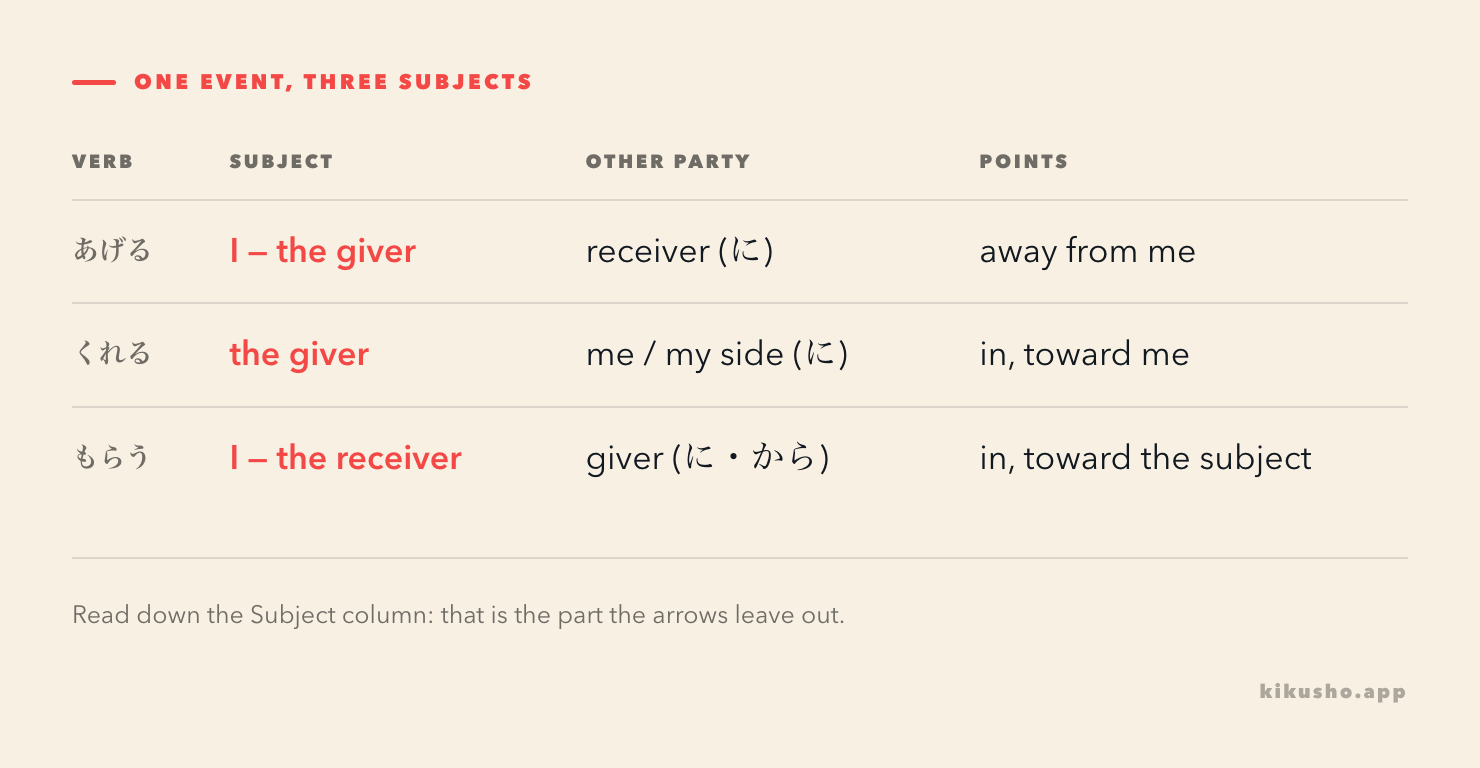
Two rules drop straight out of it. First, くれる only ever points inward, toward you or someone on your side of the conversation. You cannot say ✗友達が私にプレゼントをあげた for a gift that lands in your hands; an incoming gift forces くれた every time, and getting this wrong is the classic tell of a learner. Second, もらう moves the subject onto the receiver and marks the giver with に or から instead: 友達からもらった works just as well as 友達にもらった.
The subject is not always the giver
Here is the trap the diagrams build in. With あげる the subject is the giver, and with もらう the subject is the receiver, so far so tidy. But くれる breaks the pattern: its subject is the giver, yet the verb is only legal when the receiver is you. The giver sits in the subject seat while the sentence is really about a kindness done to you.
Watch one come apart:
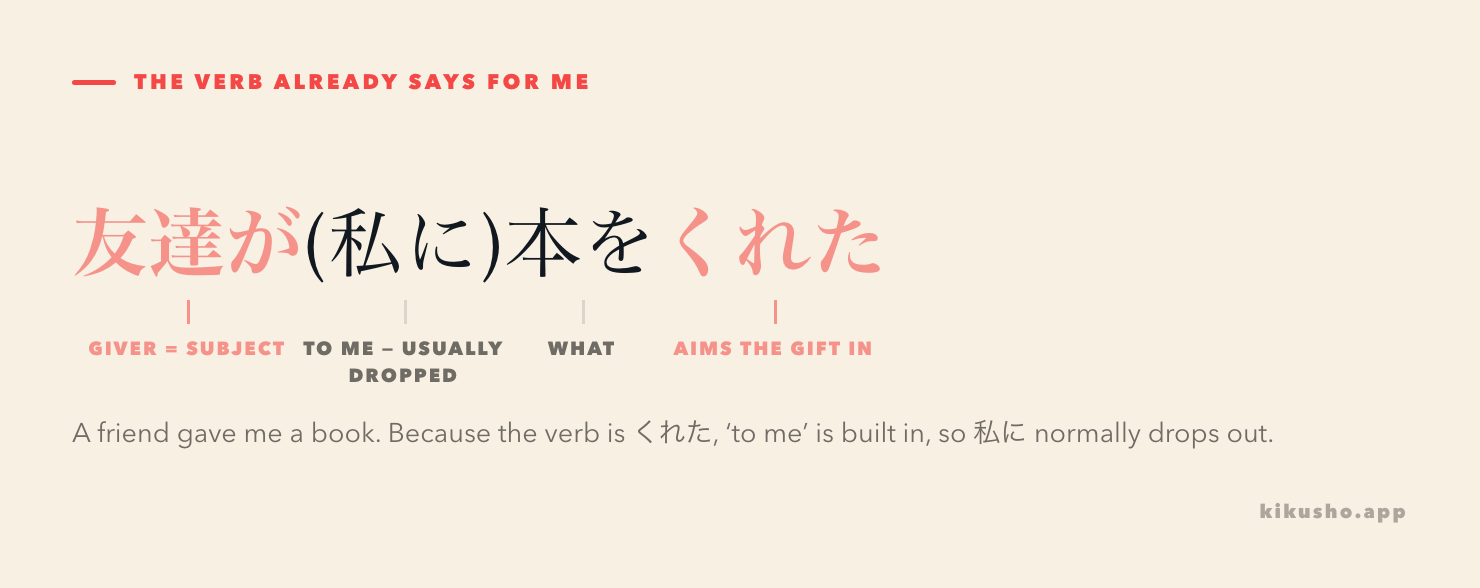
The 私に sits in brackets because you will rarely say it. Once the verb is くれた, "to me" is already carried inside it, and Japanese drops what it has told you once. This is the same dropped subject you meet across the whole language, and knowing which way a verb points is a large part of how a listener fills the blank.
The same three seats, now for actions
Everything so far was about handing over an object. The reason these verbs matter far more than that is that they attach to other verbs, and this is the part most guides stop just short of. Put a verb in its て-form in front of あげる, くれる or もらう and you are no longer giving a thing; you are giving, receiving or doing a favour. The seats do not change.
That て matters. 書いてあげる frames writing as a favour; stem-based 書き上げる reports finished writing. The completion and shared-action lesson separates these attachments and compares completion 上げる with mutual 合う.
私は弟の宿題を手伝ってあげた。("I helped my brother with his homework": the favour goes outward, from me.) 友達が日本語を教えてくれた。("A friend taught me Japanese": the favour comes to me, and the friend is still the subject.) 私は友達に日本語を教えてもらった。("I had a friend teach me Japanese": the same lesson, but now I am the subject, receiving it.)
Look hard at the last two. The same event, a friend teaching me, is told twice and the subject moves:
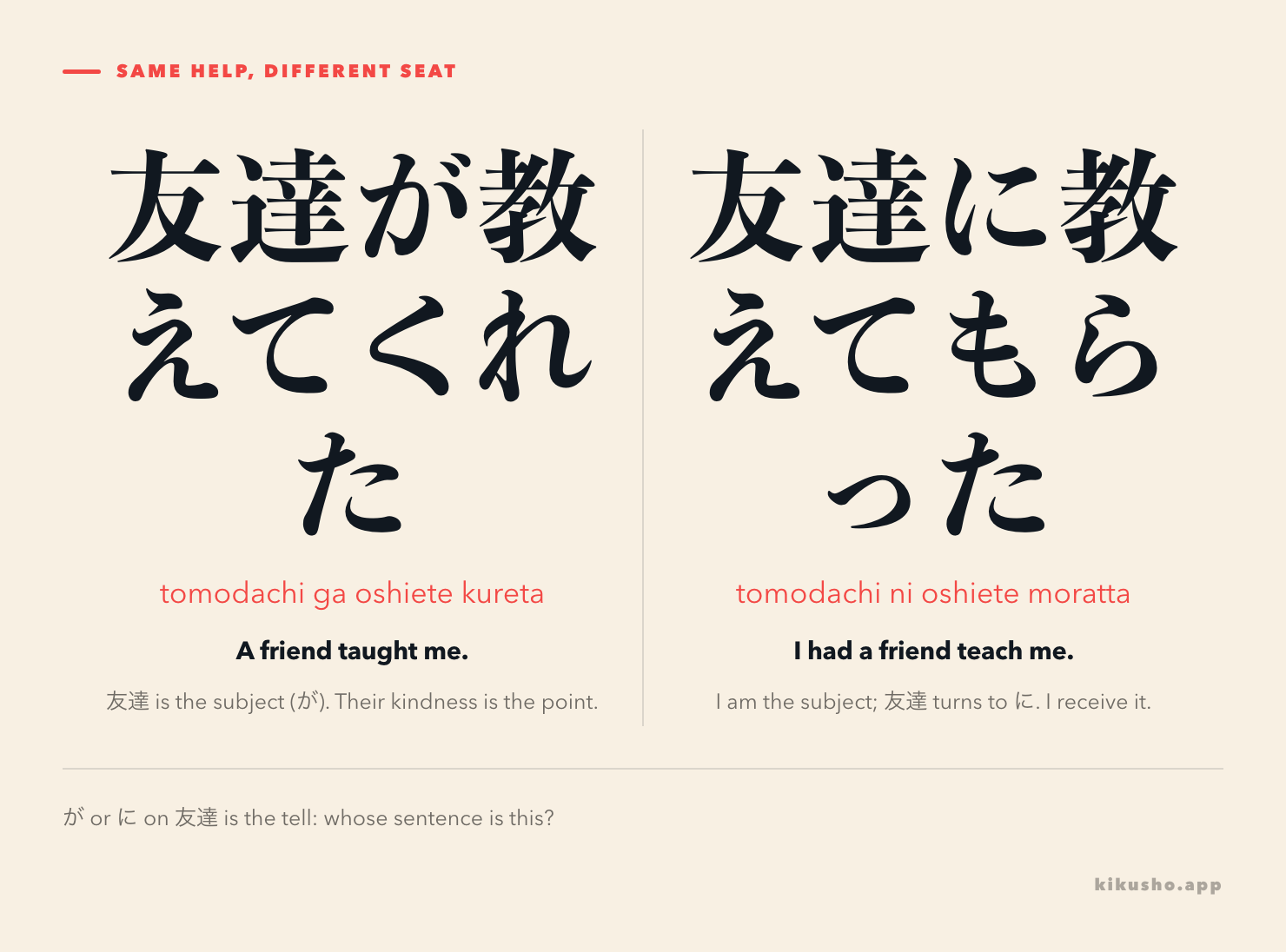
The difference is not meaning; it is seat. 〜てくれる foregrounds the other person's kindness, that a friend did this for me. 〜てもらう foregrounds your receiving it, and often carries a faint sense that you brought it about, that you had someone do it. Pick the one whose subject you want the sentence to be about, just as you did with the bare verbs.
When the point is the speaker's desired action rather than a favour already received, ~てほしい states that wish directly; compare 友達に教えてほしい with 友達に教えてもらった.
One caution on 〜てあげる. Because it announces a favour, saying 手伝ってあげる to someone's face can sound as though you are bestowing a great service. Among friends it is warm; toward a stranger or a superior it grates, and a plain 手伝います is safer.
The forms that break the surface
Three things in this set refuse the tidy rows above, and they are the ones a quick listicle skips.
くれる has an irregular command. Its plain request form is くれ, not the くれろ its verb class would predict: ちょっと待ってくれ。("Wait a second": blunt, casual, and something you will hear more than say.)
The polite versions swap the whole word, not just the ending. Raise the register and each seat takes its own verb:
- あげる becomes さしあげる, humble, for giving to someone above you: 先生にお土産を差し上げた。
- くれる becomes くださる, honorific, for a superior giving to you: 先生が本を貸してくださった。 Its polite form is itself irregular, くださいます rather than くださります, and its command is the ください you already say a hundred times a day.
- もらう becomes いただく, humble, for receiving: 先生に日本語を教えていただいた。
These are the rows the arrow diagrams drop, and they are not ornament: くださる and いただく are the ordinary verbs of a shop, an email and a request. The full six-verb paradigm for handing over an object (each form sourced and drilled) is its own giving-and-receiving vocabulary set; this article is about the favour the て-form lays on top. If the register itself is what trips you, how Japanese politeness fits together works is worth reading before drilling the forms.
やる is あげる aimed downward. For plants, animals and small children you may meet やる in place of あげる: 花に水をやる。("water the flowers.") Aimed at people it sounds rough, so keep it read-only until you know the room.
Which ones you will meet this month
If you are deciding where to spend attention, start with くれる and 〜てくれる. They live inside every thank-you, 来てくれてありがとう ("thanks for coming"), and fumbling them is the quickest way to sound off. もらう and 〜てもらう come next, because asking for things leans on them. And くださる and いただく you will meet on day one of any real errand, spoken at you by staff long before you need to produce them yourself.
さしあげる and やる can wait. You will understand them the moment they appear, and you rarely need さしあげる anyway: offering to do something for a superior is delicate, and a plain polite verb usually serves you better than announcing the favour.
The verbs are never the hard part in a textbook and always the hard part in the street, because a real sentence hands you 送ってくれてありがとう or 貸していただけますか with the direction and the register already baked in, and a dictionary entry for くれる strips exactly that back off. When a line like that passes you in a message or from a clerk, you can paste it into Kikusho or say it aloud, and the card comes back carrying the verb, its reading and the politeness note that records which way the favour points and how high it is aimed. On iPhone the free plan keeps five such captures a day, and reviewing what you have kept is never metered.
Test yourself
Cover the answers and choose the verb.
先生が私に辞書を( )。 あげた / くれた / もらった? くれた. The dictionary comes toward me and the teacher is the subject, so the verb must point inward. あげた would send it away from me; もらった would need me in the subject seat (私は先生に辞書をもらった).
「重い荷物を持って( )てありがとう。」 くれ. A thank-you is for a favour done to you, and 〜てくれてありがとう is the set shape. 〜てあげて would thank yourself, and the giver is the person you are addressing.
部長が資料を貸して( )。(polite; the boss does you the favour) さしあげた / いただいた / くださった? くださった. The boss gives to you, so you need the honorific of くれる. さしあげる is humble giving, from you upward; いただく is humble receiving, which would put you back in the subject seat (部長に資料を貸していただいた).
Common questions
Is やる just a ruder あげる?
Roughly, but with a fixed direction. やる gives downward — to plants, animals or small children — and stands in for あげる there. Aimed at an adult it sounds coarse, so understand it when you hear it and reach for あげる yourself.
Should I use くださる or いただく for a favour from my boss?
Either, depending on whose seat you speak from. くださる keeps your boss as the subject (部長が貸してくださった); いただく makes you the subject receiving it (部長に貸していただいた). Same event, different subject — exactly like くれる and もらう.
How is 〜てもらう different from the passive?
〜てもらう frames the action as a favour you welcomed; the plain passive does not. 日本語を直してもらった means you were glad someone corrected your Japanese, while 日本語を直された ("my Japanese was corrected") can sound neutral or even unwelcome. Reach for 〜てもらう when the action was done for your benefit.