

On this page
なる names what something becomes, 変わる says that something changes, and 変える says that someone changes something. The quickest test is to find the changing thing: if it is the subject, 変わる is likely; if it is the direct object, use 変える.
Five N4 verbs make that choice more useful. 上がる and 増える also present a change happening to the subject, while 下げる presents someone deliberately lowering an object.
One schedule, two views of the same change
Compare these sentences:
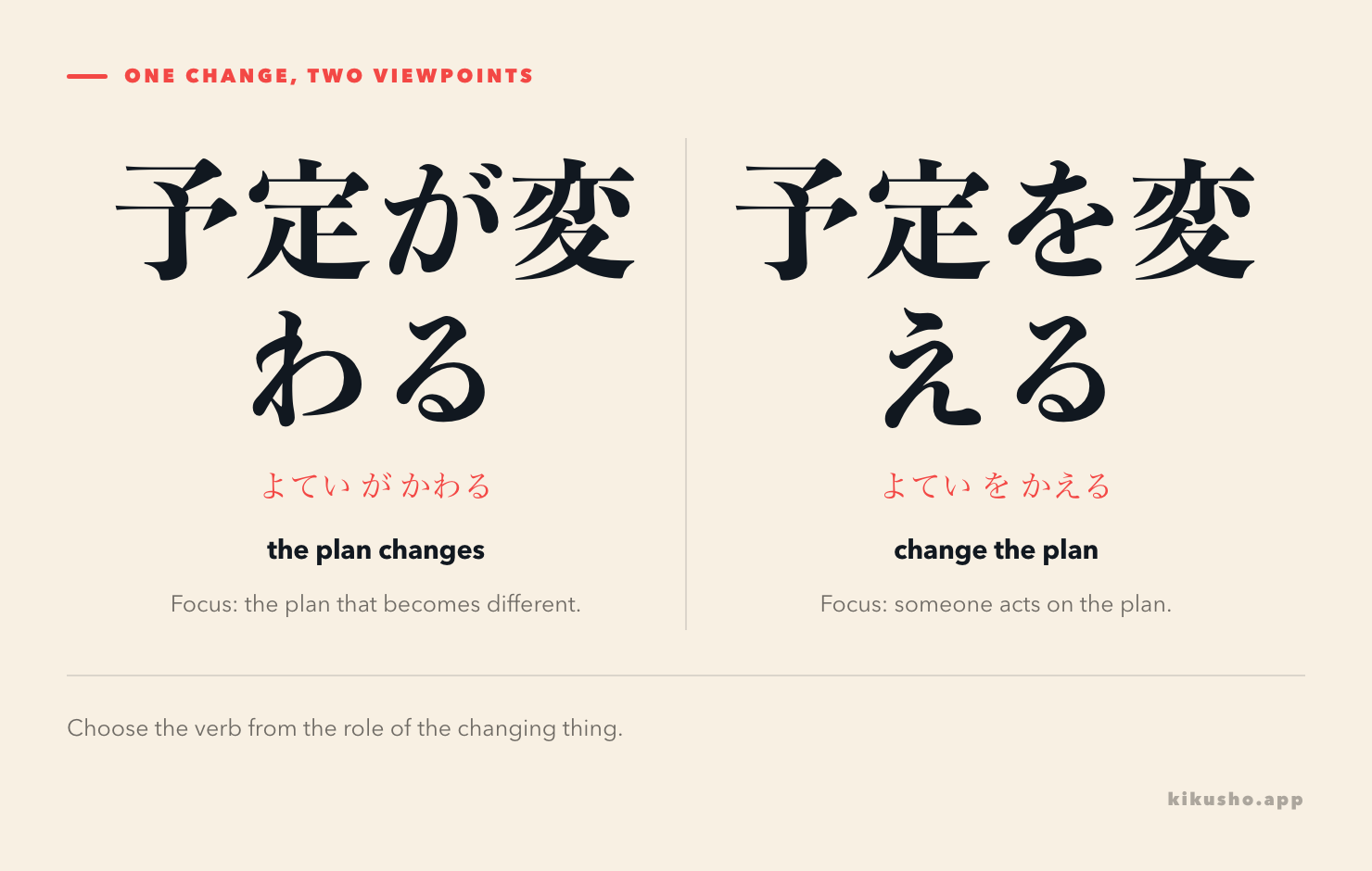
予定が変わりました。 The plan changed.
店長が予定を変えました。 The manager changed the plan.
The event can be the same. The first sentence puts 予定 in the subject role with が and reports the change. The second names the manager as the doer and marks 予定 with を as the thing affected.
The Japan Foundation gives this exact contrast, 予定を変える and 予定が変わる, in its explanation of transitive and intransitive verbs. The choice is about which participant the sentence brings into focus, not whether a human cause exists somewhere in the real world.
Five verbs divide by direction and agency
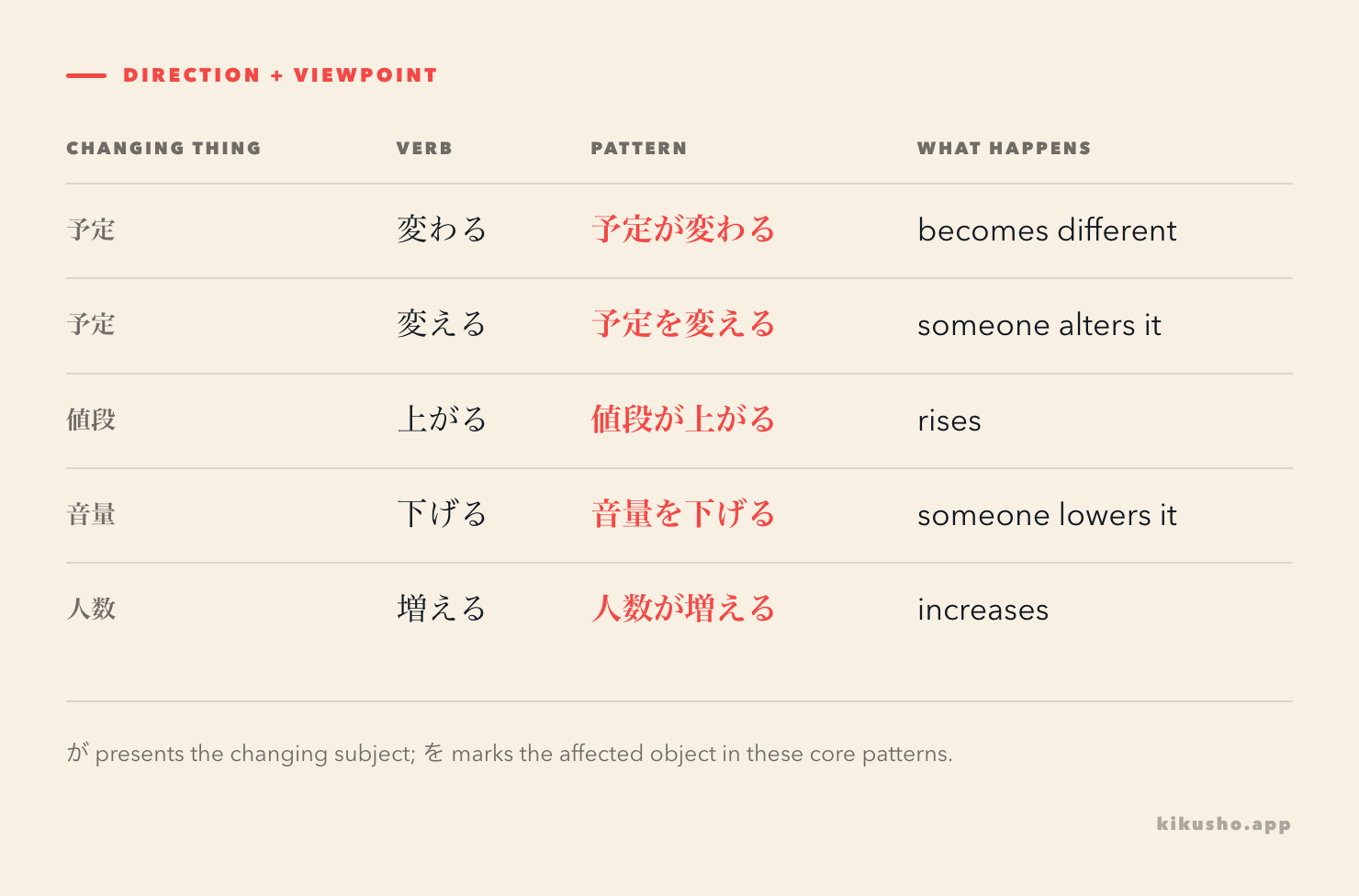
| Word | Reading | Type in this use | Core pattern | Meaning |
|---|---|---|---|---|
| 変わる | かわる | intransitive | Xが変わる | X changes; becomes different |
| 変える | かえる | transitive | Xを変える | change X; alter X |
| 上がる | あがる | intransitive | Xが上がる | X rises; goes up |
| 下げる | さげる | transitive | Xを下げる | lower X; move X down |
| 増える | ふえる | intransitive | Xが増える | X increases; grows in number |
These five are not complete pairs. The usual partner of 上がる is 上げる, the partner of 下げる is 下がる, and the partner of 増える is 増やす. Those neighbours help reveal the system, but the five rows above are the vocabulary reviewed in this lesson.
The University of Texas verb-pair chart places 変える beside 変わる and 上げる beside 上がる, while also pairing 下げる with 下がる. The endings are useful memory aids inside these families. They are not a universal rule: 増える ends in える and remains intransitive.
変わる reports difference; 変える supplies an object
Kanjipedia defines 変わる as a state, position, or quality becoming different from before. That range covers more than a physical transformation:
信号が赤に変わりました。 The light changed to red.
引っ越して、生活が変わりました。 My life changed after I moved.
会議の場所が駅前のホテルに変わりました。 The meeting location changed to the hotel in front of the station.
に can mark the new state or destination. The thing undergoing the change still takes が.
With 変える, someone selects or produces the new version:
パスワードを変えてください。 Please change the password.
会議の場所を駅前のホテルに変えました。 I changed the meeting location to the hotel in front of the station.
The changed item is now the direct object marked by を. This distinction is why learning only “to change” on two flashcards is fragile. Keep 予定が変わる and 予定を変える as complete chunks.
なる names the result rather than the alteration
なる is useful in this comparison even though it is not one of the five inventory items reviewed here. It connects a subject to its resulting category or condition:
- noun + に + なる: 医者になる, become a doctor
- な-adjective + に + なる: 静かになる, become quiet
- い-adjective stem + く + なる: 暖かくなる, become warm
春になって、暖かくなりました。 Spring arrived, and it became warm.
変わる instead points to the old thing becoming different:
春は天気が変わりやすいです。 The weather changes easily in spring.
Ask what your sentence needs to name. If it needs the destination, category, or resulting quality, なる supplies that structure. If it needs to report that an existing plan, rule, colour, or situation differs from before, 変わる is usually the clearer verb.
上がる, 下げる, and 増える add a direction
変わる does not tell you whether a number went up or down. The next three verbs do.
上がる reports an upward change:
来月、電気代が上がります。 Electricity prices will rise next month.
午後は気温が上がりました。 The temperature rose in the afternoon.
下げる reports a deliberate downward change:
音量を少し下げてください。 Please lower the volume a little.
店は商品の値段を下げました。 The shop lowered the price of the product.
増える reports an increase in amount or number:
夏は観光客が増えます。 The number of tourists increases in summer.
最近、オンライン会議が増えました。 Online meetings have increased recently.
This gives you a sharper choice than the English verb “change.” 値段が変わった only says the price is different. 値段が上がった says it rose. 店が値段を下げた says the shop caused it to fall.
The collocations also connect to すっかり変わる and どんどん増える, where an adverb adds completeness or momentum without changing the verb's argument structure.
を does not identify every transitive verb by itself
The basic contrast, Xが変わる versus Xを変える, is reliable because 予定 is the changed subject in one sentence and the affected object in the other. But を has other jobs.
階段を上がりました。 I went up the stairs.
上がる is still intransitive here. 階段を marks the route travelled, just as 道を歩く marks a path rather than a direct object. Do not classify a verb from one particle in isolation.
Tofugu's transitivity guide confirms the 変える/変わる pair and warns that ending patterns only predict some pairs. The safer method is the one used in the five Japanese verb families lesson: learn the verb with a noun and particle that reveal its role.
Practice: decide the viewpoint nine times
Question 1. The meeting time changed. Which sentence reports that fact without naming who changed it?
a) 会議の時間が変わりました。 b) 会議の時間を変わりました。 c) 会議の時間が変えました。 d) 会議の時間に変えました。
Question 2. You deliberately changed the password. Complete the sentence: パスワード__変えました。
a) が b) に c) を d) で
Question 3. Which sentence means “The temperature rose”?
a) 気温を上がりました。 b) 気温が上がりました。 c) 気温を下げました。 d) 気温が増えました。
Question 4. Choose the best request for a television that is too loud.
a) 音量が増えてください。 b) 音量を変わってください。 c) 音量が下げてください。 d) 音量を下げてください。
Question 5. Which verb completes this sentence? 夏は観光客が__。
a) 増えます b) 下げます c) 変えます d) 上げます
Question 6. Which sentence focuses on the result “became quiet”?
a) 部屋が静かを変わりました。 b) 部屋を静かに変わりました。 c) 部屋が静かになりました。 d) 部屋を静かくなりました。
Question 7. Read 下げる. Which option matches?
a) さがる b) あげる c) ふえる d) さげる
Question 8. Why can 階段を上がる contain を even though 上がる is intransitive here?
a) を marks the route travelled. b) を turns every motion verb into a transitive verb. c) 階段 is the agent causing the rise. d) 上がる means “to lower stairs.”
Question 9. Which pair keeps the viewpoint consistent?
a) 値段が上がる / 店が値段を下げる b) 値段を上がる / 店が値段が下げる c) 値段が変える / 店が値段を増える d) 値段を変わる / 店を値段が下げる
Make all nine decisions before continuing. The complete solution set starts below.
Why each answer works
Answer 1: a) 会議の時間が変わりました. 変わる reports the item that became different, so 会議の時間 is the subject marked by が.
Answer 2: c) を. 変える is transitive. The password is what you deliberately altered, so it is the direct object.
Answer 3: b) 気温が上がりました. 上がる reports the temperature's upward movement. Option c means that someone lowered it and changes both the direction and viewpoint.
Answer 4: d) 音量を下げてください. 下げる means to lower something. 音量 is the object affected and takes を.
Answer 5: a) 増えます. The number of tourists increases, so 観光客 is the changing subject. 増える is intransitive despite its える ending.
Answer 6: c) 部屋が静かになりました. A な-adjective takes に before なる: 静かになる. This sentence names the room's resulting condition.
Answer 7: d) さげる. 下げる is read さげる and is the transitive verb in this lesson. 下がる, read さがる, is its intransitive partner.
Answer 8: a) を marks the route travelled. Motion verbs can take a path marked by を. The stairs are not an object that the speaker raises.
Answer 9: a) 値段が上がる / 店が値段を下げる. In the first half, the price rises as the subject. In the second, the shop acts and the price is the object it lowers.
The useful information is small enough to fit beside each verb: 予定が変わる, 予定を変える, 値段が上がる, 音量を下げる, 人が増える. Those particles preserve the viewpoint that an English gloss leaves out.
Common questions
What is the difference between 変わる and 変える?
変わる describes the thing that changes, commonly as Xが変わる. 変える describes someone changing an object, commonly as Xを変える. Compare 予定が変わった, the plan changed, with 予定を変えた, someone changed the plan.
What is the difference between なる and 変わる?
なる names the resulting category or condition: 医者になる or 暖かくなる. 変わる presents an existing thing becoming different: 予定が変わる or 天気が変わる. The two can overlap, but they organize the sentence differently.
Are verbs ending in える always transitive?
No. 変える and 下げる are transitive in this lesson, but 増える is intransitive. Endings can provide clues inside some verb families, but the complete word and its sentence pattern must be learned together.