On this page
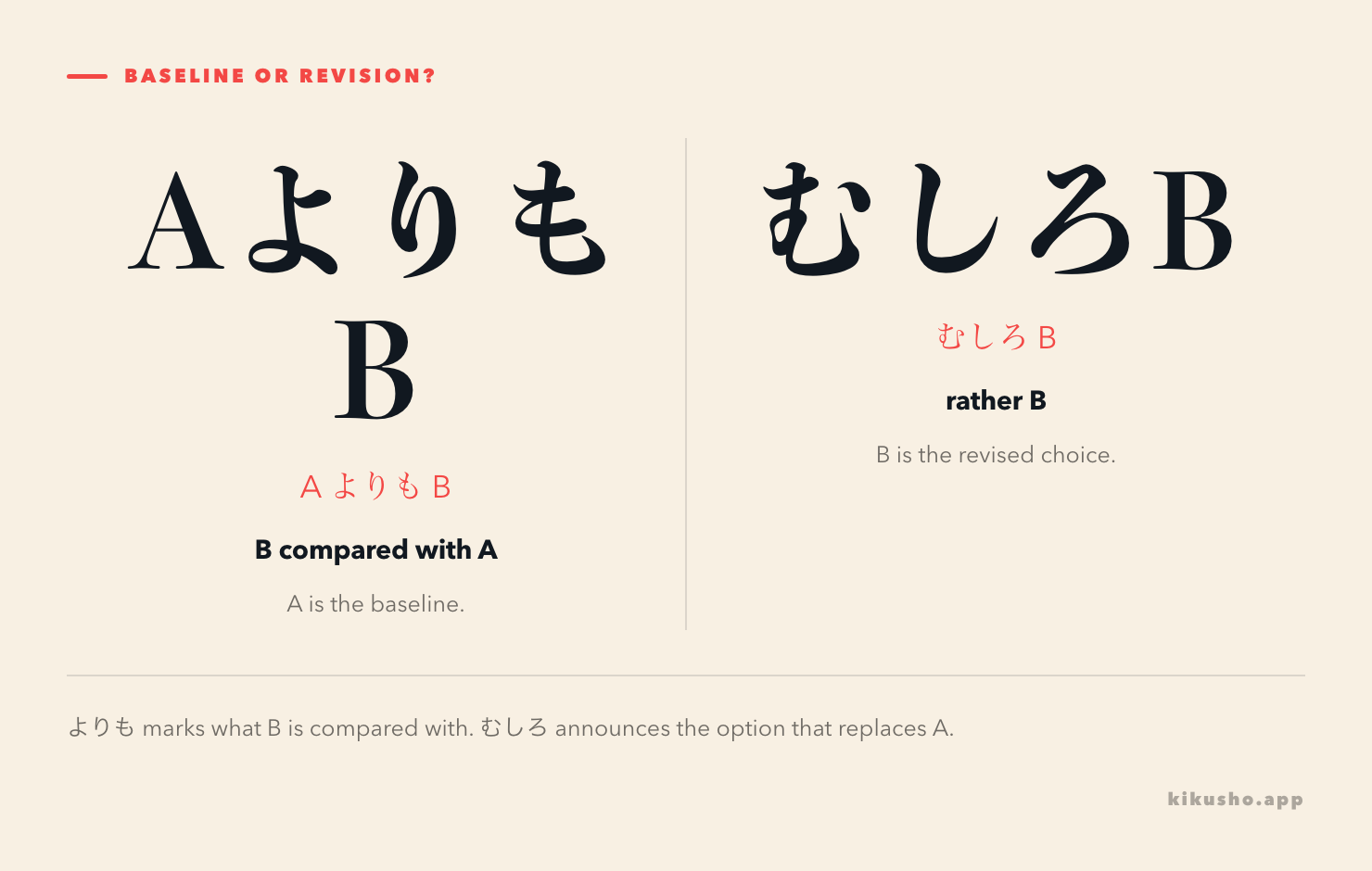
よりも marks the baseline of a comparison; むしろ introduces the alternative a speaker judges more accurate, suitable or preferable. They can work together in Aよりも、むしろB, “rather B than A,” but they do different jobs inside that frame.
If you can point to a scale, よりも may be enough. If you are replacing an initial description, expectation or choice with a better one, むしろ makes that revision explicit.
One comparison can measure or revise
Compare two comments about getting to a station:
バスよりも電車のほうが速い。
バスよりも でんしゃの ほうが はやい。
The train is faster than the bus.
バスで行くよりも、むしろ歩いて行きたい。
バスで いくよりも、むしろ あるいて いきたい。
Rather than go by bus, I would prefer to walk.
The first sentence compares speed. バスよりも names the baseline, and 電車のほうが速い places the train above it. The second presents going by bus as one option, then rejects it in favor of walking. むしろ signals the speaker's considered choice.
| Form | Its job | Question to ask |
|---|---|---|
| AよりもB | marks A as the comparison baseline | In what respect does B exceed or differ from A? |
| むしろB | selects B as more accurate or preferable | What earlier idea is B replacing? |
| Aよりも、むしろB | states both the rejected baseline and the selected alternative | Why is B the better account or choice? |
よりも follows the comparison baseline
In AよりもB, attach よりも to A. The rest of the sentence tells you the property being compared.
この部屋は前の部屋よりも静かです。
この へやは まえの へやよりも しずかです。
This room is quieter than the previous room.
量よりも質を大切にしています。
りょうよりも しつを たいせつに して います。
We value quality more than quantity.
In the first example, quietness supplies a scale. In the second, 大切にする expresses the priority. Neither sentence has to correct a mistaken description; it simply ranks two things.
JLPT Sensei's よりも page gives noun and plain-verb attachment and describes よりも as a stronger version of より. The basic comparison lesson develops AはBより and BよりAのほうが with the roles kept visible.
The も adds emphasis, not a new direction
Both of these statements make the train faster:
電車はバスより速い。
電車はバスよりも速い。
The second gives the baseline more contrast. It may sound like “even more than the bus” or simply make the comparison more explicit. も does not move the baseline to the train and does not mean “much” by itself.
Check the nouns attached to the particles before translating. 海よりも山のほうが好きだ favors the mountains. 山よりも海のほうが好きだ favors the sea.
むしろ introduces the option that survives reconsideration
むしろ is an adverb. It does not attach to a noun as a particle does. It normally comes before the clause or phrase that states the speaker's revised description, preference or conclusion.
この作業は難しいというより、むしろ時間がかかる。
この さぎょうは むずかしいというより、むしろ じかんが かかる。
Rather than being difficult, this task is time-consuming.
The speaker is not ranking two measurable quantities. “Difficult” is being replaced by a more accurate account, “time-consuming.” The common Xというより、むしろY frame makes that correction visible.
厳しい意見を聞いて落ち込むと思ったが、むしろやる気が出た。
きびしい いけんを きいて おちこむと おもったが、むしろ やるきが でた。
I thought the harsh feedback would discourage me, but instead it motivated me.
Here there is no overt より phrase. The expectation in the first clause supplies what gets replaced. Bunpro's むしろ reference describes it as a standard-register adverb used before a preferred choice or more accurate depiction. JLPT Sensei likewise shows it both alone and paired with より or というより.
The kanji spelling 寧ろ exists, but hiragana むしろ is the ordinary choice in contemporary learner-facing text.
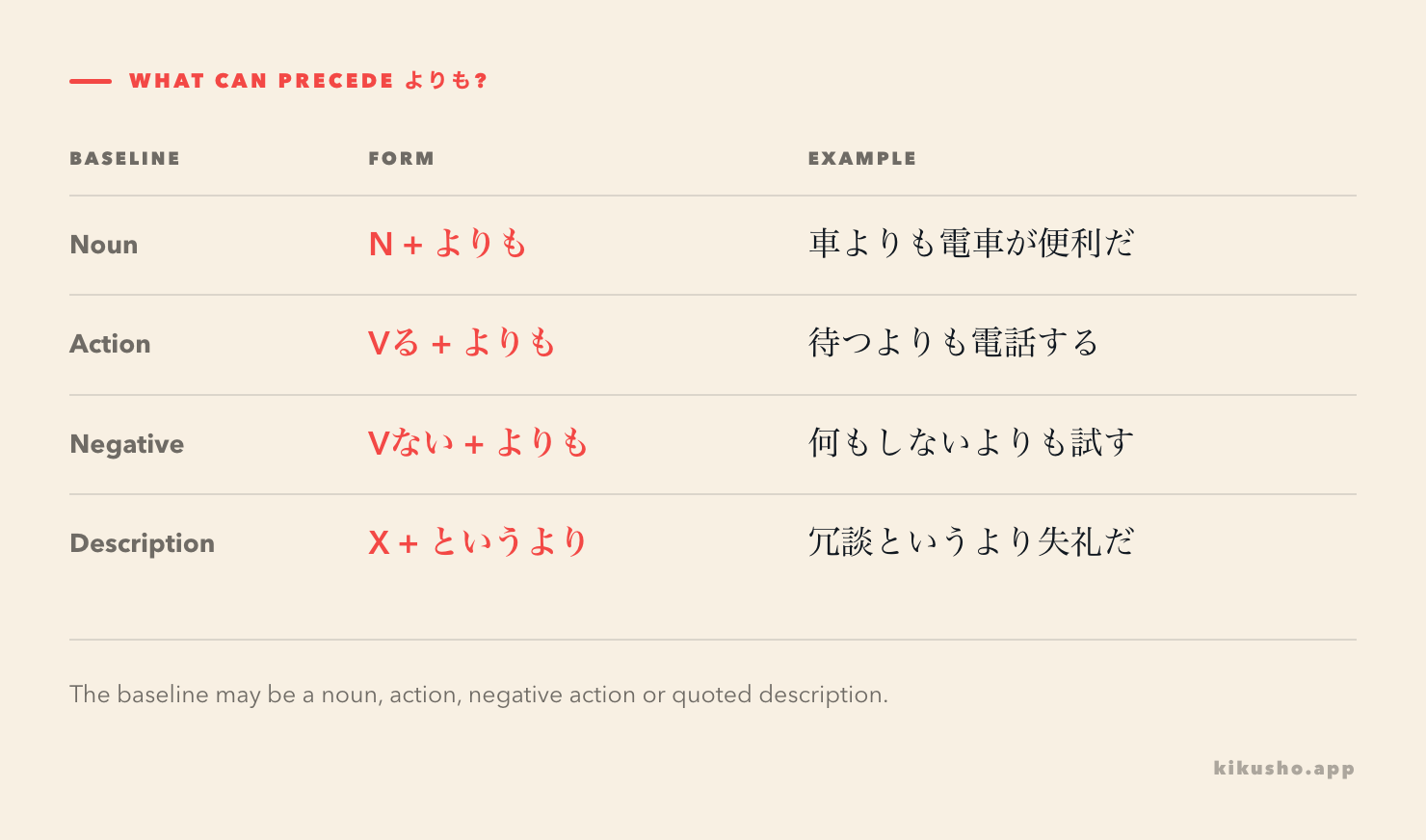
Nouns and plain clauses can stand before よりも
The comparison baseline can be a noun or an action:
| Baseline type | Form | Example |
|---|---|---|
| noun | N + よりも | 車よりも電車が便利だ |
| verb, nonpast | plain verb + よりも | 待つよりも電話したほうが早い |
| verb, negative | ない-form + よりも | 何もしないよりも試したほうがいい |
| quoted description | X + というより(も) | 冗談というより、むしろ失礼だ |
待つよりも、店に電話したほうが早い。
まつよりも、みせに でんわした ほうが はやい。
Calling the shop would be faster than waiting.
This sentence needs no むしろ because 早い supplies a straightforward time comparison. Add むしろ only when the speaker wants to foreground the alternative as the better choice: 待つよりも、むしろ今すぐ電話したい, “Rather than wait, I would prefer to call right now.”
With a noun followed by というより, the speaker comments on a label or wording. 冗談というより、むしろ失礼だ replaces “a joke” with “rude.” The optional も in というよりも can strengthen the contrast; it does not create the corrective meaning on its own.
むしろ needs a revision, not merely two facts
A past event does not automatically become a “rather than” choice.
昨日はコーヒーではなく、紅茶を飲んだ。
Yesterday I drank tea, not coffee.
This reports what happened. むしろ would be natural only if the speaker were weighing a preference, correcting an expectation or replacing one account with another:
昨日はコーヒーを飲む気分ではなく、むしろ紅茶が飲みたかった。
きのうは コーヒーを のむ きぶんでは なく、むしろ こうちゃが のみたかった。
Yesterday I was not in the mood for coffee; I wanted tea instead.
A Waseda University study of Japanese focus adverbs analyzes むしろ as more than a side-by-side comparison: the speaker dismisses or downgrades one candidate and puts another in its place. Its corpus discussion also finds a frequent tendency toward the stronger or more salient alternative, as in “warm” revised to “hot.” That tendency is useful, but not an absolute rule. Context can license a milder replacement when the sentence explicitly frames it.
This is also why 代わりに is not a universal substitute. 田中さんの代わりに会議に出た reports attending in Tanaka's place. むしろ expresses a judgment between alternatives rather than the role substitution itself.
Use both when the comparison and correction matter
The full frame keeps the rejected candidate and the new choice together:
高いホテルに泊まるよりも、むしろ小さな町をゆっくり歩きたい。
たかい ホテルに とまるよりも、むしろ ちいさな まちを ゆっくり あるきたい。
Rather than stay in an expensive hotel, I would prefer to walk slowly around a small town.
The two actions are not being measured on a single scale. よりも marks the option set aside; むしろ announces the experience the speaker prefers.
The same logic can correct a marketed label. A course may be sold as 初心者向け, yet a reviewer may say 初心者向けというより、むしろ上級者向きだ. The lesson on 向け and 向き explains the target-versus-fit contrast inside that sentence.
When you save a sentence with むしろ in Kikusho, preserve the clause it corrects. A card containing only むしろ = rather cannot show whether the speaker rejected a route, a description or an expected reaction. The paired clauses provide the retrieval cue.
The level labels describe different teaching scopes
JLPT Sensei lists both むしろ and よりも at N3, matching the Kikusho inventory. Bunpro teaches むしろ at N3 but places ordinary comparative より in its N4 sequence. That is not necessarily a disagreement about Japanese: one source isolates emphatic よりも as a later item, while another treats it as part of the basic より system.
No complete official JLPT grammar catalogue settles this boundary. This lesson credits the two assigned N3 units while treating basic より~のほうが as a prerequisite. It mentions というより only where it helps explain a common corrective frame.
Practice: baseline or revision?
Decide whether each sentence needs a comparison baseline, a revised choice, or both. Keep your answers until you reach the single explanation block.
Question 1 — comparison baseline. Complete “This room is quieter than the previous room”: この部屋は前の部屋__静かです。
- A. むしろ
- B. よりも
- C. 代わりに
- D. というより
Question 2 — corrected description. The speaker says the task is not difficult; “time-consuming” is more accurate. Choose the best continuation: この作業は難しいというより、__時間がかかる。
- A. よりも
- B. ほど
- C. むしろ
- D. だけ
Question 3 — attachment. Which line correctly makes waiting the baseline and calling the faster action?
- A. 待つよりも、店に電話したほうが早い。
- B. 待つむしろ、店に電話したほうが早い。
- C. 待つのよりもに、店に電話したほうが早い。
- D. 待ったよりも、店に電話したほうが早い。
Question 4 — direction. Which sentence says the speaker likes mountains more than the sea?
- A. 山よりも海のほうが好きだ。
- B. 海よりも山のほうが好きだ。
- C. 山は海よりも好きではない。
- D. 海のほうが山よりも好きだ。
Question 5 — sentence construction. Rebuild the sentence that chooses walking over taking the bus: むしろ/バスで行くよりも/歩いて行きたい.
Question 6 — no explicit baseline. Feedback was expected to be discouraging, but it motivated the speaker. Which adverb fits? 落ち込むと思ったが、__やる気が出た。
- A. よりも
- B. むしろ
- C. のほうが
- D. 代わりに
Question 7 — connected text. Choose the pair that first makes a plain speed comparison, then revises an expectation.
電車はバス__速い。雨で困ると思ったが、__涼しくて助かった。
A. むしろ/よりも
B. よりも/むしろ
C. 代わりに/のほうが
D. というより/よりも
Lock in both choices before checking the explanations.
Answers and explanations
Answer 1. B. よりも. 前の部屋よりも marks the previous room as the baseline for quietness. むしろ cannot attach to the noun in that role.
Answer 2. C. むしろ. 難しいというより sets aside the first description. むしろ introduces “takes time” as the more accurate account.
Answer 3. A. A plain nonpast verb can stand before よりも: 待つよりも. The comparison then selects calling as faster. B makes むしろ act like an attaching particle; C adds particles that the frame does not take; D changes the baseline to a completed past action without support from the context.
Answer 4. B. 海よりも makes the sea the baseline, while 山のほうが好きだ selects the mountains. A and D favor the sea. C explicitly says the speaker does not like mountains more than the sea.
Answer 5. バスで行くよりも、むしろ歩いて行きたい。 The plain action バスで行く comes before よりも. むしろ precedes the preferred alternative.
Answer 6. B. むしろ. The first clause provides an expected reaction, so no explicit よりも baseline is required. むしろ announces the opposite result that replaced it.
Answer 7. B, よりも/むしろ. Speed supplies a direct comparison between the train and bus. The second sentence contrasts an expected problem with a helpful result, so むしろ marks the revision.
Minion 7 (Codex) checked the Japanese and curriculum mapping for this page; it has not received human Japanese review.
Common questions
What is the difference between よりも and むしろ?
よりも follows the comparison baseline: AよりもB means B exceeds or is preferred to A. むしろ is an adverb that introduces the alternative the speaker considers more accurate or preferable.
Can よりも and むしろ appear together?
Yes. Aよりも、むしろB explicitly sets A aside and selects B: バスで行くよりも、むしろ歩きたい means the speaker would rather walk than go by bus.
Does も reverse a comparison in よりも?
No. Aより and Aよりも both mark A as the baseline. も adds contrast or emphasis, but the predicate still tells you how the other item compares with A.
Does むしろ always require よりも?
No. A previous expectation can supply the rejected alternative: 雨で困ると思ったが、むしろ涼しくて助かった means the rain was expected to be a problem but instead proved helpful because it made things cooler.