On this page
もう行かないと。 (もう いかないと) literally stops after “If I don't go…,” yet in an ordinary conversation it means “I have to go now.” Japanese can leave the unwelcome result unsaid when the situation makes it easy to recover.
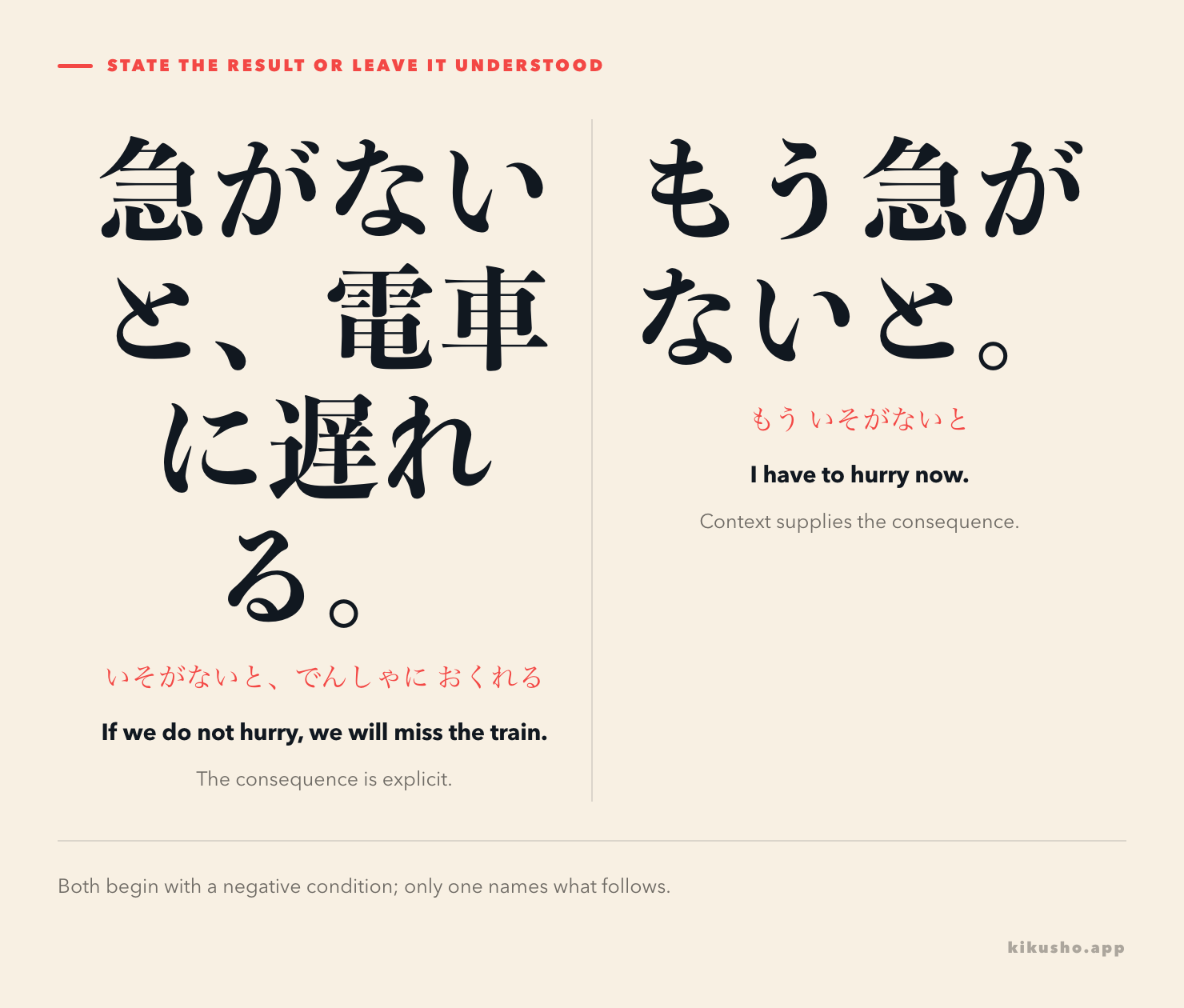
That missing ending is what makes ないと easy to recognize but easy to misread. Sometimes it introduces a complete negative condition: 急がないと、電車に遅れる (いそがないと、でんしゃに おくれる), “If we don't hurry, we'll miss the train.” Sometimes the sentence ends there: もう急がないと。, “I've got to hurry.” The form is the same; the structure and context decide whether a result is stated or understood.
Start with a complete ない-form
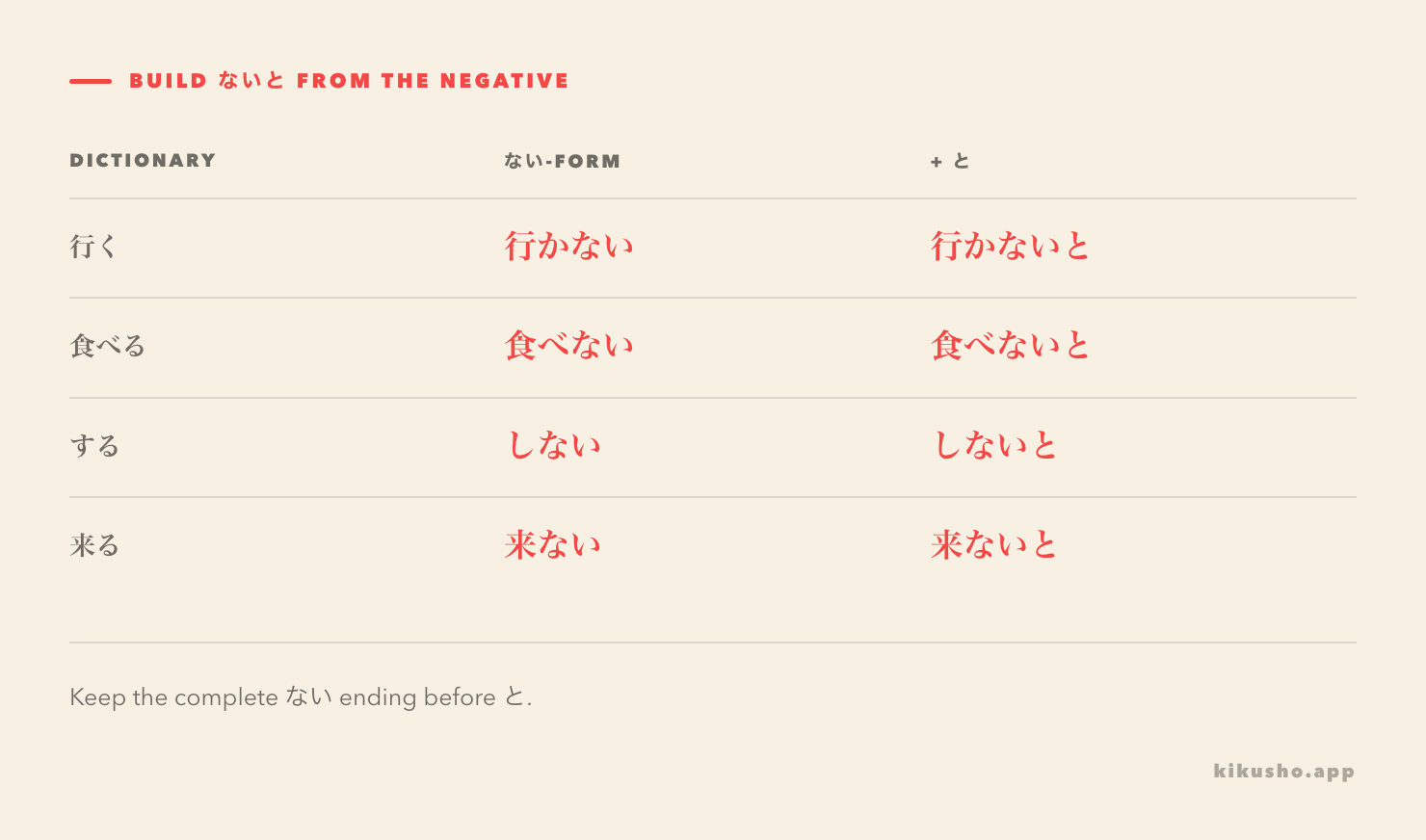
Attach と to the verb's plain negative form, including the final ない. Do not attach it directly to the dictionary form.
| Dictionary form | Plain negative | With ないと |
|---|---|---|
| 行く (いく), go | 行かない | 行かないと |
| 食べる (たべる), eat | 食べない | 食べないと |
| する, do | しない | しないと |
| 来る (くる), come | 来ない (こない) | 来ないと |
This is the ordinary conditional particle と after a negative predicate. 薬を飲まないと、よくならない (くすりを のまないと、よくならない) means “If you don't take the medicine, you won't get better.” The first clause gives the condition; the second states its predictable result. For a broader comparison of conditional forms, see と versus たら. If forming 行かない or 食べない still takes thought, review the Japanese plain negative before treating ないと as a single chunk.
A full result and an omitted result use the same doorway
Compare these two lines:
- 早く出ないと、会議に遅れる。 (はやく でないと、かいぎに おくれる) — “If I don't leave soon, I'll be late for the meeting.”
- もう出ないと。 (もう でないと) — “I have to leave now.”
The first sentence walks through the doorway and names the consequence. The second stops at the condition. A listener can infer that staying would be bad, inconvenient, or incompatible with the speaker's goal. In English, “I have to leave” is usually the natural translation; the Japanese wording still presents the reason as an unfinished “if I don't…”.
The omitted material is not one mechanically fixed phrase. Depending on the moment, a speaker might be understood as leaving out いけない (“it won't do”), だめだ (“that's no good”), 困る (こまる, “that will cause trouble”), 間に合わない (まにあわない, “I won't make it”), or another concrete result. A Hokkaido University study of Japanese unfinished sentences groups ならない, いけない, だめだ, and 困る among the recoverable endings of this pattern. That is a better model than expanding every bare ないと to exactly ないといけない.
What the unfinished ending does in conversation
Sentence-final ないと is especially natural for self-directed urgency, reminders, and practical warnings. The open ending lets the situation carry part of the message.
明日早いから、もう寝ないと。 (あした はやいから、もう ねないと) means “I have an early start tomorrow, so I need to go to bed.” The speaker is talking about their own next action. そろそろ予約しないと。 (そろそろ よやくしないと) can be a reminder to oneself or a prompt to the group: “We need to book soon.” With あなたも準備しないと, the same pattern can push the listener toward an action: “You need to get ready too.” Voice, relationship, and the named subject affect whether it sounds like self-talk, shared planning, or advice.
The unfinished shape often feels less like a written rule than a full なければならない sentence, but it can still carry pressure. もう帰らないと said while reaching for a coat is a mild explanation for leaving. Said sharply to someone who is ignoring a deadline, it may function as a warning. Do not assign politeness from the short form alone; read who must act and why.
JLPT Sensei's N3 entry presents both the “must do” use and the explicit “if you don't” use. Bunpro's ないと page calls the bare obligation casual and contrasts it with more formal alternatives. A Mie Prefecture learning guide likewise notes that the final なりません or いけません can disappear in conversation. These descriptions agree on the spoken pattern even though they assign it to different study levels.
Do not force an obligation reading every time
A visible clause after ないと usually resolves the structure immediately. 鍵がないと、中に入れない (かぎが ないと、なかに はいれない) means “If you don't have a key, you can't get inside.” It does not mean “You must not have a key.” 時間がないと難しい (じかんが ないと むずかしい) means “It is difficult if there isn't enough time.” Here ない belongs to the predicate 時間がない, not to an omitted command to perform an action.
Also distinguish conditional と from quotative と. In 田中さんは来ないと思う (たなかさんは こないと おもう), 来ない is the content of the thought: “I think Tanaka won't come.” In 来ないと、始められない (こないと、はじめられない), it is a condition: “If [they] don't come, we can't start.” The following verb 思う, 言う, or 聞く can signal quotation; a consequence clause signals the conditional relationship.
Bare ないと also belongs to a family of casual obligation endings, but the routes differ. 行かないと comes from 行かない + と. 行かなきゃ shortens 行かなければ, and 行かなくちゃ shortens 行かなくては. The meanings can overlap in conversation, but the sound changes are not interchangeable derivations. The full map is in the guide to なければならない, なきゃ, and なくちゃ.
Choose the register by the setting
Use bare ないと freely in ordinary conversation when the necessity is clear. It is also natural in private notes and inner speech: 牛乳を買わないと (ぎゅうにゅうを かわないと), “Need to buy milk.” A workplace conversation can contain it too, especially when a speaker describes their own practical task.
For a regulation, application instruction, or formal announcement, state the requirement fully. 申請書は金曜日までに提出しなければなりません (しんせいしょは きんようびまでに ていしゅつしなければなりません) is appropriate where a bare 提出しないと would sound conversational and leave the authority of the rule vague. A full form does more than add syllables: it closes the sentence and makes the judgement explicit.
Kikusho is most useful here when you save the whole situation rather than an isolated translation. Capture 明日早いから、もう寝ないと with its audio, check the reading and the implied consequence, then review it offline as a line someone would actually say. The causal phrase 明日早いから prevents the card from collapsing into the misleading equation “ないと = must.”
JLPT levels for this expression are publisher estimates, since the official test does not release a point-by-point grammar syllabus. JLPT Sensei labels bare ないと N3, while Bunpro places it at N4. Kikusho's September 2026 reference inventory records that disagreement and teaches the distinction here because understanding an unfinished condition is a listening and discourse skill beyond merely memorizing the full obligation formula.
Practice: hear what the context completes
Work through the seven prompts first. Their solutions and reasoning are grouped after Question 7 so the page does not reveal the next answer while you practise.
Question 1 — grammar choice. Which is the correct ないと form of 書く?
- A. 書くないと
- B. 書かないと
- C. 書きないと
Question 2 — stated consequence. Which option gives the entire condition-and-result sentence “If we don't leave soon, we'll miss the train”?
- A. 早く出ないと、電車に遅れる。
- B. 早く出ないと思う。
- C. 早く出なくちゃ。
Question 3 — text grammar. It is late, and you are reminding yourself to sleep. Complete the sentence with a bare ないと form: 明日も早い。もう__。
Question 4 — grammar choice. In which sentence is と quotative rather than conditional?
- A. 田中さんが来ないと、始められない。
- B. 田中さんは来ないと思う。
- C. 田中さんが来ないと困る。
Question 5 — sentence composition. Say “I have to send it today” as a casual reminder to yourself. Use 今日中に, 送る, and a sentence-final ないと.
Question 6 — grammar choice. A formal notice tells applicants that documents must be submitted by Friday. Which ending best fits?
- A. 提出しないと。
- B. 提出しなければなりません。
- C. 提出しないと思います。
Question 7 — text grammar. Complete the short exchange with the form of 予約する that leaves the bad result unstated.
A: このホテル、すぐ満室になるよ。
B: じゃあ、今日__。
Answers and explanations
Answer 1. B, 書かないと. Make the godan verb's negative first: 書く → 書かない. Then add と. A attaches ない to the dictionary form, and C uses the continuative stem instead of the plain negative.
Answer 2. A, 早く出ないと、電車に遅れる。 (はやく でないと、でんしゃに おくれる) states both the negative condition and its result. B means “I think [someone] won't leave early,” with quotative と. C is a casual “We have to leave early,” but does not name the train consequence.
Answer 3. もう寝ないと。 (もう ねないと), “I need to go to bed now.” The preceding 明日も早い supplies the practical reason. An ending such as いけない is possible, but the question asks for the conversational unfinished form.
Answer 4. B, 田中さんは来ないと思う。 (たなかさんは こないと おもう) reports the thought “Tanaka won't come,” so と marks quoted content. In A and C, Tanaka's not coming is the condition for a result: being unable to start or having a problem.
Answer 5. 今日中に送らないと。 (きょうじゅうに おくらないと), “I have to send it today.” 送る → 送らない → 送らないと. The deadline makes the omitted bad result easy to infer.
Answer 6. B, 提出しなければなりません. It explicitly closes a formal requirement. A can convey necessity in conversation, but its unfinished tone is a poor fit for an official notice. C says “I think [they] will not submit,” which changes both the structure and meaning.
Answer 7. 予約しないと completes じゃあ、今日予約しないと。 (じゃあ、きょう よやくしないと), “Then we need to book today.” The first speaker has already supplied the consequence: rooms fill quickly. 予約する → 予約しない uses the irregular negative of する, followed by conditional と.
Common questions
What does ないと mean at the end of a Japanese sentence?
After a verb's ない-form, sentence-final と often leaves a bad result or judgement unstated. もう行かないと literally begins “If I don't go,” but in context it naturally means “I have to go now.”
Is ないと always short for ないといけない?
No. A following result can be explicit, as in 急がないと電車に遅れる, “If we don't hurry, we'll miss the train.” Even when the sentence stops at ないと, context may suggest だめ, 困る, or a concrete bad result rather than one fixed hidden phrase.
How do you attach ないと to a verb?
Make the complete plain negative first, then add と: 行く becomes 行かないと, 食べる becomes 食べないと, する becomes しないと, and 来る becomes 来ないと.
Is bare ないと formal Japanese?
It is common in conversation, reminders, and self-talk. Formal rules and notices usually spell out the obligation with a form such as なければなりません.