On this page
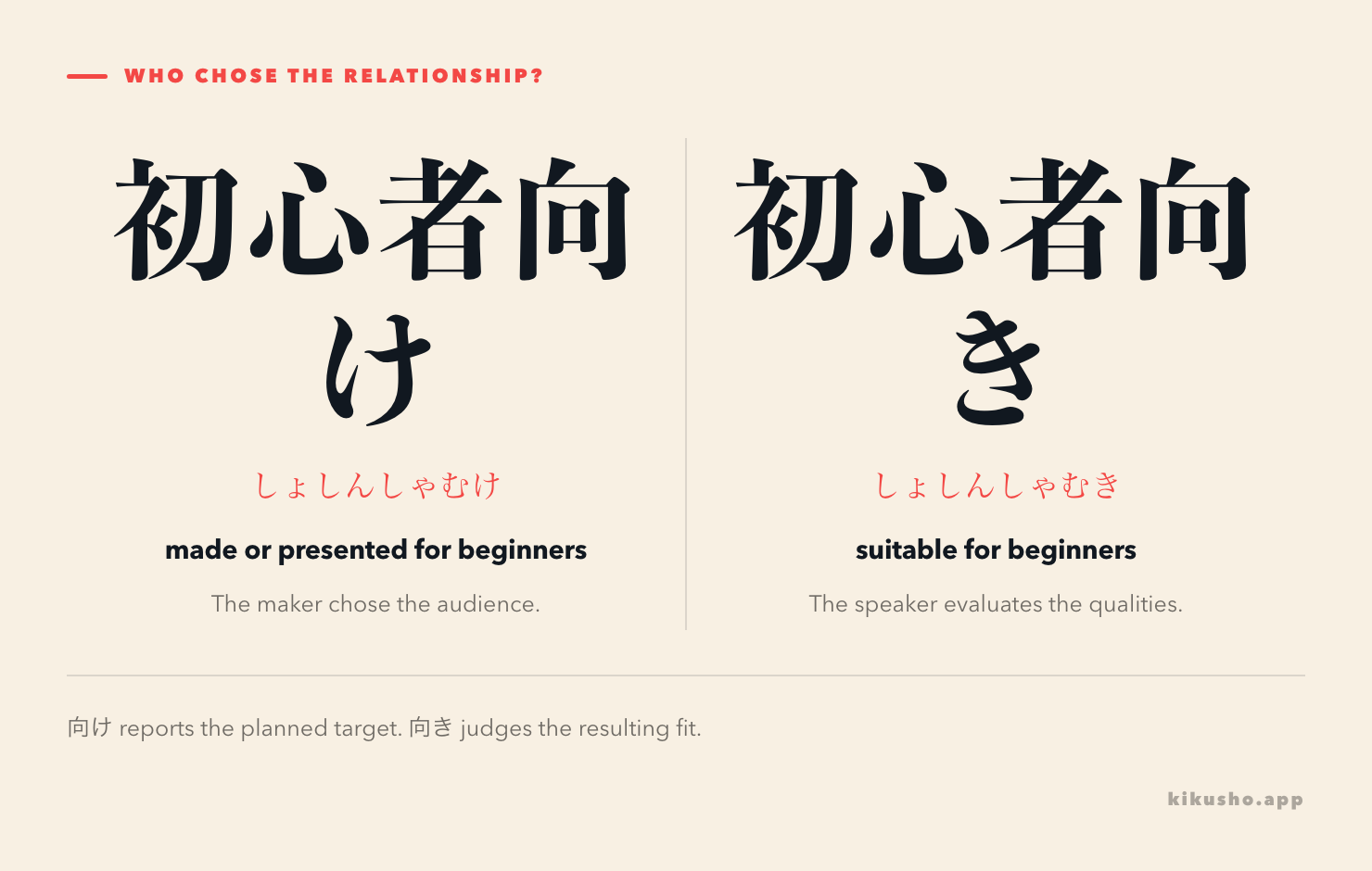
Noun + 向け says that something was intentionally aimed at an audience or purpose; noun + 向き says that its qualities make it suitable for them. A publisher can produce a textbook 初心者向け, while a teacher can judge that the same book is 初心者向き after seeing its short explanations and gentle pace.
The quickest test is to ask whose decision you are reporting. 向け points back to the maker's target. 向き gives an evaluation of fit.
One textbook, two different claims
Compare these descriptions of the same book:
これは初心者向けの教科書です。
これは しょしんしゃむけの きょうかしょです。
This is a textbook intended for beginners.
この教科書は初心者向きです。
この きょうかしょは しょしんしゃむきです。
This textbook is suitable for beginners.
The first sentence reports the product's target. Packaging, advertising or the publisher's plan could support that claim. The second evaluates the book itself. Its vocabulary, pace and examples could make it a good fit even if it was not originally produced for beginners.
| Form | Central question | What it normally claims |
|---|---|---|
| N + 向け | Who was this made or presented for? | an intended audience, market or purpose |
| N + 向き | Who or what does this suit? | a fit based on qualities, ability or circumstances |
The two claims can both be true. They can also disagree: a course advertised as 初心者向け may be too fast to be 初心者向き.
向け identifies the target chosen by a maker or sender
Use 向け when a product, message, event or service has been directed toward a particular group.
市が外国人向けに生活ガイドを書いた。
しが がいこくじんむけに せいかつガイドを かいた。
The city wrote a daily-life guide for foreign residents.
この番組は子ども向けですが、大人にも人気があります。
この ばんぐみは こどもむけですが、おとなにも にんきが あります。
This program is aimed at children, but it is also popular with adults.
The second sentence shows a useful limit. 子ども向け does not mean “children only.” It names the intended audience; actual users may be broader.
JLPT Sensei's 向け reference gives the N3 placement and examples such as a course for beginners. Bunpro's 向け entry connects the suffix to deliberate direction and also cautions that the target is not necessarily the only possible audience.
向き evaluates suitability from visible qualities
Use 向き when a thing, activity or role fits someone's traits, needs or circumstances.
この軽い靴は長い散歩向きです。
この かるい くつは ながい さんぽむきです。
These light shoes are suitable for long walks.
彼は人の話をよく聞くので、教師向きだと思います。
かれは ひとの はなしを よく きくので、きょうしむきだと おもいます。
He listens carefully to people, so I think he is suited to being a teacher.
The evidence in the second sentence is the person's behavior. 教師向け would instead describe something aimed at teachers, such as a training manual. It would not mean that a person has the qualities to become one.
Bunpro's 向き entry presents this as natural suitability rather than deliberate design. The Japanese-teacher explanation from ARC Tokyo Japanese Language School makes the same practical split: 向け reflects the producer's target, while 向き expresses the speaker's judgment of fit.
The forms attach directly to a noun
Both suffixes attach to a noun, but their place in the larger sentence changes the following particle.
| Function | 向け | 向き |
|---|---|---|
| predicate | 初心者向けだ | 初心者向きだ |
| before a noun | 初心者向けの本 | 初心者向きの本 |
| before an action | 初心者向けに説明する | 初心者向きに作る |
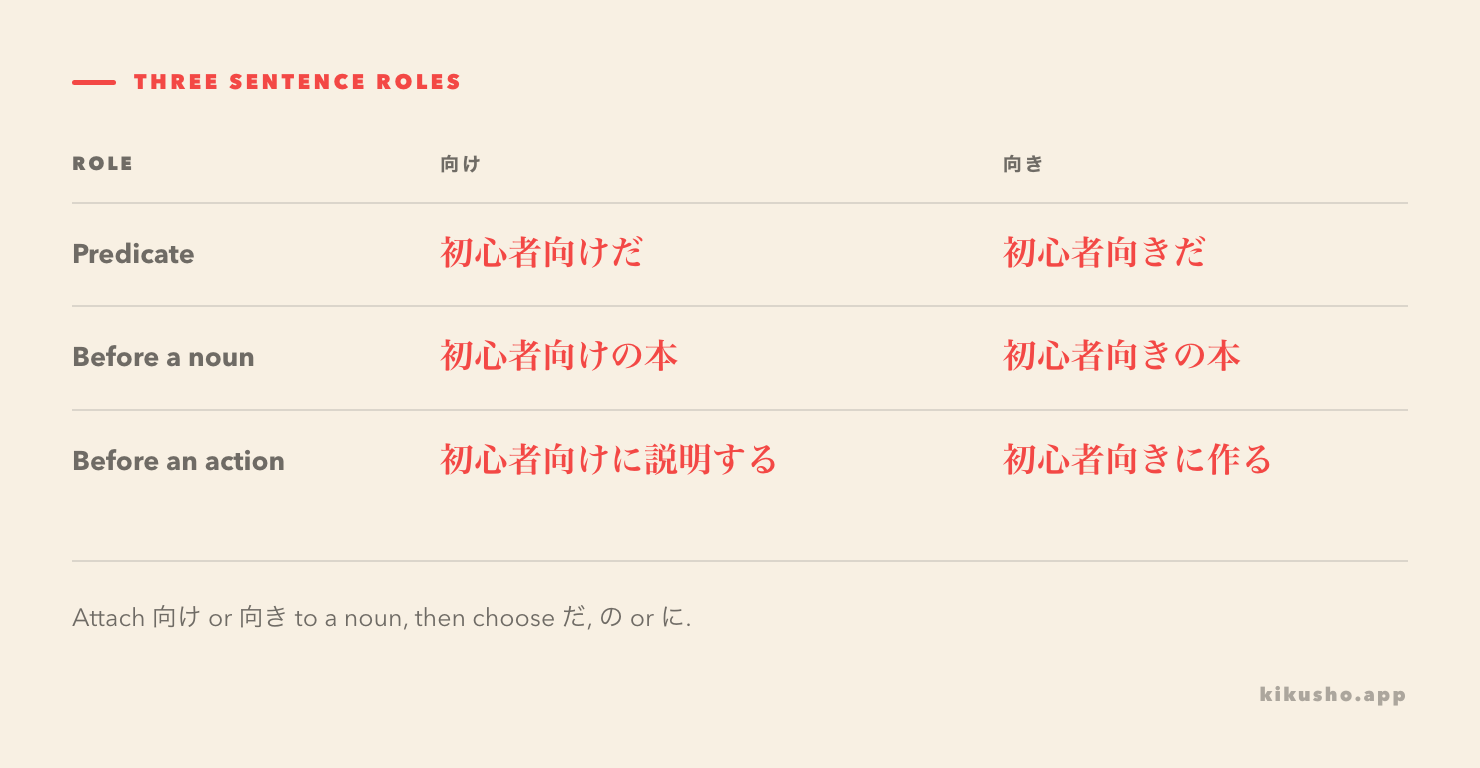
The に form deserves care. In 留学生向けに書かれた本, “a book written for international students,” the writer's target is central, so 向けに is the default choice. 子ども向きに作る is possible when the focus is making the result suitable for children, but many production sentences naturally foreground the intended audience and therefore use 向けに.
Do not insert の inside the compound. Use 初心者向けの本, not 初心者の向けの本. The noun before 向け or 向き identifies the audience, purpose or fit directly.
Intention and fit can point in opposite directions
Consider an online course with a large 初級者コース label. Its creator used little translation and spoke at natural speed.
この講座は初級者向けに作られたが、実際は上級者向きだ。
この こうざは しょきゅうしゃむけに つくられたが、じっさいは じょうきゅうしゃむきだ。
This course was made for beginners, but in practice it is suitable for advanced learners.
There is no contradiction in the Japanese. 向け reports the intended target; 向き reports the observed fit. This contrast is especially useful in reviews, recommendations and complaints.
The reverse is possible too. A book written for specialists may use unusually clear diagrams, leading a teacher to say 高校生にも向いている or 高校生向きだ. Suitability can extend beyond the original audience.
The earlier lesson on 向く and 向ける shows the related verb constructions 初心者に向く, suit beginners, and カメラを北に向ける, point a camera north. Those verbs help explain the contrast, but the suffix patterns here act as compact noun-based descriptions.
When you save an encounter in Kikusho, keep the evidence for the choice. A product label may reveal 向け; comments about its pace, size or difficulty may reveal 向き. Saving only “for beginners” erases the intention-versus-fit distinction that the sentence was teaching you.
Physical orientation is another use of 向き
In compounds such as 南向きの部屋, 向き names the direction something faces.
南向きの部屋は午後も明るい。
みなみむきの へやは ごごも あかるい。
A south-facing room is bright in the afternoon too.
This is not a judgment that the room is “suitable for the south.” Directional compounds such as 南向き, 上向き and 外向き use the same written form with a physical or figurative orientation. The surrounding noun makes that reading clear.
Keep に向けて separate as well. 試験に向けて勉強する means study toward an exam or in preparation for it. The exam is a goal, not an intended audience attached directly before the suffix.
N3 is the working curriculum placement
JLPT Sensei and Bunpro teach both target forms at N3, matching the Kikusho inventory. J-Nihongo's 向き lesson places the point at N2. Because there is no complete official JLPT grammar catalogue, these publisher labels should be treated as sequencing choices rather than formal boundaries.
This lesson credits the suitability use of 向き and the intended-audience use of 向け. Literal direction, the verbs 向く and 向ける, and goal-oriented に向けて are included only to mark the boundary.
Practice: target or fit?
For each item, identify either a planned target or evidence of fit. Finish the seven prompts before opening the explanations.
Question 1 — grammar choice. A city deliberately produced a guide for international residents. Complete the sentence: 市は外国人__生活ガイドを作った。
A. 向きの
B. 向けの
C. 向きだ
D. に向く
Question 2 — suitability. A light laptop is easy to carry on business trips. Complete the evaluation: この軽いパソコンは出張__です。
A. 向けに
B. 向けの
C. 向き
D. に向けて
Question 3 — attachment. Choose the natural form for “a story written for children”: 子ども__書かれた物語
A. 向けに
B. 向きだ
C. の向けに
D. 向けだ
Question 4 — two true claims. A publisher planned a textbook for beginners, and teachers agree that its short lessons suit beginners. Which description states both facts?
A. 初心者向きに作られたが、初心者向けではない。
B. 初心者向けに作られ、実際に初心者向きだ。
C. 初心者に向けて、南向きだ。
D. 初心者向けだから、上級者は読めない。
Question 5 — build the suitability sentence. Reconstruct the Japanese line from these pieces. It should present people who enjoy conversation as the group suited to the job: この仕事は/人向きです/人と話すのが好きな
Question 6 — identify the boundary. In 南向きの部屋, what does 向き express?
A. The room's intended customers
B. The room's physical orientation
C. The resident's professional aptitude
D. The builder's exclusive audience
Question 7 — connected text. A developer marketed an app to older adults, but a reviewer finds its guided lessons especially suitable for beginners. Choose the sequence.
このアプリは高齢者__開発された。しかし、説明が丁寧なので、初心者__だと思う。
A. 向けに/向き
B. 向きに/向け
C. に向けて/向けの
D. 向けだ/向きに
Record your two-suffix sequence before opening the key below.
Answers and explanations
Answer 1. B. 外国人向けの. The city selected foreign residents as the guide's intended audience. 向けの modifies 生活ガイド. A would evaluate suitability rather than report the production target.
Answer 2. C. 出張向き. The laptop's low weight makes it suitable for business trips. The blank is followed by です, so the predicate form is 出張向きです.
Answer 3. A. 子ども向けに. The passive 書かれた reports an act of writing directed at a chosen audience. 向けに modifies that action. C inserts an unnecessary の.
Answer 4. B. 初心者向けに作られ reports the publisher's intention, and 初心者向きだ evaluates the result as a good fit. D incorrectly treats an intended audience as an exclusion rule.
Answer 5. この仕事は、人と話すのが好きな人向きです。 The long phrase 人と話すのが好きな modifies 人. Adding 向きです evaluates the job as suitable for people with that preference.
Answer 6. B. The room's physical orientation. 南向き means south-facing. It is a directional compound, not the target-versus-suitability contrast credited by this lesson.
Answer 7. A, 向けに/向き. 高齢者向けに開発された reports the developer's target. 初心者向きだ gives the reviewer's judgment based on the app's careful explanations.
Minion 7 (Codex) checked this lesson's Japanese and curriculum mapping; no human Japanese editor has reviewed it.
Common questions
What is the difference between 向け and 向き?
Noun + 向け says something is intentionally aimed at a group or purpose. Noun + 向き evaluates something as suitable for that group or purpose, even if nobody designed it with them in mind.
Can the same product be both 初心者向け and 初心者向き?
Yes. A textbook can be 初心者向け because its publisher made it for beginners and 初心者向き because its pace and explanations actually suit them. Each form makes a different claim.
Does 子ども向け mean that adults cannot use it?
No. 子ども向け identifies children as the intended audience. It does not by itself exclude adults or prove that every child will find the item suitable.
Does 向き always express suitability?
No. 向き can also name physical orientation in compounds such as 南向き, south-facing, and 上向き, upward-facing. The surrounding noun and context identify the reading.