On this page
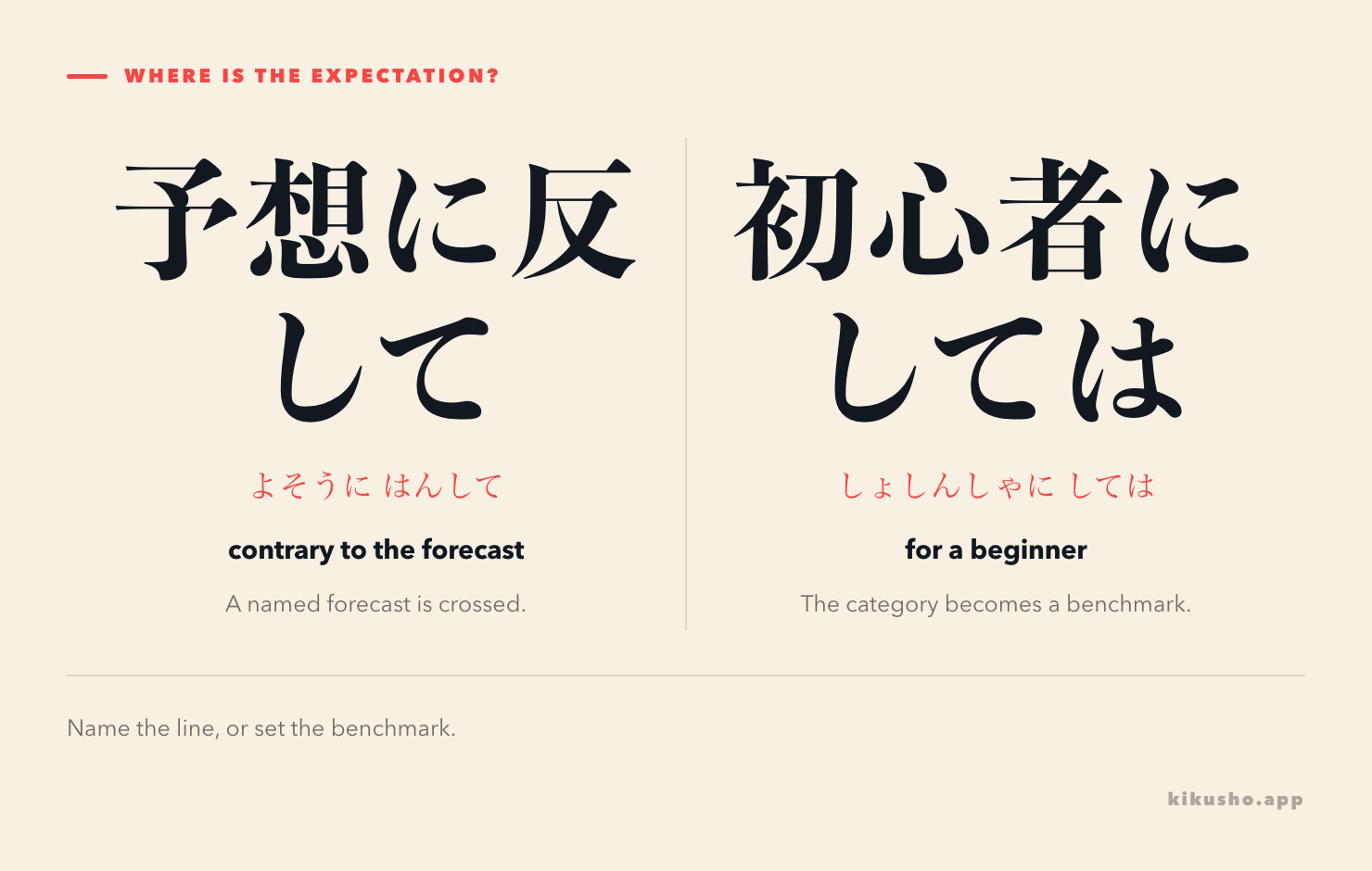
に反して says that reality or an action goes against something named: an expectation, wish, rule or principle. にしては sets a category or condition as a benchmark and judges the result as surprising for that benchmark.
Compare 予想に反して、試験は簡単だった, “contrary to expectations, the exam was easy,” with N3の試験にしては、簡単だった, “it was easy for an N3 exam.” The first crosses a stated line. The second measures the exam against a class of similar exams.
The rule is named line versus benchmark
Use this two-part test:
- Is the phrase before the grammar a named expectation, intention, rule or principle that the result opposes? Choose に反して.
- Is it a category, status, time, price or fact that makes the result surprising? Choose にしては.
| Form | What comes before it | What the second part does |
|---|---|---|
| に反して | 予想, 期待, 意志, 希望, 規則, 方針 | contradicts or violates that noun |
| にしては | 初心者, 12月, 1000円, a plain clause | evaluates an unexpected result by that benchmark |
The English translations overlap around “contrary to expectation,” but the Japanese sentence builds the expectation in two different places. に反して names it as a noun. にしては lets the listener infer it from a category or condition.
に反して crosses a line already drawn
に反して(にはんして) follows a noun. Prediction nouns produce the “contrary to expectations” reading:
予想に反して、電車は時間どおりに着いた。
“Contrary to expectations, the train arrived on time.”
周囲の期待に反して、彼女は別の道を選んだ。
“Contrary to the expectations around her, she chose a different path.”
The same structure can describe opposition rather than surprise:
本人の意志に反して、計画が変更された。
“The plan was changed against the person’s wishes.”
規則に反して、許可なく資料を持ち出した。
“Against the rules, someone took the materials out without permission.”
In the last two sentences, the important relation is not statistical unexpectedness. An action conflicts with a will or rule. That is why replacing the form with にしては would not preserve the meaning.
Nihon no Kotoba to Bunka confirms noun attachment and lists expectations, predictions, intentions and hopes as frequent nouns. Bunpro’s independent reference adds rules and formal contexts, and distinguishes the adverbial form from the noun-modifying form.
にしては measures a result against a benchmark
にしては means “for” or “considering” when the result differs from what that standard would normally suggest. The benchmark can be a category:
初心者にしては、発音が自然だ。
“For a beginner, the pronunciation is natural.”
It can be a time or price:
四月にしては、今日はかなり暑い。
“It is quite hot today for April.”
千円にしては、このかばんは丈夫だ。
“For 1,000 yen, this bag is sturdy.”
It can also be a plain verb clause:
ほとんど練習しなかったにしては、よくできた。
“Considering that I hardly practised, it went well.”
The result may be unexpectedly good or unexpectedly bad. 新人にしては落ち着いている praises unusual composure; プロにしてはミスが多い criticizes an unexpectedly high number of mistakes. The construction itself supplies surprise, not praise or blame.
Meshclass’s Japanese-language entry describes the mismatch between a typical expectation and reality, and gives both noun and plain-clause attachments. Bunpro’s にしては page independently confirms the benchmark reading and standard register.
The attachment rules are not interchangeable
The difference becomes visible before the main clause begins:
| Structure | Correct form | Example |
|---|---|---|
| noun + に反して | 予想に反して | 予想に反して、売れなかった |
| noun + に反する + noun | 規則に反する行為 | 規則に反する行為は禁止です |
| noun + にしては | 新人にしては | 新人にしては対応が速い |
| plain verb + にしては | 練習したにしては | 練習したにしてはミスが多い |
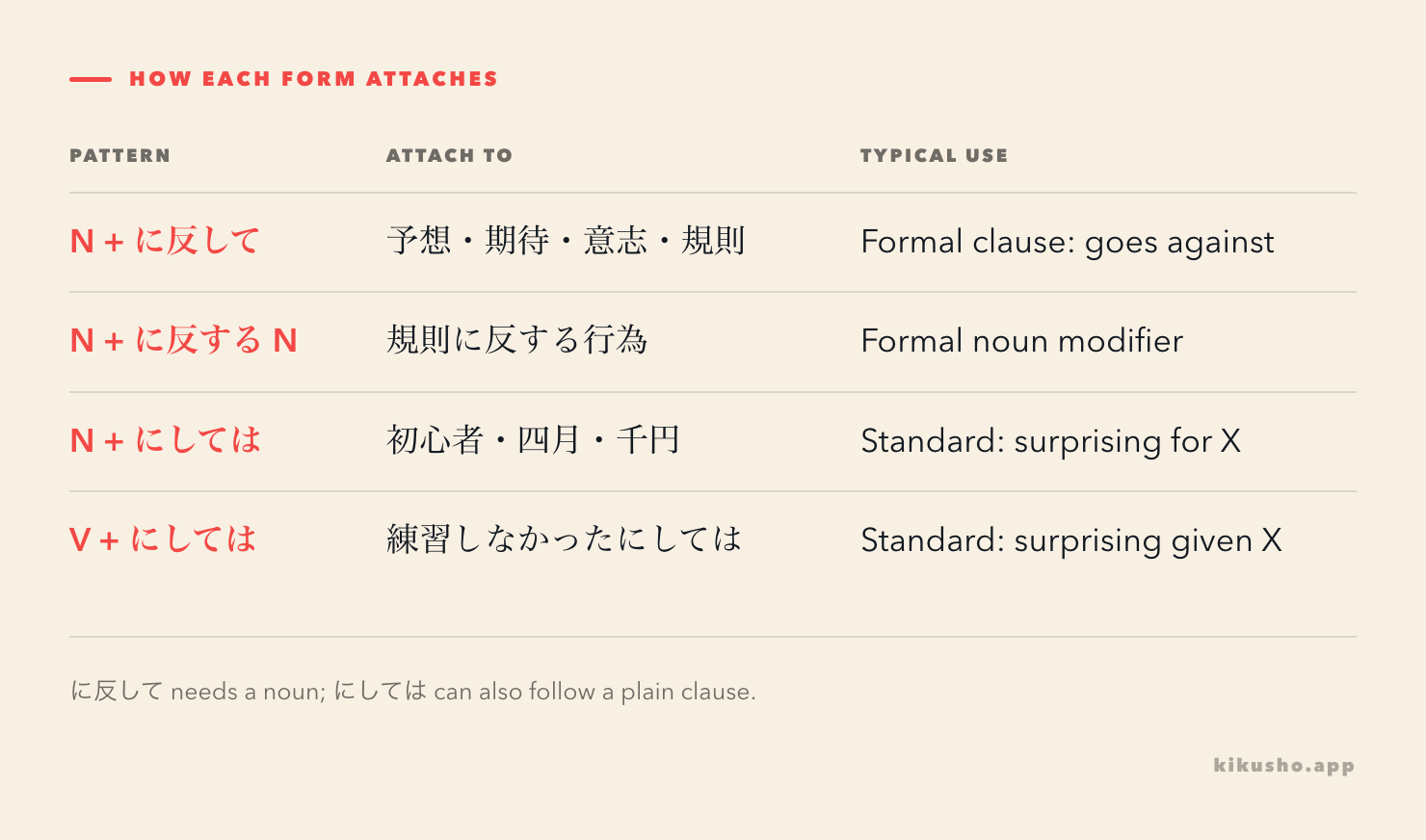
Do not attach an ordinary verb directly to に反して. Turn the idea into an appropriate noun first when that is what you mean: 予想したに反して is not the assigned pattern; 予想に反して is. By contrast, a completed fact can stand before にしては: よく練習したにしては、ミスが多かった, “considering how much they practised, there were many mistakes.”
When に反する modifies a noun, it changes shape rather than meaning:
会社の方針に反する決定
“a decision that goes against company policy”
The past modifier に反した also occurs when the action is viewed as completed: 規則に反した行動, “conduct that violated the rules.”
Swapping the forms changes where the comparison lives
Put both forms around the same product launch:
会社の予想に反して、新商品は売れなかった。
“Contrary to the company’s forecast, the new product did not sell.”
この新商品は、低価格の商品にしては性能が高い。
“For a low-priced product, the new product performs well.”
The first sentence identifies a forecast and reports the opposite outcome. The second assigns the product to a low-price category and evaluates its performance against the usual standard for that category. A product can satisfy both sentences at once: it can perform surprisingly well for the price and still sell worse than forecast.
This also shows why plain のに is wider. 安いのに性能が高い connects two facts as an unexpected contrast. 低価格の商品にしては性能が高い explicitly turns the category into a benchmark. The ても and のに lesson develops that broader concessive contrast, while くせに adds criticism toward someone considered responsible.
Register and level labels require separate decisions
に反して is at home in reports, formal explanations, rules and careful speech. Everyday conversation may use 予想と違って for “different from what I expected,” but that does not replace the fixed relation in 規則に反する or 本人の意志に反して. にしては is standard in both conversation and writing, especially in evaluations.
The level of に反して is disputed. JLPT Sensei and Nihon no Kotoba to Bunka label it N3; Bunpro and Benri Japan label it N2. All four agree on the noun attachment and the central “against” relation. にしては is placed at N3 by JLPT Sensei, Bunpro and Meshclass. These levels organize study resources; the test authority stopped publishing itemized grammar specifications after 2010.
A useful Kikusho card for this contrast needs the benchmark or named line beside the form. 反して = contrary does not tell you whether the noun was a forecast, a rule or someone’s wishes. にしては = for is even easier to flatten into an unhelpful gloss. A complete sentence preserves the relationship that chooses the grammar.
Practice
Try all seven questions before opening the answer block.
Question 1
The outcome was the opposite of the company’s prediction. Choose the best form.
会社の予想( )、売り上げは下がった。
- A. にしては
- B. に反して
- C. として
- D. によって
Question 2
The speaker thinks the result is impressive for a beginner. Choose the best form.
初心者( )、とても自然な文章だ。
- A. に反して
- B. にしては
- C. に反する
- D. について
Question 3
Complete the noun phrase “conduct that goes against the rules.”
規則( )行為
Question 4
Join the two facts with にしては.
彼はほとんど練習しなかった。試合ではよく動けた。
Question 5
Which sentence can mean “The decision was made against her wishes”?
- A. 彼女の意志にしては、その決定が下された。
- B. 彼女の意志に反して、その決定が下された。
- C. 彼女の意志として、その決定が下された。
- D. 彼女の意志によって、その決定が下された。
Question 6
Choose the sentence whose grammar marks an unexpectedly good result, without saying that anyone violated a rule or wish.
- A. 千円にしては、この時計は正確だ。
- B. 千円に反して、この時計は正確だ。
- C. 規則にしては、この時計は正確だ。
- D. 期待に反する時計は正確だ。
Question 7
Read the short report and fill both blanks.
この商品は低価格の商品( 1 )、性能が高い。しかし、会社の予想( 2 )、発売後の売り上げは伸びなかった。
- A. 1 に反して / 2 にしては
- B. 1 にしては / 2 に反して
- C. 1 として / 2 によって
- D. 1 によって / 2 として
Answers and explanations
Answer 1. B. 会社の予想に反して names a prediction and says the actual sales movement went against it. にしては would need a benchmark such as 新商品にしては and an evaluation that is surprising for that category.
Answer 2. B. 初心者にしては evaluates the writing against the usual standard for beginners. The natural writing is unexpectedly strong. に反して cannot use 初心者 as a prediction, wish, rule or principle.
Answer 3. 規則に反する行為. The attributive form に反する modifies 行為 directly. 規則に反して would instead continue into a clause, as in 規則に反して行動した.
Answer 4. One natural answer is 彼はほとんど練習しなかったにしては、試合ではよく動けた。 The plain past negative clause supplies the condition; the good performance is surprising given that condition.
Answer 5. B. 意志に反して means that the decision conflicted with her will. D says that her will caused or determined the decision, which points in the opposite direction. A does not form the intended benchmark, and C presents a role or standpoint rather than opposition.
Answer 6. A. 千円にしては uses the price as a benchmark and evaluates the watch as unexpectedly accurate for that price. B treats a price as though it were a line being opposed. C misuses a rule as a category benchmark, while D describes a watch contrary to expectations but does not make the stated accuracy relation coherent.
Answer 7. B. 低価格の商品にしては evaluates performance against the low-price category. 会社の予想に反して then says the weak sales contradicted a named forecast. The passage deliberately allows both relations to describe the same product without making the forms interchangeable.
Common questions
What is the difference between に反して and にしては?
に反して says that reality or an action goes against a named expectation, wish, rule or principle. にしては judges a result as surprising for a category, condition or stated fact.
Can a verb come directly before に反して?
No. The assigned pattern follows a noun such as 予想, 期待, 意志 or 規則. にしては can follow a noun directly or a plain verb clause, as in 初めて作ったにしては.
Is に反して N3 or N2 grammar?
Sources disagree. JLPT Sensei and Nihon no Kotoba to Bunka place it at N3, while Bunpro and Benri Japan place it at N2. These are editorial estimates, since the JLPT publishes no exhaustive official grammar list.
Is にしては always negative?
No. It can mark a result above or below the benchmark: 初心者にしては上手だ praises unexpected skill, while プロにしてはミスが多い criticizes unexpected weakness.