On this page
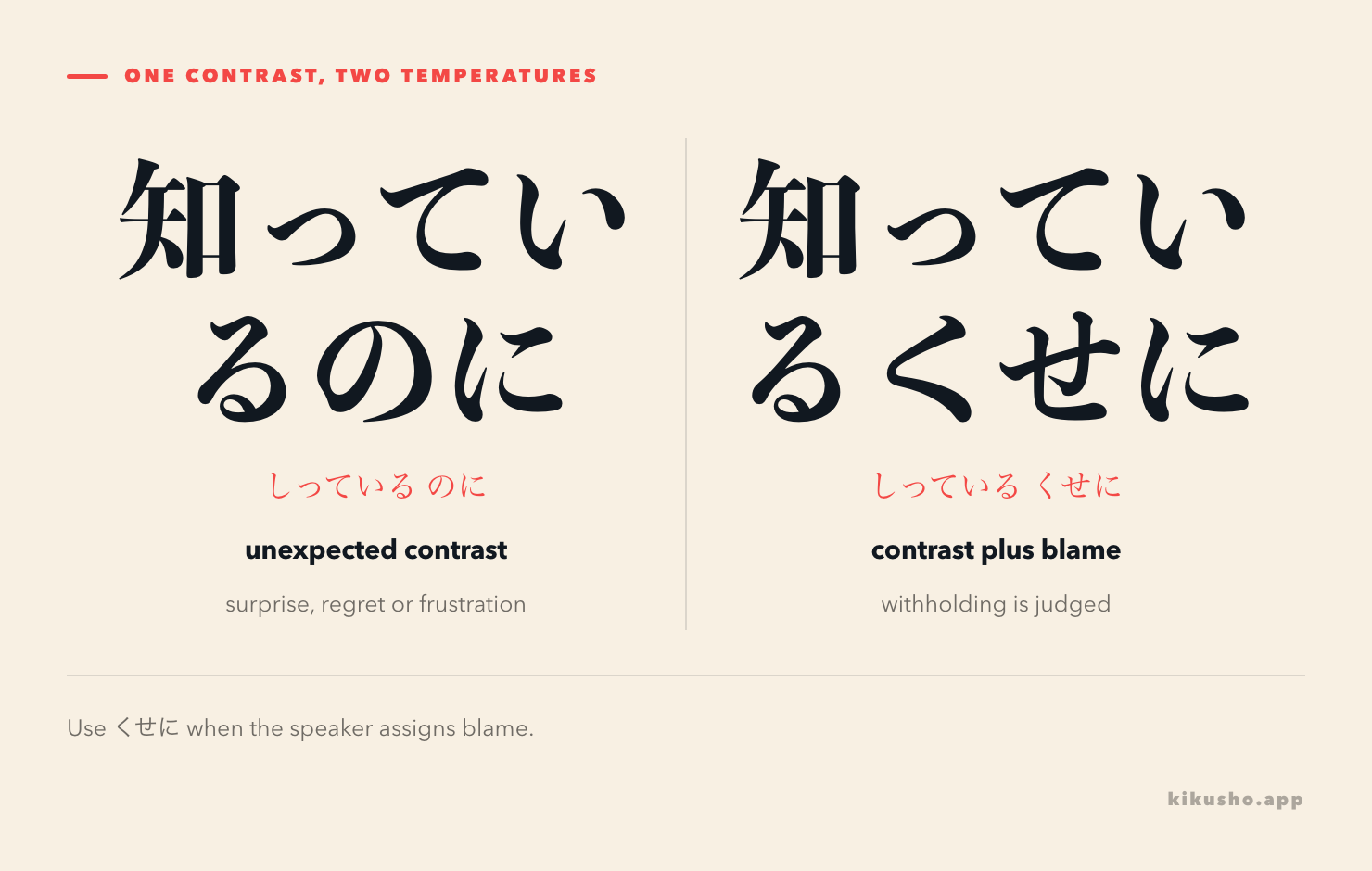
くせに joins two facts that clash and makes the clash sound blameworthy, irritating or teasing. 知っているくせに、教えてくれない means “They know, yet they will not tell me,” with a criticism that plain のに does not force.
The construction does more than translate although. It tells you that the speaker thinks the person should know or behave better.
くせに turns the first fact into grounds for criticism
The first clause supplies a position, ability, state or action. The second shows behaviour that the speaker judges inconsistent with it.
自分もよく遅刻するくせに、彼は人の遅刻には厳しい。
じぶんも よく ちこくする くせに、かれは ひとの ちこくには きびしい。
He is often late himself, yet he is strict about other people being late.
The contradiction is not merely surprising. The speaker treats it as hypocrisy. That attitude is why くせに often appears in complaints, arguments and private comments about someone.
It can also carry lighter teasing when the relationship and voice allow it:
本当はうれしいくせに。
ほんとうは うれしい くせに。
You are happy about it, even if you pretend otherwise.
The words alone do not mark friendly teasing. Said coldly, the same line can sound accusatory. Learn the construction with its emotional temperature, not with one English gloss.
JLPT Sensei places くせに at N3 and describes it as a stronger, more negative counterpart to けど and のに. Bunpro also places it at N3 and identifies blame or criticism as its usual stance.
Attach くせに to the attributive form
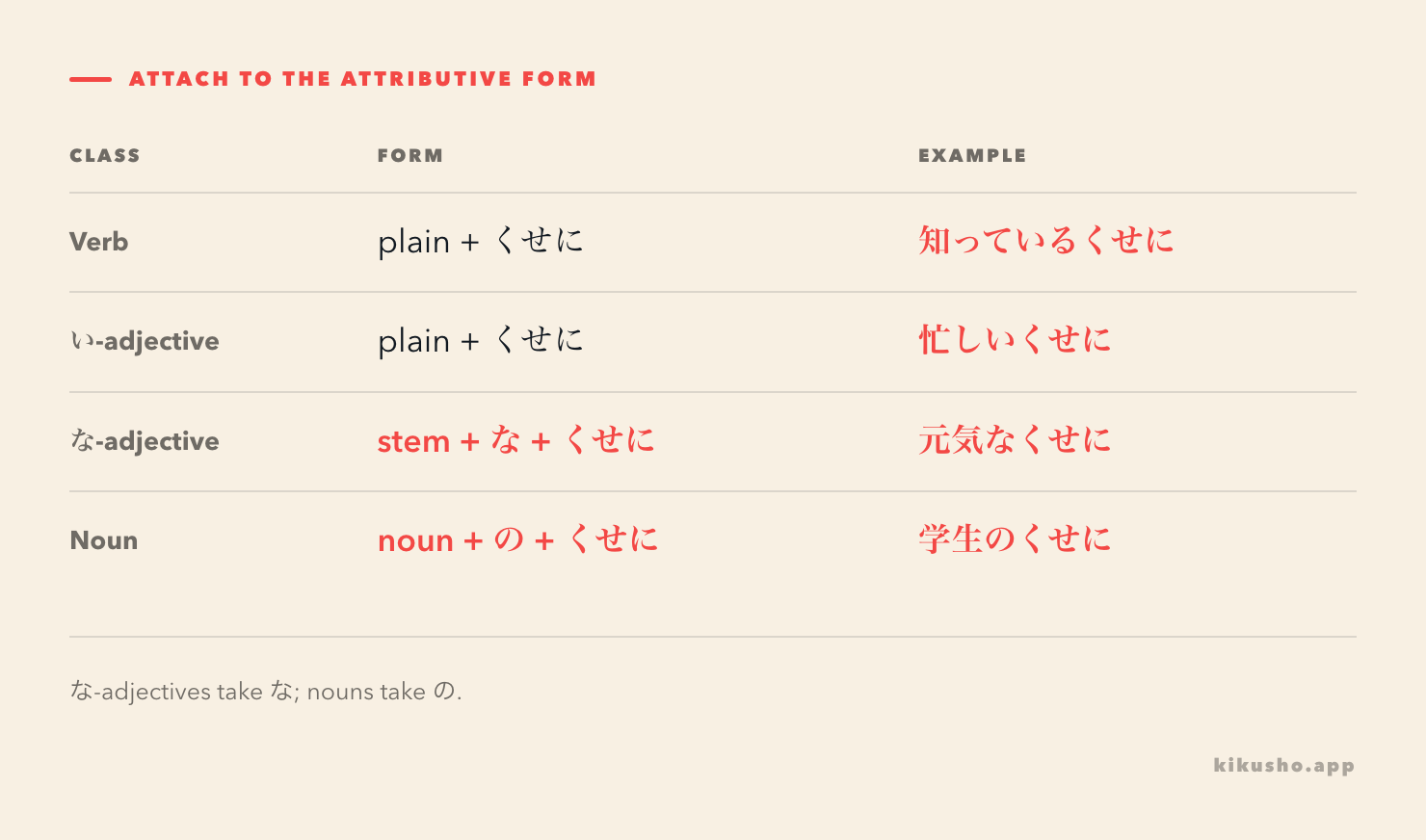
癖(くせ) is a noun meaning a habit or tendency. In this construction it is usually written in hiragana, but the noun origin still explains the attachment: the preceding expression modifies くせ.
| Word before くせに | Attachment | Example |
|---|---|---|
| verb | plain form + くせに | 知っているくせに |
| い-adjective | plain form + くせに | 忙しいくせに |
| な-adjective | stem + な + くせに | 元気なくせに |
| noun | noun + の + くせに | 学生のくせに |
何も知らないくせに、分かったようなことを言わないで。
なにも しらない くせに、わかった ような ことを いわないで。
You do not know anything, so do not talk as if you understand.
忙しいくせに、動画は毎晩見ている。
いそがしい くせに、どうがは まいばん みている。
You say you are busy, yet you watch videos every night.
元気なくせに、病気のふりをして休んだ。
げんきな くせに、びょうきの ふりをして やすんだ。
Although he was fine, he pretended to be ill and took the day off.
新人のくせに、先輩に仕事を任せきりにしている。
しんじんの くせに、せんぱいに しごとを まかせきりに している。
Despite being new, he leaves all the work to his senior colleagues.
The noun row needs の, not な: 学生のくせに. The な-adjective row needs な, not の: 元気なくせに. Negative and past plain forms already have their own endings, so they attach directly: 知らないくせに, 元気だったくせに, 学生だったくせに.
The two clauses normally judge the same person
In the clearest pattern, the person described in the first clause is also responsible for the second. This is what lets the speaker measure behaviour against that person's own situation.
彼は約束したくせに、連絡もしなかった。
かれは やくそくした くせに、れんらくも しなかった。
He made a promise, yet he did not even get in touch.
Both 約束した and 連絡しなかった describe him. Another person may appear inside the second clause without changing that relationship:
部長は自分も遅刻するくせに、部下が遅れると怒る。
ぶちょうは じぶんも ちこくする くせに、ぶかが おくれると おこる。
The manager is late too, yet gets angry when a subordinate is late.
The subordinate is the subject of 遅れる, but the manager remains the person whose behaviour is judged: the manager is late and the manager gets angry. Teaching resources often summarize this as “the subjects must be the same.” It is more useful to trace who owns the contradiction than to count every が in the sentence.
When two genuinely different people supply the two main facts, のに is the ordinary choice:
彼女が頼んだのに、彼は貸さなかった。
かのじょが たのんだ のに、かれは かさなかった。
Although she asked, he did not lend it to her.
Japanese teacher YaToMonkey's くせに lesson gives this same-subject tendency and contrasts it directly with のに. Benri Japan's N3 explanation likewise treats shared responsibility and a strong negative attitude as central.
Choose のに when the contrast does not deserve blame
Compare the same basic information:
| Sentence | Speaker's stance |
|---|---|
| 彼は知っているのに、教えてくれない。 | The mismatch is frustrating or unexpected. |
| 彼は知っているくせに、教えてくれない。 | His refusal is criticized as knowing and withholding. |
のに can carry disappointment, surprise or dissatisfaction, so it is not emotionless. Its range is simply wider. The ても and のに comparison explains how のに presents a given fact followed by an unexpected result.
The safer choice is のに when the outcome is positive or when nobody is answerable for it:
このかばんは小さいのに、たくさん入る。
この かばんは ちいさい のに、たくさん はいる。
This compact bag has room for a surprising amount.
This sounds like pleased surprise. Replacing のに with くせに would force a complaint or personified grudge that the context does not provide. Weather gives the same test: 雨なのに人が多い is a contrast; the rain has not behaved badly.
Meshclass defines くせに through behaviour that conflicts with what the situation leads one to expect. Bunpro's comparison with のに makes the tone difference explicit: のに can state the mismatch, while くせに evaluates it negatively.
Self-criticism and non-human subjects are marked uses
You will most often use くせに about someone else. Applying it to yourself is possible when you step outside your own behaviour and reproach yourself:
ダイエット中のくせに、またケーキを買ってしまった。
ダイエットちゅうの くせに、また ケーキを かって しまった。
Even though I am dieting, I went and bought cake again.
Here the speaker judges their own inconsistency almost as if talking about another person. If you only want to express disappointment at a result, のに is more natural: 昨日勉強したのに、三十点しか取れなかった, “I studied yesterday, but only got thirty points.”
Some teaching sources state that くせに cannot take a non-human subject. That is a strong production rule for learners, but conversation can extend blame through personification or through an implied responsible person. A pet that begs after eating can be teased with さっき食べたくせに. An angry owner may complain about an expensive device. Ordinary rain, distance or price contrasts still call for のに.
The practical rule is to look for an accountable target. Without someone or something being treated as responsible, くせに has nowhere to place its criticism.
A final くせに leaves the accusation unsaid
The second clause can be omitted when the listener can recover it:
何も知らないくせに。
なにも しらない くせに。
You do not know anything, and yet…
The unfinished form may imply “so stop talking,” “do not interfere,” or another rebuke supplied by the scene. Goo's Japanese dictionary records this sentence-final use as well as attachment to attributive forms and nouns followed by の.
You may also meet くせして, a more conversational variant with the same critical core:
知らないくせして、偉そうに言わないで。
しらない くせして、えらそうに いわないで。
Do not speak so arrogantly when you do not know.
Recognize it, but build your first examples with the assigned くせに. Avoid using either form toward a superior or in a neutral report. Its sharpness survives polite endings; くせにです does not turn blame into courtesy.
The N3 placement is not unanimous. JLPT Sensei and Bunpro teach this construction at N3, while the Kikusho inventory records Tanos at N2 and several Japanese-teacher sites also label it N2. Kikusho keeps it in the N3 sequence because two independent current resources place this exact use there. All such levels are study estimates, since the JLPT publishes no exhaustive official grammar syllabus.
If you capture くせに from dialogue in Kikusho, save enough of both clauses to preserve who is being judged. A card containing only “even though” loses the point; an editable card with the speaker's accusation intact gives you something you can recognize in the next argument or teasing exchange.
Practice
Question 1 — attach a な-adjective
Complete the sentence: 元気( )、病気のふりをして休んだ。
A. のくせに
B. なくせに
C. だくせに
Question 2 — attach a noun
Which form correctly means “despite being a professional”?
A. プロなくせに
B. プロだくせに
C. プロのくせに
Question 3 — choose the speaker's stance
A colleague knows the answer but refuses to tell anyone. You want to criticize that deliberate behaviour. Which sentence best fits?
A. 答えを知っているくせに、誰にも教えない。
B. 答えを知っていても、誰にも教えない。
C. 答えを知っているので、誰にも教えない。
Question 4 — keep the contrast neutral
You are pleasantly surprised that a small room feels spacious. Choose the natural connector:
この部屋は小さい( )、広く感じる。
A. くせに
B. のに
C. ので
Question 5 — rebuild the criticism
Put these chunks in order to mean “He promised, yet he did not even contact me.”
連絡もしなかった / 彼は / 約束したくせに
Question 6 — follow the responsible person
Read the sentence:
部長は自分も遅刻するくせに、部下が遅れると怒る。
Who is criticized, and which two actions create the contradiction?
Question 7 — recover the missing clause
After someone gives confident advice about a topic they do not understand, another speaker mutters 何も知らないくせに。 What does the unfinished ending do?
A. It praises the advice as unexpectedly useful.
B. It leaves a negative conclusion for the listener to infer.
C. It turns the sentence into a neutral factual report.
Answers and explanations
1 — B. Build the attributive form 元気な from the な-adjective 元気, giving 元気なくせに. A uses the noun attachment, while C keeps the predicative だ where な is required.
2 — C. An affirmative nonpast noun takes の before くせに: プロのくせに. The な-adjective pattern in A and the plain copula in B do not attach correctly here.
3 — A. 知っているくせに presents knowing the answer as grounds for criticizing the refusal. B says that the result holds even under the condition of knowing, without building in the same accusation. C supplies a reason and produces the illogical claim “because they know, they do not tell anyone.”
4 — B. この部屋は小さいのに、広く感じる expresses a pleasing mismatch between size and impression. Nothing in the setting deserves blame, so くせに would impose an unsupported complaint. ので means “because” and reverses the intended relation.
5. 彼は約束したくせに、連絡もしなかった。 The same person made the promise and failed to contact the speaker. も after 連絡 strengthens the complaint: he did not even make contact.
6. The manager is criticized. 自分も遅刻する says the manager is late too, while 怒る says the manager gets angry when a subordinate is late. 部下 is the subject of the embedded 遅れる clause, but the contradiction still belongs to the manager.
7 — B. Sentence-final くせに leaves the rebuke unspoken. The scene can supply something like “so you should not advise people” or “stop acting like an expert.” It neither praises the advice nor removes the speaker's negative judgment.
Common questions
What does くせに mean in Japanese?
くせに means “even though” or “and yet,” but it also signals criticism, irritation or teasing. 知っているくせに、教えてくれない complains that someone knows something yet will not say it.
What is the difference between くせに and のに?
Both can mark an unexpected contrast. のに can express surprise, regret or dissatisfaction without directly blaming someone. くせに presents the person’s behaviour or position as grounds for criticism, so it sounds sharper.
How does くせに attach to nouns and adjectives?
Use a plain verb or い-adjective directly, な after an affirmative nonpast な-adjective, and の after an affirmative nonpast noun: 知っているくせに, 忙しいくせに, 元気なくせに, 学生のくせに.
Is くせに N3 or N2 grammar?
JLPT Sensei and Bunpro place it at N3, while Tanos and some Japanese-teacher resources place it at N2. These are editorial estimates because the JLPT does not publish an exhaustive official grammar list.