On this page
Use Yに比べて when Y is the standard against which you measure X. Use Yに対して when an action or attitude points toward Y, or use Aのに対してB when two complete facts are set against each other.
The English words “compared with,” “toward,” and “whereas” can overlap around contrast, but the Japanese structures do different jobs. Find the role of the phrase before translating it.
One test separates the three relationships
Ask what follows from the relationship:
| Intended relationship | Form | What it establishes |
|---|---|---|
| measure X using Y as a standard | XはYに比べて… | a difference in degree, quality, or change |
| direct an action or attitude toward Y | Yに対して… | Y is the target |
| place fact A beside contrasting fact B | Aのに対して、B | two propositions are opposed |
この町は東京に比べて家賃が安いです。
Rent is inexpensive in this town compared with Tokyo.
店員は客に対して丁寧に説明しました。
The clerk explained things politely to the customer.
姉は慎重なのに対して、弟はすぐ行動します。
The older sister is cautious, whereas the younger brother acts immediately.
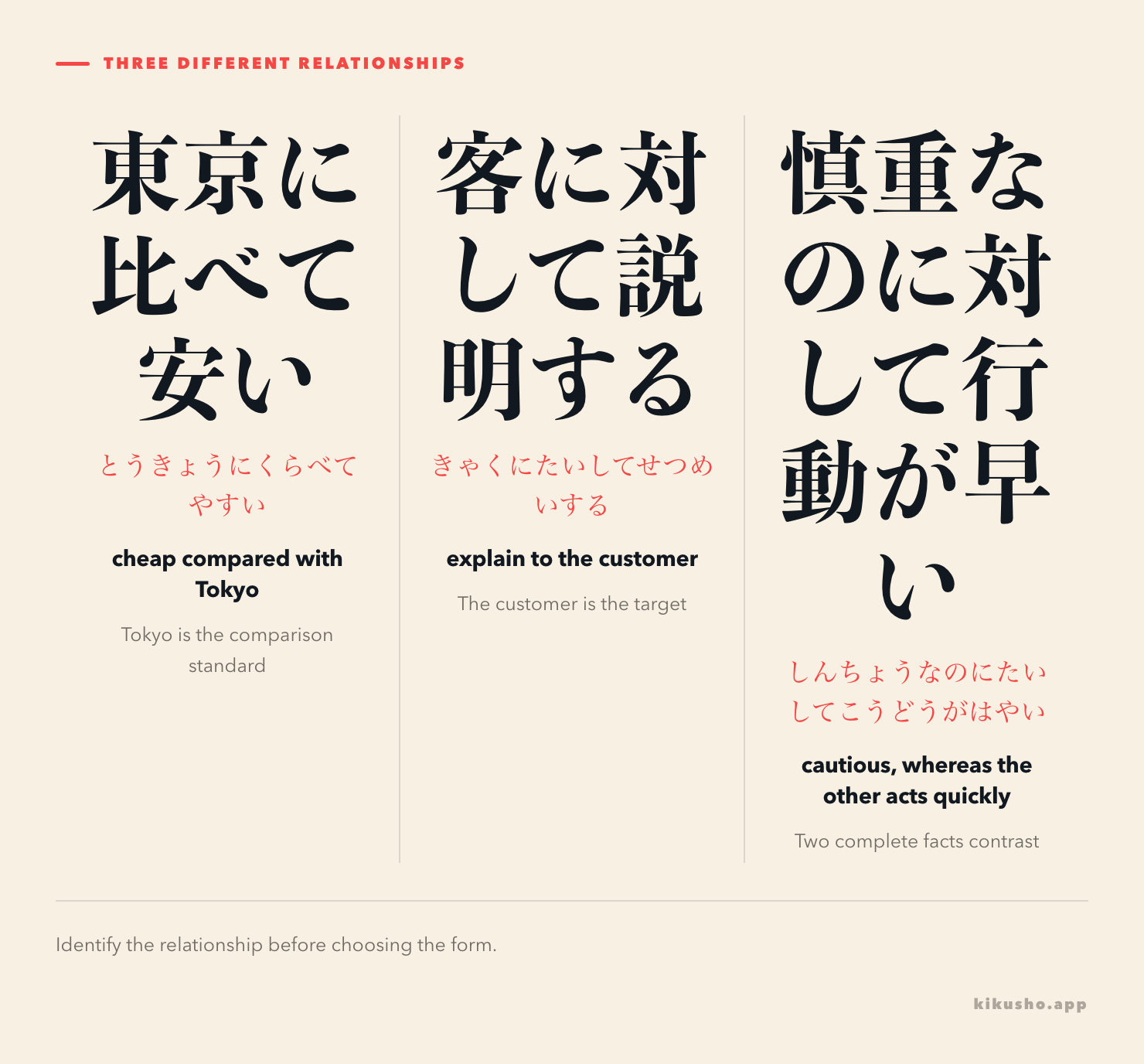
The first sentence needs a scale: rent is cheaper. The second has no comparison at all; the customer receives the clerk's manner and explanation. The third contrasts two habits without measuring either person on one shared scale.
に比べて supplies the comparison standard
The basic frame is XはYに比べて + description. Y is the reference point, and the final predicate tells you what differs.
今年は去年に比べて雨が少ないです。
This year has less rain than last year.
電車はバスに比べて時間が正確です。
Trains are punctual compared with buses.
五年前に比べて、この駅の周りはにぎやかになりました。
Compared with five years ago, the area around this station has become lively.
The compared property does not need a special comparative ending. 少ない, 正確だ, and にぎやかになった keep their ordinary forms. に比べて only names the baseline.
You can compare an action by turning it into a noun phrase with の:
車で行くのに比べて、電車で行くほうが早いです。
Going by train is faster than going by car.
The Japan Foundation's teaching reference for に比べて gives both noun attachment and this verb + の + に比べて pattern. It also records と比べて, に比べると, and に比べれば as close alternatives. At N5, the lesson on より, ほうが, and いちばん builds the basic comparison; に比べて packages the reference as an explicit act of comparing.
に対して points an action, feeling, or attitude at a target
In its directional use, Nに対して identifies the person, group, question, decision, or issue that receives a response, attitude, or action.
先生は学生に対して公平です。
The teacher is fair toward the students.
住民はその計画に対して反対しました。
The residents opposed that plan.
この質問に対して、短く答えてください。
Please answer this question briefly.
Words such as 反対する, 抗議する, 答える, 失礼だ, 厳しい, and 親切だ make the direction easy to see. The target is not merely the subject matter of a conversation. The previous lesson on について, に関して, and に関する separates a topic from this directed relationship.
The form before a noun is Nに対する + noun:
子どもに対する支援
support for children
質問に対する答え
an answer to a question
に対して introduces a following clause; に対する modifies a following noun. The shorter に対し is common in formal writing and performs the same clause-linking job as に対して.
のに対して contrasts two complete facts
The second major use puts one proposition against another. The first side is not a comparison standard like Y in Yに比べて. It is a complete fact whose counterpart follows.
兄は朝型なのに対して、弟は夜型です。
The older brother is a morning person, whereas the younger brother is a night person.
父は毎日車で通勤するのに対して、母は電車を使います。
My father commutes by car every day, whereas my mother takes the train.
去年の夏は暑かったのに対して、今年は涼しいです。
Last summer was hot, whereas this year is cool.
Attachment follows the plain form plus の:
| First side | Attachment | Example opening |
|---|---|---|
| verb clause | dictionary or past form + のに対して | 車で通勤するのに対して |
| い-adjective clause | present or past form + のに対して | 暑いのに対して |
| な-adjective description | adjective stem + なのに対して | 静かなのに対して |
| noun statement | noun + なのに対して | 朝型なのに対して |
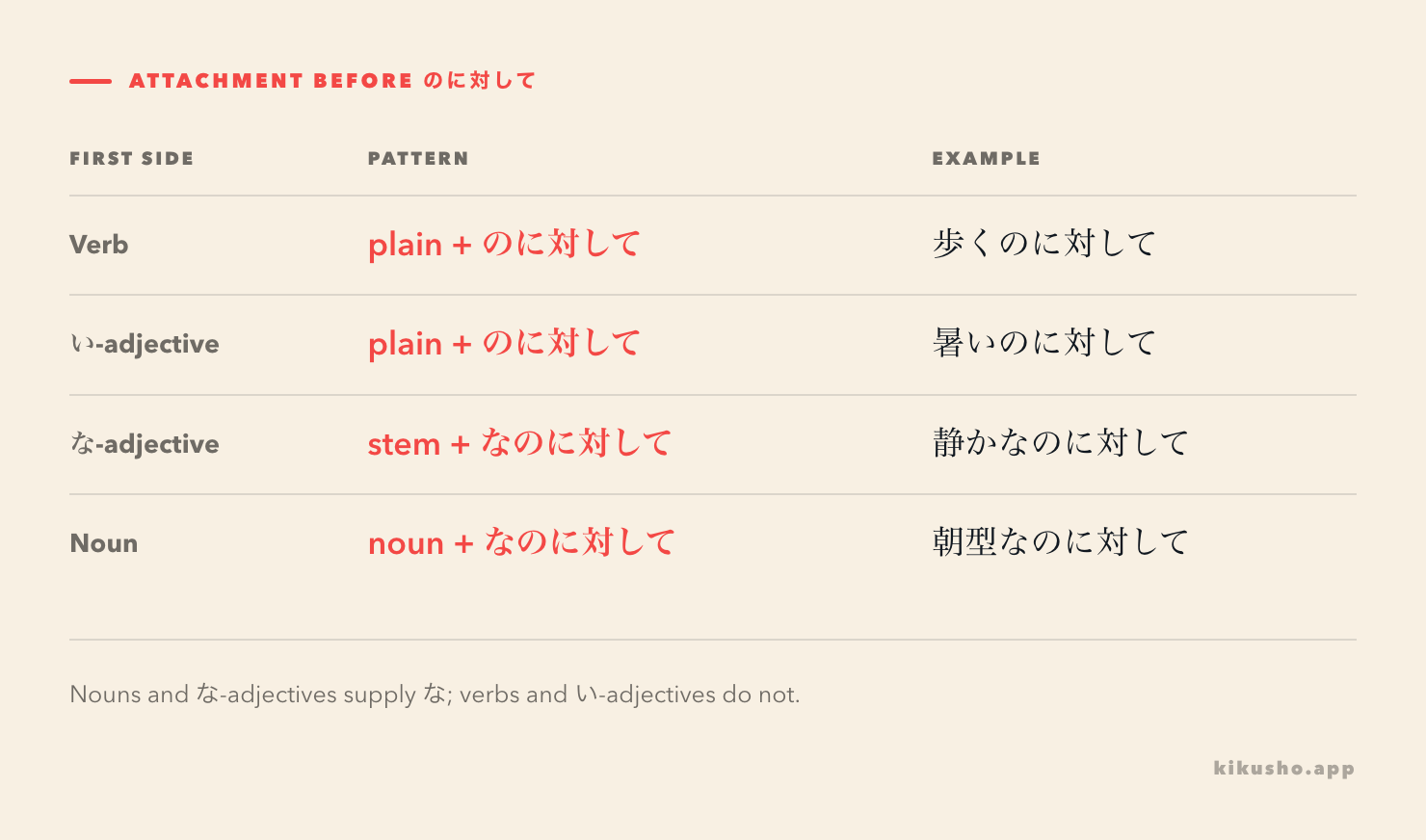
This の belongs to the contrast construction. In the target use, a noun attaches directly: 学生に対して. Compare 学生に対して説明する, “explain to the students,” with 学生が多いのに対して、先生は少ない, “there are many students, whereas there are few teachers.”
The Japan Foundation reference for に対して explicitly separates the target use from the proposition-to-proposition contrast and gives the noun and な-adjective change to な. Bunpro's N3 entry likewise records に対して and に対する and emphasizes the contrastive relationship.
Both can compare, but they organize the sentence differently
に比べて and contrastive に対して can describe the same pair, yet they make different claims.
去年に比べて、今年は売り上げが多いです。
Compared with last year, sales are higher this year.
去年は売り上げが少なかったのに対して、今年は多いです。
Sales were low last year, whereas they are high this year.
The に比べて sentence makes last year the baseline and evaluates this year on the scale of sales. The のに対して sentence gives both years their own proposition, then contrasts them. The first is efficient when one item is the focus. The second is useful when both sides deserve parallel wording.
This distinction also prevents confusion with に反して. 予想に反して売り上げが増えた means sales rose contrary to expectations; the lesson on に反して and にしては explains that violated expectation. Neither に比べて nor に対して by itself says that a result was unexpected.
Practice: decide the relationship before the form
Question 1. Complete the sentence that measures this year against last year: 今年は去年__雨が多いです。
- ア. に比べて
- イ. に対して
- ウ. に対する
- エ. なのに対して
Question 2. Choose the target marker: 会社は利用者の質問__すぐ回答しました。
- ア. に比べて
- イ. に対して
- ウ. のに対して
- エ. に比べると
Question 3. Choose the form before a noun: 高齢者__支援を増やしました。
- ア. に対して
- イ. に比べて
- ウ. に対する
- エ. のに対して
Question 4. Complete the contrast: 姉は慎重__、弟はすぐ行動します。
- ア. に比べて
- イ. に対して
- ウ. なのに対して
- エ. に対する
Question 5. Which sentence contains an attachment error?
- ア. 去年に比べて、今年は暖かいです。
- イ. この質問に対する答えました。
- ウ. 父は歩くのに対して、母は自転車に乗ります。
- エ. この質問に対して答えました。
Question 6. Arrange the pieces to say “Going by train is faster than going by car”: 早いです / 車で行くのに比べて / 電車で行くほうが.
Question 7. Read the workplace note, then fill ① and ②.
前の職場( ① )、今の職場は休みが多い。それに、会社は休暇を取る社員( ② )理解がある。
- ア. ① に比べて / ② に対して
- イ. ① に対して / ② に比べて
- ウ. ① に対する / ② のに対して
- エ. ① なのに対して / ② に対する
Answers and explanations
Answer 1: ア, に比べて. Last year is the baseline, and 多い supplies the measured difference. に対して would need a target relationship or two parallel propositions.
Answer 2: イ, に対して. The company's answer is directed at the users' question. に比べて would turn the question into a comparison standard, which the sentence does not support.
Answer 3: ウ, に対する. 支援 is a noun, so the directional family takes に対する immediately before it. に対して must introduce a following clause.
Answer 4: ウ, なのに対して. 慎重 is a な-adjective. The proposition-to-proposition contrast therefore uses 慎重なのに対して before the younger brother's different behavior.
Answer 5: イ. The noun-modifying form に対する needs a noun on its right. Here 答えました is verbal, so the clause requires この質問に対して答えました. The other three sentences correctly express a comparison baseline, a contrast between two actions, and a directed answer.
Answer 6: 車で行くのに比べて、電車で行くほうが早いです。 The action 車で行く is nominalized with の before に比べて. 電車で行くほう is the alternative evaluated as faster.
Answer 7: ア. 前の職場に比べて、今の職場は休みが多い。それに、会社は休暇を取る社員に対して理解がある。 The former workplace is the comparison baseline. The employees are the target of the company's understanding.
Both assigned constructions are commonly placed at N3 by Bunpro and JLPT Sensei; the Japan Foundation materials retain the historical 旧2級 label. These are publisher study estimates because the JLPT does not publish an exhaustive official grammar-item list.
Common questions
What is the difference between に比べて and に対して?
に比べて sets a comparison standard and describes a difference in degree, quality, or change. に対して directs an action or attitude toward a target, or places two complete facts in contrast.
What comes before a noun: に対して or に対する?
Use に対する directly before a noun, as in 学生に対する支援. Use に対して when the rest of a clause follows, as in 学生に対して支援を行う.
Can に対して mean whereas?
Yes. A plain-form clause plus のに対して can be followed by a contrasting clause. Nouns and な-adjectives take なのに対して in this pattern.