On this page
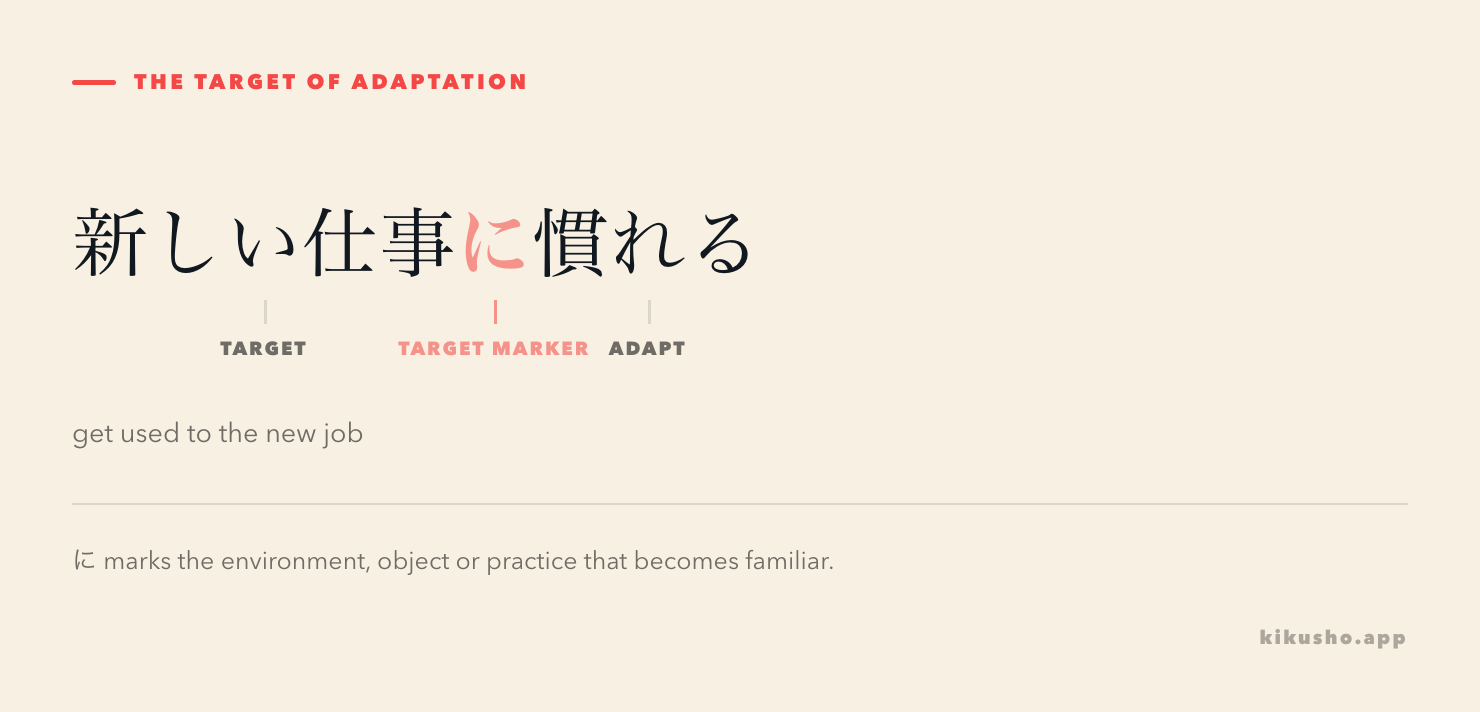
に慣れる means “to get used to” or “to become accustomed to” a thing, place, situation or repeated action. Put that target before に: 新しい仕事に慣れる means “get used to the new job,” while an action becomes Vること/Vるの + に慣れる.
The form itself is simple. The useful distinction is aspect: 慣れる presents the change, 慣れている presents the settled state after it, and 慣れてきた lets you look back at progress toward now.
The pattern puts the target before に
The basic attachment is:
| What you adapt to | Pattern | Example |
|---|---|---|
| noun | noun + に慣れる | 新しい職場に慣れる |
| action with こと | dictionary-form verb + こと + に慣れる | 日本語で話すことに慣れる |
| action with の | dictionary-form verb + の + に慣れる | 早く起きるのに慣れる |
新しい職場に慣れるまで、一か月かかりました。
しんしいしょくばに なれるまで、いっかげつ かかりました。
It took a month to get used to the new workplace.
Here 新しい職場 is neither a destination nor a direct object. It is the environment to which the person adapts. That relationship takes に.
The same pattern works with sounds, food, equipment, climate and routines:
- 電車の音に慣れる: get used to the sound of trains
- 辛い料理に慣れる: get used to spicy food
- 新しいキーボードに慣れる: get used to a new keyboard
- 早起きに慣れる: get used to waking early
JLPT Sensei's に慣れる entry gives the noun attachment and also shows action clauses with の and こと. Its N3 label is a study-list estimate. The JLPT organizers explain that they no longer publish exhaustive vocabulary, kanji and grammar lists, so N3 describes a useful preparation sequence rather than an official boundary around the verb.
Turn an action into the thing you get used to
A finite verb cannot stand directly before this に. First nominalize the action with こと or の.
日本語で電話することに慣れました。
にほんごで でんわすることに なれました。
I got used to making phone calls in Japanese.
人前で話すのに慣れていません。
ひとまえで はなすのに なれていません。
I am not used to speaking in front of people.
Both Vることに慣れる and Vるのに慣れる can name a repeated activity. こと packages the action as a general practice; の often feels close to the particular activity being experienced. That is a tendency, not a rule that changes the core meaning. Choose one cleanly and keep the particle に after it.
This sequence contains two separate pieces:
- 日本語で話すこと names “speaking in Japanese” as an activity.
- に慣れる says that the subject adapts to that activity.
Do not read のに here as the concessive connector meaning “although.” In 早く起きるのに慣れた, の nominalizes 早く起きる, and に belongs to 慣れる. A following verb makes the structure visible.
慣れる is a change; 慣れている is its result
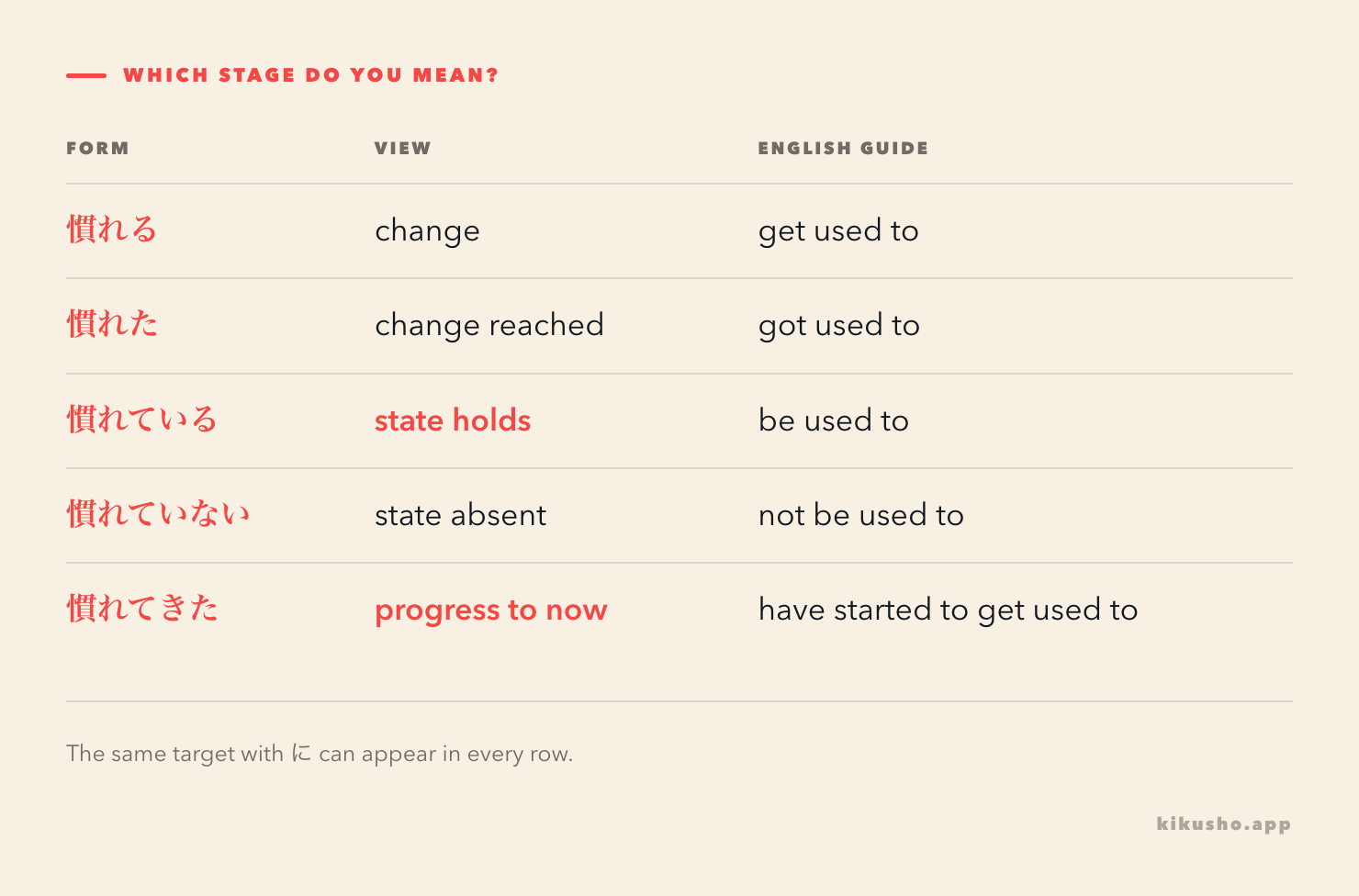
English often uses “be used to” for the state and “get used to” for the change. Japanese makes that difference with the verb form.
| Form | View of adaptation | Natural translation |
|---|---|---|
| 慣れる | change as a general or future event | get used to |
| 慣れた | change reached in the past | got used to |
| 慣れている | resulting state holds now | be used to |
| 慣れていない | resulting state does not hold | not be used to |
| 慣れてきた | process has developed toward now | have started to get used to |
Compare one situation at three moments:
このソフトにすぐ慣れると思います。
I think I will soon get used to this software.
このソフトにはもう慣れました。
I have already got used to this software.
このソフトには慣れています。
I am accustomed to this software.
The last two can describe the same person on the same day. 慣れました looks at reaching the change; 慣れています looks at the state that now continues. The same result-state logic appears in many Japanese ~ている forms, so the translation “am getting used to” is not automatic.
慣れてきた makes progress visible
Use 慣れてきた when adaptation began earlier and has become noticeable at the present point.
最初は大変でしたが、少しずつ夜勤に慣れてきました。
さいしょは たいへんでしたが、すこしずつ やきんに なれてきました。
It was hard at first, but I have gradually started to get used to the night shift.
The helper くる gives the process a direction toward now. Words such as だんだん, 少しずつ and 最近 fit because they make development visible. The ていく and てくる lesson explains that time axis in full.
慣れてきた does not promise that the process is complete. If the situation now feels ordinary, もう慣れた or 慣れている is clearer. If adaptation is still unfolding, だいぶ慣れてきた leaves room for more.
There is also a forward-looking form:
毎日使えば、だんだん慣れていくでしょう。
If you use it every day, you will gradually get used to it.
Here ていく follows the process onward from the chosen point. This is an aspect choice built around 慣れる, not a separate particle pattern.
に stays attached even when another particle enters
Topic and emphasis particles can follow に without erasing its job.
この暑さにはなかなか慣れません。
I cannot easily get used to this heat.
The sequence には combines the target marker に with topic or contrast は. It can highlight this particular difficulty, especially against other conditions that are easier.
新しい生活にも慣れてきました。
I have also started to get used to the new way of life.
In にも, も adds “also/even” while に still marks the target. Removing に changes the verb's required relationship. The broader verb-and-particle guide shows why learning a verb with its usual noun pattern is safer than translating particles one at a time.
A direct-object sentence is therefore wrong:
× 新しい仕事を慣れました。
○ 新しい仕事に慣れました。
The subject experiences the adjustment; the job is not an object acted upon. 慣れる behaves as an intransitive verb in this use.
慣らす changes who causes the adjustment
慣れる describes the person or animal becoming accustomed. 慣らす is transitive: someone deliberately accustoms a person, animal or body part to something.
毎日日本語を聞いて、耳を速い会話に慣らします。
I listen to Japanese every day and accustom my ears to fast conversation.
耳が速い会話に慣れてきました。
My ears have started to get used to fast conversation.
The first sentence names an affected object with 耳を and a target with 速い会話に. The second makes 耳 the adapting subject. This resembles other transitive and intransitive pairs, but you should learn the pair as XがYに慣れる / XをYに慣らす, rather than guessing from the ending alone.
Do not stretch 慣らす into every ordinary description of experience. When the subject simply adapts through repeated contact, 慣れる is the direct verb.
What this N3 point does not cover
The lesson teaches independent noun/action + に慣れる. Japanese also forms compound verbs such as 使い慣れる, 見慣れる and 住み慣れる. In those, the stem of the first verb joins directly to 慣れる:
- 使い慣れた道具: a tool one is accustomed to using
- 見慣れない景色: unfamiliar scenery
- 住み慣れた町: a town one has long been accustomed to living in
The independently authored 毎日のんびり日本語教師 lesson documents this compound-verb construction and its restrictions. It is related in meaning, but it is not interchangeable with every Vることに慣れる clause. 人前で話すことに慣れる names the activity as a target; 話し慣れる presents speaking as an action made familiar through experience.
Keeping that boundary prevents a short N3 pattern from becoming a claim that any verb stem can freely combine with 慣れる.
Practice
Try all seven before opening the answer block. The three forms are close enough that the time cue often decides the best answer.
Question 1. Choose the particle: 新しい環境( )慣れるまで、少し時間が必要です。
- ア. を
- イ. に
- ウ. で
- エ. から
Question 2. Your colleague now handles the software comfortably. Which sentence presents that settled state?
- ア. このソフトに慣れています。
- イ. このソフトを慣れています。
- ウ. このソフトに慣らしています。
- エ. このソフトで慣れました。
Question 3. Complete the action pattern: 日本語でメールを書く( )慣れてきました。
- ア. ことを
- イ. ことに
- ウ. ことが
- エ. ことで
Question 4. The speaker is still making progress. Choose the best ending: 最初は難しかったですが、最近はだいぶ__。
- ア. 慣れてきました
- イ. 慣れていました
- ウ. 慣らしました
- エ. 慣れるまでです
Question 5. Rewrite 毎朝早く起きます so that it means “I am used to getting up early every morning.” Use の and 慣れている.
Question 6. Read the short passage and choose the best form.
先月、夜の仕事を始めました。最初の一週間は眠くて大変でした。今も少し疲れますが、前より楽になりました。少しずつ夜勤に( )。
- ア. 慣れてきました
- イ. 慣らしました
- ウ. 慣れていませんでした
- エ. 慣れるでしょうでした
Question 7. Write one sentence saying that it took you two weeks to get used to speaking in online meetings. Use Vることに慣れるまで.
Answers and explanations
Answer 1. イ. に. The environment is the target of adaptation, so it takes に. を would mark a direct object, で commonly marks a setting or means, and から marks a starting point.
Answer 2. ア. このソフトに慣れています。 慣れている presents the current resulting state. イ uses the wrong particle. ウ means that the subject is deliberately accustoming someone or something to the software, and it omits the affected object. エ uses で where the target requires に.
Answer 3. イ. ことに. 日本語でメールを書くこと turns the action into a noun phrase, then に marks it as the practice being learned through repetition. The other particles do not complete に慣れる.
Answer 4. ア. 慣れてきました. 最初は, 最近 and だいぶ trace a process from an earlier difficult stage toward the present. イ describes a state that held at a past reference point. ウ is transitive “accustomed something,” and エ does not form a predicate for this contrast.
Answer 5. One natural answer is 毎朝早く起きるのに慣れています。 の nominalizes the action, に marks it as the target, and 慣れている says the resulting state already holds.
Answer 6. ア. 慣れてきました. The passage begins with difficulty last month and ends with improvement now, so a process reaching the present fits. イ would require an object being deliberately trained. ウ contradicts the stated improvement, and エ combines incompatible endings.
Answer 7. One natural answer is オンライン会議で話すことに慣れるまで、二週間かかりました。 The meeting is the setting marked by で; the full activity becomes the target through ことに. まで closes the interval at the point when adaptation was reached.
Keep the time cue on the card
The English side of a flashcard often flattens all three forms into “used to.” Preserve the word that fixes the stage instead: これから with 慣れる, もう with 慣れている, or 少しずつ with 慣れてきた.
In Kikusho, save the cue as part of the example and inspect the editable meaning before the card enters review. When it returns, the cue should force you to recover the stage of adaptation rather than merely recognize the dictionary form 慣れる.
Common questions
What does に慣れる mean?
に慣れる means to get used to or become accustomed to something. Put the environment, object or practice before に, as in 新しい仕事に慣れる.
How do you use に慣れる with an action?
Turn the action into a noun phrase with の or こと, then add に慣れる: 日本語で話すことに慣れる or 早く起きるのに慣れる.
What is the difference between 慣れる and 慣れている?
慣れる presents the change of becoming accustomed. 慣れている presents the resulting state: someone is already accustomed to the thing or activity.
What does 慣れてきた add?
慣れてきた looks back over a process that has developed toward the present, so it often means that you have gradually started to get used to something.