On this page
When two developments move together, both にしたがって and と共に can mean “as A changes, B changes.” Choose にしたがって when B follows the course set by A; choose と共に when you present A and B as parallel, accompanying developments.
Outside that overlap, the forms separate cleanly. 指示にしたがって行動する means to act according to instructions. 家族と共に暮らす means to live together with one’s family. Neither can replace the other in those sentences.
Ask what kind of link joins A and B
The English word “with” or “as” is too broad to decide. Identify the relationship first.
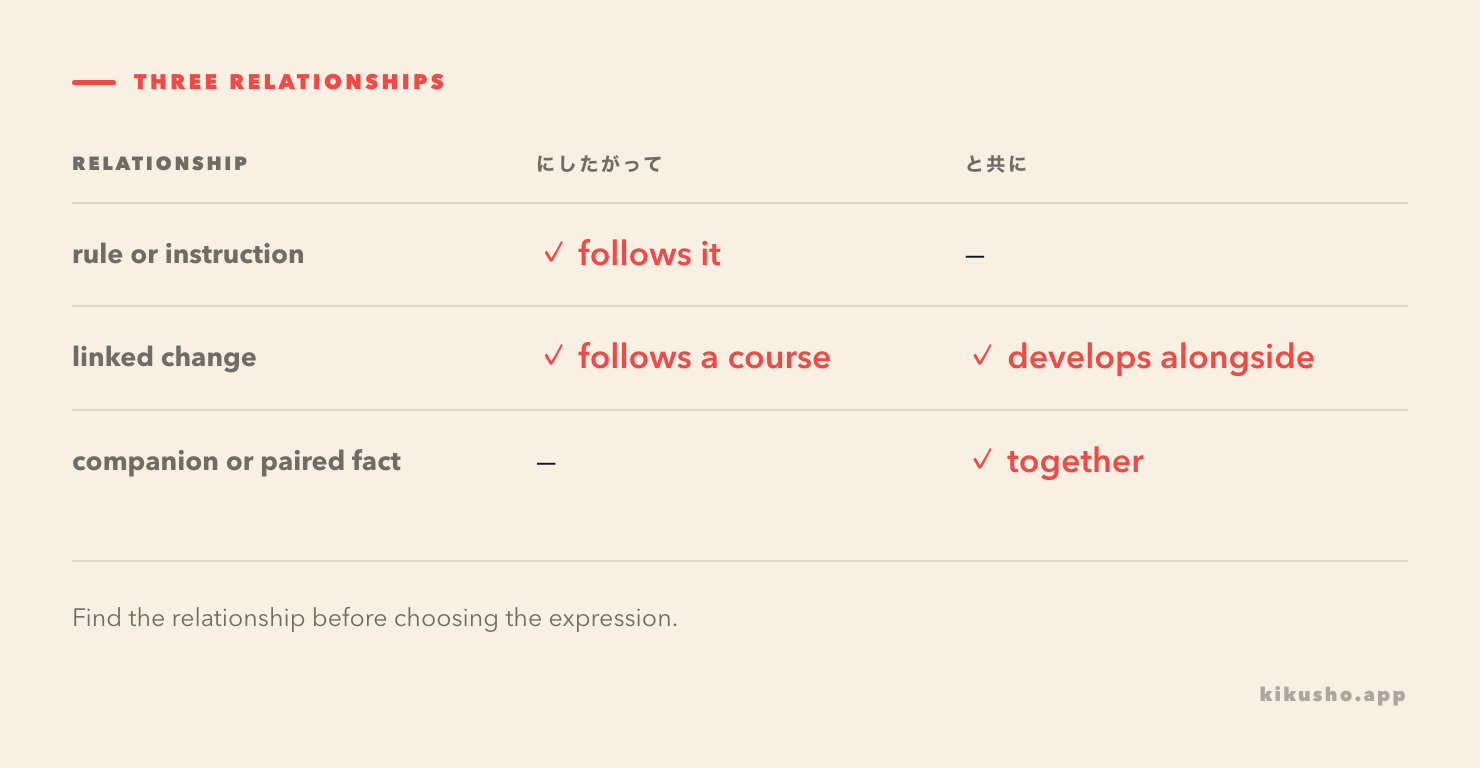
| Relationship | Natural form | Example |
|---|---|---|
| B follows a rule, direction or procedure | にしたがって | 手順にしたがって設定する |
| B develops as A progresses | にしたがって | 技術が進歩するにしたがって生活が変わる |
| a person or thing accompanies another | と共に | 仲間と共に働く |
| related events occur together | と共に | 開会と共に拍手が起こる |
| two facts or qualities coexist | と共に | 便利であると共に安全だ |
| A and B develop in parallel | と共に | 時代と共に価値観が変わる |
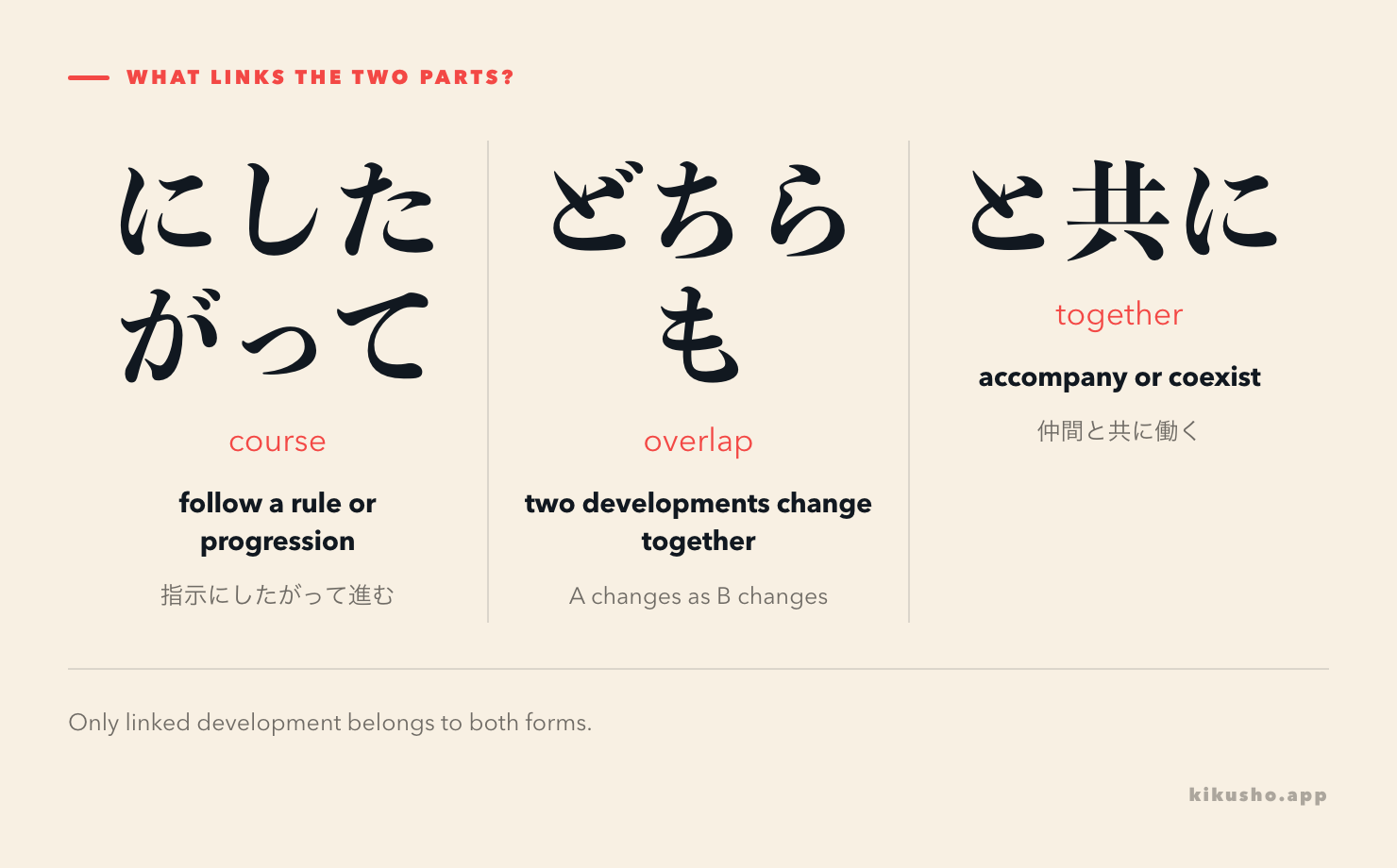
The overlap occupies only one row: linked development. If no gradual course or change exists, use the uncontested meaning of the form rather than forcing a comparison.
にしたがって follows a course
The form comes from 従う(したがう), “to follow” or “to comply.” Attach it to a noun or a dictionary-form verb.
| Attachment | Shape | Example |
|---|---|---|
| noun | N + にしたがって | 規則にしたがって |
| dictionary-form verb | Vる + にしたがって | 慣れるにしたがって |
| formal written variant | N / Vる + にしたがい | 方針にしたがい |
The first use is literal compliance or alignment:
係員の指示にしたがって、出口へ進んでください。
かかりいんの しじにしたがって、でぐちへ すすんでください。
Please proceed to the exit according to the staff member’s instructions.
The instruction sets a course, and the listener’s action follows it. Rules, policies, guidance, procedures and a person’s wishes can fill the same position.
The second use extends that image to change. One development provides the course along which another development unfolds:
日本語に慣れるにしたがって、読む速さも上がってきた。
にほんごに なれるにしたがって、よむ はやさも あがってきた。
As I became accustomed to Japanese, my reading speed also increased.
人口の増加にしたがって、住宅の需要も高まった。
じんこうの ぞうかにしたがって、じゅうたくの じゅようも たかまった。
As the population increased, demand for housing also rose.
The first part therefore needs a process, progression or change for this use. A static description such as 部屋が静かであるにしたがって supplies no course for the second part to follow.
毎日のんびり日本語教師 separates the compliance use from the linked-change use and gives noun and dictionary-form verb attachment for both. Bunpro’s reference likewise treats the pattern as formal and connects its two meanings through the idea of following what precedes it.
と共に puts two things on the same stage
共(とも)carries the idea of sharing or being together. The construction has several related uses, all of which place two participants, events, states or developments together.
For accompaniment, a noun comes before the form:
研究チームは地域の住民と共に調査を進めた。
けんきゅうチームは ちいきの じゅうみんとともに ちょうさを すすめた。
The research team carried out the survey together with local residents.
This is more formal than 住民と一緒に. It suits reports, prepared speeches and written descriptions.
For a related event that happens at the same time, use a noun or dictionary-form verb:
開会のベルと共に、会場が静かになった。
かいかいの ベルとともに、かいじょうが しずかに なった。
As the opening bell rang, the hall became quiet.
The two events are connected. A random coincidence is less suitable. The Japan Foundation notes that と共に is difficult when the events have little relation or when the second is an unexpected accident.
The form can also join two properties or roles:
この仕事は難しいと共に、大きな責任を伴う。
この しごとは むずかしいとともに、おおきな せきにんを ともなう。
This work is difficult and also carries great responsibility.
彼女は研究者であると共に、大学の教師でもある。
かのじょは けんきゅうしゃであるとともに、だいがくの きょうしでも ある。
She is a researcher as well as a university teacher.
With an い-adjective, attach と共に directly. With a な-adjective or noun in this paired-state use, add である. That attachment does not belong to the linked-change use of にしたがって.
The Japan Foundation teaching reference distinguishes accompaniment, related simultaneity, parallel change and coexisting states. It also identifies the expression as characteristic of writing. The independently authored 毎日のんびり日本語教師 lesson groups the same functions and confirms the broader attachment range.
In linked change, emphasis decides
Now consider the place where both forms work:
技術が進歩するにしたがって、働き方も変わった。
As technology advanced, ways of working also changed.
技術の進歩と共に、働き方も変わった。
Along with technological progress, ways of working also changed.
Both sentences connect technological progress with a change in working practices. The first views the second change as following the course of the first. The second places the two developments beside each other as a linked pair.
Attachment can also make one option more natural. 技術が進歩するにしたがって starts from a clause. 技術の進歩と共に packages that change as a noun. Compare complete units rather than swapping only the visible ending.
Neither pattern by itself proves a strict cause. Speakers often connect developments that are associated without claiming that A alone produced B. If causality matters, the wider sentence must establish it.
This overlap resembles につれて, which focuses on change unfolding in step with another change. For a trend that simply continues in one direction, 一方だ describes the movement itself rather than linking it to a second development.
The substitutions that fail reveal the boundary
Three failed swaps make the system easier to remember.
1. A rule cannot accompany you grammatically.
○ 手順にしたがって、申請してください。
Please apply according to the procedure.
× 手順と共に、申請してください。
The second wording would treat the procedure as an accompanying thing. It does not express compliance.
2. A companion does not set a course.
○ 友人と共に、新しい会社を始めた。
I started a new company together with a friend.
× 友人にしたがって、新しい会社を始めた。
The second sentence would mean that you followed the friend’s lead or instruction. That is a possible sentence, but it changes the relationship.
3. One sudden related event is not a progression.
○ 日の出と共に、鳥が鳴き始めた。
The birds began singing with the sunrise.
× 日の出にしたがって、鳥が鳴き始めた。
The sunrise is treated as a moment linked to the birds’ action, not a course that the action gradually follows. If the sentence described 空が明るくなるにしたがって, the progressive reading would return.
Register and spelling carry clues
Both constructions occur often in explanatory and formal prose. In casual conversation, 一緒に usually replaces the accompaniment use, while につれて may be a lighter alternative for linked change. The best replacement still depends on the relationship, so there is no single casual substitute for every sentence above.
The kanji spelling に従って makes the connection with 従う visible. Hiragana にしたがって is also common. Do not confuse either with sentence-initial したがって, “therefore.” The formal-connectors lesson separates that conjunction from the in-clause construction taught here.
Level labels also differ. JLPT Sensei lists にしたがって and と共に at N3. Bunpro places と共に at N3 but にしたがって at N2; the Japanese-teacher reference above also assigns the latter to N2. Kikusho retains both in this N3 lesson because that is the source inventory placement, while recording the disagreement rather than treating any study list as an official syllabus.
Practice
Work through the seven relationships first. The numbered explanations begin only after the final question.
Question 1. Choose the best form: 係員の案内( )、順番にお入りください。
- ア. と共に
- イ. にしたがって
- ウ. であると共に
- エ. に反して
Question 2. Choose the best form for accompaniment: 地域の人々( )、祭りの準備を進めた。
- ア. にしたがって
- イ. において
- ウ. と共に
- エ. に比べて
Question 3. Both forms can describe linked change. Which pair completes the sentences naturally?
経験を積む(甲)、判断が速くなった。
経験の増加(乙)、判断も速くなった。
- ア. 甲 にしたがって / 乙 と共に
- イ. 甲 と共に / 乙 にしたがって
- ウ. 甲 にしたがって / 乙 であると共に
- エ. 甲 と一緒に / 乙 に反して
Question 4. Which sentence uses と共に for two qualities or roles that coexist?
- ア. 家族と共に京都へ行った。
- イ. 夜明けと共に出発した。
- ウ. この装置は小型であると共に、性能も高い。
- エ. 時代と共に言葉が変化する。
Question 5. Which sentence is unnatural for the intended meaning?
- ア. 規則にしたがって手続きをしてください。
- イ. 春が近づくにしたがって暖かくなった。
- ウ. 友人と共に店を開いた。
- エ. 説明書と共に機械を操作した。〔説明書の指示どおりに、の意味〕
Question 6. Rewrite 先生の指示どおりに作文を直しました using にしたがって.
Question 7. Read the short passage and choose both answers.
新しい制度の導入(甲)、申請の方法も変わりました。利用者は画面の指示(乙)、必要な情報を入力してください。
- ア. 甲 と共に / 乙 にしたがって
- イ. 甲 にしたがって / 乙 と共に
- ウ. 甲 であると共に / 乙 において
- エ. 甲 に反して / 乙 と一緒に
Answers and explanations
Answer 1: イ, にしたがって. The staff member’s guidance sets the course the visitors should follow. と共に would describe accompaniment, not compliance.
Answer 2: ウ, と共に. The local people are participants who prepare the festival together. にしたがって would instead present them as the guide whose lead someone follows.
Answer 3: ア. A dictionary-form verb fits 経験を積むにしたがって. The nominal development 経験の増加 fits 経験の増加と共に. Both sentences present improved judgment as linked to growing experience.
Answer 4: ウ. 小型であると共に、性能も高い places compact size and high performance together as two properties. The other answers show accompaniment, related simultaneity and parallel change.
Answer 5: エ. If the intended meaning is “operate the machine according to the manual,” say 説明書にしたがって機械を操作した. 説明書と共に treats the manual as something physically accompanying the action.
Answer 6: 先生の指示にしたがって、作文を直しました。 The noun 指示 names the guidance followed. The original 指示どおりに expresses the same basic relationship in this sentence.
Answer 7: ア. 制度の導入と共に links the introduction with an accompanying change in the application process. 画面の指示にしたがって tells users to follow the directions displayed on screen.
If an exam item gives you both choices, first rule out compliance, companionship and paired qualities. Only when the sentence truly contains two linked developments do you need the finer question: does B follow A’s course, or does the writer place both changes side by side?
Common questions
What is the difference between にしたがって and と共に?
Both can connect two developments that change together. にしたがって also means following a rule, instruction or course, while と共に also expresses accompaniment, simultaneity and two qualities that coexist.
Can にしたがって and と共に be interchangeable?
Sometimes, when one gradual development accompanies another. The emphasis differs: にしたがって presents the second development as following the first, while と共に presents them as linked or parallel. Their other uses are not interchangeable.
Does と共に mean the same as と一緒に?
Only in the accompaniment use, such as 家族と共に暮らす. と共に can also connect simultaneous events, paired qualities or parallel change, where と一緒に does not provide the same grammar.
Are にしたがって and と共に N3 grammar?
JLPT Sensei lists both at N3, and Bunpro lists と共に at N3. Bunpro and some Japanese-teacher references place にしたがって at N2. These labels are study estimates because the current JLPT publishes no exhaustive grammar list.