On this page
Use noun + において before a statement, and noun + における before another noun. Both establish a formal setting: a place, a period, or a field within which an event happens or a claim holds.
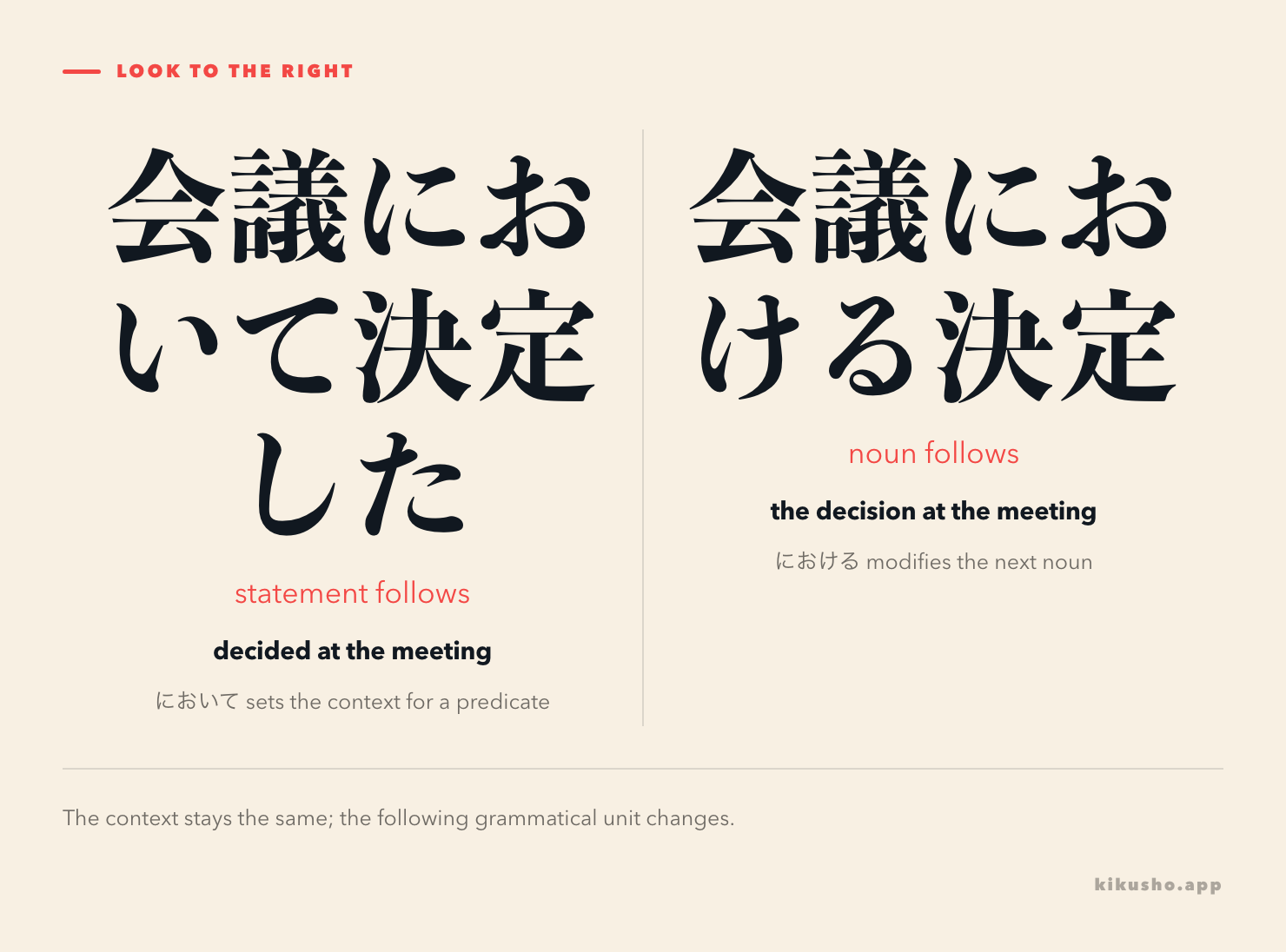
The choice is syntactic rather than a difference in core meaning. 会議において決定した says “decided at the meeting”; 会議における決定 packages “the decision at the meeting” as a noun phrase.
The following word decides the form
Start with one noun, then look immediately after the expression.
| Shape | Job | Example | Plain counterpart |
|---|---|---|---|
| N + において + statement | sets the context for a predicate | 会議において決定した | 会議で決定した |
| N + における + noun | modifies the following noun | 会議における決定 | 会議での決定 |
| N + においては + statement | marks that context as topic or contrast | 日本においては珍しい | 日本では珍しい |
| N + においても + statement | adds that context with も | 海外においても有名だ | 海外でも有名だ |
新しい規則は、昨日の会議において決定されました。
あたらしい きそくは、きのうの かいぎにおいて けっていされました。
The new rule was decided at yesterday’s meeting.
昨日の会議における決定を、全社員に知らせました。
きのうの かいぎにおける けっていを、ぜんしゃいんに しらせました。
We informed every employee of the decision made at yesterday’s meeting.
The Japan Foundation’s teaching material for において/における confirms noun attachment and separates place, period and field uses. It also calls the pattern 改まった表現, an elevated or formal expression.
において sets the scene for a statement
With において, the material after the expression forms a predicate or a wider statement.
式典は市民会館において行われます。
しきてんは しみんかいかんにおいて おこなわれます。
The ceremony will be held at the civic hall.
The hall is the place where the event occurs. In ordinary conversation, 市民会館で行われます is clearer and more natural. The longer form suits an official schedule, report, public announcement or formal presentation.
A field can serve as the setting too:
医療において、安全は最も重要な課題の一つです。
いりょうにおいて、あんぜんは もっとも じゅうような かだいの ひとつです。
In medicine, safety is one of the most important issues.
Here “medicine” is not a physical location. It defines the domain within which the evaluation holds. Bunpro’s において/における reference likewise distinguishes this formal context marker from ordinary で and from expressions meaning “about.”
における builds a noun phrase
Use における when the setting directly modifies the noun that follows.
現代社会における教育の役割を考えます。
げんだいしゃかいにおける きょういくの やくわりを かんがえます。
We will consider the role of education in modern society.
The complete noun phrase is 現代社会における教育の役割. The question is not “where does the speaker consider?” The phrase identifies which role is under discussion.
This attachment behaves like での in a less formal sentence:
- 大学での研究: research at the university
- 大学における研究: research conducted within the university context
- 職場での安全: safety at work
- 職場における安全: safety in the workplace
The formal version often appears in headings, policy language and academic prose because it packs a context into the noun phrase. It does not make the claim more accurate. It only selects a register and structure.
Place, period and field share one frame
The three central uses all answer: “Within what setting does this event or claim hold?”
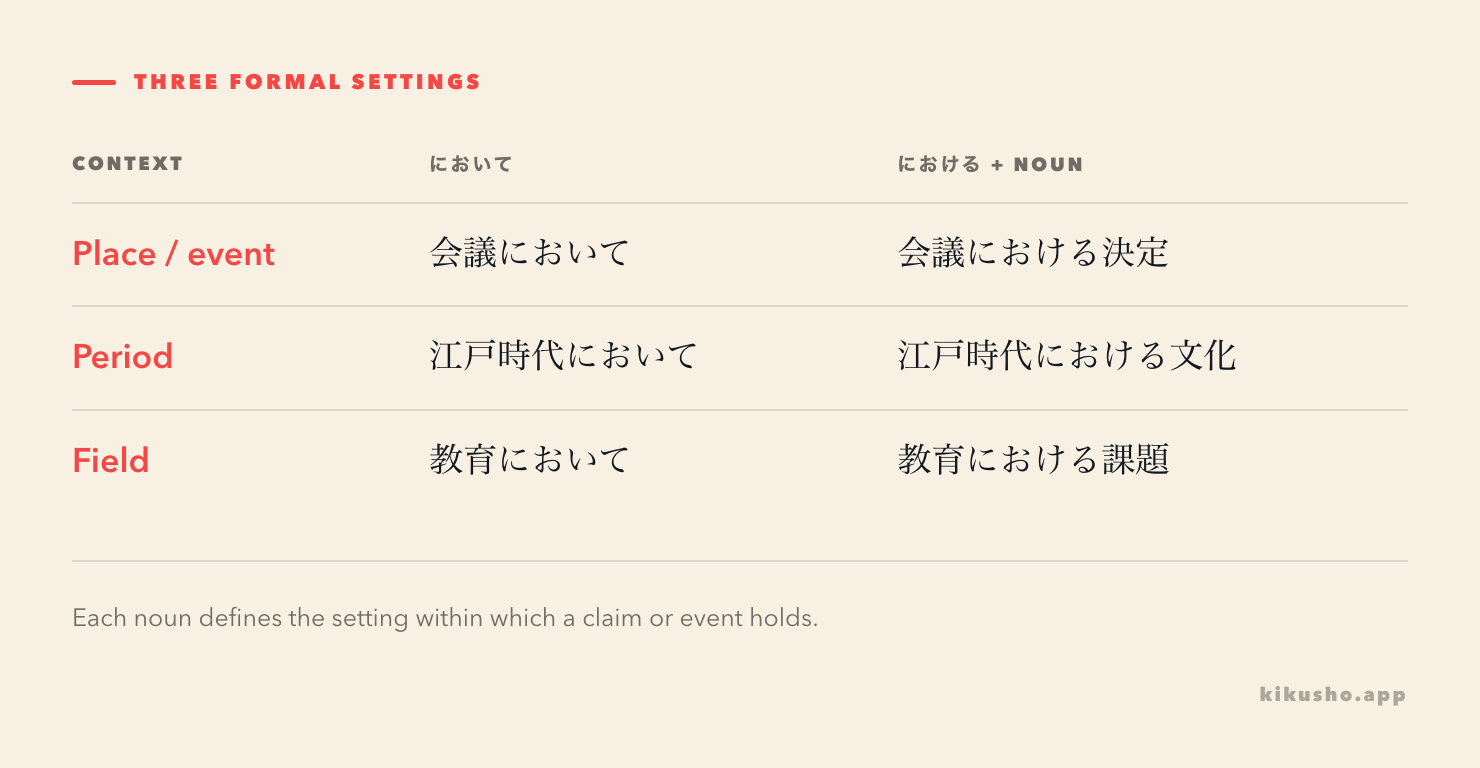
| Context | With において | With における |
|---|---|---|
| place or event | 国際会議において発表する | 国際会議における発表 |
| period | 江戸時代において広まった | 江戸時代における文化 |
| field or domain | 教育において重要だ | 教育における課題 |
The time use has a limit. The Japan Foundation notes that it normally takes a period with some extent, such as 時代 or 世紀. It is not the standard replacement for the simple time particle に:
○ 二十一世紀において、情報の価値はさらに高まった。
In the twenty-first century, the value of information rose further.
△ 三時において、会議を始めます。
For a clock time, say 三時に会議を始めます. A formal register does not license a heavier expression where its context meaning does not fit.
は and も come after the complete expression
Add は or も after において:
この地域においては、冬の交通対策が重要です。
In this region, winter transport measures are important.
国内だけでなく、海外においても高く評価されています。
It is highly regarded not only domestically but also overseas.
においては selects a setting as the topic or contrast. においても adds or extends a setting. Neither changes the attachment rule: a statement follows.
Before a noun, use における, not においては:
○ 海外における評価
evaluation overseas
× 海外においては評価
The second fragment could begin a sentence, but it does not form one noun phrase meaning “evaluation overseas.” It still waits for a predicate, such as 海外においては評価が高い.
Formality is not the same as politeness
において can appear in a plain-style report:
調査において問題が確認された。
A problem was identified in the investigation.
The sentence is formal, but its ending された does not politely address a listener. A presentation might instead use 確認されました. The context marker and the sentence ending make separate choices.
Very formal announcements can use におきまして:
本日の会議におきまして、計画の変更が承認されました。
At today’s meeting, the change to the plan was approved.
The Japan Foundation records this polite variant. It is useful to recognize, but において/における remain the forms to control first. In everyday speech, forcing them into a casual line sounds bureaucratic:
友達の家でゲームをした。
I played games at my friend’s house.
友達の家においてゲームをした is grammatically possible in a contrived report, but it clashes with the ordinary scene. Register is part of correctness.
において is not every kind of で
The shortcut “formal で” works only when で establishes a place or contextual domain. It fails for other jobs of で.
| Meaning of で | Natural sentence | において replacement |
|---|---|---|
| place of an event | 会場で式を行う | 会場において式を行う |
| contextual field | 教育で大切な点 | 教育において大切な点 |
| tool | 箸で食べる | × 箸において食べる |
| material | 木で作る | × 木において作る |
| cause | 雪で電車が止まる | × 雪において電車が止まる |
| manner or group size | 三人で行く | × 三人において行く |
Ask whether the noun is a setting within which the statement holds. If it is the instrument, material, cause or manner, keep で.
This limit also prevents an English translation from deciding the Japanese. English “in” can refer to a location, a field, a condition or a material. Japanese chooses the relationship first.
Do not confuse context with topic
に関して/に関する marks what a statement is about. において/における marks the setting within which it holds.
日本の教育に関する報告
a report about education in Japan
日本の教育における課題
challenges within education in Japan
The first phrase classifies the report by topic. The second locates the challenges inside a field. The lesson on に関して and について gives the full topic-marking system.
Similarly, 学生に対する支援 means support directed toward students. 大学における支援 means support within the university setting. The form before the noun may look parallel, but the relationship is different.
The level label is a study estimate
JLPT Sensei and Bunpro label this pattern N3. The independently authored 毎日のんびり日本語教師 reference places it at N2, while the Japan Foundation material uses the former JLPT 2級 classification.
No official current syllabus settles every grammar point by level. Kikusho keeps this pattern in its N3 sequence because that is the retained inventory placement, then records the disagreement instead of presenting a preparation label as an exam fact. In practice, you need basic で, noun modification and は/も before this formal alternative becomes useful.
Practice
Complete all seven questions before checking the shared answer block.
Question 1. Choose the form that completes the sentence: 式典は大ホール( )行われます。
- ア. における
- イ. において
- ウ. に関する
- エ. に対する
Question 2. Choose the form before the following noun: 大学( )研究活動を紹介します。
- ア. において
- イ. においては
- ウ. における
- エ. においても
Question 3. Which sentence uses において incorrectly?
- ア. 国際会議において発表しました。
- イ. 教育において大切なことを考えます。
- ウ. 箸において寿司を食べました。
- エ. 現代社会において情報は重要です。
Question 4. Rewrite 会場での注意事項 with the formal noun-modifying form.
Question 5. Add the particle that means “also” without removing the context marker: 国内だけでなく、海外において( )販売されています。
- ア. は
- イ. が
- ウ. も
- エ. を
Question 6. Read the notice and choose both forms.
新しい制度は、来月の委員会(甲)正式に決定される予定です。委員会(乙)議論の内容は、後日公開します。
- ア. 甲 における / 乙 において
- イ. 甲 において / 乙 における
- ウ. 甲 に関する / 乙 に対する
- エ. 甲 においても / 乙 においては
Question 7. Write one formal sentence saying that safety is an important issue in medical care. Use 医療において.
Answers and explanations
Answer 1. イ. において. A predicate, 行われます, follows, so the context-setting form is required. における must modify a noun; に関する means “concerning,” and に対する introduces a directional relation.
Answer 2. ウ. における. 研究活動 is the noun immediately modified: 大学における研究活動. The forms ending in おいて introduce a following statement instead.
Answer 3. ウ. 箸において寿司を食べました. 箸 is the tool used for eating, so the natural particle is で: 箸で寿司を食べました. The other nouns provide a place, field or broader setting.
Answer 4. 会場における注意事項. における replaces contextual での before the noun 注意事項. 会場において注意事項 would be an unfinished statement rather than the requested noun phrase.
Answer 5. ウ. も. 海外においても extends the claim to overseas markets. は would create topic or contrast, while が and を cannot attach here to express “also.”
Answer 6. イ. 甲 において / 乙 における. The first blank introduces the predicate 決定される. The second directly modifies 議論, producing 委員会における議論の内容. The other pairs either reverse the attachment or change the relationship.
Answer 7. One natural answer is 医療において、安全は重要な課題です。 医療 defines the field within which the evaluation holds. A plain conversational alternative is 医療では、安全が重要な課題です.
Read the sentence from its right edge
When a dense report makes the choice hard, look right first. A noun immediately after the blank calls for における; a predicate developing after it calls for において.
Save that right-hand evidence with the sentence in Kikusho. A card that keeps only “in” loses the attachment test, while 調査における結果 and 調査において確認した force you to rebuild the structure before the translation appears.
Common questions
What is the difference between において and における?
において introduces the setting for a following statement. における modifies the noun immediately after it. Compare 会議において決定した with 会議における決定.
Is において the same as で?
It can replace で when で marks the place, period or field in which something occurs or holds, but it is more formal. It cannot replace で when で marks a tool, material, cause or manner.
Can において describe a time?
Yes, especially a bounded period such as an era or century. It is not the ordinary choice for a clock time or a single calendar date.
Are において and における polite expressions?
They belong to a formal register, especially reports, notices and formal speech. Formality is separate from politeness; the sentence ending still determines whether you address the listener politely.