On this page
AつもりでB makes A the intention or imagined premise behind action B. In 本番のつもりで練習する, the practice is real, but you approach it as though it were the real performance.
The final で matters. It carries the mental stance expressed by つもり into what follows, so this pattern does more than announce a plan.
One pattern connects three kinds of mindset
The safest first reading is “do B with A in mind.” Context then tells you what A contributes.
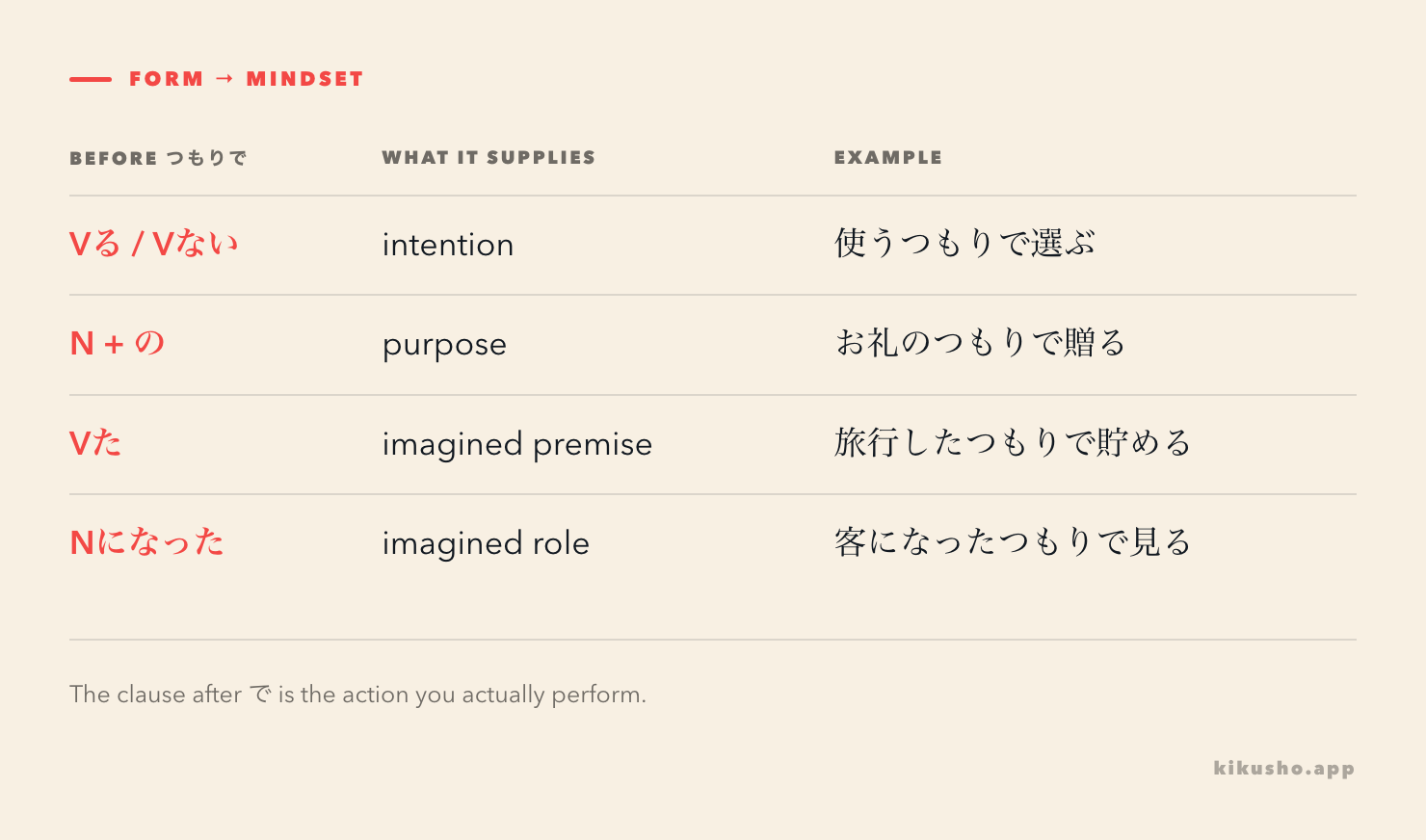
| Shape | What A contributes | Example |
|---|---|---|
| Vる/Vない+つもりで | an intention guiding B | 毎日使うつもりで、丈夫な鞄を選んだ。 |
| N+の+つもりで | a purpose or intended identity | お礼のつもりで、花を贈った。 |
| Vた+つもりで | an imagined completed premise | 旅行したつもりで、そのお金を貯めた。 |
| Nになる → Nになった+つもりで | an imagined role | 客になったつもりで、店内を見直した。 |
The sentence after で is the action you really perform. A may be real as an intention, but an imagined premise need not be true.
毎日使うつもりで、少し高い鞄を買った。 まいにち つかう つもりで、すこし たかい かばんを かった。 I bought a slightly expensive bag intending to use it every day.
The person truly bought the bag. Daily use is the intention that explains the choice, not a guarantee about the future.
Vる/Vない holds an intention through the next action
With a nonpast verb, つもりで often answers “with what intention?” The planned action and the action actually performed may be different:
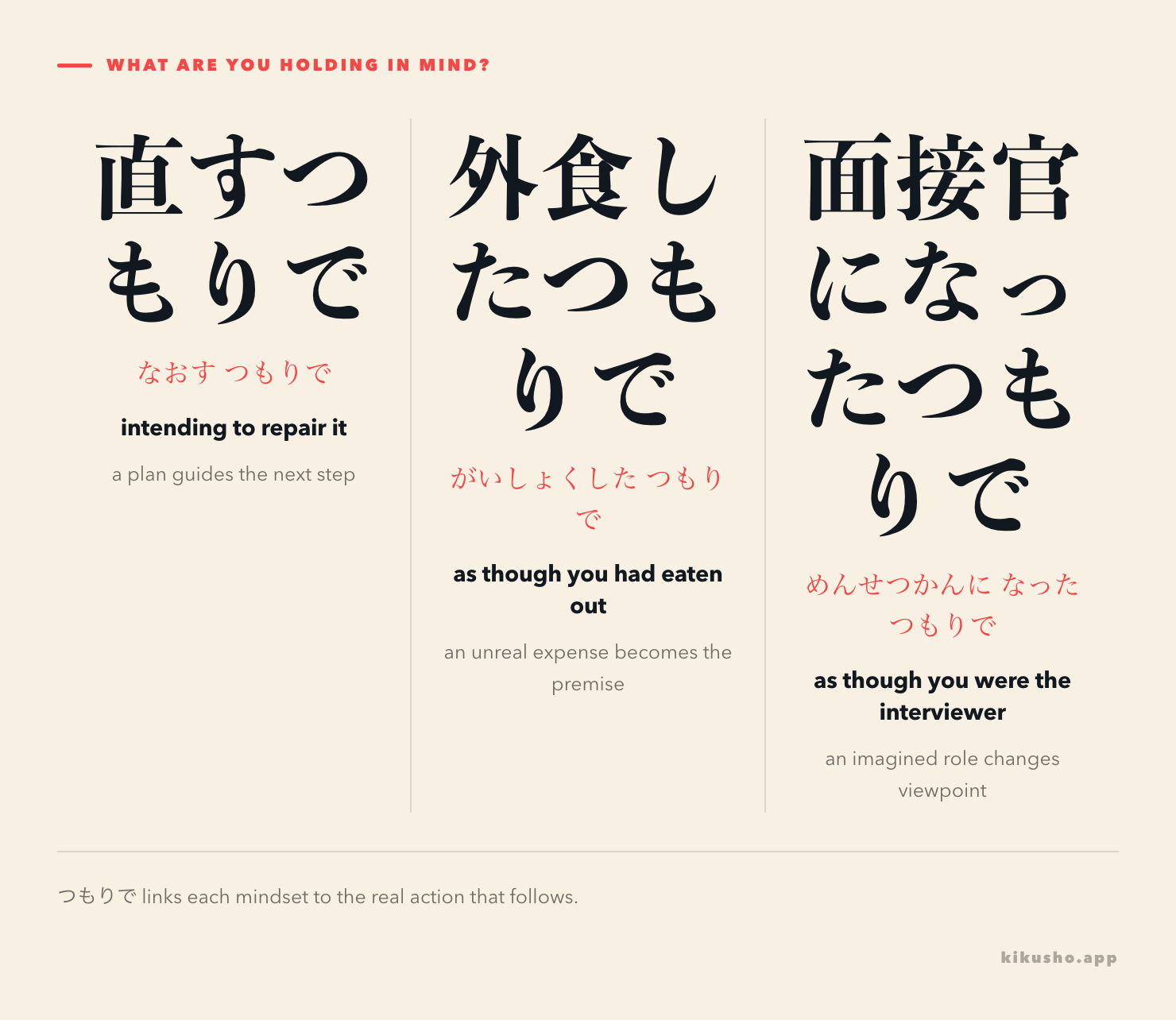
自分で直すつもりで、まず説明書を読んだ。 じぶんで なおす つもりで、まず せつめいしょを よんだ。 I first read the manual intending to repair it myself.
直す is the intended result. 説明書を読んだ is the step taken under that intention. Sentence-final 自分で直すつもりだった would merely report the earlier plan; it would not express the relationship between the plan and reading the manual.
The negative attaches to the verb in the usual way:
今日は何も買わないつもりで、財布を持たずに出かけた。 きょうは なにも かわない つもりで、さいふを もたずに でかけた。 Intending not to buy anything today, I went out without my wallet.
Use the full ない-form: 買わないつもりで, not 買いませんつもりで. The basic つもり lesson covers affirmative and negative plans; here で makes the plan the basis for another action.
Nのつもりで names a purpose or intended identity
Because つもり behaves as a noun, another noun connects with の:
お礼のつもりで、手紙を書きました。 おれいの つもりで、てがみを かきました。 I wrote a letter as a gesture of thanks.
The letter is intended as thanks. Whether the recipient accepts it that way is a separate question. This gap between intent and reception is common with 冗談のつもりで, “intended as a joke”:
冗談のつもりで言ったが、相手を傷つけてしまった。 じょうだんの つもりで いったが、あいてを きずつけてしまった。 I meant it as a joke, but I ended up hurting the other person.
The speaker's purpose does not erase the result. どんなつもりでそんなことを言ったの? asks what intention or motive lay behind the remark. Depending on tone, the question can sound accusatory: “What were you thinking when you said that?”
Nouns that describe a situational frame work the same way:
本番のつもりで、最初から通して練習しよう。 ほんばんの つもりで、さいしょから とおして れんしゅうしよう。 Let's practise all the way through as if it were the real performance.
The event remains practice. 本番のつもりで changes the seriousness and conditions adopted during it.
Vた creates an imagined completed premise
Past form before つもりで often means that you mentally treat A as already completed, then act from that assumption. It does not automatically report a real past event.
外食したつもりで、二千円を貯金箱に入れた。 がいしょくした つもりで、にせんえんを ちょきんばこに いれた。 I put 2,000 yen in my savings box as though I had eaten out.
Here the speaker did not eat out. The imagined expense supplies a rule for saving the same money. English “instead of eating out” may fit the situation, but Japanese presents the replacement through an assumed completed event.
The same logic creates a role:
自分が面接官になったつもりで、答えを聞き直した。 じぶんが めんせつかんに なった つもりで、こたえを ききなおした。 I listened to my answers again as though I had become the interviewer.
The speaker has not become an interviewer. The imagined role changes the viewpoint used for listening.
This differs from Vた+つもりだった, which can look back at a belief about a completed action: 送ったつもりだったが、下書きに残っていた means “I thought I had sent it, but it remained in drafts.” The past-intention lesson follows the position of the past marker. In the present pattern, で moves from the assumed event into a new, real action.
The role can be imagined without being deceptive
つもりで concerns the premise you adopt. ふりをして concerns presenting an appearance as though something were true.
先生になったつもりで、友達の作文を読んだ。 I read my friend's composition as though I were the teacher.
The role is a tool for changing perspective. No one needs to be fooled.
先生のふりをして、教室に入った。 I entered the classroom pretending to be a teacher.
This sentence foregrounds outward pretence. The ふりをする lesson explains that deliberate performance and contrasts it with resemblance through まるで.
として marks an actual capacity or recognised role more directly:
| Sentence | Status of the role |
|---|---|
| 代表として会議に出席した。 | I attended in the actual capacity of representative. |
| 代表になったつもりで挨拶を練習した。 | I practised the greeting while imagining I had become the representative. |
The imagined role may prepare you for a real one, but the two expressions do not make the same claim.
Register and level labels
つもりで is standard Japanese. Kana is normal; 積もりで exists but is uncommon in ordinary learning material. The construction works in casual and polite sentences because politeness normally appears in the following predicate: 練習する or 練習します.
JLPT Sensei places つもりで at N3 and records Vた and Nの attachment. A Japanese-teacher explanation at 世界で日本語教師 also treats Vた+つもりで as N3 and explains the assumed-event reading. Bunpro instead labels the broader construction N2 while confirming standard register, intention, unreal premise and role readings. MLC and the Japan Foundation support the underlying distinction between an intention and a person's belief about an action. The N3 label here records a study-list placement, not an official JLPT syllabus guarantee.
For a Kikusho capture, span the connector rather than clipping out なったつもりで. The full line 面接官になったつもりで、答えを聞き直した retains the imagined viewpoint beside the real act of listening, which is the contrast you need at review time.
Practice: identify the mindset before the action
Question 1
Choose the sentence that means “I went to the shop intending not to buy anything.”
ア) 何も買わないつもりで、店に行った。 イ) 何も買いませんつもりで、店に行った。 ウ) 何も買わなかったふりで、店に行った。 エ) 何も買わないとして、店に行った。
Question 2
You gave flowers intending them as thanks. Choose the correct attachment.
ア) お礼なつもりで花を贈った。 イ) お礼につもりで花を贈った。 ウ) お礼のつもりで花を贈った。 エ) お礼だったつもりで花を贈った。
Question 3
Which sentence clearly presents an unreal expense used as the basis for saving money?
ア) 旅行するつもりで、お金を使った。 イ) 旅行したつもりで、そのお金を貯めた。 ウ) 旅行として、そのお金を貯めた。 エ) 旅行のふりをして、そのお金を貯めた。
Question 4
Arrange all five chunks to say “I reread the email as though I were the recipient.”
- 読み直した
- メールを
- 受け取る人に
- なったつもりで
- 。
Question 5
Choose the expression that fits an actual appointed role rather than an imagined one.
会社の代表__、会議に出席した。
ア) のつもりで イ) として ウ) になったつもりで エ) のふりをして
Question 6
Which sentence asks about the motive behind a hurtful remark?
ア) どんなつもりで、そんなことを言ったの? イ) どんな予定で、そんなことを言ったの? ウ) どんな本番で、そんなことを言ったの? エ) どんな役として、そんなことを言ったの?
Question 7
Complete both blanks in this short presentation note.
発表は来週だ。今日は( )最初から最後まで練習した。そのあと、聞いている人に( )、分かりにくい部分を直した。
ア) 本番のつもりで/なったつもりで イ) 本番として/なるつもりで ウ) 本番のふりをして/なったとして エ) 本番につもりで/なるつもりだった
Answers and explanations
Answer 1
ア) 何も買わないつもりで、店に行った. The complete ない-form states the negative intention guiding the trip. Polite 買いません cannot attach directly before つもり.
Answer 2
ウ) お礼のつもりで花を贈った. A noun connects to the noun つもり with の. The flowers are intended as thanks.
Answer 3
イ) 旅行したつもりで、そのお金を貯めた. Vた supplies the imagined completed trip. The person saves the money instead of spending it on that unreal event.
Answer 4
3 → 4 → 2 → 1 → 5. 受け取る人になったつもりで、メールを読み直した。 The person adopts the recipient's role, then rereads the real email from that viewpoint.
Answer 5
イ) として. 代表として says the person attends in the actual capacity of company representative. 代表になったつもりで would make the role an imagined premise.
Answer 6
ア) どんなつもりで、そんなことを言ったの? Here どんなつもりで asks what intention or motive guided the remark and can carry reproach.
Answer 7
ア) 本番のつもりで/なったつもりで. The first phrase treats today's practice like the real presentation. The second adopts the audience member's viewpoint to revise unclear parts; neither imagined frame is claimed as fact.
Common questions
What does つもりで mean in Japanese?
AつもりでB means doing B while holding A as your intention, premise or imagined role. The exact reading depends on whether A is a planned action, a noun or an unreal completed situation.
What is the difference between つもりです and つもりで?
つもりです ends a statement by reporting a plan. つもりで links that intention or mindset to a following action: 日本へ行くつもりです states a plan, while 日本へ行くつもりで勉強する describes the intention guiding the studying.
Why does つもりで sometimes follow a past-tense verb?
Vたつもりで often asks you to adopt an unreal premise, as though the action had happened. 旅行したつもりでお金を貯める means saving the money instead while treating the trip as an imagined expense.
Is つもりで N3 or N2 grammar?
Study lists disagree. JLPT Sensei and several teaching references place this use at N3, while Bunpro places it at N2. The JLPT does not publish an exhaustive official grammar list.