On this page
Use Vる/Vない + つもりです when someone has chosen a plan. Use Nはどうですか when you place a candidate in front of the listener and leave the decision open: the first form reports commitment, while the second asks for evaluation.
One form commits to a plan; the other offers an option
Compare two lines about Saturday:
土曜日に行くつもりです。
どようびに いく つもりです。
I intend to go on Saturday.
土曜日はどうですか。
どようびは どうですか。
How about Saturday?
The first speaker has already selected Saturday as part of a plan. The second speaker presents Saturday as one possible answer and waits for the listener to accept, reject or compare it.
| Test | つもりです | はどうですか |
|---|---|---|
| Whose position matters? | the person who holds the intention | the listener who evaluates the option |
| What comes before it? | a plain nonpast verb | a candidate noun; or Vる + の for an action |
| Basic job | state a chosen plan | propose or ask about a candidate |
| Natural reply | そうなんですね | いいですね/ちょっと… |
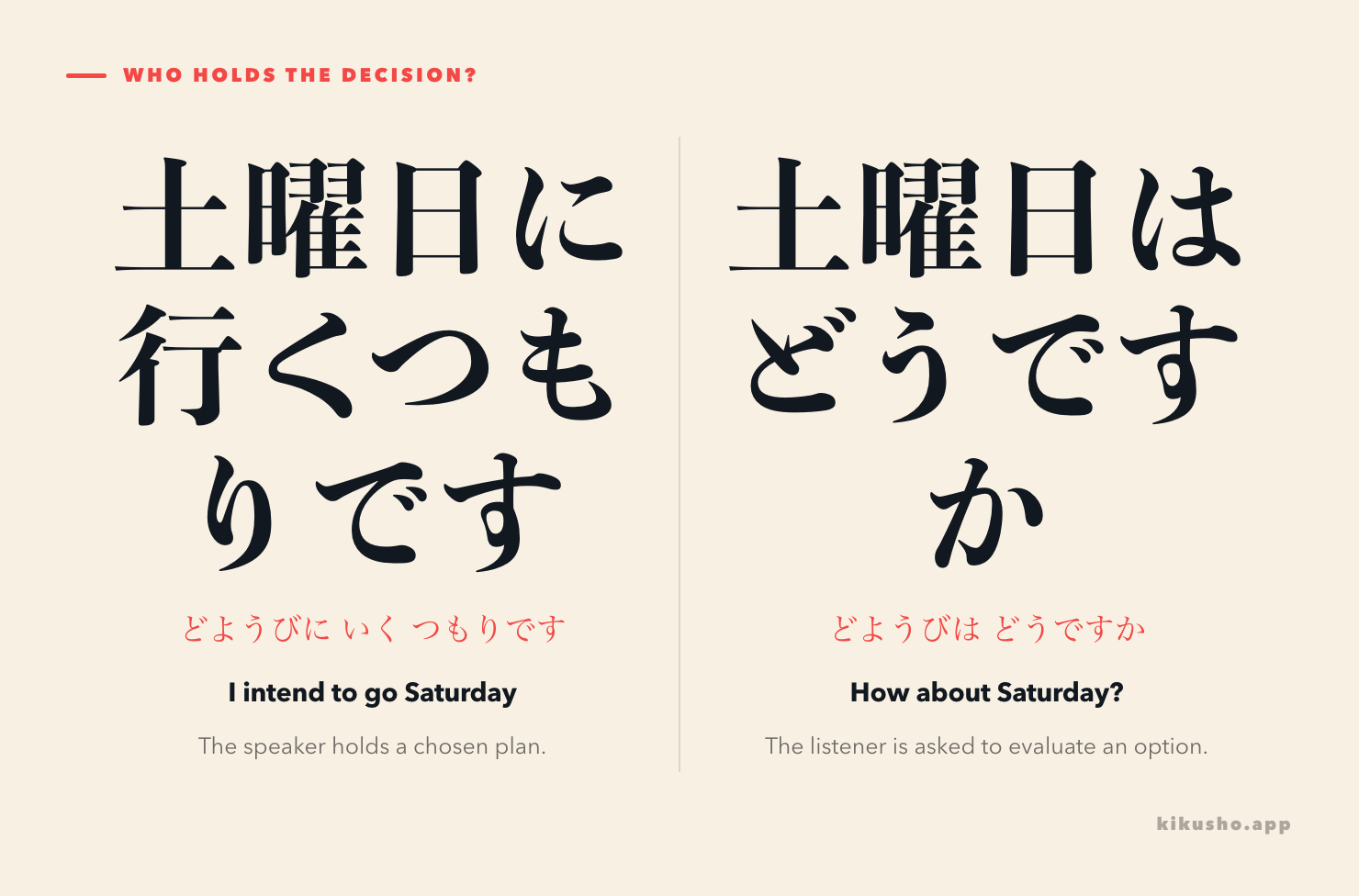
This is also why つもりですか and はどうですか ask different questions. 東京へ行くつもりですか asks whether the listener has that intention. 東京はどうですか proposes Tokyo or asks what the listener thinks about it.
~つもりです reports a chosen intention
Attach つもりです to a verb in its plain nonpast form. Use the dictionary form for an affirmative plan and the complete ない-form for a negative plan.
| Form | Example | Meaning |
|---|---|---|
| Vる + つもりです | 来年、日本へ行くつもりです | I intend to go to Japan next year |
| Vない + つもりです | 車は買わないつもりです | I intend not to buy a car |
| Vる + つもりはありません | 車を買うつもりはありません | I have no intention of buying a car |
| Vる + つもりでした | 電話するつもりでした | I intended to call |
Do not put polite ます before つもり: 行くつもりです, not 行きますつもりです. Politeness belongs at the end in です. The same attachment works with irregular verbs: 勉強するつもりです and 来ないつもりです, where 来ない is read こない.
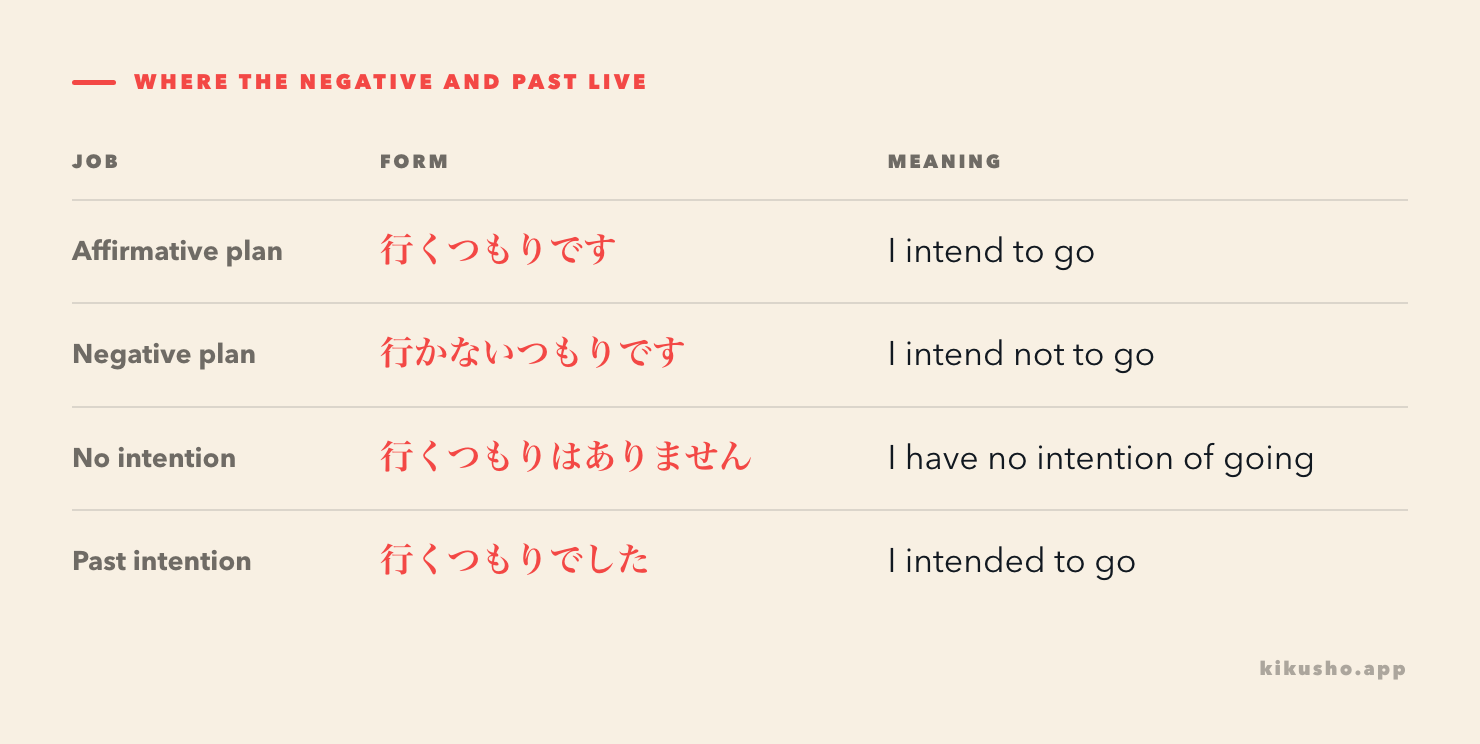
The two negative shapes deserve separate attention:
- 行かないつもりです: the chosen plan is not going.
- 行くつもりはありません: the speaker denies possessing an intention to go.
In an ordinary refusal, both may lead to the same outcome. Their grammar and emphasis differ, so keep the complete phrase rather than reducing both to “will not.”
Past つもりでした/つもりだった looks back at an intention held at an earlier time. It often appears when the plan changed or failed, but the form alone does not say that:
昨日は早く寝るつもりでしたが、仕事が終わりませんでした。
きのうは はやく ねる つもりでしたが、しごとが おわりませんでした。
I intended to go to bed early yesterday, but my work did not finish.
The clause after が confirms that this particular plan was not realised.
An intention is more specific than a desire
~たいです says what someone wants to do. ~つもりです says what they have decided or intend to do.
日本へ行きたいです。
I want to go to Japan.
来年、日本へ行くつもりです。
I intend to go to Japan next year.
A desire may exist before there is any plan. つもり does not guarantee that the action will happen, but it presents a more definite personal decision. The volitional-form lesson places 行こうと思っています nearby: it can describe a decision or intention developing in the speaker's mind, while つもり presents the intended action as the plan being held.
予定です instead points toward an arrangement or schedule. 来週出張する予定です can report a work trip fixed by a calendar or organisation; 来週出張するつもりです presents it as the person's intention. Real situations can contain both. The focused 予定だ lesson follows that arrangement viewpoint through verb and noun attachment, negation and past schedules.
Because つもり describes an intention, it most naturally reports the speaker's own plan or asks the listener about theirs. A statement about another person's つもり needs some basis, such as what that person said; do not use the form as if you could directly inspect a stranger's mind.
The Japan Foundation's Irodori grammar guide teaches V-るつもりです for a specific plan and includes both dictionary-form and ない-form attachments. JLPT Sensei and Bunpro independently place the construction at N5.
Nはどうですか leaves the candidate open
Put はどうですか after a noun when that noun is a proposed choice:
六時半はどうですか。
ろくじはんは どうですか。
How about 6:30?
駅の改札はどうですか。
えきの かいさつは どうですか。
How about the ticket gate at the station?
The planning context makes each noun a candidate. The listener can answer いいですね (“sounds good”), offer a different time or place, or soften a refusal with ちょっと…. The Irodori worksheet uses the same pattern to negotiate a meeting time and place.
To propose an action, turn the plain nonpast verb phrase into a noun-like unit with の:
少し休むのはどうですか。
すこし やすむのは どうですか。
How about taking a short break?
The の is necessary because は needs a topic: the candidate being evaluated is “taking a short break.” This open suggestion differs from ~ましょう and ~ませんか, which directly propose shared action, and from ~たほうがいいです, which recommends one course more firmly.
Context decides whether どうですか is a suggestion or an evaluation
The literal job of どうですか is to ask “how is it?” In a decision, that becomes “How about this option?” With an existing topic, it can simply ask for an impression or condition:
仕事はどうですか。
How is work?
京都はどうでしたか。
How was Kyoto?
Past どうでしたか asks about an earlier experience. The noun is no longer being offered as a future candidate; the context and tense point toward evaluation.
| Sentence | Context | Reading |
|---|---|---|
| 六時半はどうですか | choosing a time | How about 6:30? |
| 休むのはどうですか | proposing an action | How about resting? |
| 仕事はどうですか | asking about a current topic | How is work? |
| 旅行はどうでしたか | asking after a trip | How was the trip? |
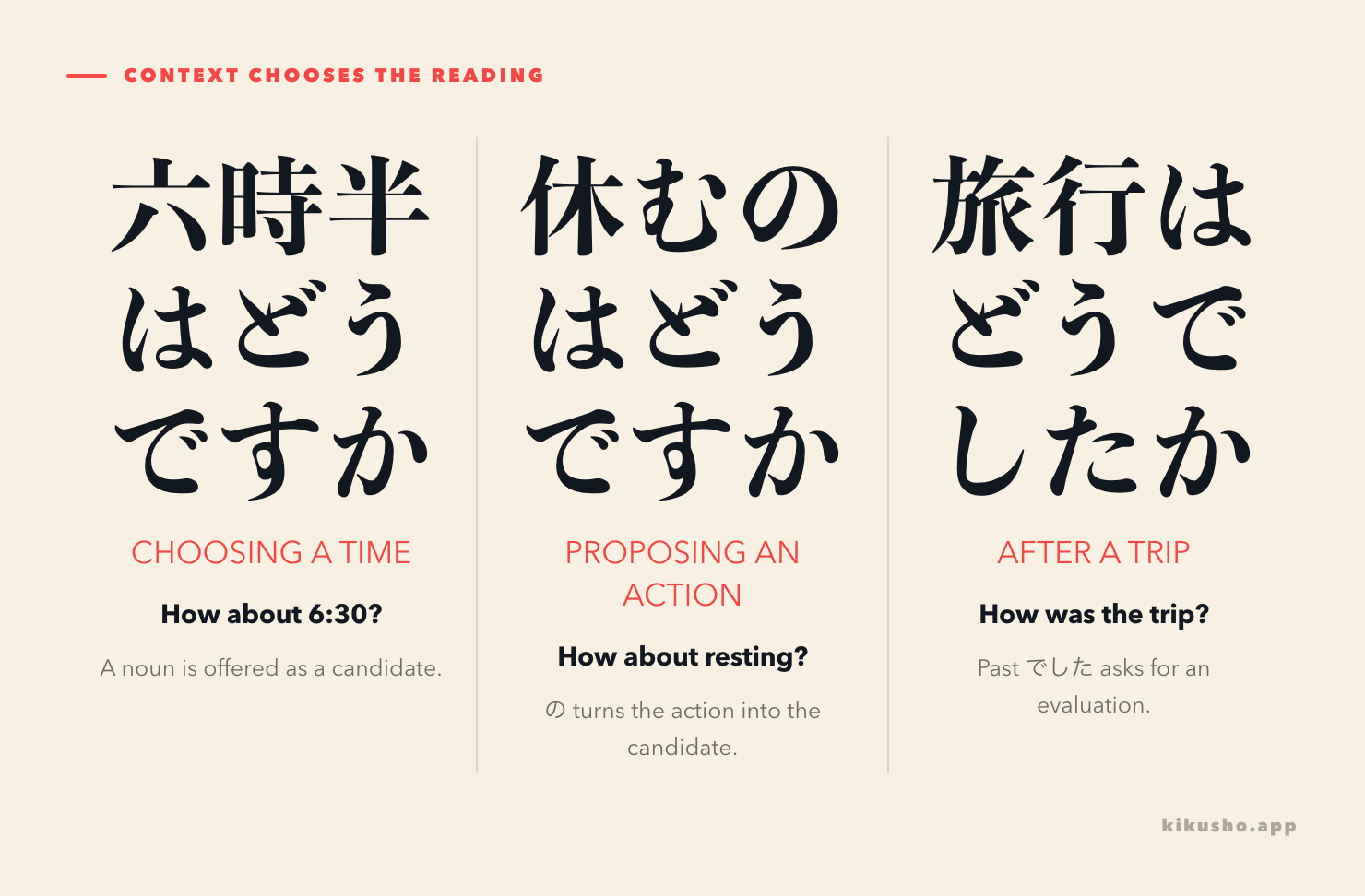
いかがですか can replace どうですか in more polite or formal service speech. The core evaluation remains. コーヒーはいかがですか offers coffee with more distance than コーヒーはどうですか.
The exact search query brings back separate lessons for the two forms rather than a standard paired construction. JLPT Sensei's はどうですか entry and JLPT Pass treat the pattern as beginner grammar; the Japan Foundation material supplies an independent beginner use. The JLPT organisers do not publish an exhaustive grammar list, so the N5 label records reference-list placement rather than an official promise about a test form.
When you capture a planning exchange in Kikusho, keep both turns in the editable example: 土曜日はどうですか。土曜日に行くつもりです。 A card containing only “つもり = intention” cannot show who has made the decision. The complete exchange preserves the candidate, the response and the polite register for review and generated audio.
Try all seven before opening the answer block
Question 1
Choose the sentence that means “I intend not to buy a car.”
- ア. 車を買いませんつもりです。
- イ. 車を買わないつもりです。
- ウ. 車を買うどうですか。
- エ. 車を買いたいつもりです。
Question 2
You are choosing a meeting time and want to ask “How about 6:30?” Which sentence fits?
- ア. 六時半にするつもりです。
- イ. 六時半はどうですか。
- ウ. 六時半をどうですか。
- エ. 六時半でしたつもりです。
Question 3
Which sentence most directly denies having any intention to go?
- ア. 行くつもりはありません。
- イ. 行かないでください。
- ウ. 行きたいです。
- エ. 行くのはどうですか。
Question 4
Compose “I intend to study Japanese next year” with 来年, 日本語を勉強する, and つもりです. Keep the verb before つもり in the required form.
Question 5
Read the exchange:
A: 日曜日はどうですか。
B: 日曜日は仕事です。土曜日に会うつもりです。
Who leaves an option open, and who states a chosen plan?
Question 6
A colleague has been working for hours. Write an open suggestion using 少し休む and のはどうですか.
Question 7
After a trip, a friend asks 旅行はどうでしたか. Which interpretation fits?
- ア. The friend is proposing that you take a trip now.
- イ. The friend is asking how the completed trip was.
- ウ. The friend is stating an intention to travel.
- エ. The friend has no intention of travelling.
Answers and explanations
Answer 1
イ. 車を買わないつもりです. The complete ない-form 買わない states that not buying is the chosen plan. ア incorrectly puts polite 買いません before つもり. ウ lacks the nominalising の needed to propose an action, and エ combines desire and つもり in a form that does not express the requested plan.
Answer 2
イ. 六時半はどうですか. 六時半 is the candidate topic marked by は, and どうですか asks the listener to evaluate it. ア states a plan to choose 6:30; ウ uses を where the candidate topic needs は; エ does not form a valid attachment.
Answer 3
ア. 行くつもりはありません. は marks the intention itself as what is denied. イ asks someone not to go, ウ states a desire to go, and エ proposes going as an option.
Answer 4
One answer is 来年、日本語を勉強するつもりです。 Use plain dictionary 勉強する directly before つもり. The final です makes the whole sentence polite.
Answer 5
Speaker A leaves Sunday open for evaluation with 日曜日はどうですか. Speaker B rejects that option by giving a work conflict, then states the selected plan to meet on Saturday with 土曜日に会うつもりです.
Answer 6
少し休むのはどうですか。 The plain nonpast verb phrase 少し休む becomes a candidate with の, は marks it as the topic, and どうですか leaves the decision with the colleague.
Answer 7
イ. The friend is asking how the completed trip was. Past どうでしたか and the after-the-trip context make 旅行 an experience to evaluate. Nothing in the sentence states an intention or denies one.
Common questions
What does つもりです mean in Japanese?
Put つもりです after a dictionary-form or ない-form verb to state a chosen intention or plan. 日本へ行くつもりです means “I intend to go to Japan,” and 行かないつもりです means “I intend not to go.”
What is the difference between ないつもりです and つもりはありません?
Vないつもりです states a plan not to do the action. Vるつもりはありません denies having the intention to do it. The practical result can overlap, but the negative sits in a different part of the sentence.
What does Nはどうですか mean?
In a choice or planning context, Nはどうですか puts the noun forward as a candidate: 六時半はどうですか means “How about 6:30?” In another context it can ask for an evaluation, such as 仕事はどうですか, “How is work?”
How do I suggest an action with どうですか?
Turn the plain nonpast verb into a noun-like phrase with の: 少し休むのはどうですか means “How about taking a short break?” A noun needs no の, as in 土曜日はどうですか.