On this page
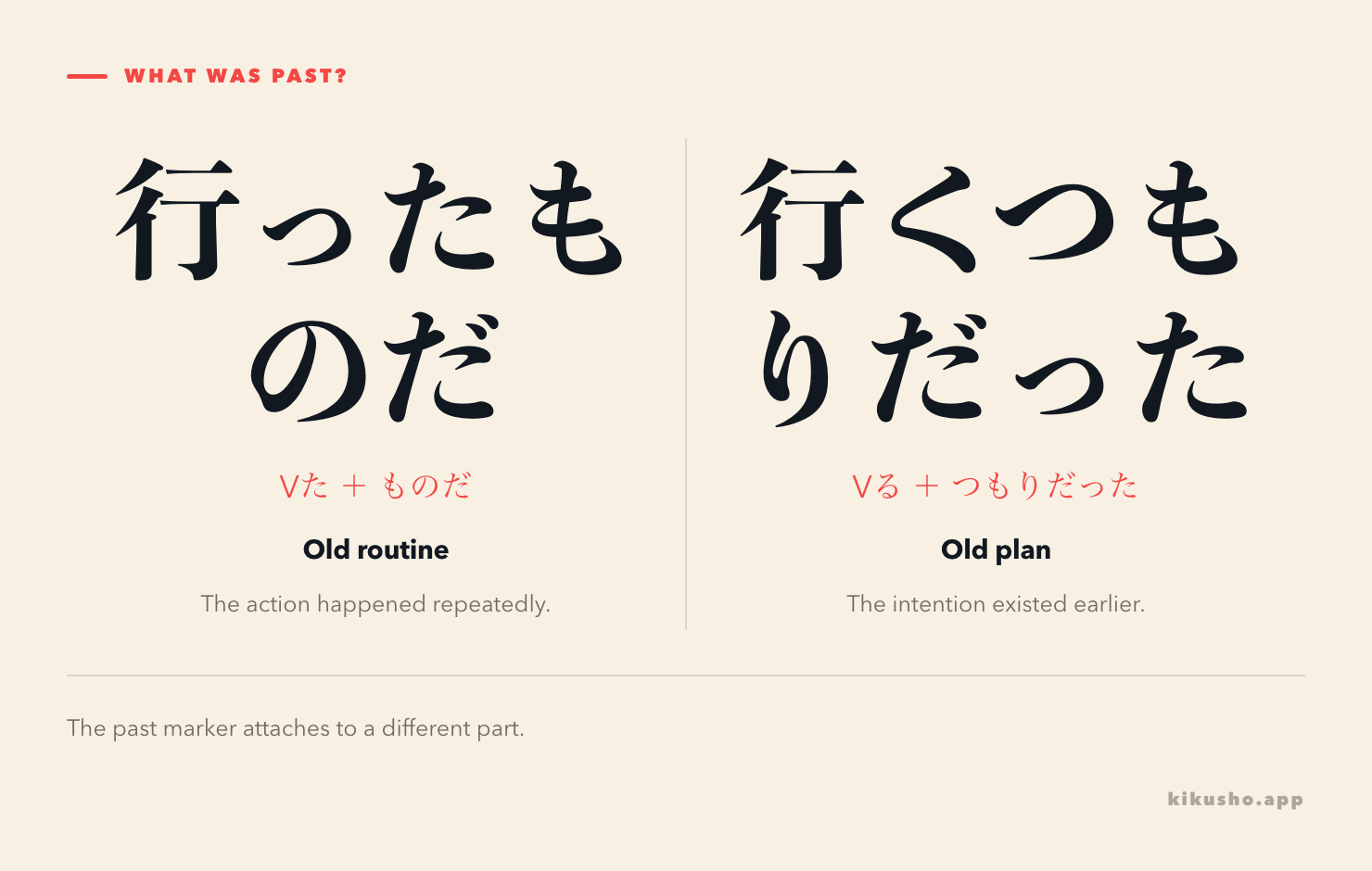
子供の頃は、夏になると祖父の家へ行ったものだ recalls a trip that formed part of many summers. 去年の夏も祖父の家へ行くつもりだった reports a plan held before last summer. One sentence looks back at what repeatedly happened; the other looks back at what someone intended.
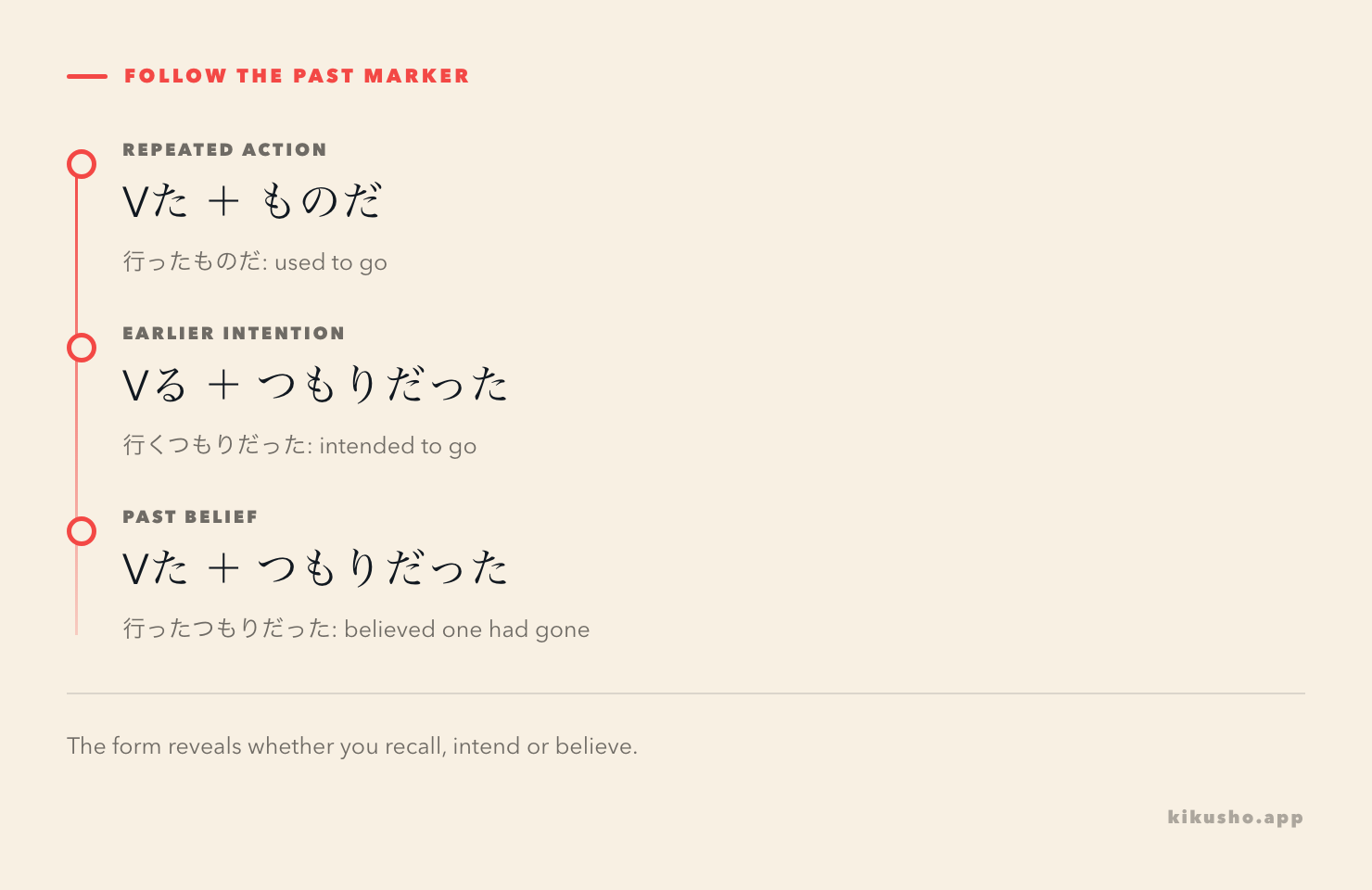
The visible clue is where Japanese marks the past. In 行ったものだ, the verb is past. In 行くつもりだった, the intended action stays in the dictionary form and だった makes the intention past.
Put the past marker on the right part
| Meaning | Form | What existed in the past? |
|---|---|---|
| Remembered habit | Vた+ものだ | The repeated action |
| Earlier affirmative intention | Vる+つもりだった | The intention to do the action |
| Earlier negative intention | Vない+つもりだった | The intention not to do the action |
学生の頃は、授業の後でよく喫茶店に寄ったものだ。
がくせいの ころは、じゅぎょうの あとで よく きっさてんに よったものだ。
When I was a student, I would often stop at a coffee shop after class.
昨日は授業の後で喫茶店に寄るつもりだったが、急いで帰った。
きのうは じゅぎょうの あとで きっさてんに よるつもりだったが、いそいで かえった。
Yesterday I intended to stop at a coffee shop after class, but I went straight home in a hurry.
The first sentence contains 学生の頃 and よく, so it presents a routine across a past period. The second locates one intention yesterday and then gives the different result.
たものだ belongs to a remembered routine
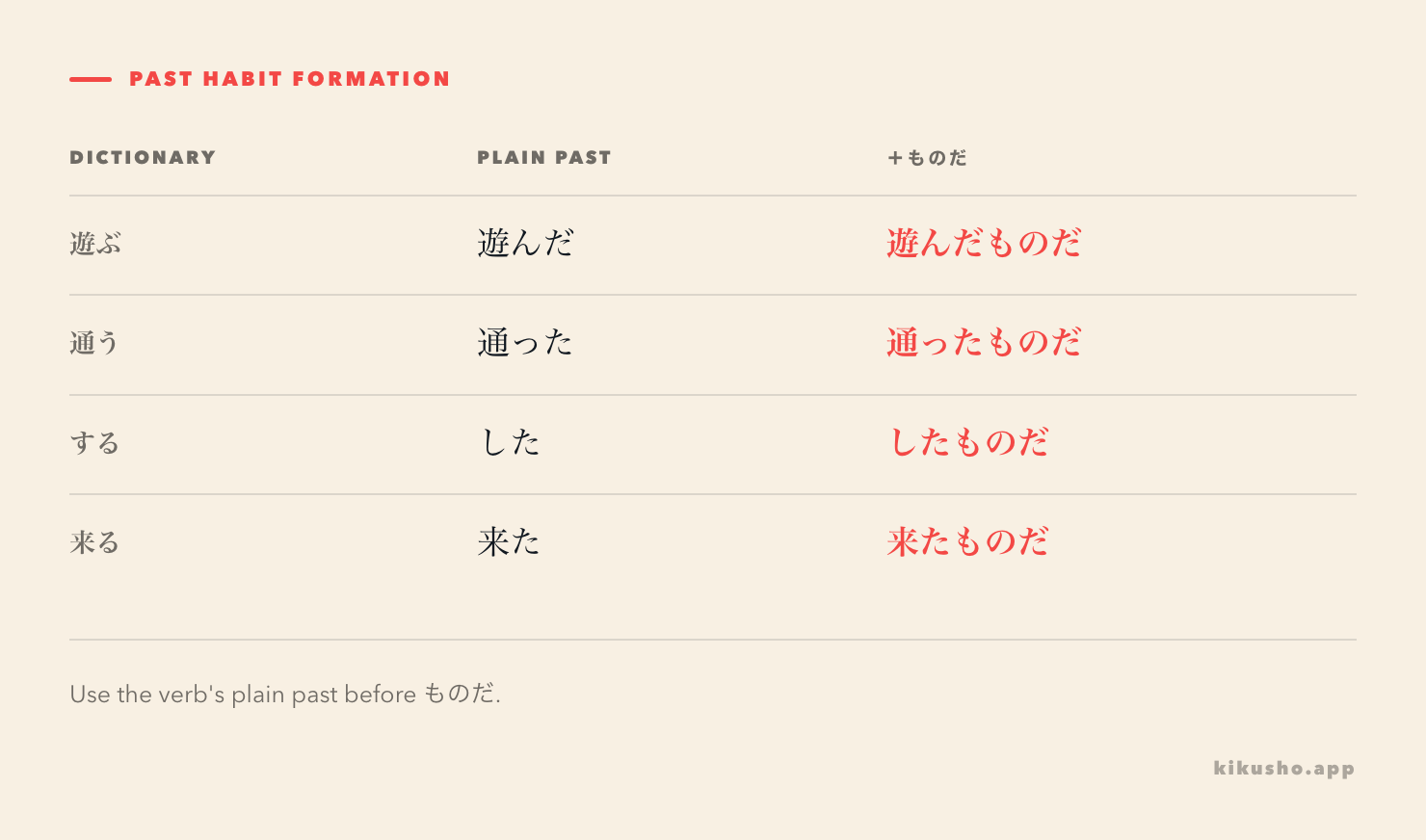
Build the central N3 use from a verb's plain past form:
| Dictionary form | Plain past | Recalled habit |
|---|---|---|
| 遊ぶ | 遊んだ | 遊んだものだ |
| 通う | 通った | 通ったものだ |
| する | した | したものだ |
| 来る | 来た(きた) | 来たものだ |
小学生の頃は、放課後になると友達と川まで走ったものだ。
しょうがくせいの ころは、ほうかごに なると ともだちと かわまで はしったものだ。
When I was in primary school, my friends and I would run to the river after school.
Words such as 昔, 子供の頃, 当時, よく, 毎日 and ~になると can establish the earlier period or repetition. They are useful evidence, though no single word is mandatory. The context must still support a remembered habit or former situation.
A state can also be recalled:
以前は、この辺りも夜になると静かだったものだ。
いぜんは、このあたりも よるに なると しずかだったものだ。
This area used to be quiet at night too.
Here 静かだった presents a former state. The focused lesson on ものだ and ものではない covers its broader attachment system, admiration, generalisation and warning uses. This article owns the narrower choice between recalled past and past intention.
The habit reading does not suit a bare one-time experience:
去年、一度だけ富士山に登ったことがある。
きょねん、いちどだけ ふじさんに のぼったことがある。
I climbed Mount Fuji once last year.
For an experience stated without a recurring routine, use the ~たことがある pattern. A plain past plus ものだ can perform other reflective jobs in other contexts, so the safe claim is narrower: the N3 habit reading needs a period, repetition or former state to remember.
つもりだった belongs to an earlier intention
For a past intention, keep the intended action in the dictionary form or ない-form. Put the past marker on the copula after つもり:
| Intention | Plain | Polite |
|---|---|---|
| intended to go | 行くつもりだった | 行くつもりでした |
| intended not to go | 行かないつもりだった | 行かないつもりでした |
| intended to study | 勉強するつもりだった | 勉強するつもりでした |
週末は部屋を片づけるつもりだったが、仕事が入った。
しゅうまつは へやを かたづけるつもりだったが、しごとが はいった。
I intended to tidy my room over the weekend, but work came up.
The intention existed before the planned action. が, けど and のに often introduce the reason the plan changed or the result differed. That recurring context explains why English translations often say “was going to, but…”
The grammar itself does not guarantee failure:
最初から一人で行くつもりだったので、そのとおり一人で行った。
さいしょから ひとりで いくつもりだったので、そのとおり ひとりで いった。
I had intended from the start to go alone, so I went alone as planned.
The Japan Foundation's detailed account of つもり describes Vるつもりだった as reporting an earlier intention and separately explains Vたつもりだった as a past belief about a completed action. JLPT Sensei's つもりだった page places the past-intention pattern at N3.
One た changes the centre of the sentence
Compare these two forms:
メールを送るつもりだった。
I intended to send the email.
メールを送ったつもりだった。
I believed that I had sent the email.
In the first, 送る names the future action viewed from the earlier planning point. The final だった is the only past marker. In the second, 送った is already complete inside the person's understanding: they thought the sending had been done. That belief use is a neighbouring construction, not the past-intention item taught here.
Now compare the target pair with the same verb:
高校生の頃は、祖母に毎週電話したものだ。
こうこうせいの ころは、そぼに まいしゅう でんわしたものだ。
When I was in high school, I used to call my grandmother every week.
日曜日に祖母へ電話するつもりだったが、忘れてしまった。
にちようびに そぼへ でんわするつもりだったが、わすれてしまった。
I intended to call my grandmother on Sunday, but I forgot.
The first reports many completed calls and adds reflective distance. The second reports one earlier plan; the following clause tells you it was not carried out.
Read the time frame before translating “used to”
English can hide the distinction. “I was going to call” clearly suggests intention, while “I used to call” suggests habit, but “I meant to” and “I remember calling” can still tempt a word-for-word choice. Japanese gives you firmer evidence:
| Context clue | Likely reading |
|---|---|
| 昔, ~の頃, よく, 毎週 | Recalled habit with たものだ |
| one planned time, then が/けど/のに | Earlier intention with つもりだった |
| Vた before つもりだった | Belief that the action had been completed |
| 一度だけ and an experience claim | たことがある rather than the habit reading |
NIHONGO NET independently describes たものだ as the recollection of a past habit or situation and gives the Vた attachment at N3. Bunpro likewise treats たものだ as a retrospective routine rather than a neutral experience report. The official JLPT publishes no exhaustive grammar list, so N3 remains a reference-based study placement.
If a message contains つもりだった, save the clause that reveals the outcome when you make a Kikusho card. For たものだ, keep the time or frequency phrase that makes the routine visible. Text capture produces an editable card, so the example can retain the exact clue that separates an old plan from an old habit.
Practice: six questions
Choose or assemble each form from its time frame. Finish the full set before opening the explanations.
Question 1: grammar choice.
子供の頃は、冬になると父とよくスキーに( )。
- A. 行くつもりだった
- B. 行ったものだ
- C. 行ったつもりだった
- D. 行くものだった
Keep the seasonal childhood frame in view when you choose.
Question 2: grammar choice.
昨日の帰りに牛乳を( )が、店がもう閉まっていた。
- A. 買ったものだ
- B. 買ったつもりだった
- C. 買うつもりだった
- D. 買うものだ
Write down one letter before moving to the meaning check.
Question 3: meaning.
書類を送ったつもりだったが、下書きのまま残っていた。
What had the speaker believed?
- A. Sending the document was a childhood habit.
- B. The document had already been sent.
- C. The document should never be sent.
- D. Sending the document was only a future schedule.
Keep your interpretation separate from what the draft later revealed.
Question 4: sentence assembly.
Put the four chunks in a natural order for “When I was at university, I used to study in this library every day.”
- この図書館で
- 勉強したものだ
- 大学生の頃は
- 毎日
Use every numbered chunk exactly once.
Question 5: grammar choice.
Which sentence clearly says the intention was carried out?
- A. 一人で行くつもりだったが、病気で行けなかった。
- B. 一人で行ったものだが、今は行かない。
- C. 一人で行ったつもりだったが、道を間違えた。
- D. 一人で行くつもりだったので、そのとおり一人で行った。
Let the second clause decide whether the plan succeeded.
Question 6: text grammar.
小学生の頃は、夏休みになると毎朝早く起きて虫を取りに( )。去年の夏も早起きする( )が、目覚まし時計をかけ忘れた。
Choose the pair that completes the passage.
- A. 行くつもりだった/ものだ
- B. 行ったものだ/つもりだった
- C. 行ったつもりだった/ものだった
- D. 行くものだ/つもりだった
Before checking, identify whether each blank describes repeated action, an earlier plan or a mistaken belief.
Answers and explanations
Answer 1. B: 行ったものだ. 子供の頃, 冬になると and よく establish a repeated activity in an earlier period. A reports one past intention, while C means the person believed they had gone. D does not produce the target recalled-habit pattern.
Answer 2. C: 買うつもりだった. The speaker intended to buy milk on the way home, but the closed shop prevented it. The intended action stays in the dictionary form 買う; だった makes the intention past. A would need a recurring remembered context. B would mean “I believed I had bought it.”
Answer 3. B. 送ったつもりだった contains a past verb before つもり, so the speaker believed the sending had been completed. The unsent draft shows that the belief was mistaken. This is the boundary pattern, rather than the target 送るつもりだった, “intended to send.”
Answer 4. 3 → 4 → 1 → 2: 大学生の頃は、毎日この図書館で勉強したものだ。 The time period and 毎日 support a former routine, and the plain past 勉強した comes directly before ものだ. Read 図書館 as としょかん.
Answer 5. D. The first clause reports the earlier intention, and そのとおり一人で行った explicitly says the action happened as planned. A states failure. B recalls a habit without establishing a single intention. C presents a belief about a completed action.
Answer 6. B: 行ったものだ/つもりだった. The childhood passage gives a recurring summer routine, so Vた+ものだ fits. The second sentence reports one plan last summer, and forgetting the alarm explains why it changed. Read 虫を取りに行く as むしを とりに いく and 目覚まし時計 as めざましどけい.
Common questions
What is the difference between たものだ and つもりだった?
Vた+ものだ recalls an action that happened repeatedly in an earlier period, often with a reflective tone. Vる/Vない+つもりだった reports an intention that someone held at an earlier time.
Does つもりだった always mean the plan failed?
No. A changed or unrealized plan is common because speakers often mention the contrast, but the form itself only places the intention in the past. The following context tells you whether the action happened.
Why is the verb nonpast before つもりだった?
In 行くつもりだった, 行く names the intended action and だった places the intention in the past. 行ったつもりだった has a different reading: the person believed that they had gone.
Are たものだ and つもりだった N3 grammar?
JLPT Sensei lists both at N3, and Bunpro and NIHONGO NET also place the recalled-habit use of たものだ at N3. These are study estimates because the JLPT does not publish an exhaustive grammar list.