On this page
After three postponements, the doors open: コンサートがついに始まった. ついに marks the point where a meaningful wait or sequence reaches its decisive result, whether that result is welcome, unwelcome, or a final failure to happen.
The event needs a lead-up and an endpoint
ついに keeps one shape. Place it before the result clause or near the predicate whose endpoint it frames.
| Lead-up | Endpoint with ついに | Meaning |
|---|---|---|
| years of preparation | ついに店を開いた | finally opened the shop |
| a worsening situation | ついに店が閉まった | the shop closed in the end |
| repeated waiting | ついに返事は来なかった | no reply ever came |
| an anticipated date | ついにその日が来た | the day finally arrived |
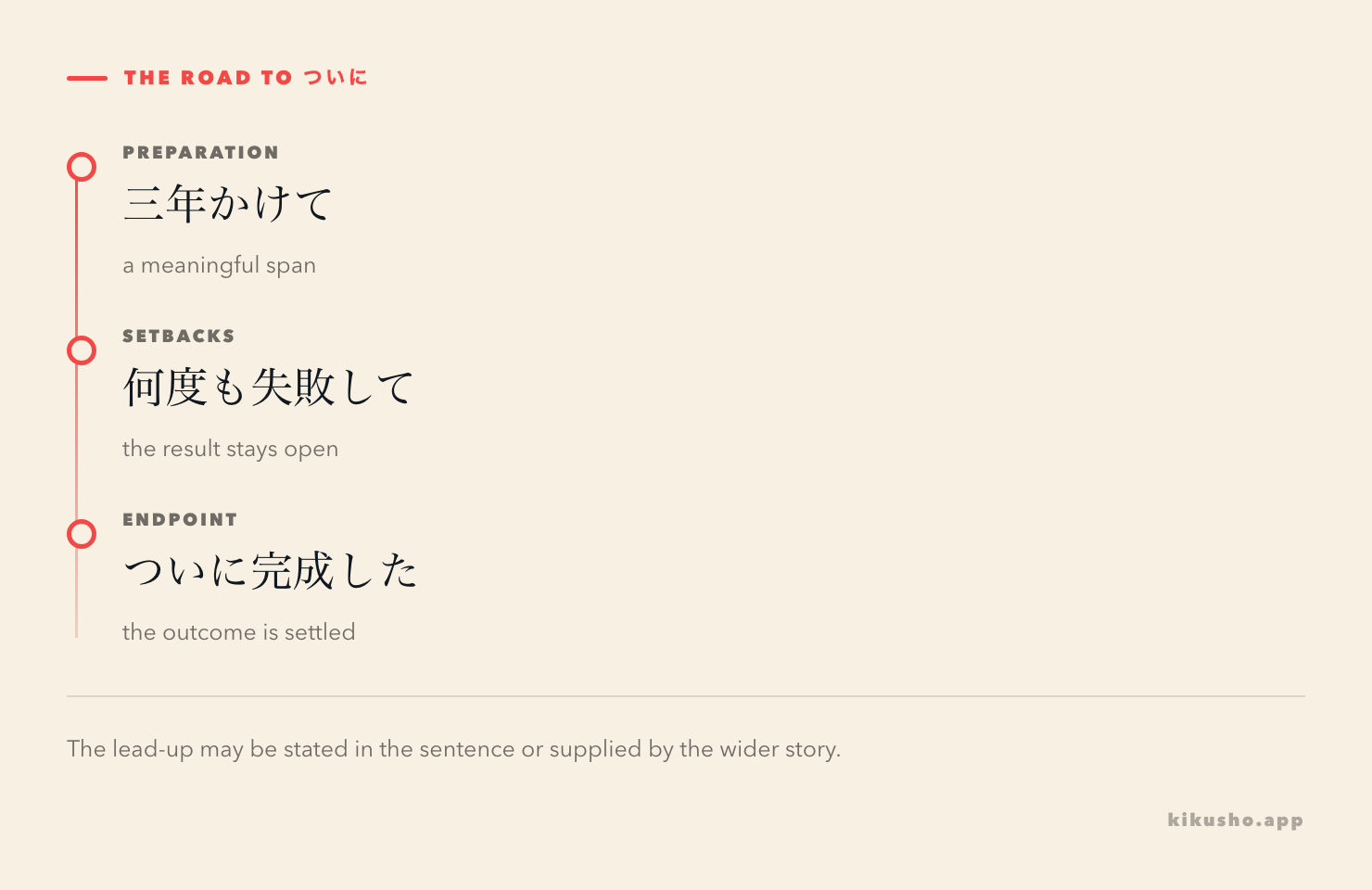
The lead-up need not be stated in the same sentence. A story, conversation, or shared situation can supply it:
何度も計画を立て直して、私たちはついに出発した。
After revising the plan many times, we finally departed.
新しい橋がついに完成した。
The new bridge was finally completed.
The second sentence works when the bridge has been under construction or discussion for long enough that completion feels like a settled endpoint. Without such a background, ついに can sound theatrical. A routine action that merely happens later normally needs a sequence word instead.
JLPT Sensei places ついに at N3 and gives both “finally” and “in the end.” Bunpro likewise classifies it as a standard-register N3 adverb and ties it to a significant period or course of events rather than an instant, effortless result.
The result does not have to be good
English “at last” can sound celebratory, but ついに is not a positive word. It can close a story that the speaker hoped would end differently.
長い話し合いのあと、二人はついに別れることにした。
After a long discussion, the two finally decided to separate.
古いパソコンがついに動かなくなった。
The old computer finally stopped working.
The tone comes from 別れる and 動かなくなる, plus the surrounding story. ついに contributes completion: the situation has reached the outcome toward which it had been moving.
It can also settle the matter by saying the expected event never occurred:
一日中待ったが、彼からの連絡はついに来なかった。
I waited all day, but in the end no message from him came.
The negative is not a delay still in progress. ついに来なかった looks back after the waiting period has closed and says non-arrival was the final result. By contrast, まだ来ていない leaves open the possibility that the message will come later.
The comparison by Japanese Language Learning Support explicitly includes affirmative and negative endpoints for ついに and describes the form as focusing on the final result. That source also notes that positive outcomes are common, but its own negative examples show why “positive only” is too narrow.
It can announce that the decisive moment has arrived
ついに does not require a completed past event. If the waiting is over because the crucial moment is now fixed or beginning, a present or future predicate is possible:
ついに明日、新しい店が開店する。
At last, the new shop opens tomorrow.
ついに私たちの番が来た。
Our turn has finally come.
In the first sentence, the shop has not opened yet. The long-awaited opening has become the next settled event, and “tomorrow” is now the endpoint of the wait. In the second, the decisive stage has already arrived.
This differs from a calendar announcement such as 最後に質問の時間があります, “Lastly, there will be time for questions.” 最後に orders the final item in a sequence. It does not imply delay, anticipation, or a story reaching resolution.
ついに, やっと, とうとう and いよいよ
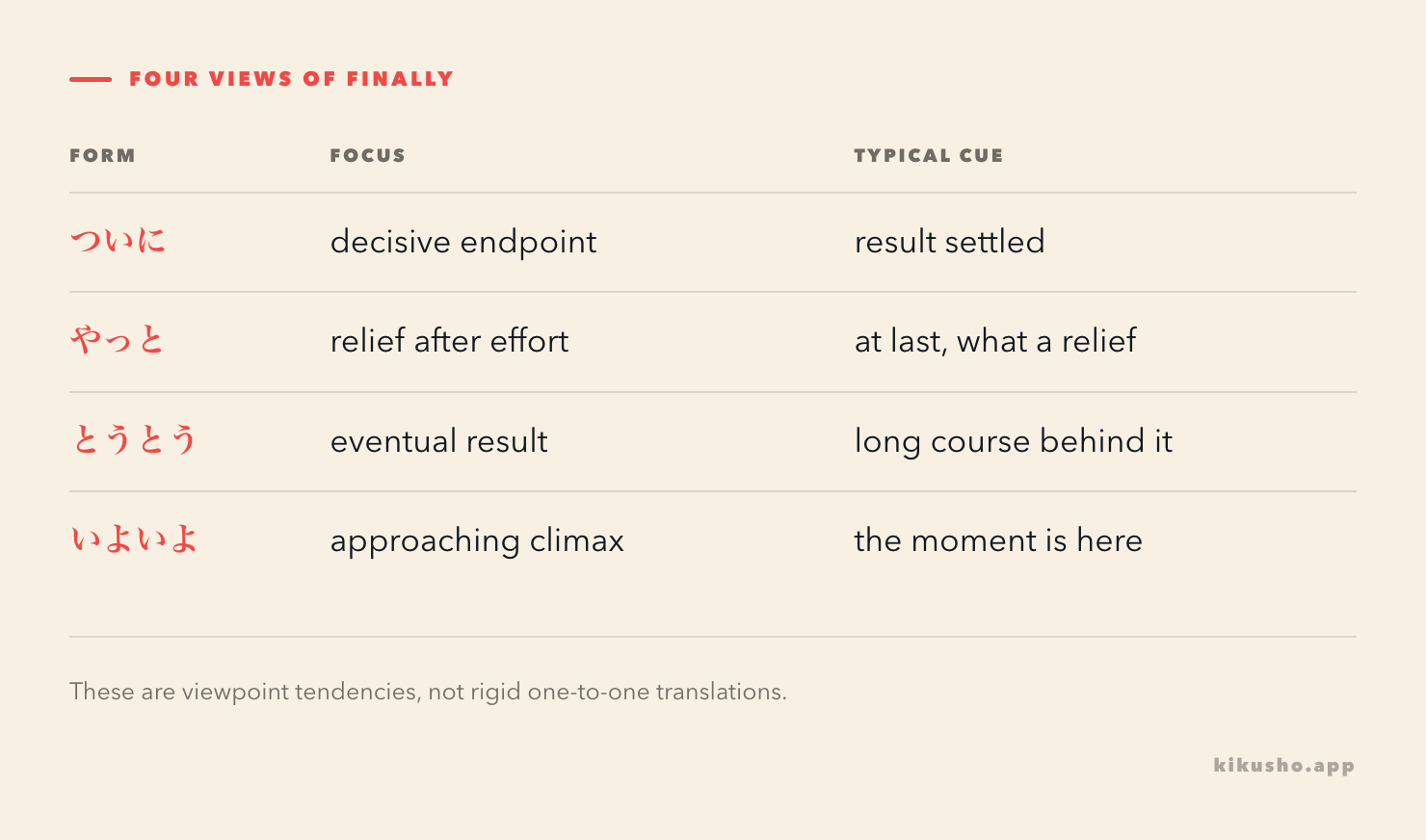
These adverbs overlap, so no single English translation can enforce the boundary. The following tendencies give you a dependable first choice.
| Form | What the speaker foregrounds | Negative final result? |
|---|---|---|
| ついに | the decisive endpoint itself | yes |
| やっと | relief after difficulty or delay | normally no |
| とうとう | the long course arriving at its eventual result | yes |
| いよいよ | an anticipated climax is now imminent or beginning | not its central use |
Suppose you have worked on a report for months:
レポートがついに完成した。
The report finally reached completion.
レポートがやっと完成した。
The report is finally done, what a relief.
Both are natural. ついに puts the completed report in the spotlight. やっと lets the difficulty and the speaker's relief remain audible. The 急に, やっと and なかなか lesson follows that relief-focused path from delay to success.
とうとう often carries more of the road behind the result, including exhaustion, inevitability, or a feared outcome. 何度も警告したが、彼はとうとう会社を辞めた looks back over the warnings and the path to resignation. Replacing it with ついに turns more attention toward the resignation as the decisive fact. This is a tendency, not a hard ban; real examples overlap.
いよいよ commonly stands at the threshold: いよいよ決勝戦が始まる, “the final is about to begin at last.” The focus is mounting anticipation as the major event starts. ついに can also mark its arrival, but with stronger closure of the waiting period.
Corpus research from Tokyo Metropolitan University, published as a detailed study of ついに and とうとう, finds substantial overlap and examines the pair through actual preceding clauses and time expressions. That evidence is a reason to teach the contrast as viewpoint, not as a rigid positive-versus-negative rule.
Keep つい separate from ついに
The similar spelling hides different grammar:
セールだったので、つい買ってしまった。
It was on sale, so I bought it without meaning to.
探していた本をついに買うことができた。
I was finally able to buy the book I had been looking for.
The first つい marks an impulse or lapse in restraint. The second ついに closes a search with a successful result. The ふと and つい lesson separates unplanned awareness, impulse, carelessness, and recent-time つい from this endpoint adverb.
Kana ついに is common. You may also see 遂に, especially where the writing style favors kanji. The reading and grammar do not change.
Preserve the road that makes the endpoint matter
A card containing only ついに完成した records a result but leaves the wait abstract. In Kikusho, capturing the whole line 三年かけて、ついに完成した keeps the duration beside the endpoint. You can check that sentence before saving it, then review the contrast between the process and its conclusion rather than memorizing another isolated translation of “finally.”
That context is also what lets you distinguish a calm narrative endpoint from relief, dread, or anticipation. The adverb selects a viewpoint; the surrounding clause supplies the feeling.
Practice: locate the endpoint
Question 1
After four failed attempts, Mika passed the exam. Choose the best completion: 美香は四回失敗したが、五回目で__合格した。
ア) ついに
イ) 最後に
ウ) つい
エ) まだ
Question 2
Which sentence naturally presents a final non-result after the waiting period ended?
ア) 返事はついに来なかった。
イ) 返事はやっと来なかった。
ウ) 返事はつい来なかった。
エ) 返事は最後に来なかった。
Question 3
Choose the sentence that means “I unintentionally ate the cake.”
ア) ケーキをついに食べた。
イ) ケーキをいよいよ食べた。
ウ) ケーキをつい食べてしまった。
エ) ケーキを最後に食べた。
Question 4
Arrange all five chunks to say “After three years of construction, the bridge was finally completed.”
- ついに
- 三年の工事を経て
- 完成した
- 橋が
- 。
Question 5
The speaker has struggled all afternoon and feels strong relief. Which adverb best fits the intended viewpoint?
ああ、__仕事が終わった。帰れる!
ア) やっと
イ) 最後に
ウ) つい
エ) まだ
Question 6
Which sentence uses ついに for an awaited event whose decisive time has arrived, even though the event is tomorrow?
ア) ついに明日、決勝戦が始まる。
イ) 明日、つい決勝戦が始まる。
ウ) 最後に明日は決勝戦だった。
エ) まだ明日、決勝戦が始まらない。
Question 7
Read the passage and choose the best pair.
新薬の研究は十年続いた。何度も実験に失敗したが、今年( )国の承認を得た。発売日も決まり、( )来月から患者に届けられる。
ア) つい/最後に
イ) ついに/ついに
ウ) やっと/まだ
エ) 最後に/つい
Answers and explanations
Answer 1
ア) ついに. Four failures provide the lead-up, and passing on the fifth attempt is the decisive result. 最後に would merely order a final item, while つい would suggest an unplanned impulse.
Answer 2
ア) 返事はついに来なかった. The negative predicate settles the story after the waiting period: no reply ever came. やっと normally presents an achieved, often relieving result rather than final non-realization.
Answer 3
ウ) ケーキをつい食べてしまった. つい plus てしまう frames the eating as a lapse in restraint. ついに would require a meaningful lead-up ending in the act of eating.
Answer 4
2 → 4 → 1 → 3 → 5. 三年の工事を経て、橋がついに完成した。 The three-year construction supplies the process and ついに marks its completed endpoint.
Answer 5
ア) やっと. The exclamation and 帰れる foreground relief after a difficult afternoon. ついに could describe the endpoint, but やっと best matches the requested emotional viewpoint.
Answer 6
ア) ついに明日、決勝戦が始まる. The wait has reached the point where the anticipated final is tomorrow. A past form is not required when the decisive time has arrived.
Answer 7
イ) ついに/ついに. The first endpoint is approval after ten years of research. The second announces that the long-awaited delivery stage will begin next month. Repetition is justified because each clause closes a distinct wait.
Common questions
What does ついに mean in Japanese?
ついに marks the decisive result reached after a meaningful wait, process or chain of events. It often translates as “finally,” “at last” or “in the end.”
Can ついに describe a bad result?
Yes. The outcome can be welcome, unwelcome or neutral: ついに合格した means “finally passed,” while ついに店が閉まった can mean “the shop finally closed.”
Can ついに be followed by a negative?
Yes. ついに返事は来なかった means that after waiting until the matter was settled, no reply ever came. This negative endpoint is an important difference from relief-focused やっと.
What is the difference between ついに and つい?
They are separate adverbs. ついに means “finally” after a lead-up. つい often describes an unplanned impulse or lapse, as in つい買ってしまった.