On this page
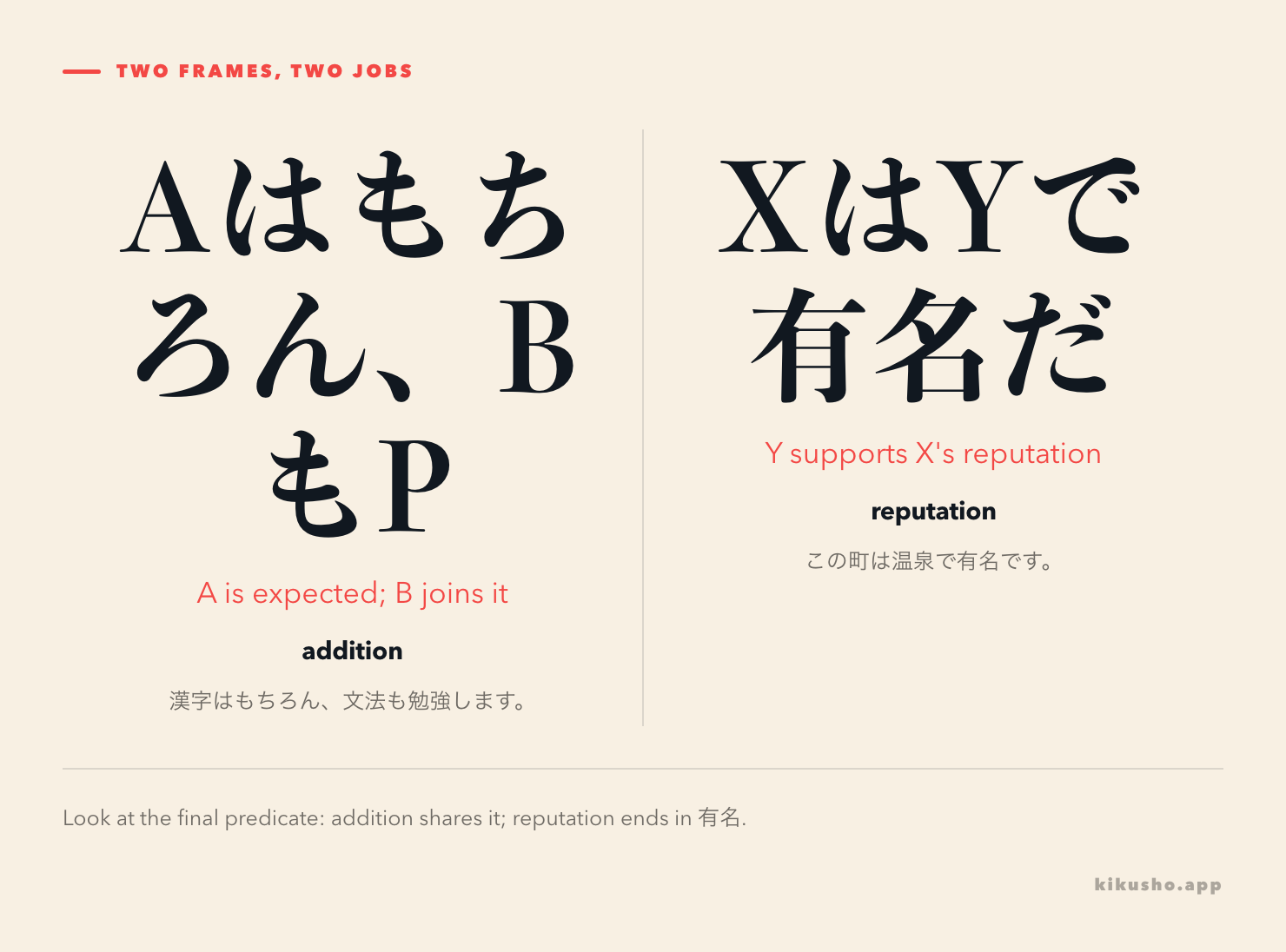
Aはもちろん、Bも adds B after presenting A as expected: “A, of course, and B too.” XはYで有名だ makes a different claim: X is famous, and Y is what the reputation rests on. The first pattern expands a set; the second names a basis.
That distinction matters because English can use “known” or “of course” loosely around both ideas. Japanese marks the jobs separately, and can place both patterns in one sentence when a reputation has more than one basis.
The test: addition or reputation?
Ask what the sentence must do next.
- If it presents A as an obvious member and then adds B, choose Aはもちろん、Bも.
- If it names what X is famous for, choose XはYで有名だ.
| Pattern | First frame | Required relationship | Secure example |
|---|---|---|---|
| Aはもちろん、BもP | A is expected | B shares predicate P | 漢字はもちろん、文法も勉強します。 |
| XはYで有名だ | X is the topic | Y supports X's reputation | この町は温泉で有名です。 |
The English translations may both contain extra words such as “also” or “known,” but the Japanese question is concrete. Are you adding another member to the same statement, or supplying the content of a reputation?
Where はもちろん is at home
もちろん means “of course” or “naturally.” In Aはもちろん、BもP, the particle は sets A apart as the unsurprising case. B then arrives as an additional case under the same predicate P.
この図書館では、本はもちろん、映画も借りられます。
この としょかんでは、ほんは もちろん、えいがも かりられます。
At this library, you can borrow books, of course, and films too.
Books are the expected library item. Films are the addition worth stating. The usual shape is noun A directly before はもちろん and も on B:
| Attachment | Form | Example |
|---|---|---|
| noun | Nはもちろん、Nも | 読解はもちろん、聴解も練習する |
| verb clause | V普通形のはもちろん、…も | 読むのはもちろん、声にも出す |
| い-adjective clause | ~いのはもちろん、…も | 安いのはもちろん、使いやすい |
| な-adjective clause | ~なのはもちろん、…も | 静かなのはもちろん、明るい |
A clause needs to become noun-like before は can frame it. の does that work in the table. The noun pattern remains the safest and most frequent form to recognize first.
The second も is common because it makes the addition explicit. It is not decorative. Compare:
この店は料理はもちろん、接客も丁寧です。
This restaurant naturally has good food, and its service is attentive too.
With only 料理はもちろんです, the sentence instead says “The food is of course [so]” or “Of course, the food…,” depending on context. The two-part N3 construction is easiest to identify when you can point to both A and B.
Bunpro's はもちろん entry records the core noun pattern, the frequent Bも continuation and its standard register. Japanese with Kanako independently shows both nouns and nominalized clauses before はもちろん. Both place the form at N3, but that placement is a study estimate rather than an official exhaustive JLPT list.
The nearby connector だけでなく also means “not only A but also B.” Its starting claim is different. Aだけでなく says A is not the limit; Aはもちろん treats A as already expected and moves attention to the added B.
Where ~で有名 is at home
In XはYで有名だ, は marks the person, place or thing being described. Y marks the feature behind the reputation, and 有名(ゆうめい) supplies “famous” or “well known.”
青森はりんごで有名です。
あおもりは りんごで ゆうめいです。
Aomori is famous for apples.
This で does not mark an activity location. It connects the reputation to its basis: apples are what Aomori is known for. A noun can stand directly before で. A full event or quality is normally nominalized first:
| Basis Y | Form before 有名 | Original example |
|---|---|---|
| noun | Nで有名 | この町は温泉で有名です |
| verb clause | V普通形ことで有名 | この店は早朝から営業していることで有名です |
| い-adjective clause | ~いことで有名 | この道は桜が美しいことで有名です |
| な-adjective clause | ~なことで有名 | このホテルは部屋が静かなことで有名です |
こと packages the entire preceding clause as the feature people know. Without it, a finite verb or adjective cannot simply occupy the noun slot before で有名. の is also possible in some contexts, but ことで有名 is the stable explanatory form to learn.
Bunpro's ~は~で有名 reference distinguishes the direct noun attachment from clause plus こと and lists the form as standard-register N3 grammar. JLPT Sensei independently gives the same topic, nominalization and で有名 structure, also at N3.
Do not confuse the particle with the connective form of the な-adjective:
- この町は温泉で有名です。 The town is famous for hot springs.
- この町は有名で、観光客が多いです。 The town is famous, and it has many tourists.
In the first sentence, で belongs to the reputation basis 温泉で. In the second, 有名で is the connective form of 有名だ. The order of the words changes the grammar.
When both patterns share one predicate
The two forms are not alternatives, so there is no ban on combining them:
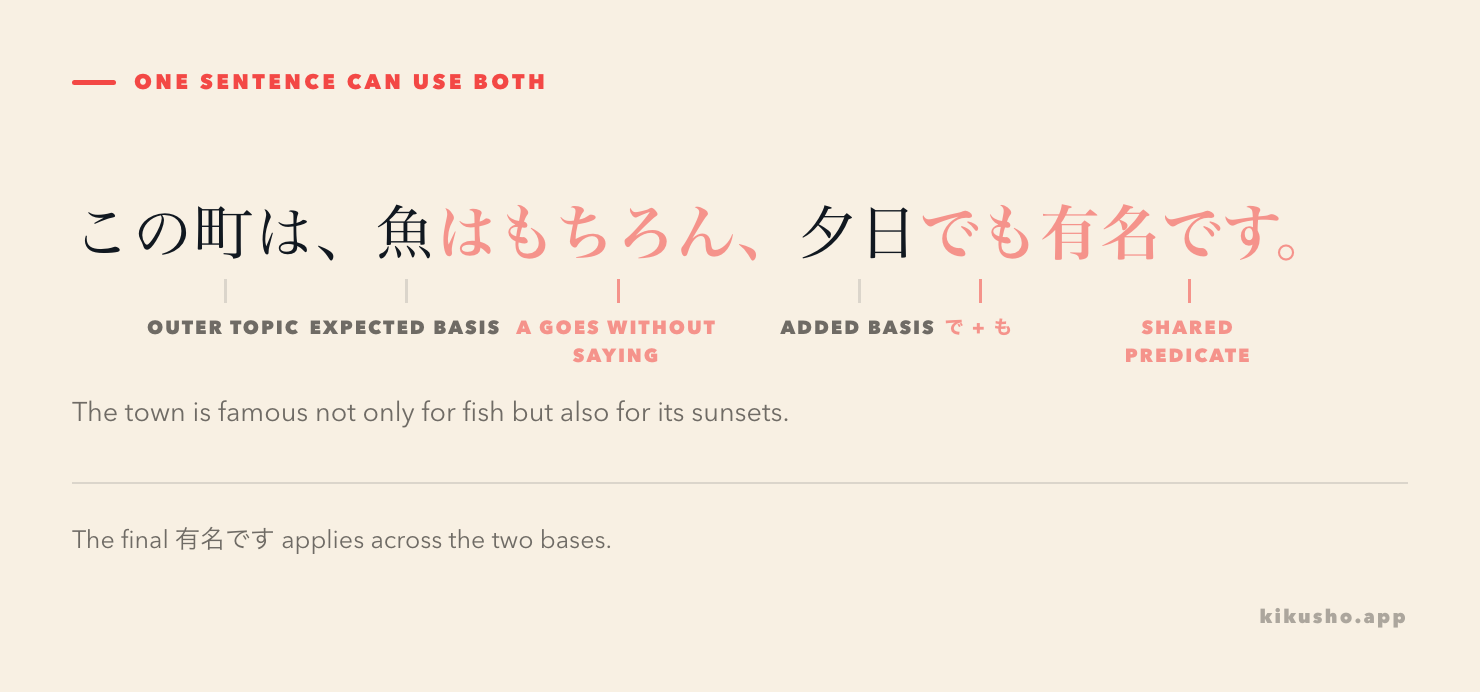
この港町は、新鮮な魚はもちろん、夕日の美しさでも有名です。
この みなとまちは、しんせんな さかなは もちろん、ゆうひの うつくしさでも ゆうめいです。
This port town is famous not only for fresh fish but also for the beauty of its sunsets.
The sentence first establishes 新鮮な魚 as the obvious basis. It then adds 夕日の美しさ. On that second basis, でも is the reputation-marking で plus the additive particle も. The final 有名です applies across the pair.
KidNihon's ~で有名 lesson supplies independent examples of this combined architecture, including Aはもちろん followed by Bでも有名. The useful reading clue is the final predicate. If 有名 closes the whole coordination, the earlier nouns can both be understood as things the topic is famous for.
A similar division appears in は and が: one particle sets the frame while the rest of the clause carries the claim. Here, do not translate each は separately. Find the outer topic first, then the A-to-B addition inside it.
What changes when the frame is wrong
Replacing one pattern with the other does more than alter style.
この町は温泉はもちろん、湖もあります。 says the town has hot springs and, additionally, a lake. It does not claim that either feature is famous.
この町は温泉で有名です。 says the town has a reputation for hot springs. It does not add a second attraction.
この町は温泉はもちろん、湖でも有名です。 combines the two moves and says the town's fame extends from the expected hot springs to its lake as well.
This is the practical test for reading. Locate the final predicate. If B is followed by も and both A and B share a verb or adjective, はもちろん is expanding that predicate's scope. If Y is followed by で有名, Y identifies the content of a reputation. A long sentence may contain both operations, but each still has one job.
When saving a sentence in Kikusho, keep the final predicate on the card. A capture ending at 温泉はもちろん preserves the setup and loses the claim. A full line such as 温泉はもちろん、湖でも有名です keeps the addition, the でも and the reputation together, so the relationship remains visible during review.
Practice: follow the final predicate
Question 1 · addition
Complete: この学校では、英語( )、中国語も勉強できます。
- A. で有名で
- B. はもちろん
- C. なことで
- D. だけ
Question 2 · reputation basis
Complete: この地方は、お茶( )有名です。
- A. で
- B. も
- C. はもちろん
- D. のは
Question 3 · clause attachment
Which sentence correctly says “This café is famous for opening at six in the morning”?
- A. このカフェは朝六時に開くで有名です。
- B. このカフェは朝六時に開くのはもちろんです。
- C. このカフェは朝六時に開くことで有名です。
- D. このカフェは朝六時に開くも有名です。
Question 4 · word order
Which sentence means “The town is famous, and it has many visitors,” without naming what it is famous for?
- A. この町は観光客で有名です。
- B. この町は有名で、観光客が多いです。
- C. この町は有名はもちろん、観光客です。
- D. この町は観光客が多いことで有名で。
Question 5 · combined frame
Complete: この島は、白い砂浜はもちろん、星空( )有名です。
- A. には
- B. でも
- C. とは
- D. のも
Question 6 · two claims
A guide says: この町は古い城で有名です。城はもちろん、春の祭りも多くの観光客を集めます。 Which interpretation is accurate?
- A. The festival is the reason the castle is old.
- B. The town is famous for its old castle, and both the castle and spring festival attract many visitors.
- C. The town is famous only for its spring festival.
- D. The castle and the festival are both described as quiet.
Answers and explanations
Answer 1
B. はもちろん. English is the expected subject and Chinese is added with も under the shared predicate 勉強できます. A would leave no complete basis before で有名, C requires a preceding な-adjective clause, and D would mean “only.”
Answer 2
A. で. お茶で有名です names tea as the basis of the region's reputation. B cannot connect the noun directly to 有名, C needs a later added member, and D begins a different nominalized frame.
Answer 3
C. このカフェは朝六時に開くことで有名です. The whole event 朝六時に開く becomes a noun-like basis with こと before で有名. A attaches で directly to a finite verb, B presents the opening as obvious but adds nothing, and D cannot attach も directly to 開く.
Answer 4
B. この町は有名で、観光客が多いです. Here 有名で is the connective form of the な-adjective: the town is famous, and then a second fact follows. A specifically says the town is famous for tourists. C does not form the additive pattern, and D leaves the connective sentence unfinished.
Answer 5
B. でも. The white beach is the expected basis and the starry sky is an added basis of fame. The で connects 星空 to 有名, while も marks it as the addition. The other combinations do not express both relationships.
Answer 6
B. The first sentence uses 古い城で有名 to identify the reputation. The second uses 城はもちろん、春の祭りも with 観光客を集めます to add the festival under a shared predicate. It does not say that the festival caused the castle's age, restrict the fame to the festival or describe either attraction as quiet.
Common questions
What does はもちろん mean in Japanese?
Aはもちろん、Bも means that A is already expected or obvious and B should be included too. It often translates as “not only A but also B” or “A, of course, and B too.” The second part commonly contains も.
How do you use ~で有名?
Put the topic before は and the basis of its reputation before で有名, as in 青森はりんごで有名です. For a whole event or quality, nominalize the clause, commonly with こと: この店は朝早く開くことで有名です.
Can はもちろん and ~で有名 appear in the same sentence?
Yes. この港町は、新鮮な魚はもちろん、夕日の美しさでも有名です presents fresh fish as the obvious basis of the town's reputation, then adds the beauty of its sunsets. The でも on the second basis is で plus も.
Is はもちろん the same as だけでなく?
Both can add B beyond A, but はもちろん presents A as something already expected or taken for granted. だけでなく simply rejects A as the limit and can give A and B more neutral weight.