On this page
この仕事はほぼ終わったと言ってもいい is the speaker's assessment: “It is fair to say this job is almost finished.” この仕事は難しいと言われている reports a view already circulating: “This job is said to be difficult.”
Both constructions place a complete claim before the quotation particle と. To choose between them, ask one question: who takes responsibility for the description now?
One claim, two owners
The quoted clause comes first. The ending tells you whose view the sentence presents.
| Construction | Claim belongs to | Natural English |
|---|---|---|
| plain clause + と言ってもいい | the current speaker | it is fair to say; one could call it |
| plain clause + と言われている | people in general or an unnamed group | it is said; it is generally considered |
The passive inside 言われている is doing real work. Active 言う means “say”; passive 言われる means “be said”; ~ている presents that saying as an established or continuing state. The result leaves the individual speakers unnamed. The passive-form lesson explains how passive voice changes the sentence's center; here it also moves the source out of the foreground.
Use と言ってもいい for your own acceptable description
~と言ってもいい literally builds the idea “it is all right even if one says X.” In use, it offers X as an acceptable label or conclusion.
この作業はほとんど終わったと言ってもいい。
このさぎょうはほとんどおわったといってもいい。
It is fair to say this task is almost finished.
The speaker has looked at the work and endorses ほとんど終わった as a reasonable account. The form can soften the surface of the statement, but it does not transfer responsibility to somebody else.
彼はこのチームのリーダーだと言ってもいいだろう。
かれはこのチームのリーダーだといってもいいだろう。
One could say that he is the leader of this team.
だろう/でしょう adds another layer of judgment and often makes the assessment sound considered rather than blunt. In a strong context, however, と言ってもいい can support a confident evaluation: “it would not be wrong to call it X.” Treat it as an acceptable-description frame, not as an automatic marker of uncertainty.
The description can be favorable, critical or neutral:
この計画は成功したと言ってもいい。
It is fair to say this plan succeeded.
その説明は少し不十分だと言ってもいい。
One could call that explanation slightly inadequate.
The construction does not require praise. It marks the speaker's decision to apply the quoted description.
Use と言われている for a circulating view
~と言われている presents a claim as something people say, believe or repeat.
この木は三百年以上前に植えられたと言われている。
このきはさんびゃくねんいじょうまえにうえられたといわれている。
It is said that this tree was planted more than three hundred years ago.
The sentence does not identify the first speaker. It reports the existence of the story or accepted account.
この小説は作者の最高傑作だと言われている。
このしょうせつはさくしゃのさいこうけっさくだといわれている。
This novel is said to be the author's masterpiece.
This pattern is common in explanations, articles and presentations because it can summarize a public reputation. It also appears in conversation. Written use is common, but “written only” would be too strong.
The form creates distance, not proof. と言われている can report a reliable scholarly consensus, a local legend or an unsupported rumor. If the evidence matters, name the source instead of making an unnamed crowd carry the claim.
Attach a complete plain clause before と
The と is the quotation particle. Build the content as an ordinary plain clause, then add either reporting frame.
| Predicate type | Quoted clause | Speaker's assessment | Circulating view |
|---|---|---|---|
| verb | もう終わった | もう終わったと言ってもいい | もう終わったと言われている |
| い-adjective | 難しい | 難しいと言ってもいい | 難しいと言われている |
| な-adjective | 静かだ | 静かだと言ってもいい | 静かだと言われている |
| noun | 町の中心だ | 町の中心だと言ってもいい | 町の中心だと言われている |
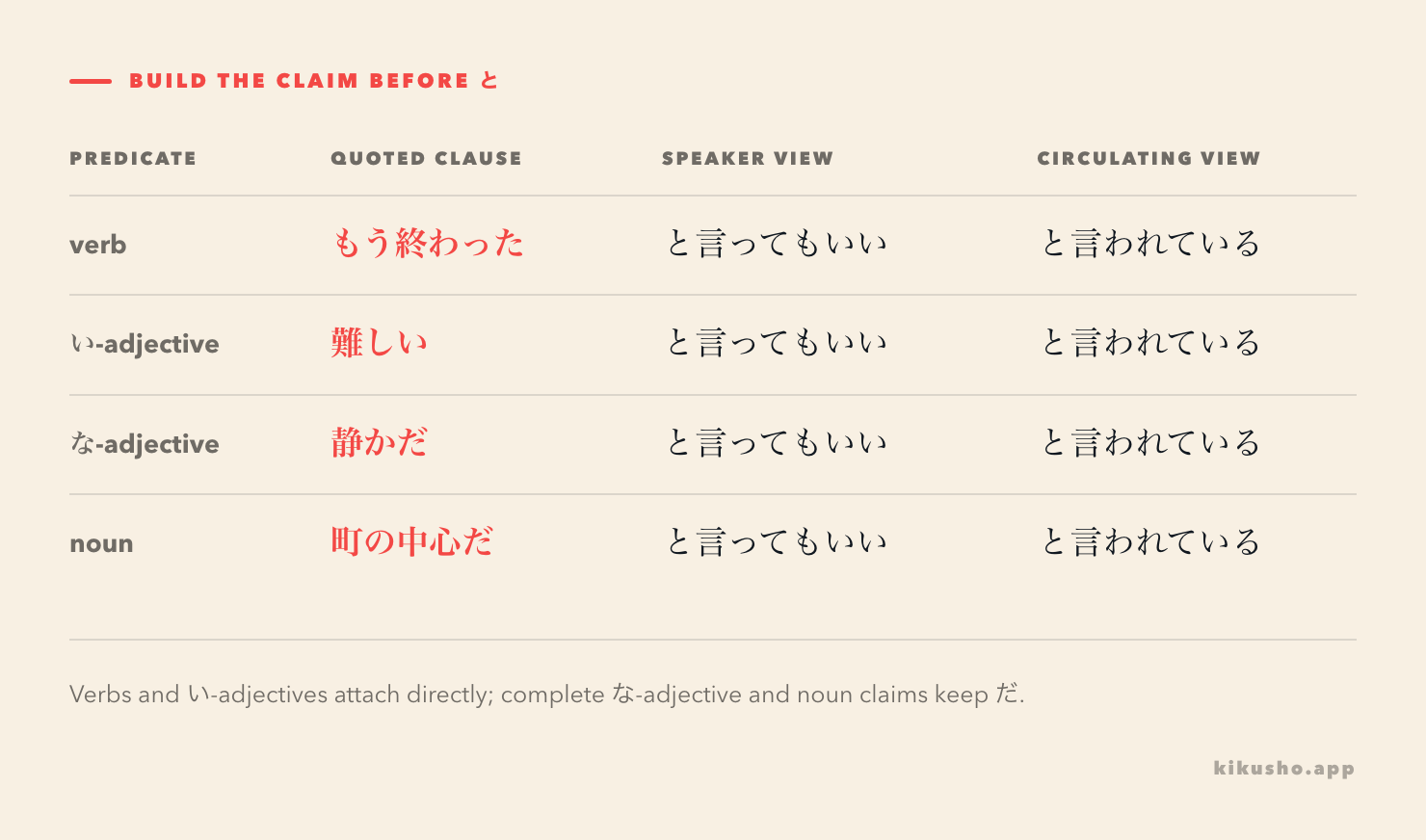
For a reliable N4 production rule, keep だ in a complete noun or な-adjective claim. Labels sometimes appear without it, especially in compact expressions such as 天才と言われている, but 天才だと言われている makes the quoted sentence structure explicit.
Tense and negation remain inside the quote:
昔は、この方法がいちばん安全だと言われていた。
むかしは、このほうほうがいちばんあんぜんだといわれていた。
In the past, this method was said to be the safest.
この結果は失敗ではないと言ってもいい。
このけっかはしっぱいではないといってもいい。
It is fair to say that this result is not a failure.
Changing 言われている to 言われていた moves the circulating view into the past. It can imply that people once held the view without asserting that they still do.
The same clause can support different sentences
Compare one description without changing its words:
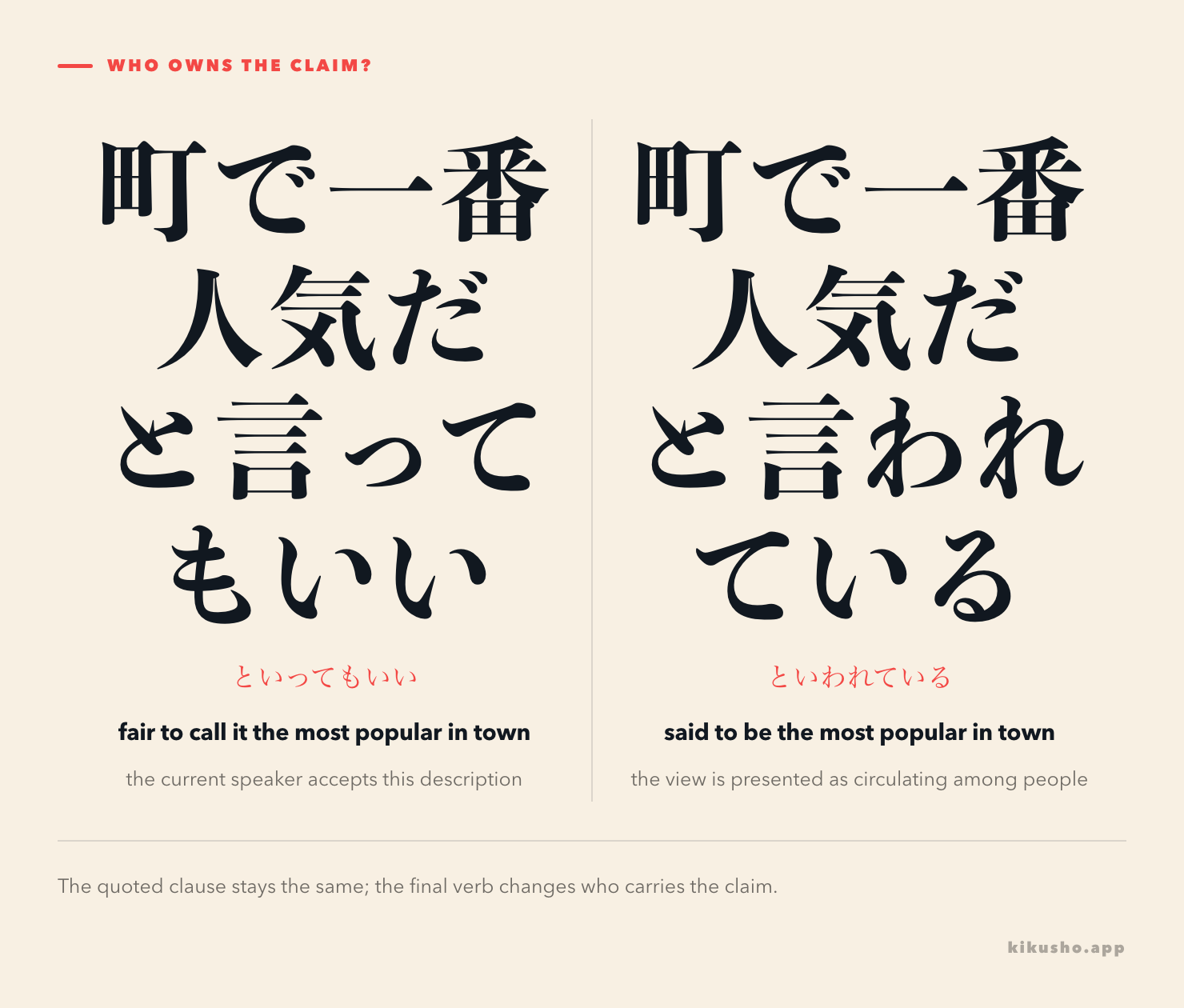
この店は町で一番人気だと言ってもいい。
It is fair to say this shop is the most popular in town.
この店は町で一番人気だと言われている。
This shop is said to be the most popular in town.
The first sentence may follow the speaker's own comparison of reservations, queues and reviews. The second reports a reputation without adopting it as a personal conclusion. Either speaker might believe the claim, but the grammar chooses how to present its source.
That difference matters in disagreement. After と言ってもいい, a listener can challenge the speaker's judgment directly. After と言われている, the natural next question is 誰に? or 何を根拠に?: “Said by whom?” or “On what basis?”
Keep two lookalikes separate
と言っても without いい
Xと言ってもY concedes the label X and then limits the expectation it creates.
春だと言っても、まだ寒い。
はるだといっても、まださむい。
Although it is spring, it is still cold.
This does not mean “it is fair to say spring.” The following clause corrects what the listener might infer from 春. Do not drop いい and expect the assessment meaning to survive.
言ってもいいですか as permission
At the end of a question, 言ってもいいですか can ask whether saying something is permitted:
ここで意見を言ってもいいですか。
May I give my opinion here?
This is the ordinary ~てもいい permission pattern attached to the action 意見を言う. In 彼はリーダーだと言ってもいいですか, context can produce “Is it fair to call him the leader?” or “May I call him the leader?” A declarative sentence with だろう/でしょう usually makes the assessment reading clearer.
One person's words
先生は来週試験があると言っていました reports what the teacher said. 先生に来週試験があると言われました says that you were told this by the teacher. Those sentences identify a source or recipient. 来週試験があると言われている instead presents the claim as circulating, so it is a poor choice when one named speaker is the point.
Read the final verb before accepting the claim
When a sentence in an article ends with either construction, keep the entire quoted clause on the card. In Kikusho, hide only the ending during review and ask: “Is the writer making this assessment, or reporting what people say?” The clause supplies the view; the last verb supplies its owner.
That method is especially useful for だ. A card containing 町の中心だと言われている preserves the noun predicate and the report together. You can edit the drafted explanation before saving, then review the same source wording offline instead of learning two disconnected glosses.
Practice
Answer all seven questions before checking the shared solution section.
Question 1. You inspected the work yourself and conclude that it is almost finished. Choose the best ending: この作業はほとんど終わった__。
- ア. と言ってもいい
- イ. と言われている
- ウ. と言っても
- エ. と言われてもいいですか
Question 2. A guidebook reports a local reputation without naming its source. Complete: この城は国で最も美しい__。
- ア. と言ってもいいですか
- イ. と言われている
- ウ. と言っても、閉まっている
- エ. と言わせている
Question 3. Choose the reliable N4 attachment for “It is said to be the center of the town.”
- ア. 町の中心なと言われている。
- イ. 町の中心でと言われている。
- ウ. 町の中心だと言われている。
- エ. 町の中心ですと言われている。
Question 4. Put these parts in order to mean “It would be fair to call this result a success.”
- と言ってもいいでしょう
- この結果は
- 成功だ
Question 5. Which sentence means “Although it is spring, it is still cold”?
- ア. 春だと言ってもいいでしょう。
- イ. 春だと言われている。
- ウ. 春だと言っても、まだ寒いです。
- エ. 春を言ってもいいですか。
Question 6. The view belonged to the past. Complete: 昔は、この計画は無理だ__が、今は実現できそうです。
- ア. と言われていた
- イ. と言ってもいい
- ウ. と言われている
- エ. と言っても
Question 7. Read the bridge account and select both missing endings.
この町では、この橋は百年前に造られた(A)。市の記録にも同じ年が書かれています。これらの資料から、この橋は町で最も古い橋の一つ(B)でしょう。
- ア. first blank: と言ってもいい/second blank: と言われている
- イ. first blank: と言われている/second blank: だと言ってもいい
- ウ. first blank: と言っても/second blank: だと言われている
- エ. first blank: と言われてもいい/second blank: と言っても
Answers and explanations
Answer 1. ア. と言ってもいい. The speaker inspected the work and now endorses “almost finished” as a fair description. イ would attribute the view to unnamed people, while ウ requires a following contrast.
Answer 2. イ. と言われている. The guidebook presents a local reputation and leaves the speakers unnamed. ア asks a question about the acceptability of saying it; ウ opens a concession; エ means that someone causes another person to say it.
Answer 3. ウ. 町の中心だと言われている. A complete noun predicate keeps だ before the quotation particle. ア treats the noun like a な-adjective before another noun, イ uses a connecting form instead of the quoted predicate, and エ puts polite です inside an indirect plain-style quote.
Answer 4. この結果は成功だと言ってもいいでしょう. 成功だ is the complete noun claim. と言ってもいいでしょう then presents it as the speaker's considered assessment.
Answer 5. ウ. 春だと言っても、まだ寒いです. Xと言ってもY limits the expectation created by X. ア says it is fair to call the season spring; イ reports a circulating view; エ is not a natural way to express this contrast.
Answer 6. ア. と言われていた. 昔は and the contrast with what now seems possible place the general opinion in the past. ウ would say the view remains current; イ would make it the present speaker's acceptable assessment.
Answer 7. イ. A と言われている・B だと言ってもいい. The first sentence reports what people in the town say. After consulting the record, the writer draws a conclusion and owns the description 町で最も古い橋の一つだ. The noun phrase requires だ before と言ってもいい.
Level evidence and a genuine placement difference
JLPT Sensei places と言ってもいい at N4 and gives the “one might say” assessment reading. It separately assigns と言われている to N4 with verb, adjective and noun claims.
Bunpro independently lists と言ってもいい as N4 and describes it as an acceptable or somewhat qualified assertion. Its と言われている lesson treats the passive as a commonly held or public opinion and also places it at N4.
Benri Japan instead labels と言ってもいい N2 and emphasizes confident evaluation, especially in writing and speeches. The difference shows that study lists draw the boundary differently; it does not change the attachment or the speaker-owned claim. A Waseda paper on Japanese passives supports the analysis of agentless と言われている as a general opinion.
The official JLPT publishes task types rather than an exhaustive grammar allocation. Kikusho retains the inventory's N4 placement, records the external N2 estimate, and treats plain-form quotation and ordinary passive conjugation as prerequisites.
Every quoted-clause attachment, English rendering and distractor was checked against the sources named here and the saved Kikusho inventory. The reviewer was Codex (GPT-6), an AI agent; no human language review is claimed.
Common questions
What is the difference between と言ってもいい and と言われている?
と言ってもいい presents the description as the current speaker's acceptable assessment. と言われている reports a view that people generally express, with the original speakers left in the background.
What form comes before と言ってもいい and と言われている?
Put a plain clause before the quotation particle と. Verbs and い-adjectives attach directly; a complete noun or な-adjective predicate normally keeps だ.
Does と言われている prove that a statement is true?
No. It presents a claim as generally said or accepted, but does not supply evidence. A careful report should still identify the source when it matters.
Is と言っても the same as と言ってもいい?
No. Xと言ってもY usually corrects an expectation: “although X is said, Y.” Adding いい creates the assessment “it is fair to say X.”