On this page
A price, an age or an amount of effort creates a rough standard. A割にB says B does not sit where that standard led you to expect: この靴は安い割に丈夫です, “These shoes are durable for how cheap they are.” The pattern is a judgment about proportion, not a general word for “but.”
That standard can make the result pleasantly better or disappointingly worse. What matters is the gap.
The form compares one result with its own standard
The noun 割(わり) can refer to a proportion or share. In the grammar pattern, A supplies the basis and B supplies the reality being evaluated.
このホテルは高い割に、部屋が狭いです。
この ホテルは たかい わりに、へやが せまいです。
The rooms are small considering how expensive this hotel is.
High price normally raises the expected room standard. The small room falls below it. Now reverse the direction:
この靴は安い割に、丈夫です。
この くつは やすい わりに、じょうぶです。
These shoes are durable for how cheap they are.
Low price may lower the expected durability. The actual durability exceeds it. 割に works in both directions because it marks disproportionality, not approval or disappointment by itself.
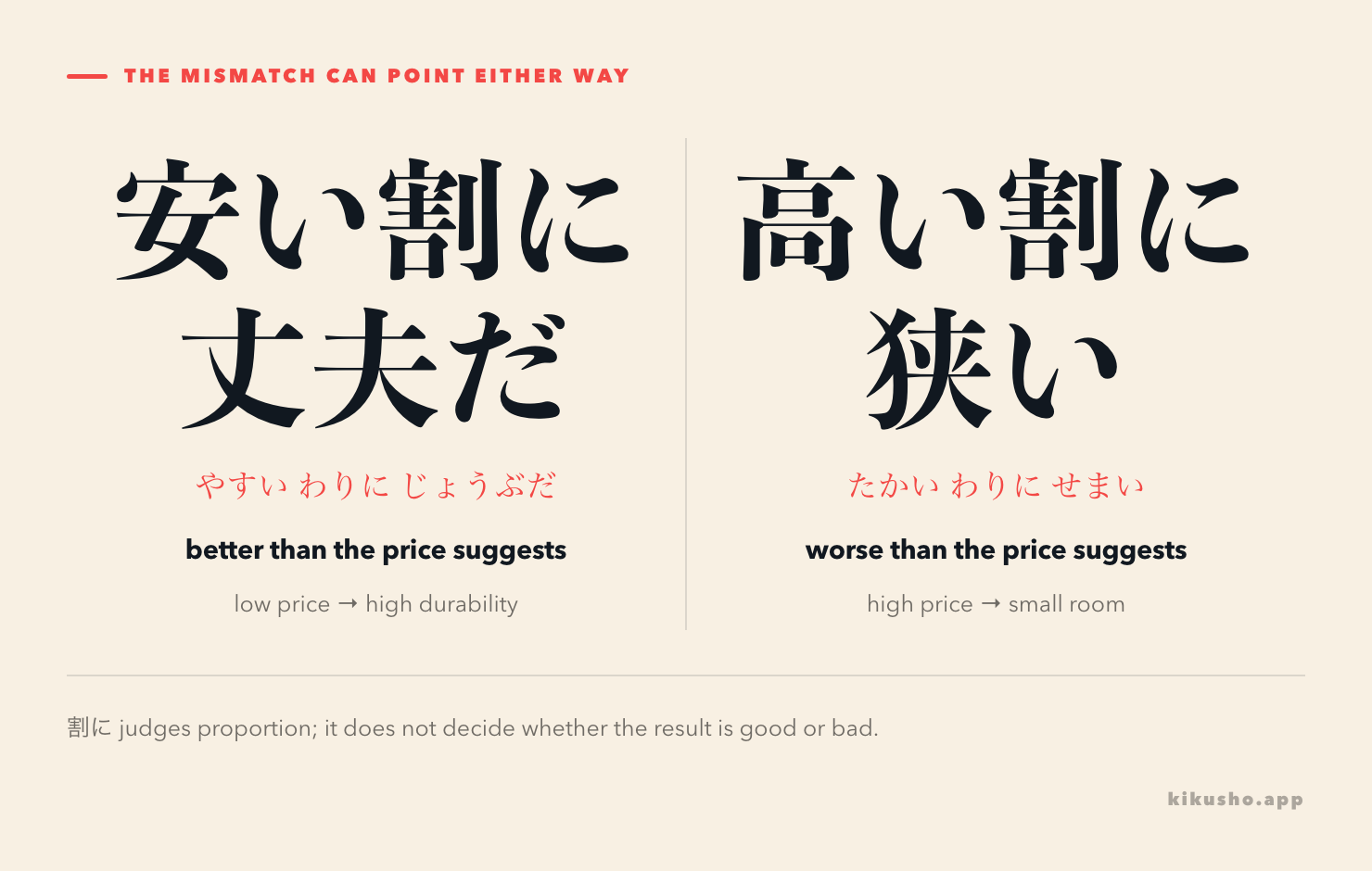
The useful mental picture is a scale. A establishes where ordinary experience would place B. The speaker then says reality landed elsewhere. The contrast is often mild and evaluative rather than dramatic.
Attach plain predicates, な, or の
The form before 割に follows the usual noun and adjective classes.
| Before 割に | Attachment | Example |
|---|---|---|
| verb | plain form + 割に | 三か月練習した割に、上達しなかった |
| い-adjective | い-adjective + 割に | 安い割に丈夫だ |
| な-adjective | な-adjective + な割に | 静かな割に交通が便利だ |
| noun | noun + の割に | 値段の割に量が多い |
Past and negative plain verbs fit when they supply the relevant baseline:
あまり勉強しなかった割には、よくできました。
あまり べんきょうしなかった わりには、よく できました。
I did well considering that I did not study much.
There is no grammatical ban on using 割に about yourself. The sentence above can describe the speaker's own result. The important condition is that the speaker has a recognizable standard to compare with, such as preparation and performance.
For present affirmative な-adjectives and nouns, do not keep だ:
- 有名な割に人が少ない, not 有名だ割に
- 学生の割に詳しい, not 学生だ割に
Bunpro's 割に reference gives the same four attachment classes and labels the register standard. JLPT Sensei independently records plain verbs, noun + の, both adjective classes, the N3 placement and both kanji and hiragana spellings.
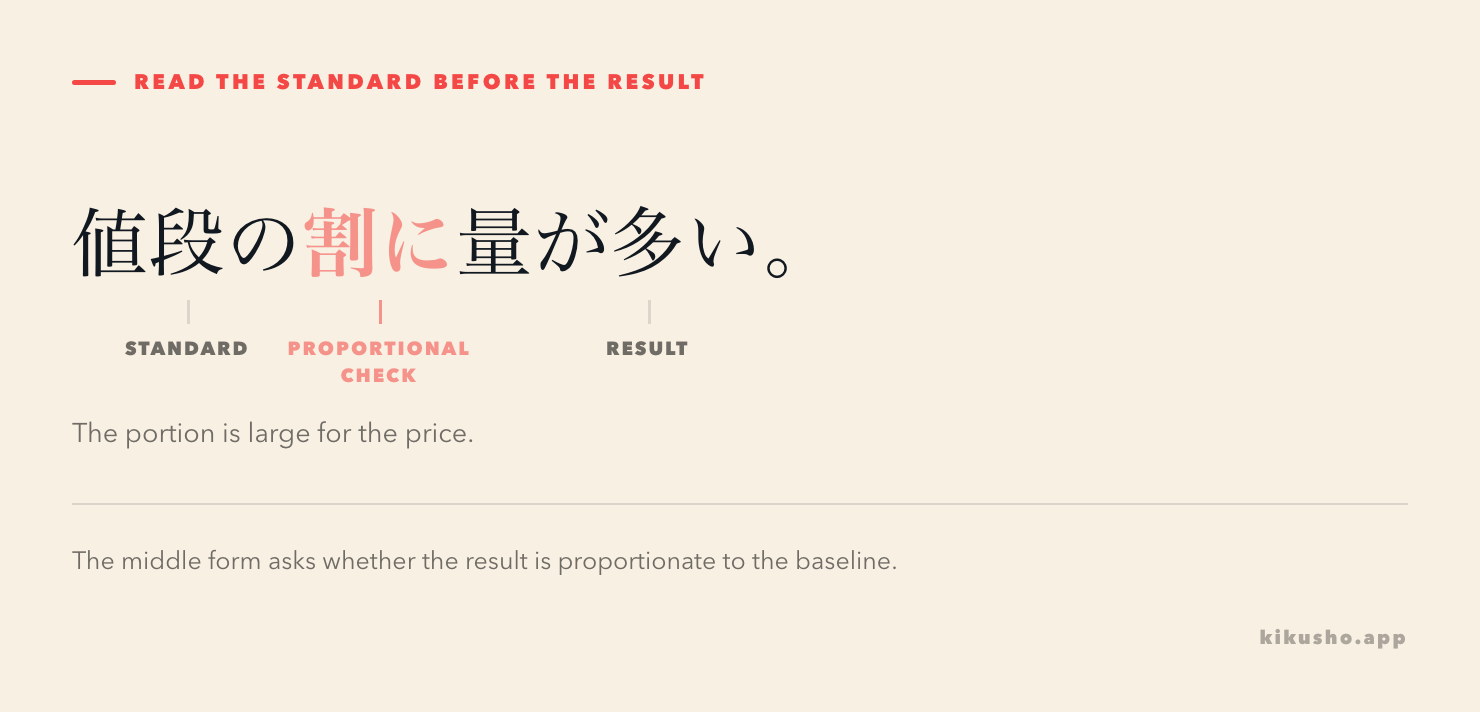
割には makes the contrast more visible
You will meet both 割に and 割には. The added は is contrastive. It places a little more attention on the standard under discussion, but it does not create a separate meaning or change the attachment rule.
初めて作った割には、よくできています。
はじめて つくった わりには、よく できています。
It turned out well considering it was the first attempt.
The sentence is still grammatical without は. With は, the speaker more clearly frames “as first attempts go” before giving the favorable assessment.
Do not treat は as mandatory whenever English says “considering.” It is a focus choice. In many ordinary examples, 割に alone carries the comparison cleanly.
Both spellings, 割に and わりに, are used. The kanji helps reveal the idea of proportion; the hiragana form is common in running text. The reading is わりに in either case.
The result can be good, bad, or simply unusual
Some short introductions teach 割に through pleasant surprise because 安い割においしい is memorable. That is only one direction.
| Baseline A | Result B | Evaluation |
|---|---|---|
| 安い | 丈夫だ | better than the price suggests |
| 高い | すぐ壊れた | worse than the price suggests |
| 冬 | 暖かい | unusually warm for the category |
| 練習した | 上達しなかった | less progress than the effort suggests |
Bunpro and JLPT Sensei both include favourable and unfavourable outcomes. Bunpro also supplies a first-person example, so neither “positive results only” nor “never about yourself” is a sound grammatical restriction.
A judgment about another person can still be socially delicate. 年齢の割に若く見える is grammatically ordinary, but the listener may not welcome having their age turned into a public benchmark. That is a question of situation and politeness, not formation.
Where the proportional reading stops
English “although” is wider than 割に. The Japanese pattern needs A to support a norm, degree or expected range that B can exceed or fall short of.
雨なのに試合をしました means “Although it was raining, we played the match.” Rain creates an obstacle, but the sentence need not measure the match against a rain standard. The broader concessive のに fits.
雨の日の割に観客が多かった means “There were many spectators for a rainy day.” Now “a rainy day” provides a recognizable baseline for attendance, so 割に fits.
The ても and のに lesson separates a condition that changes nothing from a fact followed by an unexpected outcome. 割に adds a narrower question: is B high, low, good, bad, much or little relative to A?
にしては comes closer. It often evaluates someone or something against a role, category or stated status:
- 新人にしては説明が落ち着いている。 The explanation is composed for a newcomer.
- 経験年数の割に説明が落ち着いている。 The explanation is composed relative to the years of experience.
The first foregrounds membership in the category 新人. The second makes the amount of experience a scale. Real sentences overlap, but this difference helps: category favors にしては; proportion or degree favors 割に. The にしては lesson develops that comparison beside に反して.
割に at the start leaves the standard implicit
You may also see 割に before an adjective or evaluation with no explicit A:
この問題は割に簡単でした。
この もんだいは わりに かんたんでした。
This problem was relatively easy.
The comparison class is supplied by context: perhaps other problems at this level, or what the speaker expected before trying it. 割と is also common, especially in conversation, with this stand-alone adverbial meaning. Keep that use separate from a clearly stated A割にB when parsing a long sentence.
This is one place where a one-word card loses too much. If you save only 割に = considering, you cannot recover whether the benchmark was price, age, effort or an unstated comparison class. In Kikusho, paste the complete line and keep both sides of the pattern in the editable example. The card then preserves the standard that makes the result surprising.
Practice the proportional judgment
Question 1 · noun attachment
Complete: この料理は、値段( )量が多いです。
- A. な割に
- B. の割に
- C. だ割に
- D. にして割に
Question 2 · な-adjective attachment
Complete: この町は静か( )、交通が便利です。
- A. の割に
- B. だ割に
- C. な割に
- D. で割に
Question 3 · direction of evaluation
Which sentence shows that an unfavourable result can follow 割に?
- A. この鞄は安い割に丈夫だ。
- B. このホテルは高い割に部屋が狭い。
- C. この問題は割に簡単だ。
- D. 値段の割には量が多い。
Question 4 · first attempt
Choose the complete sentence meaning “It turned out well considering I made it for the first time.”
- A. 初めて作った割には、よくできた。
- B. 初めて作ったの割には、よくできた。
- C. 初めて作るだ割に、よくできた。
- D. 初めての割に作った、よくできた。
Question 5 · proportional baseline
A café is busy even though it is raining. Which sentence explicitly evaluates attendance against the standard of a rainy day?
- A. 雨なのに、カフェに行きました。
- B. 雨でも、カフェは開いています。
- C. 雨の日の割に、カフェは混んでいます。
- D. 雨にしては、カフェで待ちます。
Question 6 · context reading
A review says: この店は駅から遠いです。しかし、場所の割には客が多く、週末は予約が必要です。 What judgment does 割には express?
- A. The location should normally bring more customers than this.
- B. The number of customers is high considering the inconvenient location.
- C. Every distant restaurant requires a weekend reservation.
- D. The location changed after the customers arrived.
Answers and explanations
Answer 1
値段の割に is the completed phrase, so B is correct. The noun 値段 needs の before 割に. A belongs after a な-adjective, C wrongly keeps だ, and D forms neither target pattern.
Answer 2
C. な割に. 静か is a な-adjective, so its present affirmative attachment is 静かな割に. A is the noun attachment, while B and D insert forms that do not connect the adjective to 割に.
Answer 3
B. このホテルは高い割に部屋が狭い. High price establishes a favorable expectation, and small rooms fall below it. A and D give favorable outcomes. C uses stand-alone adverbial 割に and simply says the problem was relatively easy.
Answer 4
A. 初めて作った割には、よくできた. The past plain verb 作った attaches directly, and は emphasizes the contrast with the good result. B adds an unnecessary の after a verb, C inserts だ, and D breaks the baseline and result into the wrong order.
Answer 5
C. 雨の日の割に、カフェは混んでいます. 雨の日 is a noun phrase that creates a normal attendance baseline; の attaches it to 割に. A gives a general concession about going, B says the café stays open even in rain, and D does not express the intended proportional comparison.
Answer 6
B. The distant location suggests fewer customers, yet the actual number is high enough to require weekend reservations. 割には evaluates that customer count against the location. It does not create a universal rule, reverse the direction of the expectation or describe a change of address.
Common questions
What does 割に mean in Japanese grammar?
A割にB evaluates B against the standard created by A and says the degree or result is out of proportion. English often uses “considering A,” “for A” or “despite A,” as in 値段の割に丈夫だ, “durable for the price.”
How does 割に attach to nouns and adjectives?
Use noun + の + 割に, な-adjective + な + 割に, and plain verbs or い-adjectives directly before 割に. For example: 値段の割に, 静かな割に, 勉強した割に and 安い割に.
Can the result after 割に be negative?
Yes. 安い割に丈夫だ gives a favourable result, while 高い割にすぐ壊れた gives an unfavourable one. The pattern requires a mismatch with the standard, not a positive evaluation.
What is the difference between 割に and のに?
割に judges a result against a scale, norm or proportional expectation. のに is a broader concession joining one fact to a conflicting fact or outcome. If there is no meaningful standard to compare against, のに is usually the better fit.