On this page
きれいな部屋 means “a clean room,” even though きれい ends in い: it belongs to the な-adjective class. い-adjectives change their own ending, while regular な-adjectives keep their stem and use different attachments for a noun or a statement.
That distinction decides whether you write 高かった or 静かだった, 高くない or 静かじゃない. Looking only at the last sound leaves those choices unexplained.
This N5 grammar lesson teaches two items: い-adjectives and な-adjectives, including noun attachment, affirmative and negative statements, past forms, polite style and basic adverbial use. JLPT Sensei and Bunpro place these foundations at N5. That is reference guidance; the JLPT no longer publishes item lists.
Ask which class you have, then what follows it
Start with a word whose class you know. Then ask whether you are describing a noun or completing a statement.
| Job | い-adjective: 高い(たかい), expensive | な-adjective: 静か(しずか), quiet |
|---|---|---|
| Describe a noun | 高い時計, an expensive watch | 静かな部屋, a quiet room |
| Finish a plain statement | この時計は高い。, This watch is expensive. | この部屋は静かだ。, This room is quiet. |
| Finish a polite statement | この時計は高いです。 | この部屋は静かです。 |
Read 時計 as とけい, “watch” or “clock,” and 部屋 as へや, “room.” Both polite sentences have the same factual meaning as their plain counterparts. These non-past forms can describe now or a future state; time words and context decide.
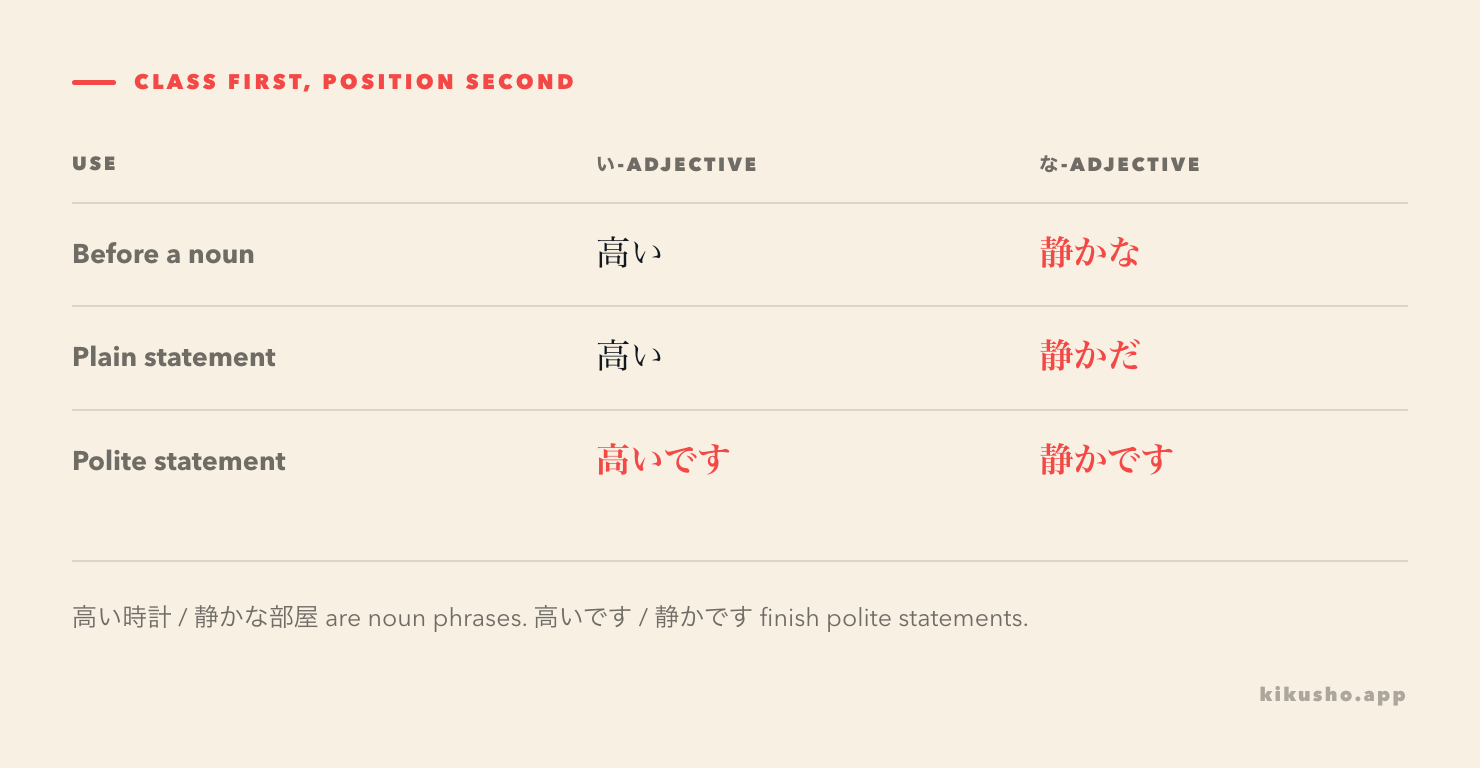
The な belongs between the な-adjective stem and the noun. It disappears when you turn 静かな部屋 into 部屋は静かです. With 高い, the adjective can already finish a plain sentence, and です adds polite style. 高いだ, 静かなです, 高いな時計 and 静かだ部屋 do not fit these standard beginner constructions.
TUFS's noun-modification lesson separates adjective + noun from な-adjective + な + noun. For the social choice between plain and polite endings, continue with です and だ.
An ending in い is a clue, not proof of the class
Every base-form い-adjective ends in い, but the reverse does not hold. Learn the class with a short phrase rather than guessing it from English or kana.
| Word and reading | Class | Phrase that makes the class visible |
|---|---|---|
| 新しい(あたらしい), new | い | 新しい時計, a new watch |
| 静か(しずか), quiet | な | 静かな部屋, a quiet room |
| きれい, clean; beautiful | な | きれいな部屋, a clean room |
| 嫌い(きらい), disliked | な | 嫌いな食べ物, food you dislike |
| いい, good | い, with an irregular stem | いい店, a good shop |
Read 食べ物 as たべもの, “food,” and 店 as みせ, “shop.”
The kanji can help: きれい can be written 綺麗, with no inflecting い outside the kanji. But 嫌い still has an external い and still takes な. A spelling shortcut cannot replace checking the entry. Tofugu's な-adjective guide identifies both traps, and Bunpro's い-adjective lesson warns that not every word ending in い belongs to that class.
For new words, keep the dictionary's class label or an attested noun phrase. The English word “clean” tells you a meaning; きれいな部屋 tells you how the Japanese word attaches.
い-adjectives carry the negative and past in their ending
For a regular い-adjective, remove the final い and add the ending you need. With 高い, that leaves 高(たか) as the stem.
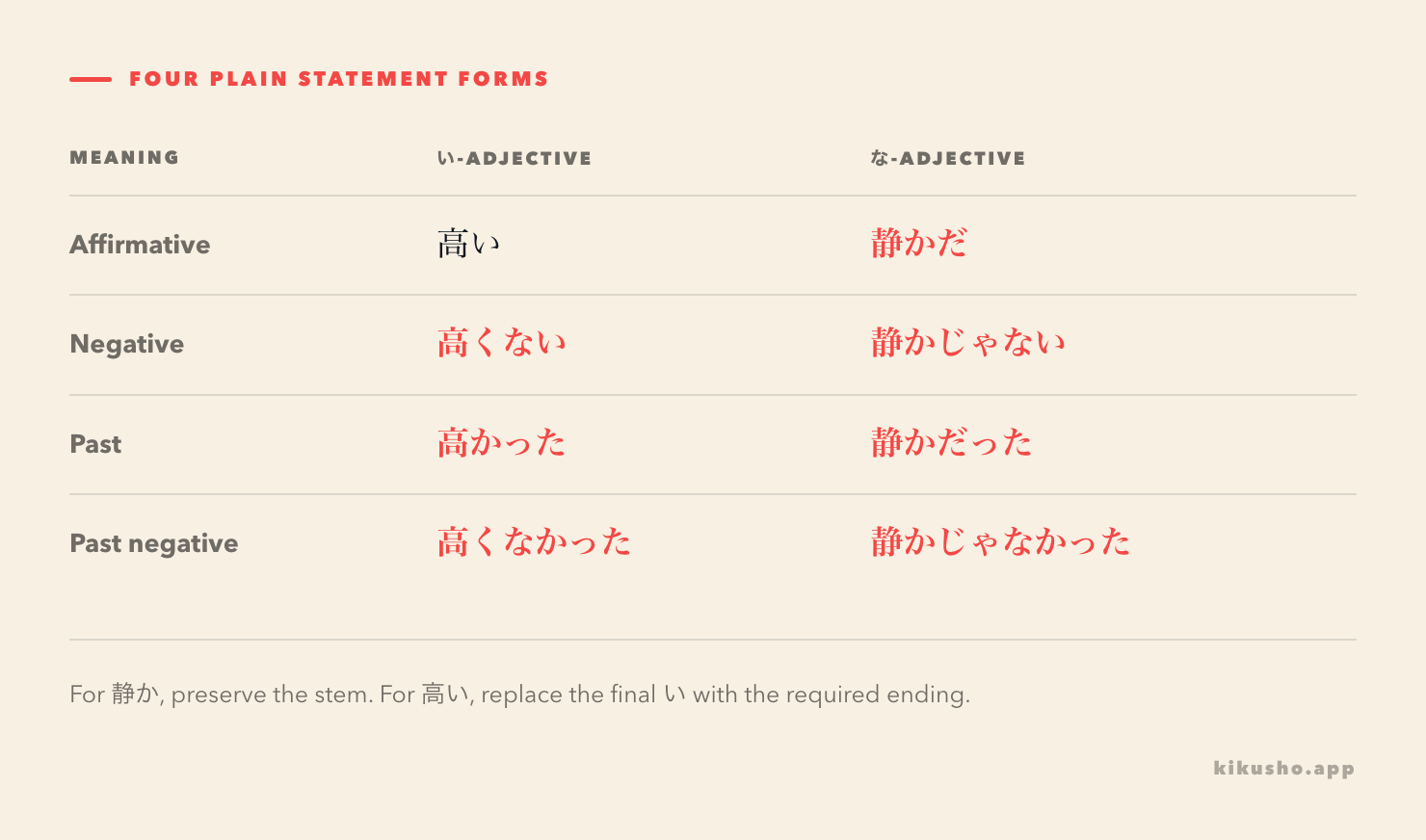
| Meaning | Plain form | Common polite form |
|---|---|---|
| is expensive | 高い | 高いです |
| is not expensive | 高くない | 高くないです |
| was expensive | 高かった | 高かったです |
| was not expensive | 高くなかった | 高くなかったです |
Use この時計は高くないです for “This watch is not expensive.” Use この時計は高くなかったです when describing its price at a past time. The polite marker remains です because the adjective ending already marks the past. 高いでした and 高いだった cannot replace 高かったです and 高かった.
These polite patterns are standard: TUFS teaches 高いです and the two negative options, then past affirmative and negative forms.
You will also meet 高くありません and 高くありませんでした. They express the same negative and past-negative claims in a more formal style than the conversational forms in the table. Do not mark them wrong simply because your first textbook chose くないです. Tofugu's negative-form page explains that register difference.
な-adjectives keep their stem while the following form changes
With 静か, leave the word intact. Do not remove its last kana to imitate the い-adjective pattern.
| Meaning | Plain form | Common polite form |
|---|---|---|
| is quiet | 静かだ | 静かです |
| is not quiet | 静かじゃない | 静かじゃないです |
| was quiet | 静かだった | 静かでした |
| was not quiet | 静かじゃなかった | 静かじゃなかったです |
この部屋は静かでした means “This room was quiet.” この部屋は静かじゃなかったです means “This room was not quiet.” Apply the same pattern to きれい: きれいだった, not きれかった; きれいじゃない, not きれくない. JLPT Sensei's な-adjective lesson gives the corresponding four-way pattern, and Iori Hamada's past-tense table checks the polite forms.
The fuller negative ではない corresponds to じゃない; its past is ではなかった. Formal polite negatives include 静かではありません and 静かではありませんでした. Tofugu's negative-copula guide compares these styles. The stem is still 静か. In close conversation, you may also hear a bare stem such as 静か?, “Is it quiet?”; the tables show complete affirmative statements, not every conversational omission.
いい uses よ for the forms you change
The everyday form いい, “good,” is an い-adjective with the stem よ for these transformations.
| Meaning | Plain form |
|---|---|
| good | いい, also よい |
| not good | よくない |
| was good | よかった |
| was not good | よくなかった |
You can add です to each form when it ends a polite statement. Thus この店はよかったです means “This shop was good.” Avoid いくない and いかった.
The change also applies to かっこいい, “cool” or “good-looking”: かっこよかった. But かわいい, “cute,” is regular: かわいかった, not かわよかった. Its two final い characters do not make it a compound containing いい. Tofugu explains the two stems, and Hamada's adjective-conjugation lesson independently checks the contrast.
Before a noun, tense and negation still belong to the description
You can place an inflected description before a noun. With an い-adjective, no な is inserted:
- 高くない時計: a watch that is not expensive.
- 前は高かった時計: a watch that was expensive before. 前は(まえは)anchors the earlier price.
For a regular な-adjective, な is the non-past affirmative attachment. Other descriptions use their own plain forms: 静かじゃない部屋, “a room that is not quiet,” or 昨日は静かだった部屋, “a room that was quiet yesterday.” 昨日 is きのう.
Do not produce 静かなだった部屋. And keep polite sentence endings outside this construction: 高いです時計 and 静かです部屋 are not the ordinary adjective phrases.
TUFS's plain-form summary gives both classes across the four forms, including noun modification. Tofugu's past-form guide also shows past adjectives immediately before nouns.
An earlier description does not by itself prove the property has disappeared. 昨日は静かだった部屋 reports yesterday's state; whether it is quiet today needs context. Equally, a past main verb does not force every adjective into the past. You can describe an expensive watch you bought yesterday as 高い時計 if you are presenting expensive as its current or general quality.
Describe an action with く or に
For an adjective describing how an action happens, the class decides again:
| Base | Adverbial form | Short example |
|---|---|---|
| 早い(はやい), fast; early | 早く | 早く歩く, walk quickly |
| 静か(しずか), quiet | 静かに | 静かに話す, speak quietly |
Read 歩く as あるく, “walk,” and 話す as はなす, “speak.” Replace an い-adjective's final い with く; put に after the な-adjective stem. 静かな人 describes a quiet person, while 静かに話す人 describes a person who speaks in a low voice. The noun attachment and the adverbial attachment do different jobs. Tofugu's く-form page and the TUFS summary verify this split.
The two classes do not absorb every English adjective. Japanese colour 緑(みどり), for example, is a noun in 緑のかばん. The N5 colour lesson explains why forcing な or い there fails. For words to practise within the い class, use the N5 adjective pairs.
When keeping an adjective in Kikusho, paste the phrase that exposed its class. A card for きれいな部屋 retains evidence that a card headed only “clean” loses. Before saving, check the generated example and edit the meaning or note so that な remains visible. Later, recall a second form such as きれいでした from the same stem.
Practice
Complete the whole set before going to the answer section. These are original exercises; alternative model sentences are accepted where the instructions allow them.
Question 1. Choose the standard phrase for “a clean room.”
- ア. きれい部屋
- イ. きれいな部屋
- ウ. きれいだ部屋
- エ. きれいです部屋
Question 2. Arrange all three pieces into a polite statement meaning “This watch was expensive”: 高かった / この時計は / です.
Question 3. Write a polite sentence meaning “This room was not quiet,” using この部屋, 静か and a form from the common polite table.
Question 4. Choose the plain negative of いい.
- ア. いくない
- イ. いいくない
- ウ. よくない
- エ. よかった
Question 5. Choose one pair that matches both the Japanese text and its time words. The first blank must report a past clean state; the second reports a present lack of quiet.
昨日、この部屋は___。でも、今は___。となりの部屋で音楽が聞こえます。
The last sentence means “Music can be heard from the next room”; 今(いま)means now, となり means next door, and 音楽(おんがく)means music.
- ア. きれいでした / 静かじゃないです
- イ. きれかったです / 静かじゃないです
- ウ. きれいでした / 静かかったです
- エ. きれいです / 静かでした
Question 6. Choose the pair that supplies the adjective-based adverbs in ___歩きます。図書館では___話します。, “I walk quickly. In the library, I speak quietly.” Read 図書館 as としょかん, “library.”
- ア. 早い / 静かな
- イ. 早く / 静かに
- ウ. 早な / 静かく
- エ. 早く / 静かな
Question 7. Give a noun phrase meaning “a watch that is not expensive,” using 高い and 時計. Keep the negative description inside the noun phrase, without です.
Answers and explanations
Answer 1. イ. きれいな部屋. きれい is a な-adjective, so its affirmative non-past description takes な before 部屋. The other options omit that attachment or insert a statement ending inside the noun phrase.
Answer 2. この時計は高かったです。 高い becomes 高かった for the past. The final です makes the completed statement polite; it does not change to でした after this past adjective.
Answer 3. この部屋は静かじゃなかったです。 静か stays intact and じゃなかった supplies the past negative. この部屋は静かではありませんでした is also grammatical, in a more formal style, though it is outside the requested common-table wording. 静かくなかった incorrectly applies the い-adjective ending.
Answer 4. ウ. よくない. いい uses よ as its changed stem. ア invents the stem い; イ appends くない to the full base form rather than changing its ending; エ is affirmative past, “was good.”
Answer 5. ア. きれいでした / 静かじゃないです. 昨日 calls for the requested past description, and 今 introduces the current statement. イ and ウ give invented い-adjective transformations of な-adjective stems. エ reverses the required time forms. Yesterday's cleanliness and today's noise are separate claims; the text does not say the room is dirty today.
Answer 6. イ. 早く / 静かに. The first word is an い-adjective transformed with く; the second is a な-adjective followed by に. 静かな attaches to a noun, not directly to 話します. ウ invents both transformations, while ア leaves the first adjective in its base form.
Answer 7. 高くない時計. 高くない directly modifies 時計. この時計は高くないです would be a correct statement about a watch, but the task asks for a noun phrase that can itself become part of a longer sentence.
Common questions
How are i-adjectives and na-adjectives different?
I-adjectives change their own ending for negative and past forms and attach directly to a noun. Regular na-adjectives use な before a noun and copular endings such as だ, です, だった and じゃない in statements.
Is きれい an i-adjective because it ends in い?
No. きれい is a na-adjective. Use きれいな部屋 for a clean room, きれいでした for was clean and きれいじゃない for is not clean. The final sound alone does not identify the word class.
What are the negative and past forms of いい?
The adjective いい, good, uses the stem よ in these forms: よくない, not good; よかった, was good; and よくなかった, was not good. The regular adjective かわいい instead becomes かわいくない and かわいかった.