On this page
依頼する gives you a way to describe requesting a task, 確認する means checking or making sure, and 希望する states a wish or preference in contexts such as an application. Together with 許可、承認、訪問、要求, they form a useful N3 vocabulary set for reading forms, work messages and reports alongside more familiar Japanese expressions.
The familiar expressions below are meaning guides. They are not replacements that fit every sentence. These seven words are not restricted to writing, and the set does not represent all formal Japanese or all N3 vocabulary.
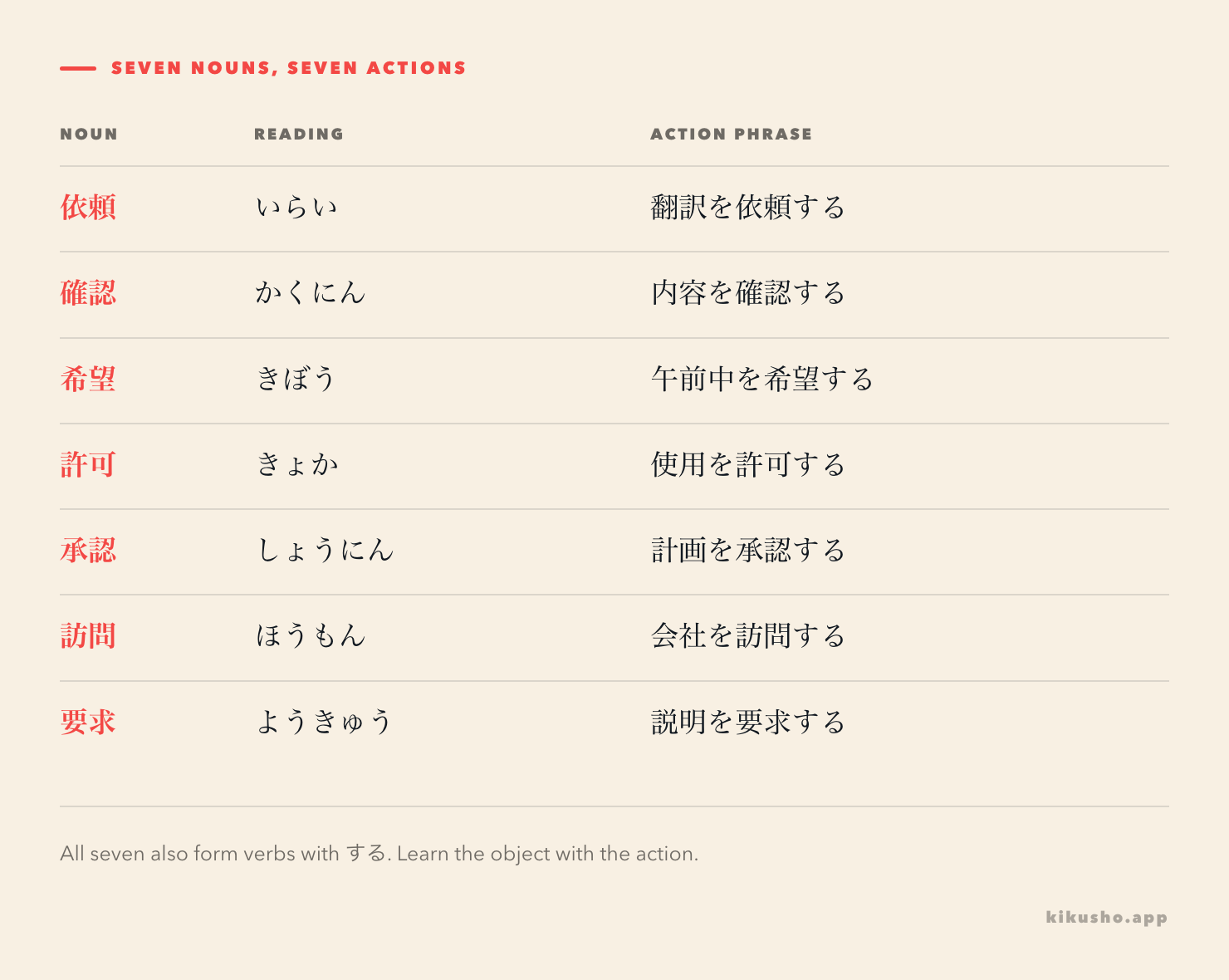
Seven nouns also name actions with する
Each headword is a noun and can form a する verb. This shared shape lets a document name an action briefly, then describe who performs it in a full sentence.
| Headword | Reading | Sense taught here | Familiar meaning guide | Construction to learn |
|---|---|---|---|---|
| 依頼 | いらい | request; commissioning someone to do a task | 頼む, ask; お願いする, make a request | 人に仕事を依頼する, ask someone to do work |
| 確認 | かくにん | checking; making certain | 確かめる, make sure | 内容を確認する, check the contents |
| 希望 | きぼう | wish or preference; also hope | 望む, wish for; ~たい, want to do | 午前中を希望する, prefer the morning |
| 許可 | きょか | permission; allowing an action | 許す, allow | 使用を許可する, permit use; 許可を得る, obtain permission |
| 承認 | しょうにん | acknowledgment; approval or acceptance | 認める, acknowledge or accept | 計画を承認する, approve a plan |
| 訪問 | ほうもん | a visit; visiting a person or place | 訪ねる, visit | 会社を訪問する, visit a company |
| 要求 | ようきゅう | a demand or strong request | 強く求める, press for something | 相手に説明を要求する, demand an explanation from someone |
Here 人 is ひと, 仕事 is しごと, 頼む is たのむ, 確かめる is たしかめる, 内容 is ないよう, 望む is のぞむ, 午前中 is ごぜんちゅう, 使用 is しよう, 許す is ゆるす, 得る is える, 認める is みとめる, 計画 is けいかく, 訪ねる is たずねる, 会社 is かいしゃ, 相手 is あいて, 説明 is せつめい and 求める is もとめる.
Shogakukan’s Digital Daijisen verifies the readings, noun/する classification and selected modern senses: 依頼, 確認, 希望, 許可, 承認, 訪問 and 要求. The lesson concentrates on everyday communication, rather than the dictionaries’ specialised legal or historical senses.
These are N3 vocabulary study placements. JapaneseTest4You groups the same readings and senses under N3, including 依頼, 承認 and 訪問. The JLPT does not publish an exhaustive vocabulary syllabus; a study label cannot promise a particular test appearance.
Change する to change the tense or politeness
The noun stays intact. The verb ending carries the change:
| Function | Example | Meaning |
|---|---|---|
| Plain non-past | 確認する | check; will check |
| Polite non-past | 確認します | check; will check, politely |
| Plain past | 確認した | checked |
| Plain negative | 確認しない | do not check; will not check |
| て-form request | 確認してください | please check |
This is the verbal-noun pattern described in Tofugu’s noun guide and its する reference. It applies to all seven taught headwords, but it is not a rule that turns every two-kanji noun into a verb.
送る前に、住所を確認してください。
おくる まえに、じゅうしょを かくにんして ください。
Please check the address before sending it.
A form might instead have the label 住所の確認, “address check.” A label names the action without choosing tense or making a request. The N3 abstract-noun lesson explains nearby document words such as 内容, “contents,” which can be what you check.
Keep the participants too. 田中さんに翻訳を依頼した (たなかさんに ほんやくを いらいした) means “I asked Tanaka to do the translation.” に names the person asked; を names the task. 田中さんの依頼 instead means “Tanaka’s request,” whose direction must be worked out from the surrounding sentence.
Requests, checks and approvals do different jobs
The broad English words “request” and “confirm” can hide the distinction you need to read a message.
| What happens | Japanese phrase | What it establishes |
|---|---|---|
| Someone is asked to undertake work | 翻訳を依頼する | A task is requested |
| Someone presses for an explanation | 説明を要求する | An explanation is demanded |
| Someone checks a document | 内容を確認する | The contents are examined or verified |
| Someone allows photography | 撮影を許可する | Photography is permitted |
| Someone accepts a proposal | 計画を承認する | The plan is approved |
Read 翻訳 as ほんやく and 撮影 as さつえい.
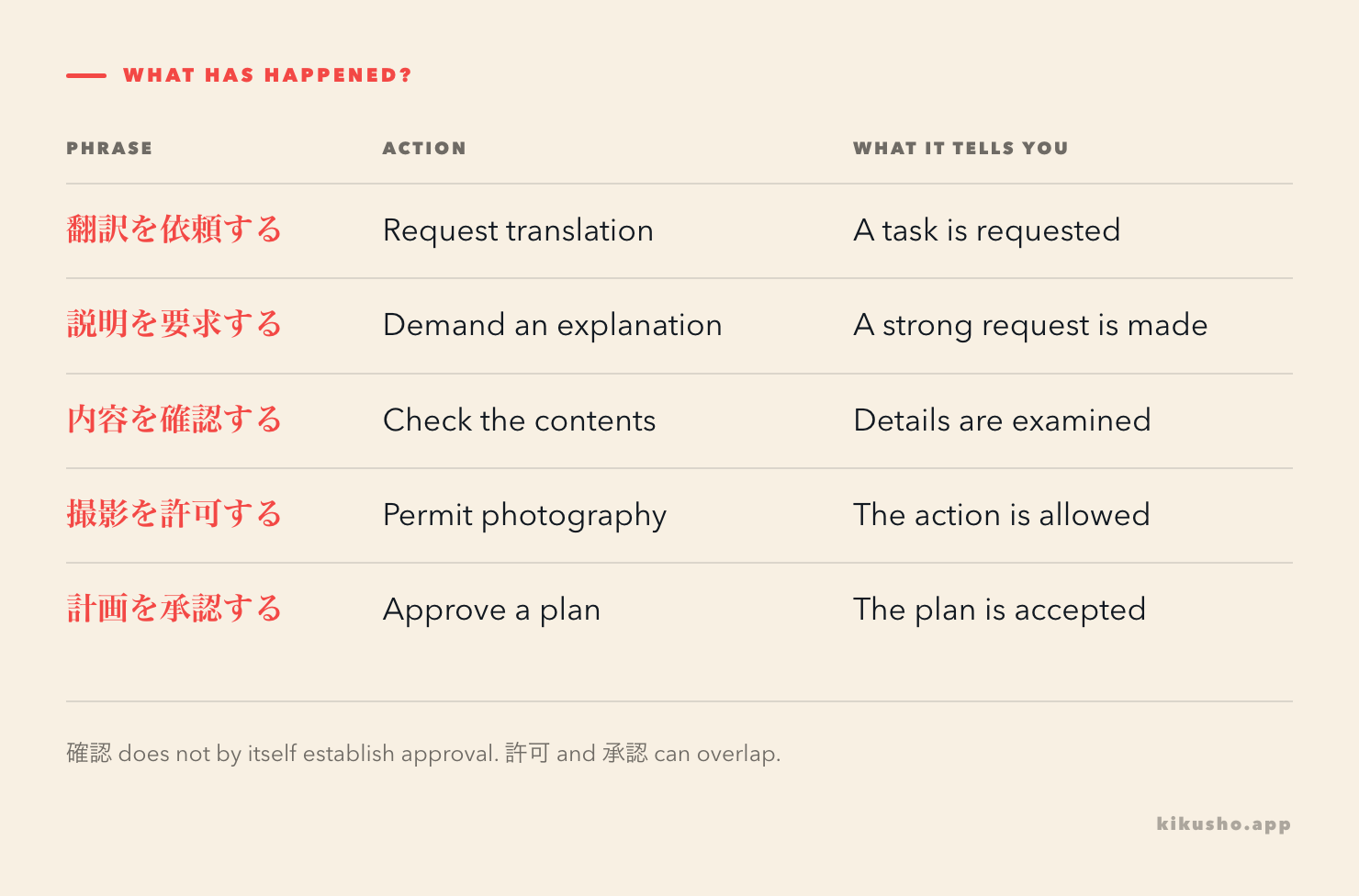
依頼 concerns asking someone to do something. 要求 can press for something viewed as necessary or due. Neither word alone tells you whether the person agrees. Adding します to 要求する makes the sentence polite toward the listener; it does not remove the force of a demand.
確認 asks whether something is established, correct or as expected. 承認 can express acceptance or approval. A manager can check a plan and then reject it. Reading 確認しました as “approved” would erase that possibility.
許可 puts permission for an action in view. 承認 puts recognition or acceptance in view. The two can overlap when accepting a request also allows the action. They are not universally exclusive terms: follow the wording of the particular form rather than inventing a rigid rule about who can use each.
For conversational permission, compare ~てもいい and ~てはいけない. 写真を撮ってもいいですか asks “May I take a photo?” A notice might name 撮影の許可, “permission to take photographs,” without using the question pattern.
希望 and 訪問 resist a simple English swap
On an appointment form, 希望日 (きぼうび) means your preferred date. It expresses what you would like, not a confirmed booking.
面談は午前中を希望します。
めんだんは ごぜんちゅうを きぼうします。
I would prefer the interview or meeting to be in the morning.
The everyday thought might be 午前中に話したい, “I want to talk in the morning.” The ~たい lesson teaches how to attach that ending to a verb. 希望する can instead take a noun phrase identifying the preferred arrangement. 希望を失う (きぼうを うしなう), “lose hope,” uses the noun’s broader emotional sense. Replacing it with ~たい would not preserve the sentence.
訪問 refers here to visiting someone or somewhere. In older English, “pay a call” can mean a visit; that dictionary gloss does not make 訪問する mean “telephone.”
明日、その会社を訪問します。
あした、その かいしゃを ほうもんします。
Tomorrow I will visit that company.
This describes the visit in a polite sentence. It does not itself lower the speaker or raise the person visited. Those choices belong to honorific and humble expressions. A word’s suitability for a work report and its role in keigo are separate questions.
Keep the document phrase that gives the word its sense
Start with three small pieces of text: a booking form with 希望日, a message asking you to 確認してください, and a notice mentioning 許可. The surroundings tell you whether a date is preferred, a detail needs checking or an action needs permission.
Kikusho’s text capture suits a short line from a message. In the editable card draft, retain the phrase 内容を確認する or 許可を得る with the headword. That gives a later review a specific action to recall; the English gloss “approval” alone leaves too much undecided.
Practice with eight separate decisions
Attempt the complete set before scrolling to the explanations. The questions sample kanji reading, spelling, context, paraphrase and usage; they are original exercises rather than official JLPT questions.
Question 1
Read 先生に翻訳を依頼した。 Which kana sequence belongs to 依頼?
A. いれい
B. えらい
C. いらい
D. いらん
Question 2
Select the spelling for きょか in 撮影には、きょかが必要です。
A. 許可
B. 希望
C. 訪問
D. 確認
Question 3
You are selecting a preferred appointment time. Which word completes the form response?
面談は午後を( )します。
A. 訪問
B. 承認
C. 確認
D. 希望
Question 4
The manager accepted the new plan as satisfactory. Complete the sentence describing that decision.
部長は新しい計画を( )した。
A. 訪問
B. 承認
C. 依頼
D. 希望
Question 5
Identify the closest paraphrase of 日付を確認してください。
A. 日付を消してください。
B. 日付を隠してください。
C. 日付が正しいか確かめてください。
D. 日付を忘れてください。
Question 6
Which situation best matches 会社に説明を要求した?
A. I strongly asked the company to explain.
B. I visited the company’s office.
C. I approved the company’s explanation.
D. I lost hope of joining the company.
Question 7
Pick the sentence that uses 訪問 for a visit to a place.
A. この計画を訪問しました。
B. 書類の日付を訪問しました。
C. 午前中を訪問しました。
D. 昨日、友人の家を訪問しました。
Question 8
A photographer needs permission before taking pictures inside a building. Which sentence fits?
A. 撮影の希望を失いました。
B. 撮影の許可を得ました。
C. 撮影の依頼を訪問しました。
D. 撮影の確認を失いました。
Write down your eight choices before checking the numbered explanations below.
Answers and explanations
Answer 1. C. 依頼 is いらい. The sentence says the teacher was asked to do a translation: 先生に names the person asked and 翻訳を names the task. The other readings do not match this headword.
Answer 2. A. 許可 is きょか, permission. 希望 is きぼう, 訪問 is ほうもん and 確認 is かくにん. 必要 (ひつよう) means necessary: the sentence says photography requires permission.
Answer 3. D. 希望します states the preferred arrangement, here 午後 (ごご), the afternoon. 確認します would describe checking it; 承認します would describe approving it. 訪問します needs a suitable person or place to visit.
Answer 4. B. 承認した expresses the approval specified by the prompt. 部長 (ぶちょう) is the department manager. 希望した would say the manager wished for the plan; 依頼した would describe requesting a task rather than accepting the finished proposal. A plan is not a place to 訪問.
Answer 5. C. 日付が正しいか確かめてください means “Please make sure the date is correct,” preserving the check. 日付 is ひづけ and 正しい is ただしい. 消す (けす), 隠す (かくす) and 忘れる (わすれる) mean erase, hide and forget. None describes verification.
Answer 6. A. 要求した presents a demand or strong request for the explanation. It does not say the explanation was accepted, nor does it describe a visit or a loss of hope. The sentence leaves the company’s response unstated.
Answer 7. D. 友人の家を訪問しました describes visiting a friend’s home. 友人 is ゆうじん, 家 is いえ and 昨日 is きのう. The other objects are a plan, a document’s date and a time period, rather than a destination for this sense of 訪問する.
Answer 8. B. 許可を得ました means “obtained permission.” This says permission was granted; 希望 would describe a wish, and 確認 would describe a check. A work request is not an object one visits, so C cannot describe the photographer’s next step either.
Common questions
Are these N3 words only used in written Japanese?
No. 依頼、確認、希望、許可、承認、訪問、要求 appear in writing and speech. They are useful in forms, workplace messages and reports, but 確認する is also an ordinary way to say check. A formal context does not make each word an honorific or humble expression.
Is 要求する a more polite version of お願いする?
No. 要求する can mean demand: pressing for something considered necessary or due. 依頼する describes asking someone to undertake a task. For a small favour, replacing お願いする with 要求する can make the request much stronger.
How do 確認、許可 and 承認 differ?
確認 concerns checking or establishing something. 許可 concerns allowing an action. 承認 concerns acknowledging something or accepting it as satisfactory, often approving a proposal. 許可 and 承認 can overlap; the document and its named procedure determine the intended meaning.