On this page
この本が読みたいです means “I want to read this book”: attach たい to the verb's ます-stem to express wanting to do the action. The ending changes like an い-adjective, and a simple transitive verb's desired object can take を or が.
This N5 grammar lesson teaches ~たい, including ~たくない, ~たかった and ~たくなかった, the object-particle choice, and whose wishes a sentence can express. Wanting to read, having read and being able to read are separate claims.
Attach たい where ます would attach
If you know 読みます(よみます), the polite form of 読む, remove ます. What remains is 読み, the stem used here. Add たい: 読みたい(よみたい), “want to read.” Keep です outside the stem: 読みたいです is the polite statement.
The MIT Japanese course notes give this stem attachment and the plain/polite distinction. 読みますたい does not work: ます and たい are alternatives at this attachment point.
Use each verb's own stem
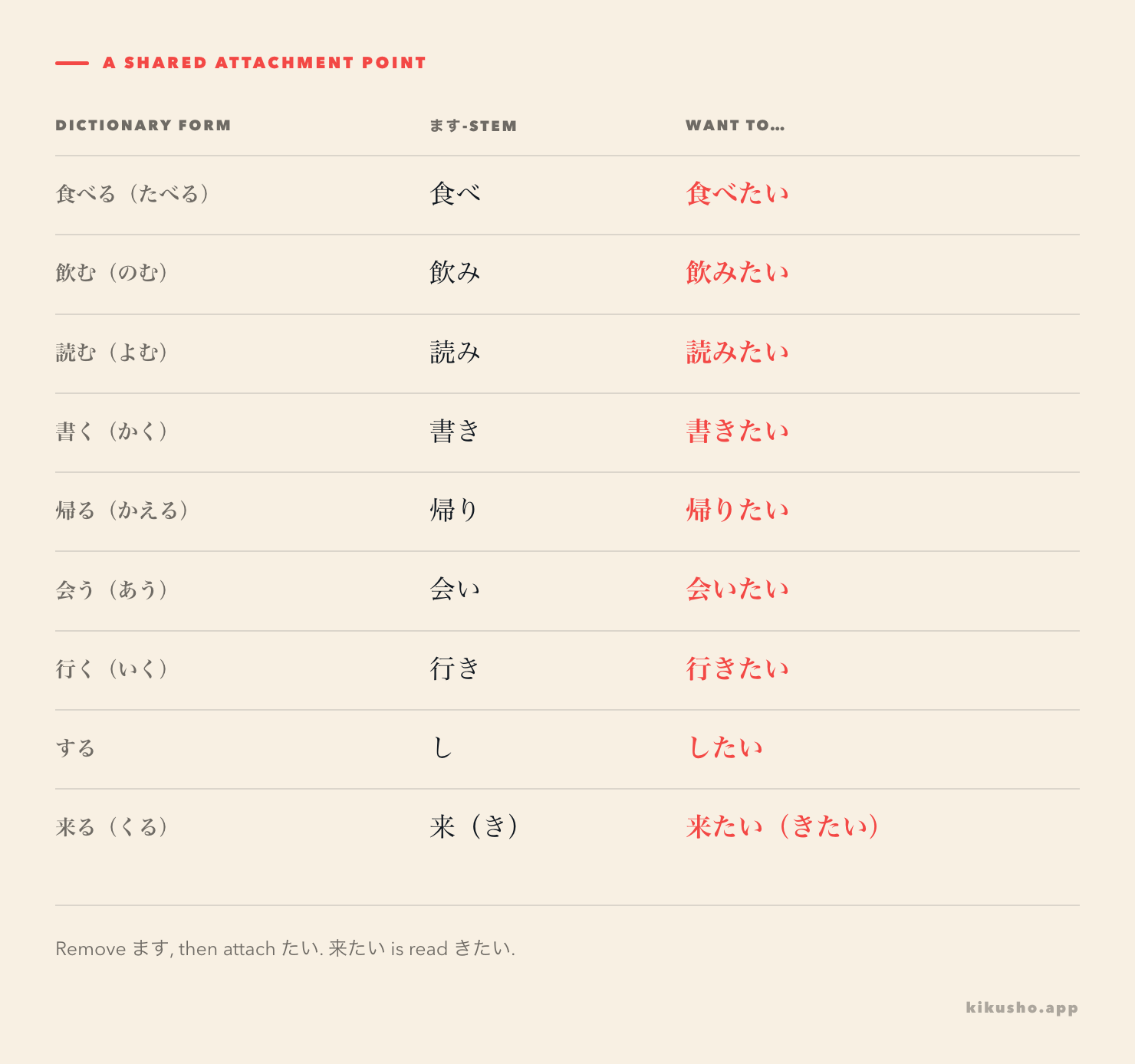
With an ichidan verb such as 食べる, the stem is 食べ. With a godan verb such as 飲む, use 飲み. The irregular stems are し for する and 来(き) for 来る. The verb-group lesson supplies the full ます-stem patterns; this table shows their use with たい.
| Dictionary form and reading | ます-stem | Want to… and reading |
|---|---|---|
| 食べる(たべる), eat | 食べ | 食べたい(たべたい) |
| 飲む(のむ), drink | 飲み | 飲みたい(のみたい) |
| 読む(よむ), read | 読み | 読みたい(よみたい) |
| 書く(かく), write | 書き | 書きたい(かきたい) |
| 帰る(かえる), go home | 帰り | 帰りたい(かえりたい) |
| 会う(あう), meet | 会い | 会いたい(あいたい) |
| 行く(いく), go | 行き | 行きたい(いきたい) |
| する, do | し | したい |
| 来る(くる), come | 来(き) | 来たい(きたい) |
Tokyo University of Foreign Studies checks these stems, including 帰りたい, which follows the godan pattern, and 来たい, whose reading is きたい, not くるたい. 行く uses its ordinary 行き stem here; its exceptional て-form does not produce 行ったい.
Negate or put the wish in the past by changing たい
Treat the final い as the part that changes. 読みたい becomes 読みたくない, 読みたかった or 読みたくなかった. The stem 読み stays.
| The wish | Plain ending | Common polite ending |
|---|---|---|
| want to read | 読みたい | 読みたいです |
| do not want to read | 読みたくない | 読みたくないです |
| wanted to read | 読みたかった | 読みたかったです |
| did not want to read | 読みたくなかった | 読みたくなかったです |
MLC Japanese's たい lesson presents all four polite endings. The pattern is the one used by regular い-adjectives. Avoid 読みたいでした and 読みたいじゃない: move the tense or negation into たい itself.
You will also see 読みたくありません and 読みたくありませんでした, more formal polite negative forms. They are valid alternatives to the conversational negatives in the table. TUFS explicitly teaches たくありません alongside たくないです.
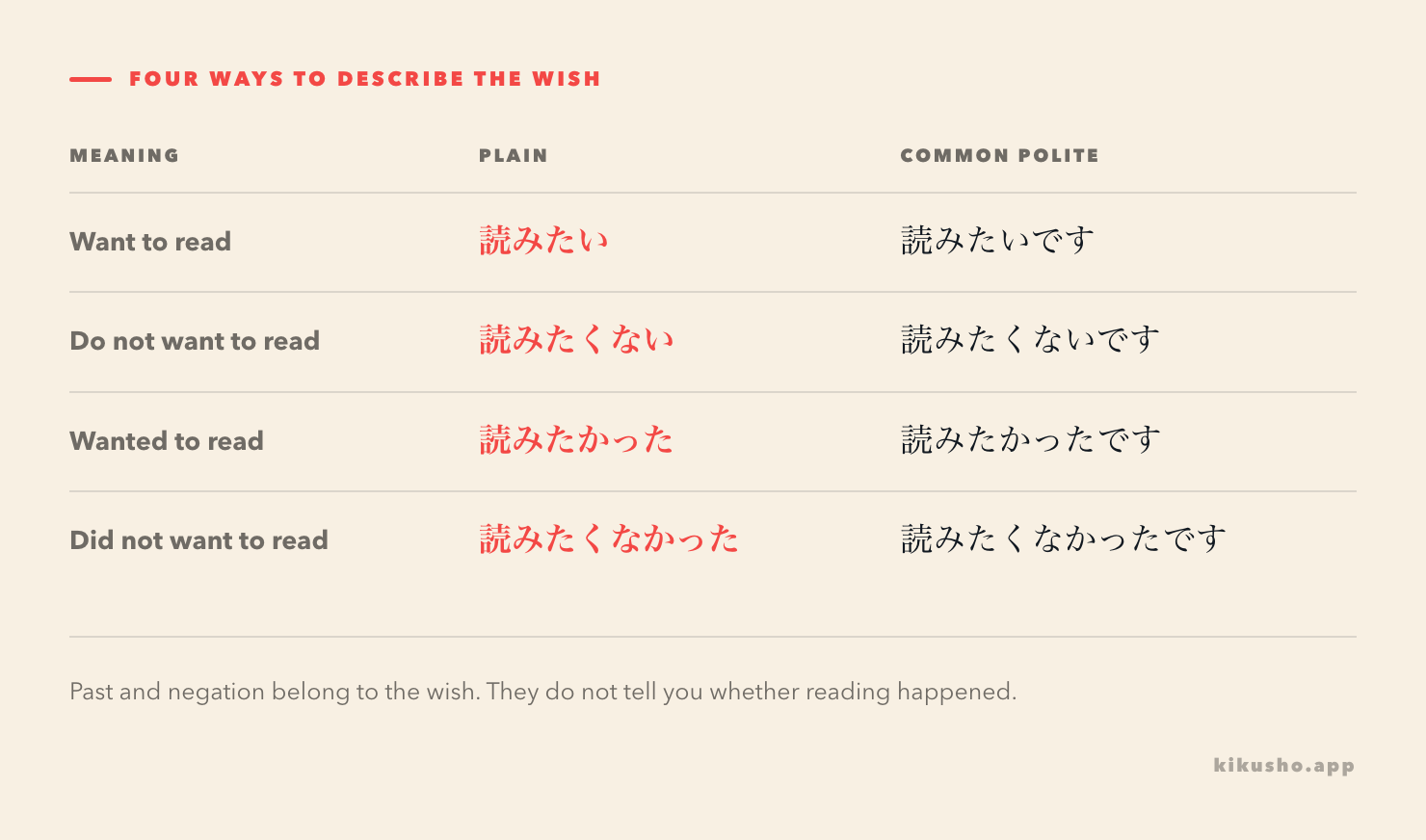
昨日、この本を読みたかったです means “Yesterday, I wanted to read this book.” It leaves open whether you read it. 昨日、この本を読みました says that you did. Likewise, “I did not want to read” does not prove that you refused or avoided reading. The grammatical form reports the wish, not its outcome. Yesterday is 昨日(きのう).
が can mark the desired thing while を remains possible
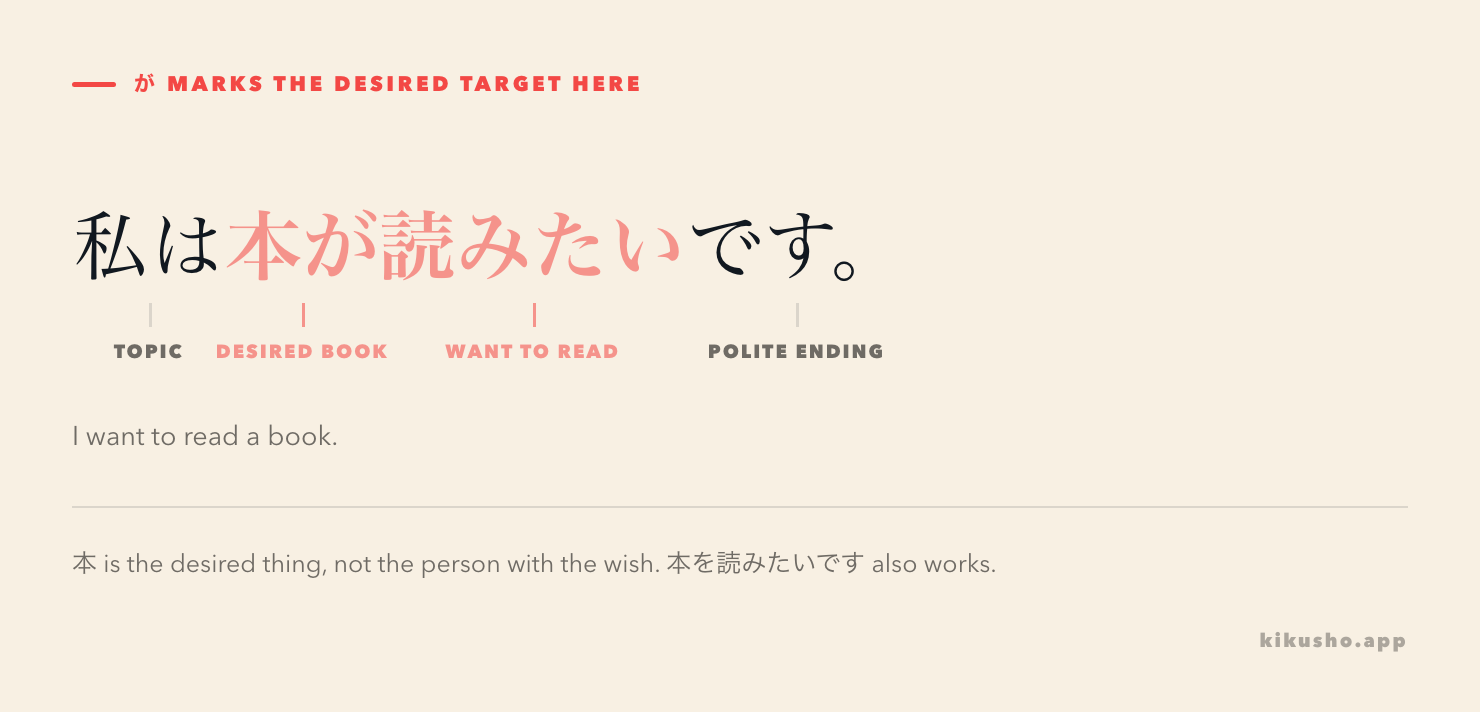
With a straightforward transitive verb such as 読む, both of these work:
| Sentence | Meaning |
|---|---|
| この本を読みたいです。 | I want to read this book. |
| この本が読みたいです。 | I want to read this book. |
The を version retains the verb's familiar object marking. In the が version, the noun is the desired target of a predicate that inflects adjectivally. The book has not become the person who wants to read.
This is a construction to learn, rather than a universal rule that “adjectives have no objects.” The Japan Foundation's grammar-teaching discussion places が + Vたい among patterns whose target takes が, while explaining that を also occurs normally. It describes が as capable of singling out the particular desired thing.
So この本が読みたい can bring “this book” into focus. Do not translate が mechanically as “want more,” or treat を as less sincere. A plain exercise asking which particle is grammatical here must allow both, unless its context adds a separate restriction.
Other noun roles keep their own particles
京都に行きたいです(きょうとにいきたいです) means “I want to go to Kyoto.” 京都 is the destination, so に stays. 家で読みたいです(いえでよみたいです), “I want to read at home,” keeps で for the action's location. Neither noun is the book-like desired object in the pattern above.
The を/が option does not instruct you to replace every particle in the sentence. First identify the noun's role, then choose a particle for that role.
A statement usually gives your wish; a question asks theirs
In a direct everyday statement, 今夜は家で映画を見たいです, “Tonight, I want to watch a film at home,” normally describes the speaker's desire. Read 今夜 as こんや and 映画 as えいが. You can omit 私は when the person is understood.
Change the sentence into a question for a friend: 今日は何を読みたいですか, “What do you want to read today?” Read 今日は as きょうは and 何を as なにを. Asking the listener is a normal use, as MIT's course notes explain. The N5 question lesson covers the question words and か.
Reporting someone else's words also preserves たい:
母は「今日は家で休みたい」と言いました。 Mother said, “I want to rest at home today.”
Here 母(はは) is your mother, 休みたい(やすみたい) means “want to rest,” and 言いました(いいました) means “said.” The wish inside the quotation belongs to Mother. You have reported her words rather than independently asserted her inner state.
Tofugu's たい guide discusses quotations, reporting expressions and narrative perspective. Its distinction is about how the wish is presented, not a ban on mentioning other people. A bare third-person statement is usually too direct as an everyday report; narrators and additional expressions can adopt or explain another person's perspective.
A wish is different from a request or invitation
先生と話したいです(せんせいとはなしたいです) says “I want to speak with the teacher.” It does not mean “I want the teacher to speak,” and it is not a command to the teacher. The person who wants to perform 話す is the speaker.
For wanting another person to act, Japanese has other constructions, including ~てほしい. That is a separate learning point, not an extra meaning you can get by adding a person's name to たい. Bunpro distinguishes the two.
Asking a friend's preference is fine. Asking a teacher or a less familiar person directly whether they “want to” accept your invitation can sound intrusive. です supplies politeness but does not settle whether the question suits the relationship. The same Bunpro lesson recommends invitation patterns instead of routinely translating English “Do you want to…?” with たい. The Japan Foundation's account of wishes also distinguishes polite marking from the directness of the desire.
A reading note containing 読みたい is useful because it preserves that unfinished intention. Pasting the phrase into Kikusho starts a card you can inspect and edit before saving; later reviews and saved audio work offline. The app keeps the vocabulary available for another encounter. It does not establish that you have carried out the wish.
Practice
Try the entire set without scrolling into the solutions. These questions were written for this page; readings are supplied where they affect the task.
Question 1. Choose the ordinary polite form meaning “I want to swim.” 泳ぐ(およぐ)means “swim.”
- ア. 泳ぐたいです
- イ. 泳ぎたいです
- ウ. 泳ぎたくないです
- エ. 泳ぎますたい
Question 2. Write the plain “want to…” forms of 帰る(かえる), “go home,” and 来る(くる), “come.” Give the reading of each result.
Question 3. Change 読みたいです into a common polite form meaning “I did not want to read.” Keep the conversational style ending in です.
Question 4. Select every particle that can complete this simple sentence meaning “I want to read this book”: この本__読みたいです.
- ア. を
- イ. が
- ウ. に
- エ. で
Question 5. A friend asks where you want to go. Complete 京都__行きたいです, “I want to go to Kyoto,” with one of に / が / で.
Question 6. Complete this short diary passage. The writer wanted to read the book yesterday, but had no time. Choose the form that states that past wish, while the final line describes today's intention. 忙しかった(いそがしかった)means “was busy”; 時間(じかん)means “time”; 今から(いまから)means “from now.”
昨日は忙しかったです。でも、この本を__。今日は時間があります。今から読みます。
- ア. 読みたかったです
- イ. 読みたくなかったです
- ウ. 読みたいでした
- エ. 読みました
Question 7. You hear 母は「今日は家で休みたい」と言いました. Whose wish does 休みたい express? Does the report establish that the rest actually happened?
Answers and explanations
Answer 1. イ. 泳ぎたいです. 泳ぎ is the ます-stem. The dictionary form cannot take たい directly, and ます must be removed before たい attaches. ウ is grammatical but means “I do not want to swim,” reversing the requested wish.
Answer 2. 帰りたい(かえりたい) and 来たい(きたい). 帰る is godan, so its stem ends in り. 来る uses the irregular stem 来(き). Returning 帰たい or 来るたい would bypass the required stem.
Answer 3. 読みたくなかったです. Replace the final い of たい with くなかった, then keep です. 読みたくないです expresses a non-past negative wish; 読みたかったです expresses a positive past wish. 読みたくありませんでした is valid Japanese but uses the more formal style rather than the requested conversational ending.
Answer 4. ア. を and イ. が. Both mark the desired book in this simple たい construction. The task supplies no restriction that would make one compulsory. に does not mark the object of 読む here, and で would assign a location or means role instead of the book-as-object meaning.
Answer 5. に. 京都 is the destination of 行く, not a direct object that takes the を/が option. が does not mark the destination here, and で would mark an action location or other role. 京都へ行きたいです would also work, but へ was not among the choices.
Answer 6. ア. 読みたかったです. The supplied context requires a positive wish at yesterday's past time. イ negates that wish; ウ incorrectly puts the past on です; エ reports reading as an accomplished action. The last sentence, 今から読みます, looks ahead from today and does not convert yesterday's wish into a completed event.
Answer 7. The wish is Mother's, expressed from her perspective inside the quotation. 言いました reports that she said it. It does not establish that she rested: wanting and doing remain separate information.
Where the N5 placement comes from
JLPT Sensei, Bunpro and MLC place this foundational たい use at N5. The assigned inventory record has no placement disagreement. The ます-stem, adjective endings and basic questions are prerequisites; the mentions of other reporting or request constructions above establish limits and do not claim to teach those constructions fully.
These are teaching-list estimates. The official JLPT FAQ explains why an exhaustive vocabulary, kanji and grammar specification is no longer published. The Japanese forms, translations and exercises on this page were checked by Codex, an AI agent, against the named independent references; no human review is claimed.
Common questions
How do you make the Japanese たい form?
Take the verb's ます form, remove ます and attach たい. 読みます becomes 読みたい, and 来ます(きます)becomes 来たい(きたい). Use 読みたいです for a polite sentence ending.
Does たい require が instead of を?
No. With a simple transitive verb, the desired object can take either particle: この本を読みたい and この本が読みたい both mean that you want to read this book. が can focus on the desired thing. Destination に and action-location で do not automatically become が.
What are the negative and past forms of たい?
The endings are たくない, たかった and たくなかった. With 読む, use 読みたくない for do not want to read, 読みたかった for wanted to read, and 読みたくなかった for did not want to read. Each can end with です in a common polite statement.
Can you use たい about another person's wishes?
A direct everyday statement with たい normally expresses the speaker's wishes. You can ask a listener what they want to do, or retain たい inside a quotation of someone else's words. A bare third-person statement is not the usual way to report another person's private wishes; narrative perspective and additional reporting expressions allow other uses.