On this page
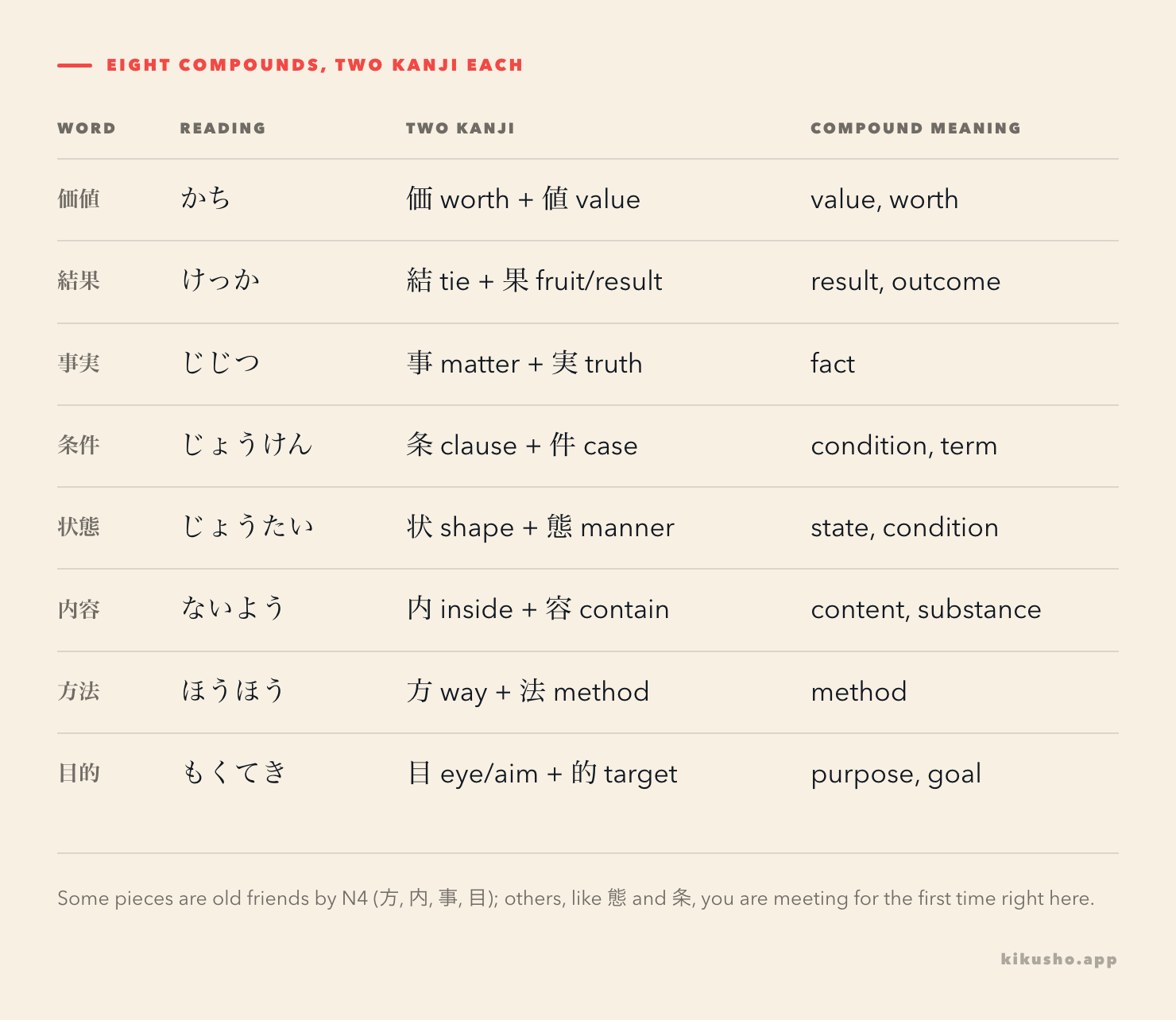
You expect N3 vocabulary to be more of what N4 gave you: nouns for things, just less common ones. It isn't. N4's nouns named objects: 部屋, 天気, 電車. N3's new nouns are almost all abstract, 価値, 結果, 事実, 条件, 状態, 内容, 方法, 目的, and every one of them is two kanji welded into a single word. The level is not asking you to memorize eight new sounds. It is asking you to read a compound as two meanings stacked, because that is the only way words this abstract stay memorable at all.
N4 named things; N3 names what's true of them
部屋 is a room, 天気 is weather, 電車 is a train: things you could point at from across the street. 価値 is not a thing. It is a property something has, the way a coin has a value or an argument has merit, and neither one sits still long enough to photograph. 事実 and 状態 do the same job for different targets: 事実 names what is true regardless of anyone's opinion, 状態 names the condition something happens to be in right now. This is the real shape of the jump from N4 to N3: not harder nouns for objects, but the first nouns that describe rather than point.
Two kanji, welded, and neither half is decorative
Every one of the eight splits cleanly into two kanji, and both halves carry weight. 価値 is 価 (price, worth) plus 値 (value): two words for the same idea, reinforcing each other. 内容 is 内 (inside) plus 容 (to hold, contain), which is exactly what "content" means. 目的 is 目 (eye, aim) plus 的 (target, mark): literally the target your eye is aimed at.
Some of these pieces are old friends. 方, 内, 事 and 目 are all common by N4. Others you are meeting for the first time right here: 態, 条, 結 and 価 do not get their own kanji lesson until much later lists reach them. That does not matter for reading the word in front of you, the same way it does not matter that a kanji can carry several readings before you have settled on the one this compound uses. Either way you are learning one stable meaning, not an arbitrary string of sound, and a stable meaning is what a kanji piece gives you that a whole memorized word does not.
That piece pays out again in the next word you meet
The payoff runs forward, not backward. Once 方 has meant "way" inside 方法, it is already doing the same work in 方向 (direction) and in 一方 (on the other hand): you are not starting from zero on either. The same 目 that built 目的 is doing "aim" again in 目標 (goal, also N3) and "mark" in 目印 (landmark). 内 built 内容; it turns up again as "domestic" in 国内 and as the guiding half of 案内 (information, guidance). Even 事, the most ordinary of the eight pieces, is carrying its own compounds elsewhere: 事件 (incident), 事故 (accident), 大事 (important).
None of this is guaranteed. A kanji's sense can narrow from one compound to the next; 方 inside 方法 lands closer to "method" than to "direction." But a narrowed guess beats starting cold, which is the entire difference between meeting a ninth abstract compound as sixteen strokes and meeting it as two characters you already recognize from somewhere else.
Where the piece stops predicting the whole
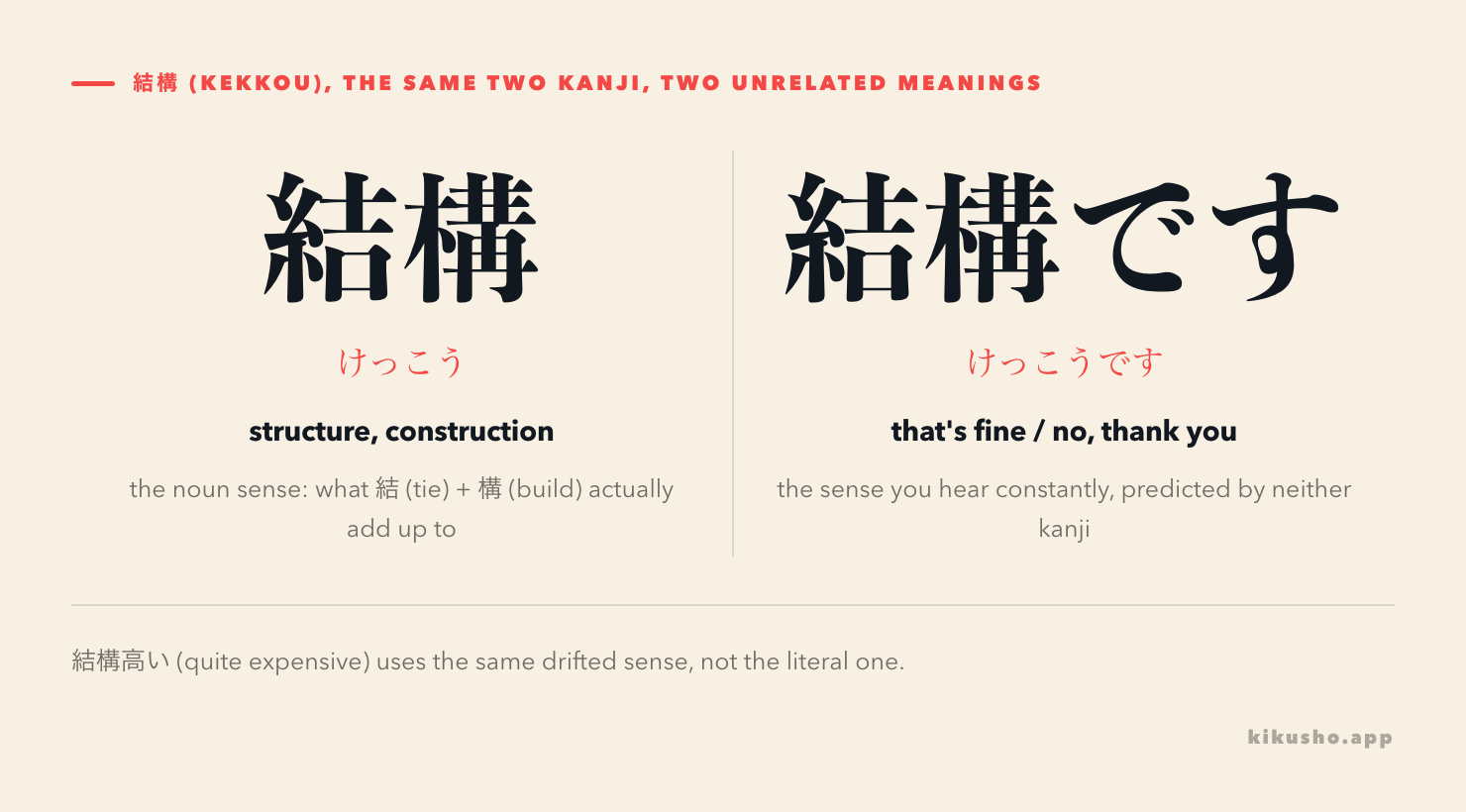
The strategy has a real limit, and it is worth meeting the counterexample before trusting it too far. 結構 is built from 結 (tie, bind) and 構 (structure, build), and as a noun it does mean exactly that: "structure, construction." But the sense you will hear a hundred times before you hear that noun is the adjective: 結構です means "that's fine" or "no, thank you," and 結構高い means "quite expensive." Nothing in "tied structure" predicts "no, thank you." A learner who trusts the kanji all the way loses here. The fix is the same one that already works for whole words: confirm the actual sense in a dictionary or a sentence, and treat the kanji breakdown as a memory aid you build after that, not a substitute for it.
These eight rarely stand without a verb
A vocabulary list stops at the gloss, and that is exactly where these eight stop being useful. Each one leans on a fixed verb or particle almost every time it appears: 価値がある (to have value), 条件を満たす (to meet a condition), 内容を確認する (to check the content), 方法を考える (to think of a method), 危険な状態になる (to become a dangerous state), 目的で (for the purpose of), 結果として (as a result), 事実だ (it is a fact). Miss the collocation and you can still name the word in isolation without ever producing it correctly in a sentence.
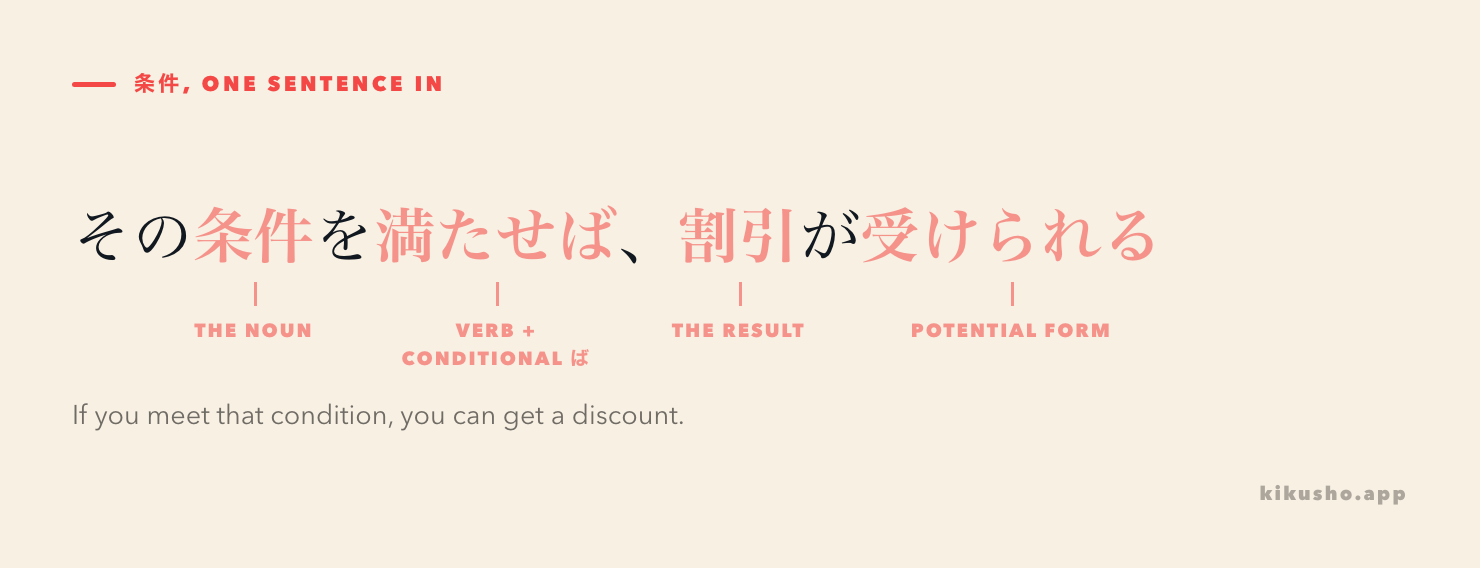
That sentence, その条件を満たせば、割引が受けられる (if you meet that condition, you can get a discount), is the version worth keeping, not 条件 on its own. 状態 alone hands you a gloss; 彼はまだ興奮した状態だった (he was still in an excited state) hands you the word, the kanji piece behind it, and the verb it leans on, together. Capture the sentence as it stands and the card holds all three. Capture the word alone, off a list, and you are back to guessing at the collocation later. That is the difference Kikusho's photo, voice and text capture is built to preserve: the sentence a word actually showed up in, not the word by itself.
Practice: four questions on reading and using the abstract eight
Question 1. In 「この本には読む価値がある。」(This book is worth reading.), how is 価値 read here?
a) かち b) あたい c) ねうち d) かじ
Answer 1: かち. This is the on-reading used for the compound 価値. あたい is a real reading, but only for 値 standing alone (値がある, "there's worth to it"); ねうち is a different word entirely, 値打ち, spelled with different kanji even though it means almost the same thing; かじ is not a reading either kanji takes here.
Question 2. Complete with the correct kanji: 「会議の___をメモした。」(I wrote down the ___ of the meeting.)
a) 内容 b) 内用 c) 内要 d) 内洋
Answer 2: 内容. 内用 is a real word, also read ないよう, but it means "for internal or private use," the sense on a medicine label, not "content." It is the wrong word for a meeting, not a wrong reading. 内要 and 内洋 are not words at all.
Question 3. Complete the sentence with the best word: 「大雨のため、道路が危険な___になっている。」(Because of the heavy rain, the road has become a dangerous ___.)
a) 状態 b) 条件 c) 結果 d) 内容
Answer 3: 状態. 状態になる describes the condition something has ended up in, which is exactly what a road turning dangerous is. 条件 names a stipulation someone sets, which fits "the condition for a discount," not a weather outcome; 結果 names what followed from a cause, not the ongoing condition itself; 内容 names what is inside something, not the state it is in.
Question 4. Which sentence uses 目的 correctly?
a) 彼が毎朝走る目的は、健康を維持することだ。 b) 地震が起きた目的は分からない。 c) 彼が遅刻した目的は、電車が遅れたからだ。 d) 疲れた目的で早く寝た。
Answer 4: (a). 目的 names the intention behind a deliberate action, and running every morning is exactly that kind of choice. (b) is wrong because an earthquake carries no intention: 原因 (cause) is the word that sentence needs. (c) fails the same way: arriving late was not done on purpose, so 理由 (reason) fits, not 目的. (d) reverses cause and effect; being tired is why he went to bed early, not a purpose he was pursuing, so 疲れたから (because he was tired) replaces it.
N3 is not where the two-kanji habit stops. N2 keeps building nouns the identical way, both halves still doing real work, aimed at a narrower target: the words a newsroom needs to describe its own workflow, from a reporter's 取材 to the 報道 that results.
Common questions
Is all N3 vocabulary this abstract?
No. N3 still adds plenty of concrete nouns and everyday verbs. But compared with N4, the noun set skews sharply toward properties and relationships rather than objects, and the eight here — 価値, 結果, 事実, 条件, 状態, 内容, 方法, 目的 — are the ones that show up across nearly every topic once you read anything past a beginner text.
Do I need to study these kanji on their own before learning the words?
No. A few of these pieces, 態, 条, 結 and 価, are not "taught" as standalone kanji until much later lists get around to them, and that is fine: you meet the kanji for the first time inside the compound, learn its meaning there, and carry it forward. Waiting to learn a kanji until you have supposedly earned it backwards only delays the word you need right now.
What's the difference between 状態 and 状況?
状態 names the condition something is in, a state you could in principle freeze and describe. 状況 names the situation around it: what is going on, more than the fixed condition of one thing. They overlap enough that dictionaries gloss both as "situation," but 状態 answers "what state is it in," while 状況 answers "what's happening around it."