On this page
たぶん is the everyday “probably,” おそらく often makes an estimate sound more formal, and きっと expresses stronger conviction: “surely,” or “I'm sure.” To choose between them, consider both how firmly you believe the claim and how you want to address the listener.
This N3 vocabulary comparison also teaches もしかすると, which raises a possibility, and 確実(かくじつ), which describes certainty or reliability. Knowing all five helps you distinguish an estimate, a confident expectation and a claim that something is dependable.
Ask about confidence first, then register
Imagine that someone wants to know whether a parcel will arrive tomorrow. You might be making an ordinary estimate, presenting a considered update, or reassuring a worried friend. The event can stay the same while your stance changes.
| Word | Reading | Part of speech here | Meaning and useful combination |
|---|---|---|---|
| 多分・たぶん | たぶん, tabun | Adverb | Probably; たぶん来ると思う, think someone will probably come |
| 恐らく・おそらく | おそらく, osoraku | Adverb | Probably, most likely; おそらく終わるでしょう, will probably finish |
| きっと | きっと, kitto | Adverb | Surely; きっと喜ぶ, will surely be pleased |
| もしかすると | もしかすると, moshika suru to | Adverb | Possibly, perhaps; もしかすると遅れるかもしれない, might be late |
| 確実 | かくじつ, kakujitsu | Noun / な-adjective | Certain, reliable; 確実な情報, reliable information; 確実に行う, carry out reliably |
Do not assign each word a percentage. In particular, たぶん and おそらく overlap in probability judgments; register often explains the choice. Shogakukan's Daijisen comparison under 多分 explicitly describes that overlap and identifies きっと as the stronger expression of confidence.
たぶん leaves room for your estimate to be wrong
A friend asks when you will finish sorting some photographs. You have made progress but have not counted what remains:
たぶん、今夜中に終わると思います。
たぶん、こんやじゅうにおわるとおもいます。
“I think I'll probably finish tonight.”
たぶん fits the ordinary uncertainty of the answer. It does not announce that you know nothing; you expect to finish, while leaving another outcome open. 多分 is its kanji spelling in this use.
You can combine it with と思う, “think that,” or a speculative ending such as でしょう. These are ways to shape the whole sentence, not extra particles that must always follow たぶん. The earlier lesson on 思う, 考える and 気がする explains how the verb itself can frame your judgment.
A dictionary may also show 多分に meaning “considerably” or “to a substantial extent.” That is a separate use. Do not add に to the probability adverb to make a sentence sound more formal.
おそらく suits a more formal estimate
A colleague asks when the same sorting work will finish. You answer in a project update:
おそらく、今夜中に終わるでしょう。
おそらく、こんやじゅうにおわるでしょう。
“It will probably be finished tonight.”
The estimate sounds more formal than the everyday たぶん version. That does not mean おそらく belongs only in writing, nor that a polite sentence containing たぶん is wrong. It is a tendency in tone, not a rule assigning one word to emails and another to speech.
Daijisen's entry for 恐らく treats the modern probability sense as a likely inference. Despite the kanji 恐, you do not have to be afraid of the outcome: おそらく間に合うでしょう, “We'll probably make it in time,” is a favorable estimate. Read 間に合う as まにあう.
きっと puts more of your conviction into the sentence
Someone doubts whether their friend will enjoy a handmade present. You know the friend's taste:
この色なら、きっと喜ぶよ。
このいろなら、きっとよろこぶよ。
“If it's this color, I'm sure they'll be pleased.”
きっと makes the reassurance stronger. It can reflect evidence, trust, or hope, rather than something you have personally verified. The listener hears your confidence; the word cannot guarantee the outcome.
It also works with a speculative ending. Mayumi Ito's explanation for Mango Languages includes たぶん, おそらく and きっと with だろう/でしょう. A sentence can acknowledge inference while still expressing strong belief.
There is a useful boundary to the comparison: きっと has uses beyond prediction. In 明日もきっと来てね, “Do come again tomorrow,” it reinforces a request. Shogakukan's dictionary entry for きっと records this requesting use as well as confident inference. Replacing it with たぶん would not preserve that intention.
The same prediction can take all three words
Hold the sentence ending still to hear what the adverb contributes:
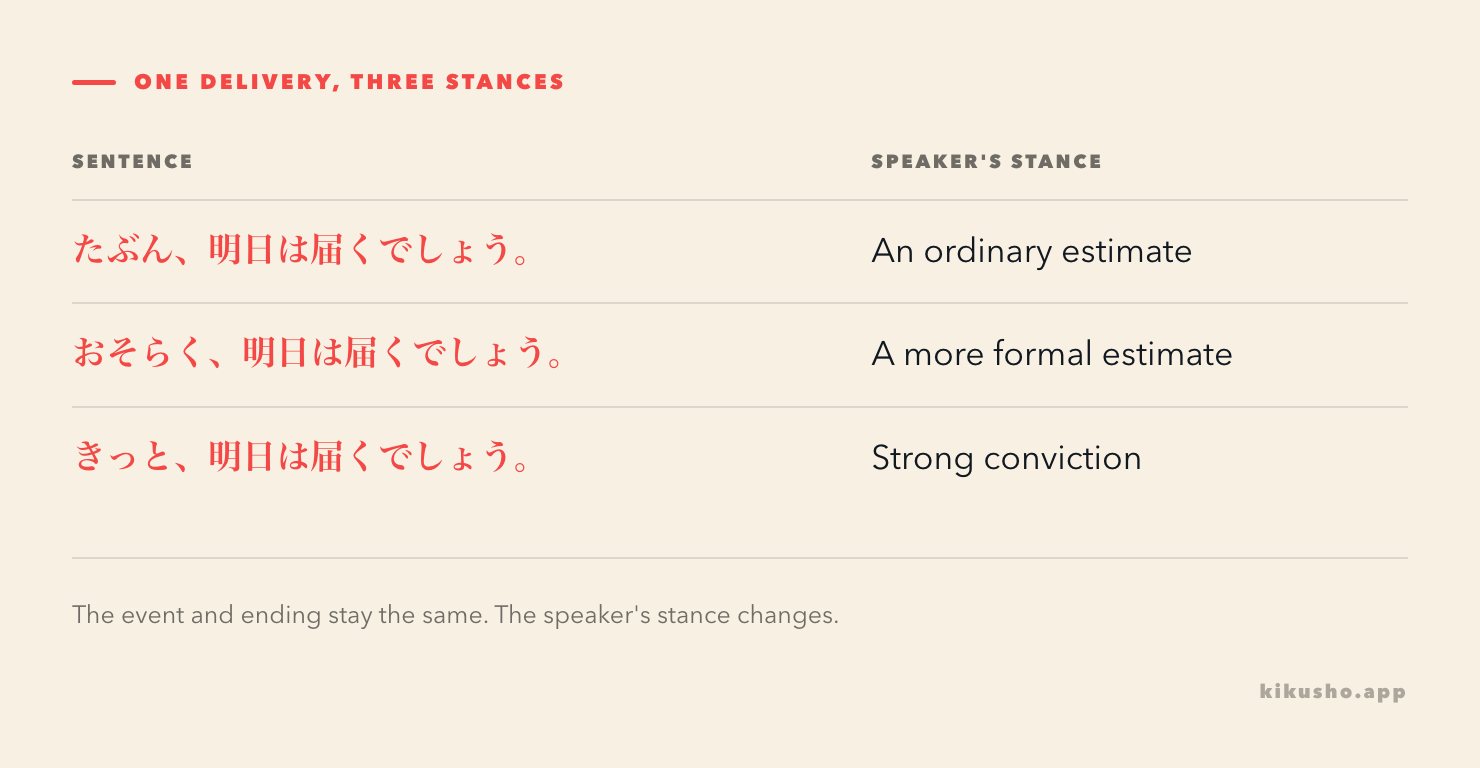
The selectable versions are たぶん、明日は届くでしょう, おそらく、明日は届くでしょう, and きっと、明日は届くでしょう. The first two can both translate as “It will probably arrive tomorrow.” The third is closer to “I'm sure it will arrive tomorrow.”
Changing たぶん to きっと can make a cautious update sound like reassurance. Changing たぶん to おそらく need not substantially change the estimate at all. In a multiple-choice exercise, “choose the only grammatical adverb” would therefore be unfair if all three appeared as options for this sentence.
These adverbs also accompany guesses about the past: たぶん、昨日は忙しかったのでしょう means “They were probably busy yesterday.” The sentence supplies the tense. For an expectation drawn from what you already know, compare the separate construction ~はず.
もしかすると raises a possibility worth considering
The parcel has not arrived, and you have no confirmation of a delay:
もしかすると、配達が遅れているかもしれません。
もしかすると、はいたつがおくれているかもしれません。
“Perhaps the delivery is running late.”
You are offering a possible explanation. もしかすると does not present that explanation with the confidence of きっと. The ending かもしれません matches the uncertainty.
Bunpro's lesson on もしかしたら includes もしかすると as a related form and explains the frequent pairing with かもしれない. That ending is common, rather than a compulsory piece of the adverb. Shogakukan's entry for もしかすると independently confirms the possibility meaning.
確実 changes the grammar as well as the claim
確実 is useful when you describe reliable information or an outcome as certain. It behaves like a な-adjective, so its connection to the next word matters.
| Shape | Example | Meaning |
|---|---|---|
| 確実な + noun | 確実な情報(かくじつなじょうほう) | Reliable information |
| 確実に + verb | 作業を確実に行う(さぎょうをかくじつにおこなう) | Carry out the work reliably |
| 確実だ/です | 成功は確実です(せいこうはかくじつです) | Success is certain |
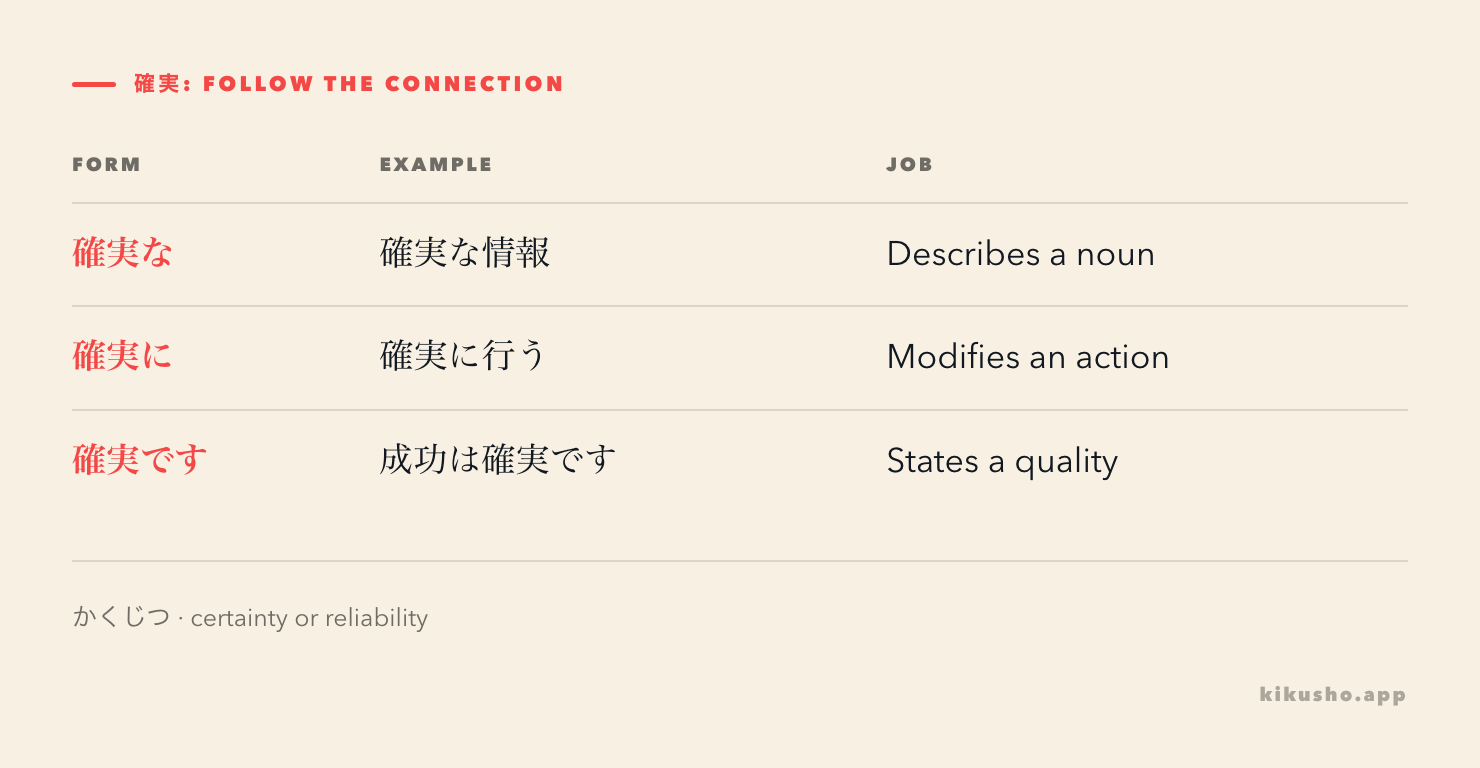
The NINJAL IPAL entry for かくじつ separates certainty of an outcome from reliable execution of an action. Both matter: 作業を確実に行う is about doing the work dependably, not guessing whether someone will do it.
確実 can also describe a future result. It is not restricted to events already verified, and it can occur with だろう. Calling a prediction certain remains a claim someone could get wrong. Daijisen confirms the noun and な-adjective classification. For more words naming qualities and ideas, continue with the section's N3 abstract nouns.
N3 is the comparison level, not the level of every word
The JLPT FAQ explains why there is no published exhaustive vocabulary syllabus for the current test. This lesson's placement is an editorial study choice.
Our dated reference inventory places 多分 at N5 and きっと at N4; treat them as earlier vocabulary being compared more carefully. 確実 is listed at N3, also the placement on JapaneseTest4You. 恐らく has N3 and N1 observations in the inventory's source lists, while Bunpro places it at N2. もしかすると has N3 and N2 observations; Bunpro lists it at N3.
Those source lists include two descendants of Jonathan Waller's vocabulary lists, so their agreement is not two independent confirmations. Learn the readings and uses here without treating the N3 label as an official boundary.
When an actual message contains one of these estimates, paste the phrase into Kikusho and check the drafted card's nuance and example before saving. Edit “probably” into a fuller explanation when it would erase the difference you just noticed. A useful review should ask you to recover the speaker's degree of commitment, too.
Try five questions before opening the answer block
These exercises are original practice, not official test questions. Choose one answer for each; all explanations follow Question 5.
Question 1: read the highlighted word
Choose the reading of 確実 in 確実な情報が必要です.
A. かくしつ
B. かくじつ
C. かくじゅつ
D. たしか
Question 2: choose the spelling
Which spelling represents おそらく in おそらく、夕方には終わります?
A. 遅らく
B. 想らく
C. 惜らく
D. 恐らく
Question 3: read the uncertain update
An update offers a possible explanation, with no confirmed cause. Choose the possibility marker meaning “perhaps,” rather than a claim about timing or frequency.
まだ分かりませんが、( )、荷物は別の住所に届いたのかもしれません。
荷物(にもつ)means parcel or luggage; 別の住所(べつのじゅうしょ)means another address.
A. いつも
B. 必ず
C. もしかすると
D. すでに
Question 4: find the closest paraphrase
Choose the closest meaning of 美咲さんはきっと来ます. Read 美咲 as みさき.
A. 美咲さんが来ると強く思っています。
B. 美咲さんはもう来ています。
C. 美咲さんが来ることはありません。
D. 美咲さんに来てほしくありません。
Question 5: choose the correct use
Which sentence uses 確実 to describe the information itself as reliable?
A. これは確実に情報です。
B. これは確実の情報です。
C. これは確実な情報です。
D. これは確実く情報です。
Answers and explanations
Answer 1: B, かくじつ
確実な情報が必要です means “We need reliable information.” The reading is かくじつ. A changes the voiced じ to し; C inserts an extra ゅ. D, たしか, belongs to 確か, a related word with different spelling and grammar.
Answer 2: D, 恐らく
恐らく and おそらく represent the word in “It will probably be finished by evening.” None of the other three spellings is the standard spelling of おそらく. The kana ending らく stays outside the kanji.
Answer 3: C, もしかすると
“We don't know yet, but perhaps the parcel was delivered to another address.” もしかすると introduces the suggested explanation and fits のかもしれません. A means “always,” B “without fail,” and D “already.” Those meanings do not supply the intended possibility marker; すでに would add a timing claim instead.
Answer 4: A
The speaker strongly believes Misaki will come. B says she has already arrived; C rules out her coming; D says the speaker does not want her to come. きっと in the original predicts her arrival confidently, without asserting that it has happened.
Answer 5: C
これは確実な情報です means “This is reliable information.” な connects 確実 to the noun 情報. A can be parsed as “This is certainly information,” with に modifying the assertion; it does not describe the information as reliable. B incorrectly uses の for this adjective connection, and D treats 確実 as though it formed an い-adjective adverb in く. Keep the whole phrase 確実な情報 when you review it.
Common questions
What is the difference between tabun, osoraku and kitto?
たぶん is an everyday probably; おそらく often gives the same estimate a more formal tone. きっと conveys stronger conviction, closer to surely or I am sure. These words do not encode fixed numerical probabilities.
Does osoraku always mean something bad will happen?
No. おそらく can introduce a favorable or unfavorable estimate. Although it can be written 恐らく, its ordinary probability meaning does not require fear or a negative outcome.
Is kakujitsu an adverb like kitto?
確実(かくじつ)is a noun and な-adjective expressing certainty or reliability. Use 確実な before a noun, 確実に with a verb, and 確実だ or 確実です as a predicate. The form 確実に can describe something happening certainly or an action being carried out reliably.