On this page
取材, 発表, 発行 and 報道 all reach for "report" or "publish" in a bilingual dictionary, and a single news story passes through all four before you ever read it: a reporter does the 取材, a source or official does the 発表, the paper's own printing and circulation is its 発行, and what results, watched from outside, is 報道. Learn the four as one small workflow, in the order a story moves through them, and each word keeps the one job that was always its own.
Why these belong together
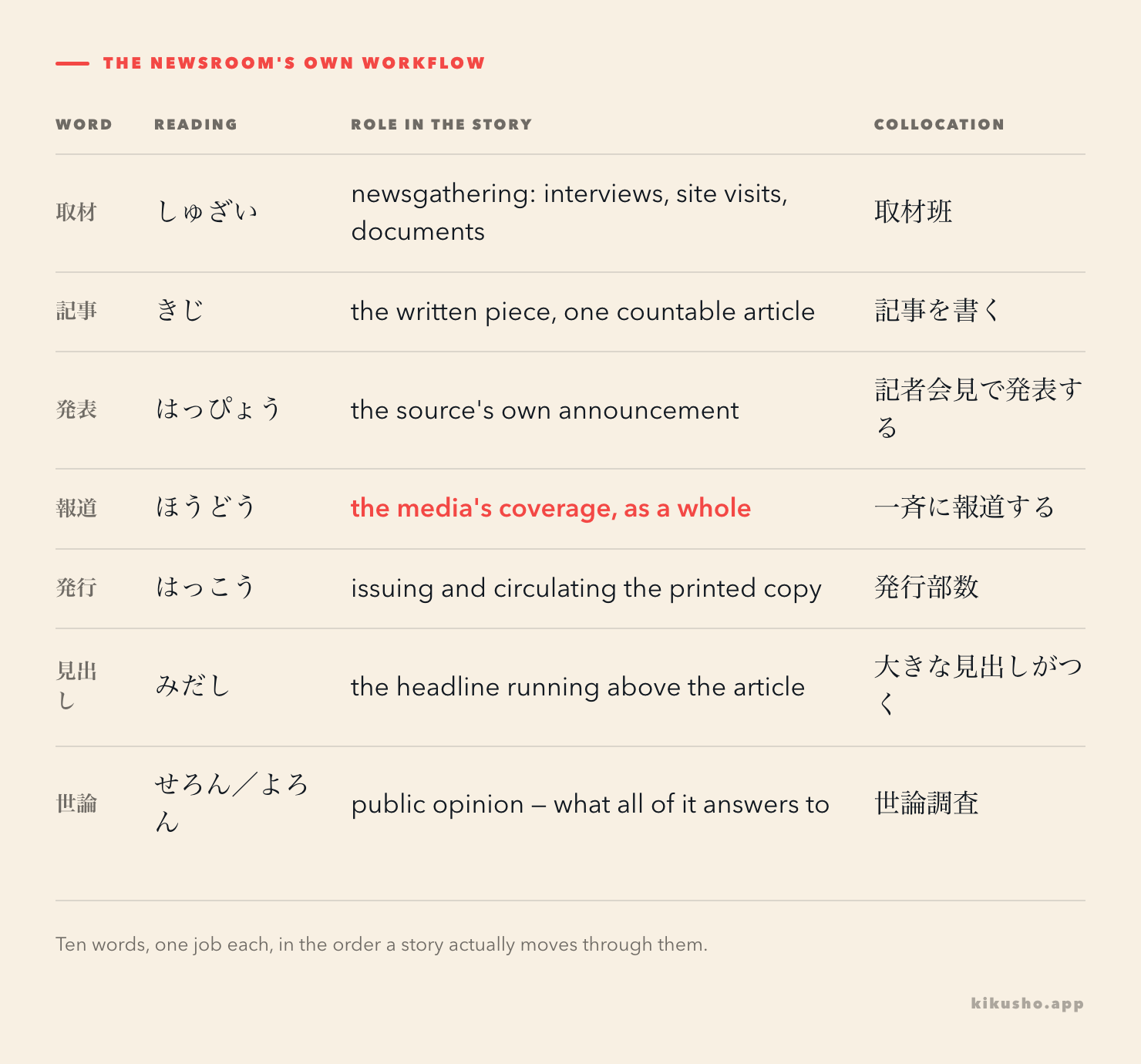
A dictionary hands you these ten words as ten separate entries, and that is the wrong shape for them. They are one story's own vocabulary for describing itself: a 記者 (reporter) sets out to do 取材 (newsgathering — interviews, site visits, documents) and comes back with 情報 (information), which becomes a 記事 (article, one countable piece of writing). Along the way, whoever the story is about may 発表 (announce) something themselves, in their own words, before a reporter ever asks a question. Once the article runs, the paper's 発行 (issuing, printing and circulating a copy) puts it in front of readers, under a 見出し (headline) that decides whether anyone stops to read it, and its own 社説 (editorial) argues a position rather than reporting one. Zoom out from any single article and all of this together is 報道: the ongoing act of covering the news, not one piece of it. What all of it answers to, in the end, is 世論 (public opinion) — measured, when anyone bothers to check, by a 世論調査 (opinion poll).
That is a real sequence, not a theme invented to group ten unrelated words under "newspaper." Confuse the roles and you get a grammatically fine sentence that describes the wrong part of the process: a company does not 報道 its own product, and a newspaper does not 発表 an earthquake. All ten are also the same two-kanji shape N3's abstract nouns already put in front of you: both halves still doing real work, just aimed at a newsroom's own vocabulary for itself instead of properties and relationships in general.
The set itself
| Word | Reading | Role in the story | Collocation |
|---|---|---|---|
| 記者 | きしゃ | the reporter, the person doing the work | 記者会見 (press conference) |
| 取材 | しゅざい | newsgathering: interviews, site visits, documents | 取材班 (a news crew) |
| 情報 | じょうほう | what the newsgathering turns up | 情報を集める (gather information) |
| 記事 | きじ | one written article, a countable piece | 記事を書く (write an article) |
| 発表 | はっぴょう | the source's own announcement, in their own words | 記者会見で発表する (announce at a press conference) |
| 報道 | ほうどう | the media's act of covering it, as a whole | 一斉に報道する (all outlets cover it at once) |
| 社説 | しゃせつ | the paper's own opinion piece, not a report | 社説を読む (read an editorial) |
| 見出し | みだし | the headline that runs above the article | 大きな見出しがつく (get a big headline) |
| 発行 | はっこう | issuing and circulating the printed copy | 発行部数 (circulation figures) |
| 世論 | せろん / よろん | public opinion, what all of it answers to | 世論調査 (opinion poll) |
The pattern that runs through them
Every word above names one specific participant's action or output, never the whole event at once, and that is the pattern worth keeping. 記者 does 取材; 取材 produces 情報; 情報 gets written into a 記事. None of those three steps belongs to anyone but the reporter. 発表, by contrast, belongs to the story's subject, not the press: a company announcing an earnings report, a ministry announcing a policy, an athlete announcing a retirement, all with 発表する, before a single reporter has asked them anything. 報道 sits one level above 記事: not a piece of writing but the fact, or the ongoing activity, of the press covering something — a single article is 記事; a week of newspapers, TV segments and radio spots all covering the same story together is its 報道.
見出し and 社説 name two things a paper adds on top of the reporting itself, and neither one is a report. A 見出し is the label, written to be read in half a second and decide whether the rest gets read at all. A 社説 is not reporting anyone's 発表 or the outcome of anyone's 取材; it is the paper arguing its own position, which is why 社説 carries an opinion a straight 記事 is supposed to avoid. 発行 sits outside the writing entirely: it is the physical or logistical act of putting a printed copy into circulation, the same word a passport office or a train station uses for issuing their own paperwork, with no reporting involved at all.
The two or three that break it
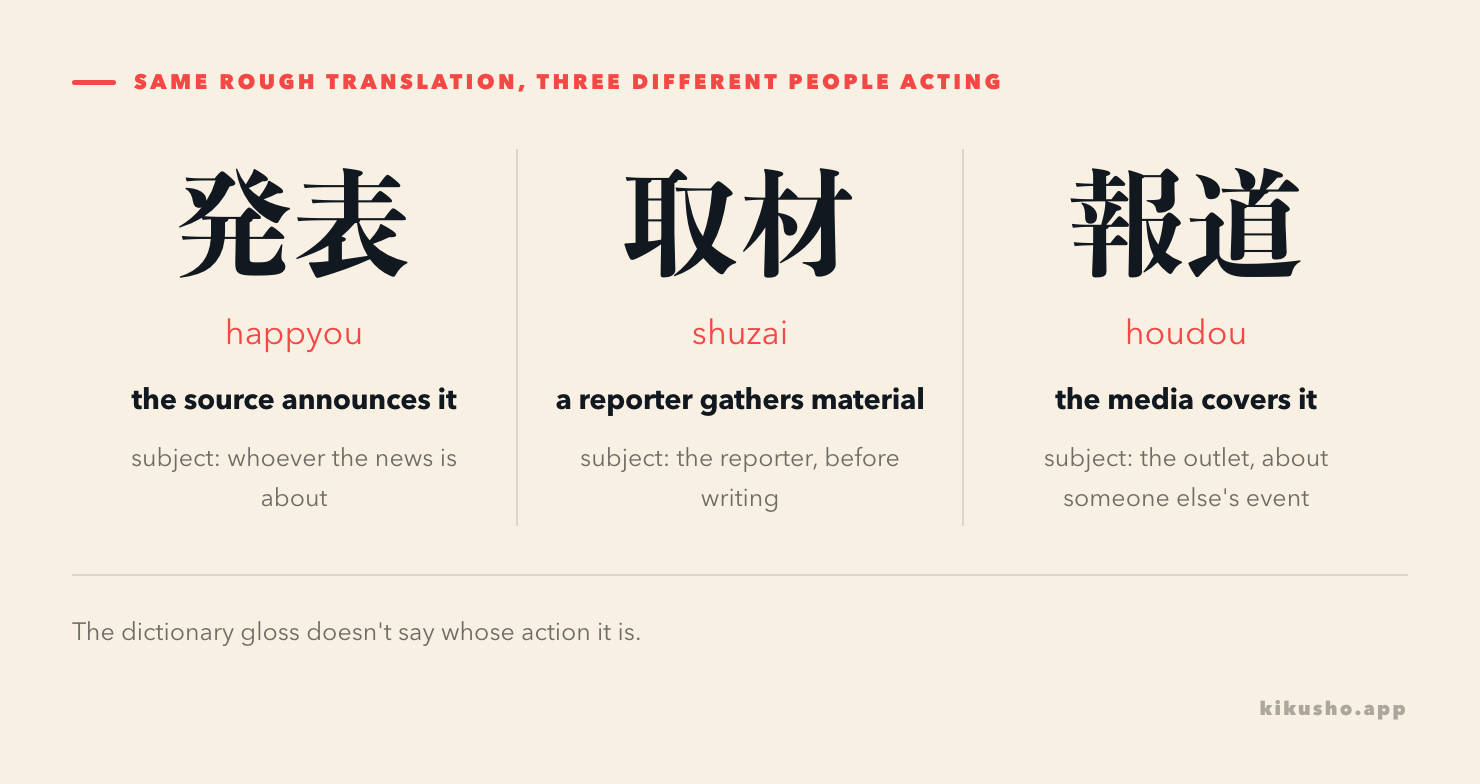
発表, 取材 and 報道 are the three a learner mixes up first, because all three can sit in an English sentence that starts "the news ___ it." The test that decides between them is whose action the sentence names.
その企業は新製品を発表した (the company announced its new product) puts the company itself in the subject slot, making its own information public on its own initiative; no reporter is implied at all. 記者はその企業に取材した (the reporter interviewed the company) puts the reporter in the subject slot instead, naming the fieldwork that happens before an article exists — asking questions, requesting documents, showing up in person. その事件について、新聞各社が一斉に報道した (every newspaper reported on the incident at once) puts the outlets themselves in the subject slot, and unlike 取材, it names the outward act of publishing coverage rather than the legwork behind it; unlike 発表, the subject is relaying something that happened to someone else, not making its own announcement.
発行 breaks the set in a different way: it is the one word here that does not require anything to have been reported at all. 定期券を発行する (issue a commuter pass) and 新聞を発行する (issue an edition of the newspaper) are the same verb doing the same job — releasing a printed or official item into circulation — whether or not a single fact was ever gathered or announced. Treat 発行 as belonging to a station counter and a printing press equally, not to the newsroom specifically.
世論 breaks the set for an unrelated reason: it is one word carrying two accepted readings, せろん and よろん, and the split is a leftover from a script reform rather than a dialect quirk or a careless dictionary. Before 1946, 輿論 (よろん) named an opinion arrived at through public discussion, and 世論 (せろん, occasionally せいろん) named the general mood of society — two related but separate words. When that year's list of characters for everyday use dropped 輿, both ideas collapsed onto the single spelling 世論, and both readings survived the merge rather than one replacing the other. 世論調査, the fixed phrase for an opinion poll, is conventionally read よろんちょうさ, but hearing せろんちょうさ from someone else is not an error to correct. It is the same kind of choice a kanji with several readings always forces on you, except here the choice survived a spelling reform instead of dialect or borrowing.
Which ones you will actually meet this month
社説 and 見出し are the two you will meet without trying, on the front page of any newspaper site or app: the headline decides whether you open the article, and if the paper runs an opinion page at all, it is labelled 社説 and kept visibly apart from the reporting around it. 発表 itself tends to arrive in the same formal register a milestone or a formal announcement calls for elsewhere: a company rarely just says it plainly, it 発表する at a scheduled moment, with the occasion marked the way any formal announcement is. 報道 and 取材 show up constantly in the reporting about the reporting — a public figure declining to comment "取材に対し," a network correcting its own 報道 — which is a sentence shape you will meet before you meet either word used about an ordinary event. 世論 and 世論調査 arrive every time an approval rating or a policy's popularity gets mentioned, which in an election season is close to daily. 発行 is the one you are more likely to meet somewhere other than a newspaper first: on the back of a receipt, on a ticket, on the line printed near a company seal.
None of these ten wait for a textbook to introduce them in order. They arrive already embedded in a sentence — a caption under a photo on a news app, a line in an NHK Web Easy piece, a phrase in a press conference clip — carrying their role in that sentence along with them. A card that keeps 一斉に報道した whole preserves which of these ten words was doing the acting and which one only looks similar in English; a card built from 報道 alone, off a list, throws that role away and leaves you to guess at it again the next time 発表 or 取材 shows up in its place.
Practice: five questions on ten words that keep their own job
Question 1. What is the reading of the underlined word? 「小さな地方新聞でも、毎週欠かさず_発行_されている。」(Even a small local paper is issued every week without fail.)
a) はっこう b) はつぎょう c) ほうこう d) はっぎょう
Answer 1: はっこう. This is the only reading either kanji takes in this compound. はつぎょう and はっぎょう are not readings 発 or 行 take together here; ほうこう is a real word, 方向, but a different word entirely, spelled with different kanji and meaning "direction."
Question 2. Complete with the correct kanji: 「今週の新聞の一面には、大きな___がついていた。」(This week's front page carried a big ___.)
a) 見出し b) 身出し c) 見出 d) 魅出し
Answer 2: 見出し. 身出し and 魅出し are not words; both borrow a kanji that looks close to 見 (身, body; 魅, to charm) but does not belong here. 見出 without し is the stem some dictionaries use to file the entry under, not the word as it is written in running text.
Question 3. Which word best completes the sentence? 「その事件について、新聞各社が一斉に___した。」(All the newspapers ___ the incident at once.)
a) 発行 b) 発表 c) 報道 d) 取材
Answer 3: 報道. 一斉に報道する, "to report on something all at once," is exactly what several outlets covering the same incident are doing. (a) 発行 needs something printed or issued, not an incident. (b) 発表 would mean the newspapers were making their own announcement, not covering someone else's event. (d) 取材 names the newsgathering stage that happens before publication, not the act of running the coverage.
Question 4. Which sentence paraphrases 「首相は新しい政策について記者会見で発表した」(The prime minister announced the new policy at a press conference) most closely?
a) 首相は新しい政策について明らかにした。 b) 首相は新しい政策について取材した。 c) 首相は新しい政策について発行した。 d) 首相は新しい政策について報道した。
Answer 4: (a). 明らかにする, "to make clear, to reveal," names the same act of making information public that 発表する does, with the prime minister still in the subject slot. (b) reverses the roles: 取材する is what a reporter does to a source, not what the source does. (c) 発行する needs a printed or issued item, not a policy being announced. (d) 報道する would mean the prime minister was covering someone else's news, not making an announcement of their own.
Question 5. 世論調査 is conventionally read which way?
a) よろんちょうさ b) せいろんちょうさ c) よんろんちょうさ d) せろんちょうさのみ正しい
Answer 5: よろんちょうさ. Dictionaries list this as the standard reading of the fixed phrase, with せろんちょうさ recorded as an accepted variant rather than an error. せいろんちょうさ and よんろんちょうさ are not attested readings of this compound, and (d)'s claim that only せろん is correct reverses which reading is treated as the default.
Ten words, four of them sharing a rough English gloss and one of them sharing two Japanese readings: the dictionary entry was never going to sort that out for you. Reading which job a word is doing in the sentence in front of you is the part a gloss leaves out, and it is the part that decides whether the next sentence you meet reads as ten words or as one story you already know how to follow.
Common questions
Are せろん and よろん both correct readings of 世論?
Yes. 輿論, read よろん, meant an opinion reached through public discussion; 世論, read せろん (or せいろん), meant the general mood of society. When the 1946 list of characters for everyday use dropped 輿, newspapers switched to writing both ideas as 世論, and both readings stayed in use rather than one replacing the other. Dictionaries list よろん first today, but せろん is not a mistake.
What is the difference between 記事 and 報道?
記事 is one piece of writing: a specific article you could point to on a page. 報道 names the broader activity, or the resulting body of coverage, of reporting on something, and it does not commit to a single count the way 記事 does. A newspaper might run several 記事 on an event, and all of them together are that event's 報道.
Does 取材 always mean conducting an interview?
No. インタビュー names the interview specifically, sitting down with someone and asking questions. 取材 is the wider newsgathering a story needs before it is written, and an interview is only one way to do it; visiting a site, requesting documents and observing an event in person all count as 取材 too.
Is 発行 only used for newspapers?
No. 発行 names issuing any printed or official item into circulation, a newspaper's daily print run as much as a passport, a train ticket or a banknote. パスポートを発行する and 定期券を発行する are as natural as 新聞を発行する; the newsroom is one user of the word, not its home.