On this page
頭が痛いです(あたまがいたいです) means “My head hurts.” The body part takes が, while 痛い is the adjective describing it. Other body and health words need different partners: 手を洗います for washing your hands, 薬を飲みます for taking medicine, and 病院に行きます for going to a hospital.
Why these sixteen words belong together
Naming the painful part is only the first step in an ordinary health conversation. You may need to say where it hurts, what you did, or where you are going. The September 2026 Kikusho reference inventory assigns the sixteen spelling-and-reading entries below to this N5 lesson. Eleven name body parts; the other five let you describe illness or the next step. Each entry has a phrase you can use, rather than only an English label.
This is a study-list placement, not an official JLPT word syllabus: the test organizers explain why they no longer publish an item list. The sources disagree on two entries. お腹(おなか) appears at N5 in one Waller-derived list and at N3 in another descendant of that same source family. 顔(かお) is N5 in the first list and N4 in a separately published index, whose underlying list provenance is not established. Both are useful beginner words, but a level label cannot guarantee that a particular item will appear on an exam. The Japan Foundation's Irodori health lesson and Kyoto Prefecture's medical guide show why these words are practical outside a test.
The sixteen body and health words
| Word and reading | Part of speech; useful sense | Phrase to keep together |
|---|---|---|
| 足(あし) | noun; foot or leg | 足が痛いです (my foot or leg hurts) |
| 頭(あたま) | noun; head | 頭が痛いです (my head hurts) |
| 医者(いしゃ) | noun; doctor | 医者に行きます (I go to the doctor) |
| 痛い(いたい) | い-adjective; painful, sore | 歯が痛いです (my tooth hurts) |
| お腹(おなか) | noun; belly or abdomen | お腹が痛いです (my stomach hurts) |
| 顔(かお) | noun; face | 顔を洗います (I wash my face) |
| 体(からだ) | noun; body, physical health | 体が痛いです (my body aches) |
| 薬(くすり) | noun; medicine | 薬を飲みます (I take medicine) |
| 口(くち) | noun; mouth | 口を開けます (I open my mouth) |
| 手(て) | noun; hand | 手を洗います (I wash my hands) |
| 歯(は) | noun; tooth or teeth | 歯が痛いです (my tooth hurts) |
| 鼻(はな) | noun; nose | 鼻が痛いです (my nose hurts) |
| 病院(びょういん) | noun; hospital | 病院に行きます (I go to a hospital) |
| 病気(びょうき) | noun; illness, sickness | 病気です (I am ill) |
| 耳(みみ) | noun; ear | 耳が痛いです (my ear hurts) |
| 目(め) | noun; eye | 目が痛いです (my eye hurts) |
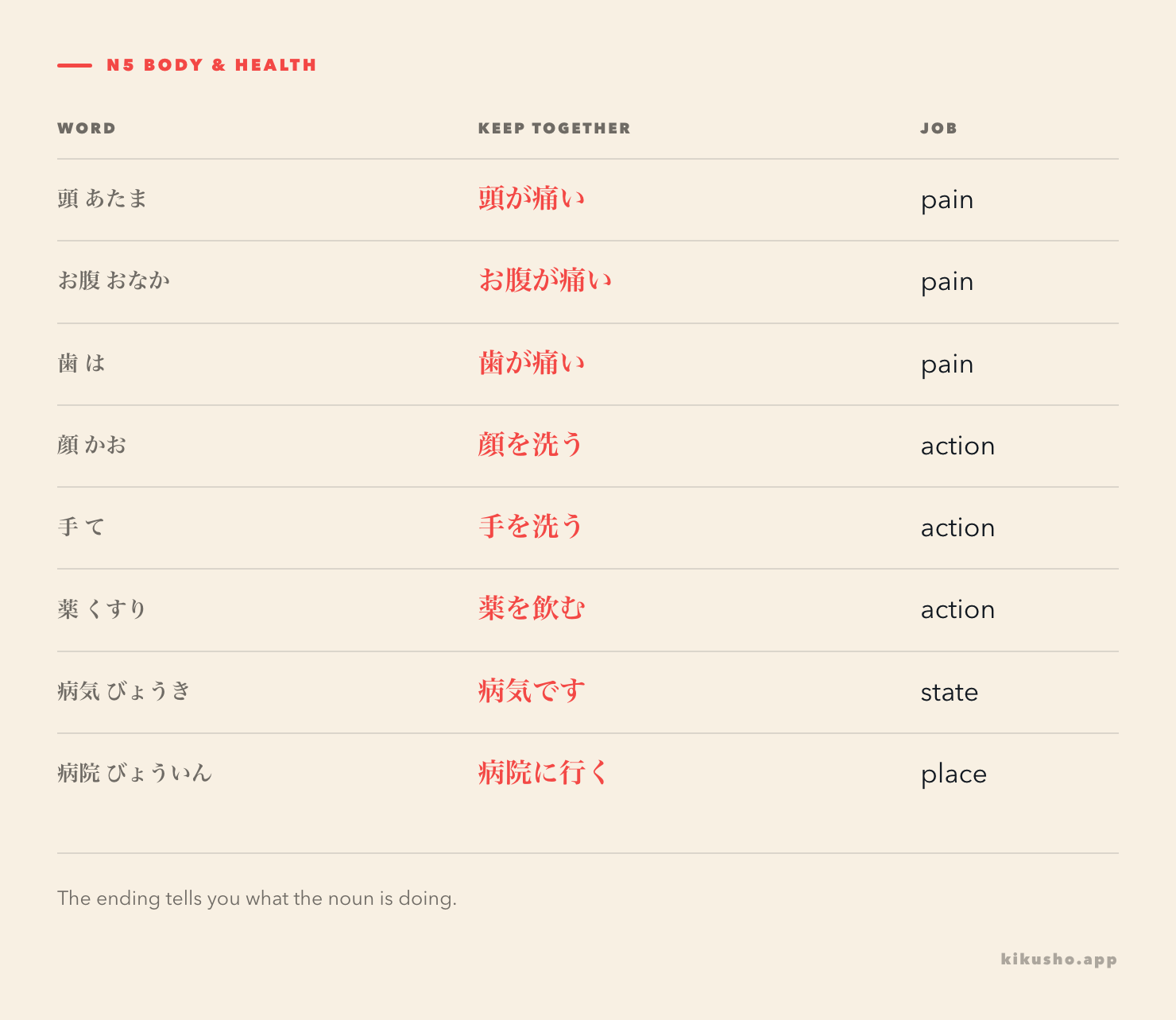
The table stays selectable so you can save the word, its reading and its partner together. 足 can mean a foot or a leg; お腹 is the everyday belly or abdominal area, not the anatomical stomach organ. Kyoto Prefecture's illustrated guide distinguishes the body areas, and the Tokyo University of Foreign Studies vocabulary module gives 手を洗います with the reading て.
が identifies the part that hurts
In 頭が痛いです, 頭 names the painful part and が marks it. English often says “my head hurts”; Japanese can leave the owner unstated when the speaker and situation make it clear. 私の is not required in this short symptom sentence. If you need to identify whose head, you can say 私は頭が痛いです: the person is the topic, and the head is the part described as painful. The Tokyo University of Foreign Studies grammar examples show 頭が痛いですか and other person/topic plus body-part clauses.
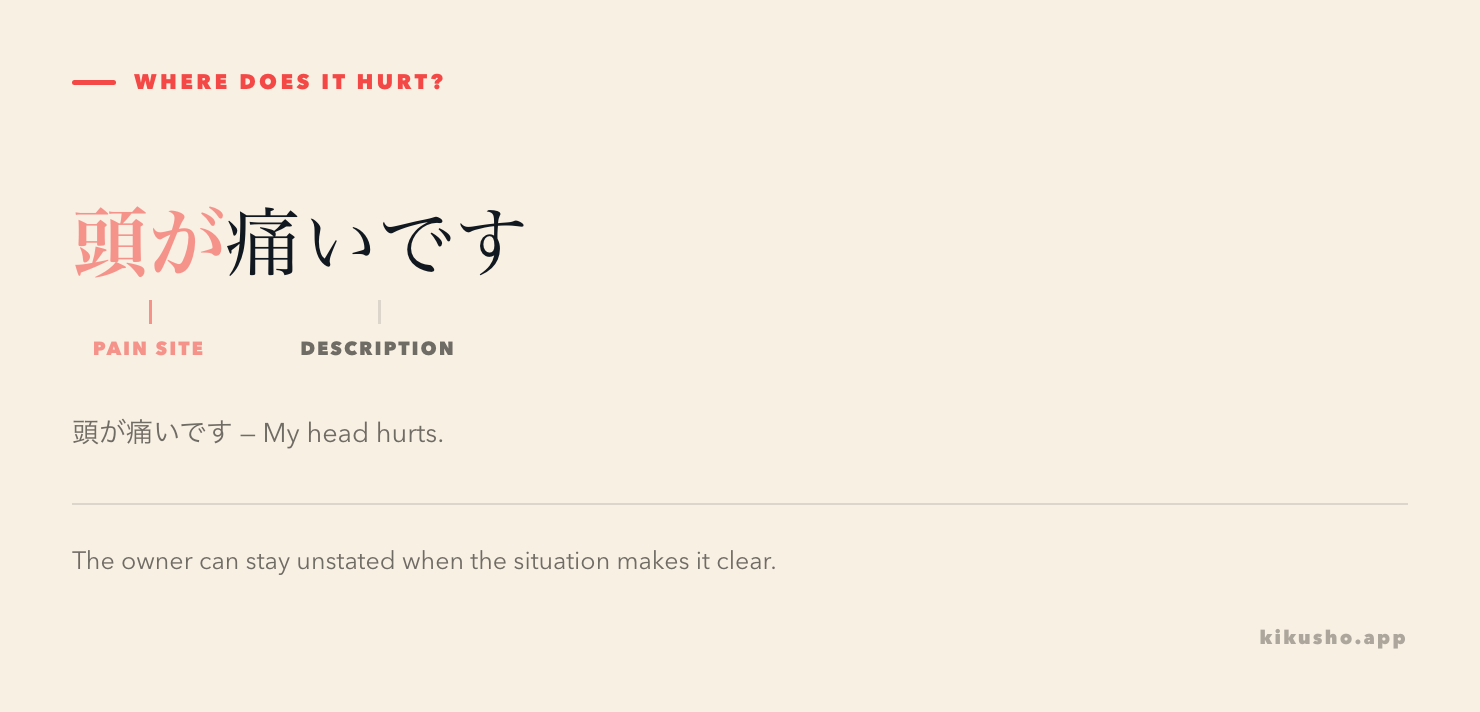
This pattern works for a real, specific pain: 歯が痛いです, 耳が痛いです, or お腹が痛いです. The university's vocabulary entry for 痛い specifically uses 歯が痛い and 頭が痛い; Kyoto's guide gives おなかが痛い as an abdominal symptom. 痛い is an adjective, so 痛いです is a polite description, not a verb conjugation. If you want to explain why an action is impossible, the potential-form lesson has an example with 足が痛いので.
Washing and medicine use を, and a destination uses に
The set does not turn every body part into a complaint. 顔を洗います and 手を洗います name something you act on, so を marks the object. The university's 顔 entry and 手 entry give these ordinary pairings. In a health setting, 口を開けます can name another action involving a body part.
薬を飲みます uses the same object marker: medicine is what you take. The university's 薬 entry verifies both the reading and phrase; Irodori's lesson includes a medical questionnaire asking whether you are taking medicine. 病院に行きます instead uses に for the destination. 医者に行きます is a conversational way to say you are going to see a doctor. These are useful short phrases; they do not teach treatment advice.
病気です describes being ill, rather than locating a pain. 病気 and 病院 start with the same character, but have different readings and jobs: びょうき is an illness; びょういん is a place. Learn the whole word instead of guessing its reading from the first kanji.
What to listen for in a short conversation
If someone says 頭が痛いです, you hear where the problem is. If they add 薬を飲みます or 病院に行きます, you hear an action or destination. The noun alone cannot tell you which of those three scenes you are in. A Kikusho card made from the whole line can retain the phrase that first made the word meaningful, rather than separating 頭 from が痛い in your next review.
The N5 everyday-verb lesson continues the particle question with actions such as walking and taking a day off.
Check yourself
Question 1: kanji reading. In 歯が痛いです, what is the reading of 歯? Write it in hiragana.
Question 2: spelling. Which word means “hospital” and has the reading びょういん?
- A. 病気
- B. 病院
- C. 医者
- D. 薬
Question 3: pain in context. Complete “My head hurts” with one assigned body noun and the particle: ___痛いです.
Question 4: action in context. A person says “I take medicine.” Choose the complete phrase with the right particle from the assigned set.
- A. 薬が飲みます
- B. 薬に飲みます
- C. 薬を飲みます
- D. 薬は病院です
Question 5: paraphrase. In 足が痛いです, does 足 necessarily mean only “foot”? Explain the other possible body area and what resolves the meaning.
Question 6: contrast. Write one short polite sentence for washing your face, and one for your tooth hurting. Use the particles that fit the two predicates.
Answers and explanations
Answer 1. は. 歯 is the tooth or teeth. 鼻, “nose,” is はな, so the short reading is not merely the beginning of the nose word.
Answer 2. B, 病院(びょういん). 病気(びょうき) means illness; 医者(いしゃ) is a doctor; 薬(くすり) is medicine. Their meanings and readings rule them out even though 病気 shares the first kanji.
Answer 3. 頭が: 頭が痛いです. 頭(あたま) identifies the head and が marks it as the part that is painful. 頭を would make the head an object of an action, but 痛い is a descriptive adjective.
Answer 4. C, 薬を飲みます. を marks the medicine as the thing taken. A and B put が or the destination marker に in the object slot; D makes a statement about medicine and a hospital instead of describing the action.
Answer 5. No. 足(あし) can mean a foot or a leg. The context, such as pointing to the sore area, resolves which is meant; the sentence alone does not specify one.
Answer 6. 顔を洗います and 歯が痛いです. 顔(かお) is the object of 洗います, so it takes を. 歯(は) is the part described by 痛いです, so it takes が. Swapping the particles would also swap their grammatical roles and would not express these two scenes.
The next time you hear a short health sentence, keep the particle and predicate with the word. That small ending tells you whether the speaker is naming a sore part, doing something to it, or heading somewhere for help.
Common questions
How do I say that my head hurts in Japanese?
頭が痛いです(あたまがいたいです) says “My head hurts.” が identifies the painful part; 痛い is an い-adjective, not a verb.
Does 足 mean foot or leg?
足(あし) can refer to the foot or the leg. The situation tells you which part the speaker means.
Is お腹 an official JLPT N5 word?
There is no exhaustive official JLPT word list. Separate study lists place お腹(おなか) at N5 and N3, so this page teaches its everyday meaning without promising a particular exam placement.