On this page
Japanese reasoning does not stop at giving a reason. A reader may need to understand an explanation, interpret evidence, examine a proposal, take conditions into account, notice a misunderstanding, evaluate a theory, become convinced, or identify an exception.
The eight words in this N3 set give each step a distinct name. Their English translations overlap, so the useful unit is the word together with the object, particle or phrase it normally takes.
Eight words for following an argument
| Word and reading | Class | Core job | Combination to keep |
|---|---|---|---|
| 理解(りかい) | Noun / する | Grasp content or a situation | 説明を理解する |
| 解釈(かいしゃく) | Noun / する | Decide or explain what something means | 文をこう解釈する |
| 誤解(ごかい) | Noun / する | Understand something incorrectly | 誤解を招く |
| 検討(けんとう) | Noun / する | Examine a proposal or problem before deciding | 案を検討する |
| 考慮(こうりょ) | Noun / する | Take a relevant factor into account | 安全性を考慮する |
| 説(せつ) | Noun | A theory, view or account | この説が有力だ |
| 納得(なっとく) | Noun / する | Understand and accept; be convinced | 説明に納得する |
| 例外(れいがい) | Noun | A case outside a rule | 例外を認める |
This is the complete assigned set. 説 here is read せつ, and 検討 is けんとう. That second reading matters because 見当 can also be read けんとう, but it is a different word meaning a rough idea or estimate.
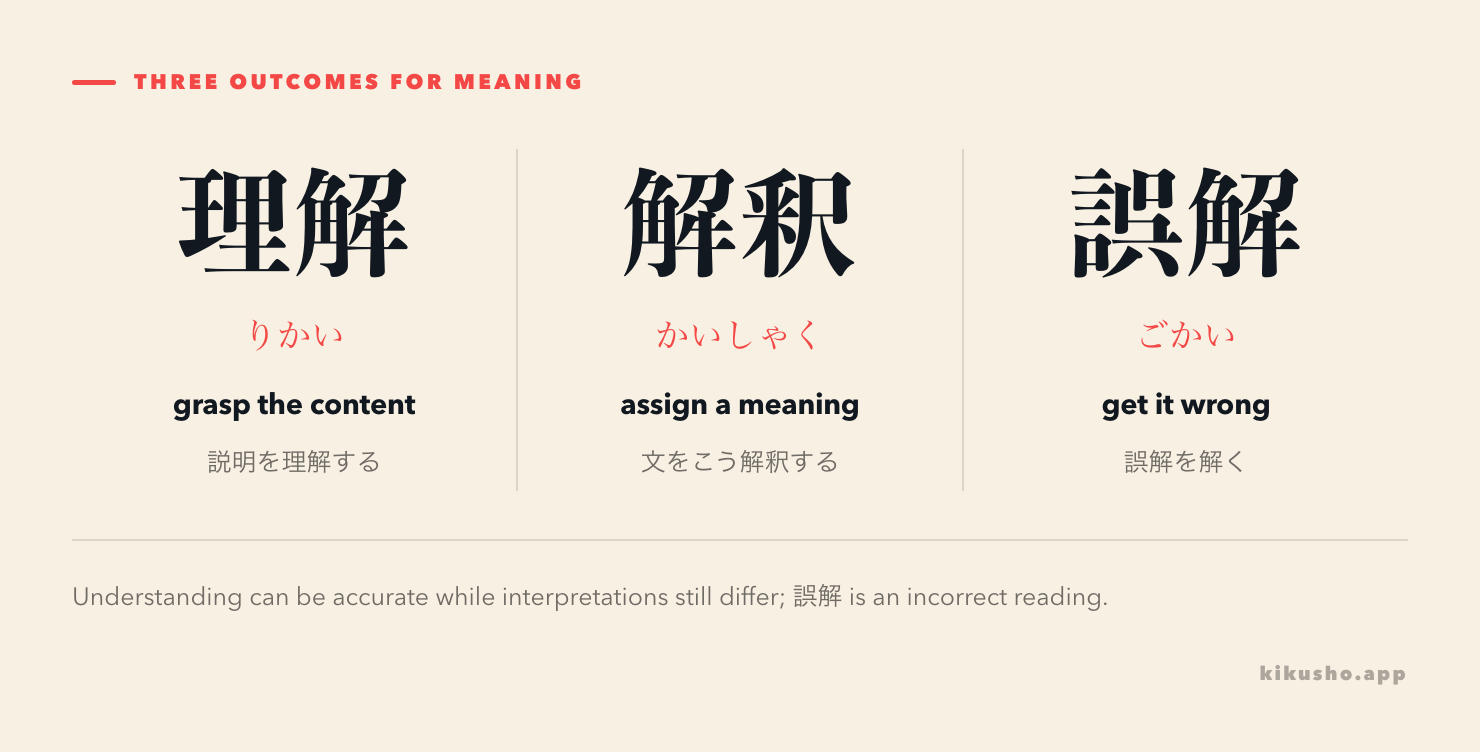
理解, 解釈 and 誤解 track what happens to meaning
理解(りかい) is the broad word for grasping content, circumstances or someone's position.
説明を読んで、変更の理由を理解した。
せつめいを よんで、へんこうの りゆうを りかいした。
I read the explanation and understood the reason for the change.
Useful frames include 内容を理解する, 状況を理解する, and 理解が深まる. Understanding says that the information has been grasped. It does not say how an ambiguous sentence should be read, and it does not guarantee agreement.
解釈(かいしゃく) focuses on the meaning assigned to words, evidence, an action or a rule. Shogakukan's dictionary entry covers both clarifying the meaning of a text and understanding something according to one's own judgment or experience.
私はこの文を「申請は任意だ」という意味に解釈した。
わたしは この ぶんを「しんせいは にんいだ」という いみに かいしゃくした。
I interpreted this sentence as meaning that the application was optional.
The frame XをYという意味に解釈する makes both the material and the resulting reading explicit. Two people can 内容を理解する yet reach different 解釈 of what the writer intended.
誤解(ごかい) is a mistaken understanding or interpretation. Common expressions show either how it starts or how it ends: 誤解を招く means to cause misunderstanding, 誤解される means to be misunderstood, and 誤解を解く means to clear one up.
短い返事だけでは、反対していると誤解されるかもしれない。
みじかい へんじだけでは、はんたいしていると ごかいされるかもしれない。
With only a short reply, you might be misunderstood as opposing the idea.
検討 examines the choice; 考慮 includes a factor
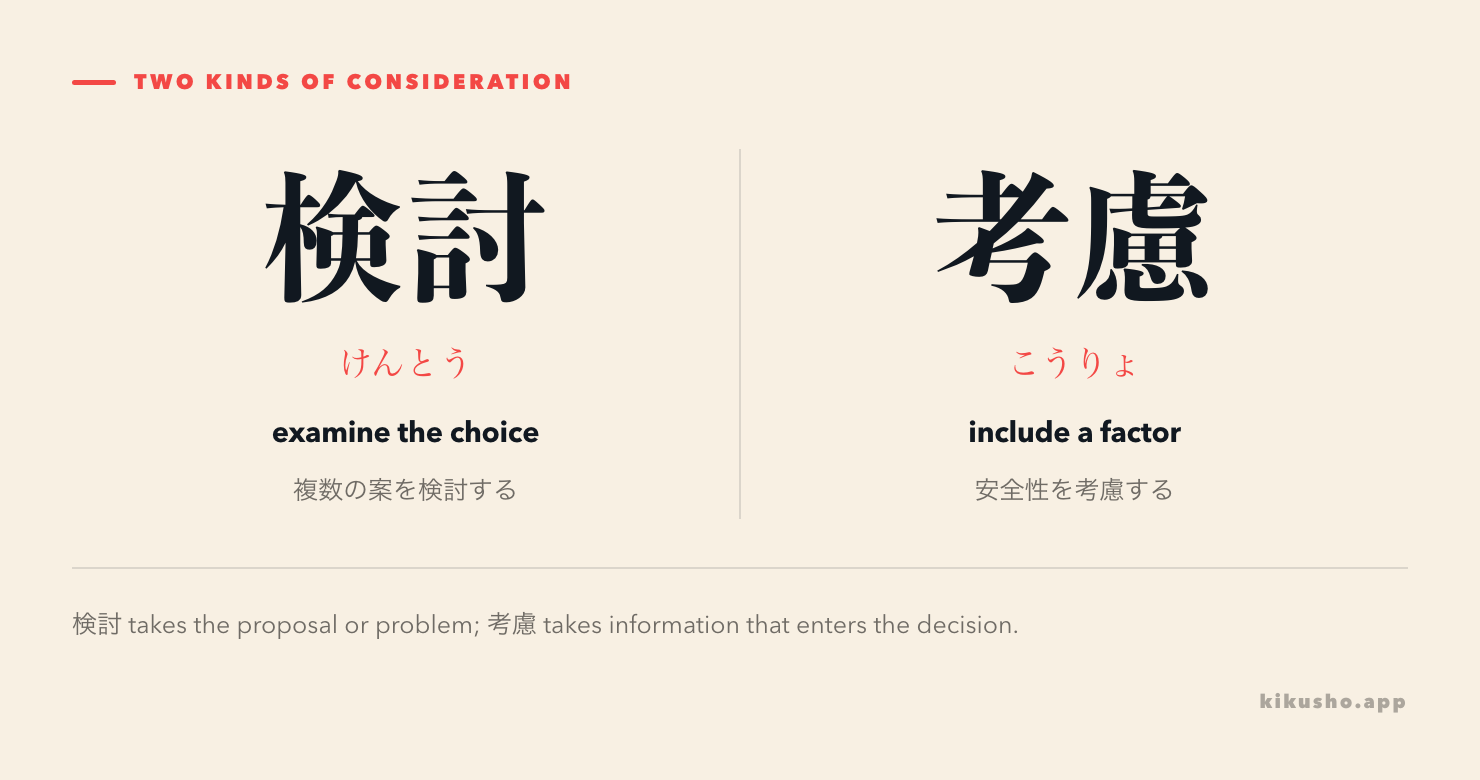
Both 検討(けんとう) and 考慮(こうりょ) may appear as “consider” in English, but they take different objects.
Use 検討する for the proposal, option, problem or question being examined. The aim is often a later judgment. The dictionary definition describes examining something from different sides and judging whether it is suitable.
委員会は三つの案を検討している。
いいんかいは みっつの あんを けんとうしている。
The committee is examining three proposals.
Natural extensions are 検討中です, “it is under consideration,” 検討を重ねる, “examine it repeatedly,” and 再検討する, “reconsider.” In a business reply, 検討します means that the matter will be examined; it does not promise acceptance.
Use 考慮する for a condition or factor that must enter the judgment. Shogakukan defines it as thinking carefully while including various factors.
費用だけでなく、安全性も考慮して案を選ぶ。
ひようだけでなく、あんぜんせいも こうりょして あんを えらぶ。
We will choose a proposal while considering safety as well as cost.
The longer frame Xを考慮に入れる also means “take X into account.” In one meeting, the committee can 案を検討する while 費用を考慮する: the plan is what it examines, and cost is one input to that examination.
The cause, result and condition lesson supplies nearby nouns such as 根拠, the basis supporting a claim, and 前提, the assumption in place before reasoning starts. This N3 lesson follows what readers do with that information.
説 names a view or theory, not the act of explaining
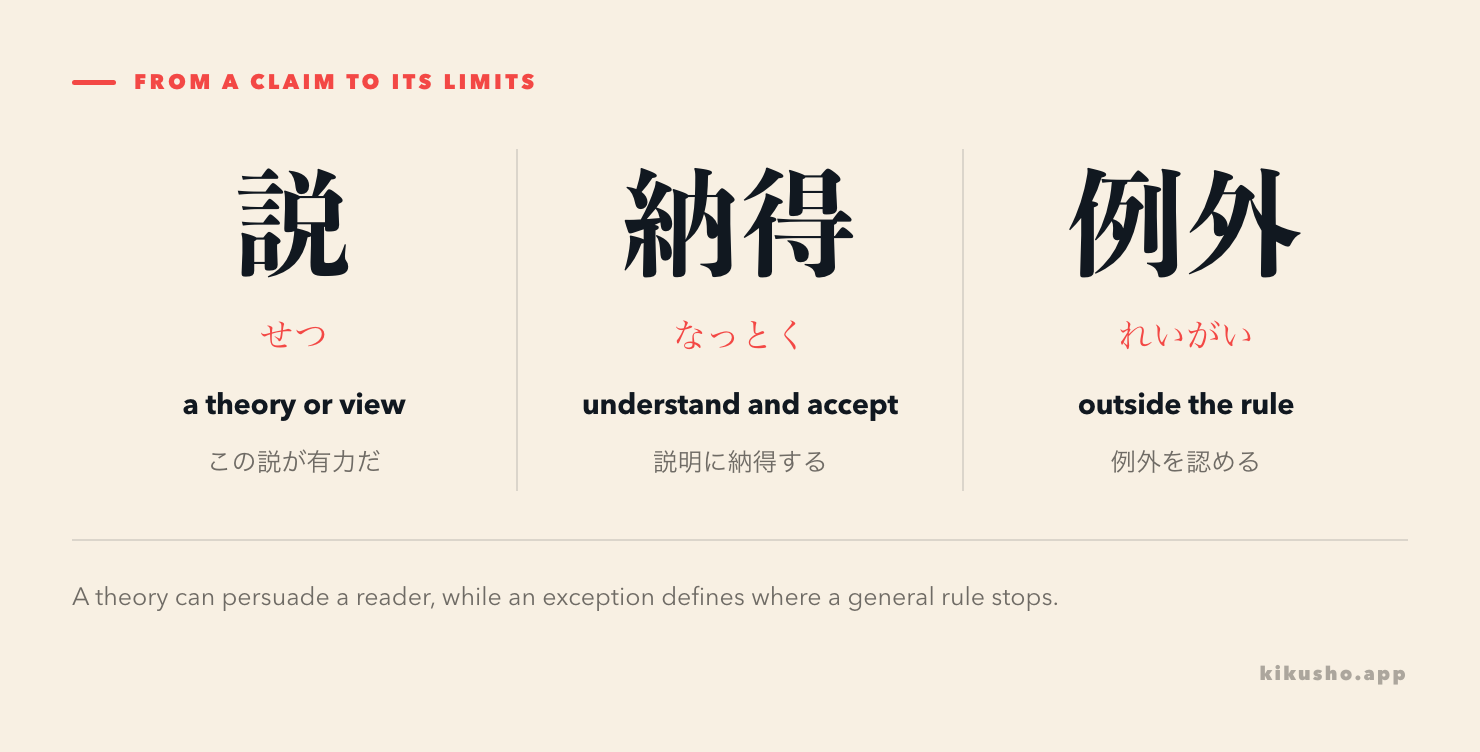
説(せつ) is a theory, view, claim or account that someone puts forward. It often appears as この説, Xという説, 説を唱える, or 説が有力だ.
この地域から人々が移動したという説が有力だ。
この ちいきから ひとびとが いどうしたという せつが ゆうりょくだ。
The leading theory is that people migrated from this region.
Do not replace it mechanically with 説明(せつめい). A 説 is the position or theory itself. A 説明 is an explanation given so that someone can understand. The dictionary entry for 説 lists views, claims and theories among its central senses.
Compounds preserve that core. 仮説(かせつ) is a hypothesis; 定説(ていせつ) is an established theory. The single word 説 can remain neutral about whether a view is correct, so the surrounding phrase tells you its status.
納得 begins where simple understanding ends
納得(なっとく) combines comprehension with acceptance. A person who 説明を理解した has grasped the explanation. A person who 説明に納得した finds it convincing or acceptable.
決定の理由は理解したが、まだ納得できない。
けっていの りゆうは りかいしたが、まだ なっとくできない。
I understand the reason for the decision, but I still cannot accept it.
Notice the usual particles: Xを理解する, but Xに納得する. Other useful forms are 納得がいく, “be satisfactory or make sense,” and its frequent negative 納得がいかない. The dictionary entry centers on sufficiently understanding another person's idea or action and accepting it.
The contrast is useful in reports and conversations because comprehension and agreement are separate outcomes. Saying 分かりました or 理解しました need not mean “I agree.”
例外 marks where a rule stops applying
例外(れいがい) is a case left outside a general rule. It commonly appears with 例外を認める, Xを例外とする, 例外なく, and the frame 原則としてX。ただし、Yは例外だ.
原則として予約が必要だ。ただし、十二歳以下の子どもは例外だ。
げんそくとして よやくが ひつようだ。ただし、じゅうにさいいかの こどもは れいがいだ。
As a rule, a reservation is required. However, children aged twelve or under are an exception.
An exception limits the range of a statement; it does not automatically disprove the rule. In careful reading, ask whether the writer is rejecting a claim or identifying one case to which it does not apply.
The N1 reasoning, evidence and explanation lesson continues from this boundary: it treats 原則 as a headword, corrects the standalone reading of 仮, and separates 認識 from 把握.
Read the eight words as one decision process
Imagine a committee reviewing a new library rule. Members first 理解する what the draft says, then 解釈する an ambiguous sentence. They correct a 誤解, 検討する several alternatives, and 考慮する cost and safety. One member presents a 説 about why use has fallen. After hearing the evidence, the group 納得する, but it still creates an 例外 for children.
Japanese argument structure also depends on the order in which reasons appear. The ことから and なぜなら lesson compares moving from observed grounds to a conclusion with stating a claim before supplying its reason.
The N3 label describes the lesson, not an official word list
Seven items are consistently N3 in the reference inventory used for this course. 例外 appears at N3 in one row and at N2 in two related rows. Those rows descend from the same Waller list family, so their disagreement is evidence of an unstable study label, not three independent votes.
The official JLPT FAQ says that the former Test Content Specifications are no longer issued. No current official page therefore assigns every word to one level. Treat the N3 label as a study guide; the useful test is whether you can recognize each reading and follow its role in context.
Kikusho can turn a sentence from a report, message or photographed page into an editable card. Keep the whole combination, such as 案を検討する, 安全性を考慮する, or 説明に納得する, so review tests the distinction instead of only an overlapping English gloss.
Practice: eight questions
Answer all eight before opening the solutions.
1 · Reading in a report. How is 解釈 read?
- ① かいせき
- ② かいしゃく
- ③ げしゃく
- ④ かいじゃく
2 · Restore the kanji. Pick the spelling for ごかいを とく, “clear up a misunderstanding.”
- ① 誤会を解く
- ② 語解を説く
- ③ 誤解を解く
- ④ 五解を溶く
3 · The object is a proposal. Supply the word that means examining alternatives before deciding.
委員会は三つの案を__している。
- ① 検討
- ② 考慮
- ③ 納得
- ④ 例外
4 · The object is a factor. Supply the word that puts safety into the decision.
費用だけでなく、安全性も__して決めます。
- ① 解釈
- ② 誤解
- ③ 検討
- ④ 考慮
5 · Comprehension without acceptance. Find the line in which the speaker grasps a decision but remains unconvinced.
- ① 決定を誤解したので、すぐ納得した。
- ② 決定の理由は理解したが、納得できない。
- ③ 決定を検討したので、理解できない。
- ④ 決定は例外だから、解釈を招いた。
6 · A supported theory. Select the established phrase for an account regarded as the strongest one.
- ① この説が有力だ
- ② この説を納得だ
- ③ この説明が例外する
- ④ この解釈に検討だ
7 · Boundary of a rule. Read the sentence, then select its accurate paraphrase.
原則として参加費が必要だが、学生は例外とする。
- ① Students must pay an additional fee.
- ② Only students may participate.
- ③ The rule about the fee does not apply to students.
- ④ The fee rule was caused by students.
8 · One decision, two operations. Fill the earlier and later gaps with the pair that preserves their different objects.
担当者は二つの案を( 前 )し、利用者の意見も( 後 )して最終案を選んだ。
- ① 前:考慮 / 後:検討
- ② 前:検討 / 後:考慮
- ③ 前:理解 / 後:誤解
- ④ 前:納得 / 後:解釈
Answers and explanations
②, かいしゃく. 解釈 means interpretation or the act of assigning meaning. かいせき is the reading of 分析-related word 解析, not 解釈.
③, 誤解を解く. 誤解 is “misunderstanding,” and 誤解を解く is the established combination for clearing one up. The distractors replace characters with similar sounds or use 説く and 溶く in the wrong phrase.
①, 検討. 三つの案 are the alternatives being examined, so 案を検討する fits. 考慮 would normally take a factor that enters the decision.
④, 考慮. Safety is a relevant factor, giving 安全性を考慮して決める. 検討 would fit the proposal or problem being examined rather than the safety condition itself.
②. The first clause says the reason was understood; が then contrasts that comprehension with the inability to accept it. This is precisely the difference between 理解 and 納得.
①, この説が有力だ. 説 names the theory or account, and 有力 describes it as influential or strongly supported. The other choices combine nouns, particles and する forms unnaturally.
③. 学生は例外とする places students outside the general participation-fee rule. It does not add a fee, restrict attendance to students or identify students as a cause.
②, 検討 / 考慮. The staff member examines the two proposals themselves with 検討 and takes user opinions into account with 考慮.
Common questions
What is the difference between 理解 and 解釈?
理解 means grasping content, a situation or another person's position. 解釈 means deciding or explaining what words, facts or actions mean. You can understand a sentence and still disagree about its interpretation.
What is the difference between 検討 and 考慮?
検討 is examining a proposal or problem from several angles before a decision. 考慮 is taking a relevant factor, such as cost or safety, into account while making that decision.
Does 納得 mean the same as 理解?
No. 理解 says that you comprehend an explanation or situation. 納得 says that the explanation makes sense to you and that you accept it. A person may understand a decision without being convinced by it.
Are all eight words officially JLPT N3 vocabulary?
No official exhaustive JLPT vocabulary list exists. The reference inventory places seven words consistently at N3, while related Waller-derived lists place 例外 at either N3 or N2.