On this page
Use ~ても始まらない when doing something will not advance the situation. Use ~ても仕方がない/~てもしょうがない when the action is pointless too, or when an unwanted result is understandable and cannot reasonably be changed.
That second use creates the difference. 後悔しても始まらない pushes away regret because it leads nowhere. 電車が遅れたなら、遅刻しても仕方がない accepts lateness as an unavoidable result. Replacing the second ending with 始まらない would lose that acceptance reading.
This lesson covers inventory item g-123aabb860eb, ても始まらない, and g-82a969fc3f6a, てもしょうがない/ても仕方がない. JLPT Sensei places both at N3, as do independent Japanese-teacher references for ~ても始まらない and ~ても仕方がない. These are study estimates: the JLPT does not publish an exhaustive grammar syllabus.
The deciding test is progress or acceptance
Ask what the speaker is judging.
| Pattern | Judgment | Typical situation | Natural continuation |
|---|---|---|---|
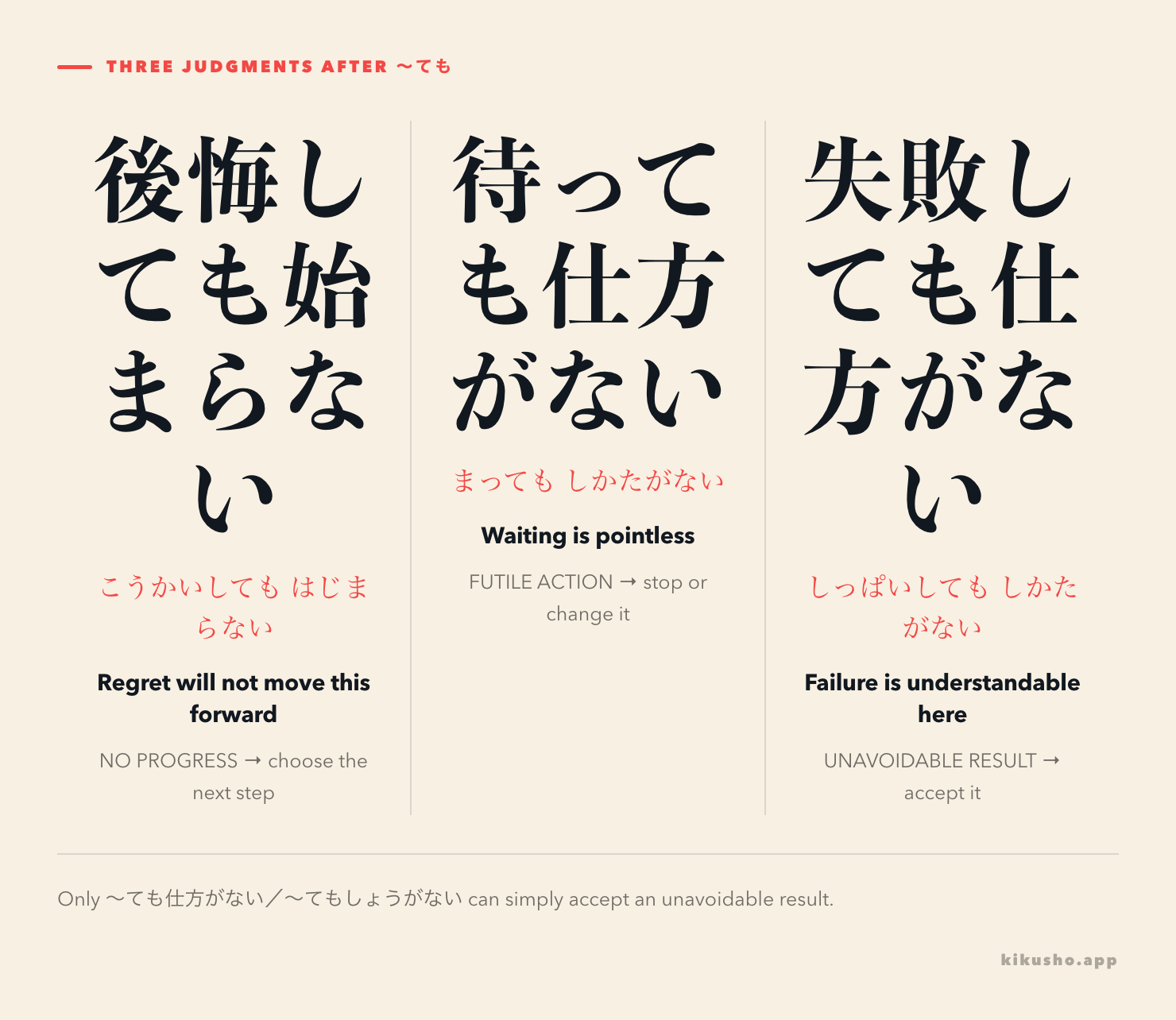
| ~ても始まらない | X will not get matters moving | regret, blame, complaint, worry | turn to the next useful action |
| ~ても仕方がない/~てもしょうがない | X is pointless | waiting, arguing, repeating | stop or change the action |
| ~ても仕方がない/~てもしょうがない | X is understandable or unavoidable | failure, delay, ignorance | accept the result |
今さら後悔しても始まらない。次の方法を考えよう。
いまさら こうかいしても はじまらない。つぎの ほうほうを かんがえよう。
Regretting it now will get us nowhere. Let us think of the next approach.
The first sentence closes an unproductive route; the second opens a productive one. That forward turn is characteristic of ~ても始まらない.
店はもう閉まっているから、ここで待っても仕方がない。
みせは もう しまっているから、ここで まっても しかたがない。
The shop is already closed, so there is no point waiting here.
Here ~ても仕方がない reaches the same practical judgment. Waiting changes nothing. In this overlap, 待っても始まらない is possible too, but it places more attention on the lack of progress and often invites a new plan.
Both begin with the concessive ~ても
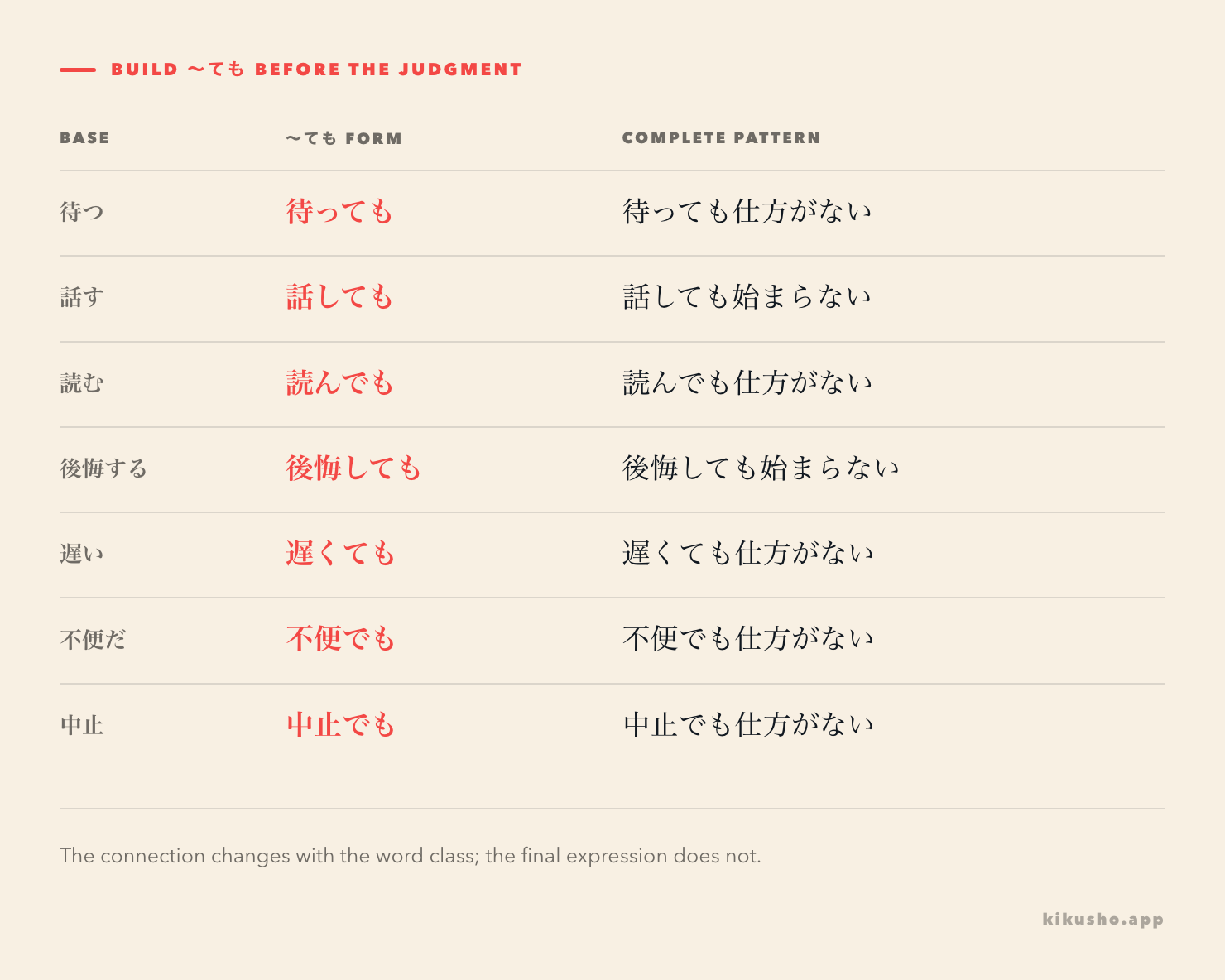
The grammar before the final expression is the ordinary ~ても form: “even if X” or “even though X.” For verbs, use the て-form plus も. The sound changes belong to the て-form, not to 始まらない or 仕方がない.
| Base | ~ても form | Complete example |
|---|---|---|
| 待つ | 待っても | 待っても仕方がない |
| 話す | 話しても | 話しても始まらない |
| 読む | 読んでも | 読んでも仕方がない |
| 後悔する | 後悔しても | 後悔しても始まらない |
| 遅い | 遅くても | 遅くても仕方がない |
| 不便だ | 不便でも | 不便でも仕方がない |
| 中止 | 中止でも | 中止でも仕方がない |
The adjective and noun connections are grammatical, but meaning still decides whether the whole sentence works. These futility patterns most often follow an action because speakers judge whether doing it can help. With states, ~ても仕方がない is more flexible because it can accept a result: 初めてなら、失敗しても仕方がない means failure is understandable for a first attempt.
~ても始まらない rejects an action that cannot create progress
The literal verb 始まる means “to begin,” but this construction does not announce that an event fails to start. It evaluates a proposed reaction as incapable of starting any useful change. Nihongo NET describes the pattern as an action that does not lead to progress in the situation.
誰が悪いかを言い争っても始まらない。まず原因を調べよう。
だれが わるいかを いいあらそっても はじまらない。まず げんいんを しらべよう。
Arguing about who is at fault will get us nowhere. Let us investigate the cause first.
なくした鍵のことを悔やんでも始まらない。管理会社に連絡しよう。
なくした かぎの ことを くやんでも はじまらない。かんりがいしゃに れんらくしよう。
Dwelling on the lost key will not help. Let us contact the property manager.
Regret, complaint, blame and repeated worry fit because they can occupy time without changing the problem. The pattern often sounds firm, but it does not have to scold. A speaker can apply it to their own reaction: 私が焦っても始まらない says that my panic will not get the situation moving.
Do not use it for every unfortunate outcome. 子どもだから、漢字が読めなくても始まらない does not naturally mean “it cannot be helped if the child cannot read kanji.” No stalled attempt or useless reaction is being rejected. 読めなくても仕方がない fits that acceptance instead.
~ても仕方がない has both a futility reading and an acceptance reading
With an action under the speaker's control, ~ても仕方がない can mean “there is no point doing X.”
同じ説明を何度繰り返しても仕方がない。別の例を使おう。
おなじ せつめいを なんど くりかえしても しかたがない。べつの れいを つかおう。
There is no point repeating the same explanation. Let us use a different example.
With a state or result, it can mean “X is understandable” or “X cannot reasonably be helped.” Japanese-teacher references distinguish these two uses of the same pattern; Hedgehog Japanese gives both the pointless-action and understandable-result readings.
準備する時間がなかったのだから、間違えても仕方がない。
じゅんびする じかんが なかったのだから、まちがえても しかたがない。
Since there was no time to prepare, making a mistake is understandable.
The sentence does not recommend making a mistake. It recognizes the circumstances that made the result likely. This use frequently follows a reason in から or のだから.
~てもしょうがない carries the same two central readings and is common in conversation. ~ても仕方がない is the safer neutral or careful form, especially in writing. JLPT Sensei lists both spellings and both English directions, “no use” and “cannot be helped.”
One small も separates futility from intense feeling
Compare these two lines carefully.
結果を心配してもしょうがない。
There is no point worrying about the result.
結果が心配でしょうがない。
I am terribly worried about the result.
The first has 心配して + も + しょうがない. It judges the action of worrying as useless. The second has 心配で + しょうがない, without the concessive も. It presents worry as overwhelmingly strong. The ~てしょうがない lesson develops that intense-state pattern and contrasts it with an irresistible action.
This is not a detail that English can rescue. “I can't help worrying” may point toward 心配でしょうがない, while “worrying won't help” points toward 心配してもしょうがない. Listen for the も and identify whether the sentence reports a feeling or evaluates an action.
Choose the next useful move before choosing the ending
The two patterns often sit at a turning point in a conversation. What follows them can expose the intended nuance.
- ~ても始まらない。~しよう。 rejects a stalled reaction and proposes a constructive step.
- ~ても仕方がない。~するのをやめよう。 judges an action pointless and stops it.
- ~ても仕方がない。 accepts an outcome because the circumstances explain it.
This also separates both expressions from ~しかない, which names the only remaining option. 待っても仕方がない。帰るしかない first rejects waiting, then concludes that going home is the sole practical choice. The ~しかない and ~ようがない lesson shows why “only option” and “no possible method” require different structures.
When you save one of these sentences in Kikusho, keep the pivot after it. A card with 文句を言っても始まらない。解決策を考えよう preserves both the rejected reaction and the useful move that replaces it. That contrast gives the ending a job rather than leaving it as another translation of “no point.”
Practice: identify what the speaker is judging
Record a response to each of the six items, then continue to the solutions.
Question 1 — choose the ending. The team is stuck arguing about blame, and the speaker wants to move toward a solution. Complete 誰が悪いかを言い争っても__。解決策を考えよう.
- A. 始まらない
- B. しょうがないほどだ
- C. しかない
- D. ようがない
Question 2 — grammar choice. A beginner had only one day to prepare. Complete 一日しか練習できなかったのだから、失敗しても__.
- A. 始まらない
- B. 仕方がない
- C. てはいられない
- D. ずにはいられない
Question 3 — build the sentence. Put these chunks in an order that means “There is no point waiting here, so let us go home.”
帰ろう/ここで/待っても/仕方がないから
Question 4 — interpretation. Explain the different role of しょうがない in these sentences.
- 試験の結果を心配してもしょうがない。
- 試験の結果が心配でしょうがない。
Question 5 — text grammar. Choose the pair that best completes the passage.
締め切りは過ぎてしまった。今さら後悔しても( )。ただ、準備する時間が短かったので、間に合わなくても( )。
- A. 始まらない/仕方がない
- B. 仕方がない/始まらない
- C. ようがない/しかない
- D. しょうがないほどだ/始まらない
Question 6 — sentence composition. Write one natural sentence that first rejects complaining as unproductive with ~ても始まらない, then proposes checking the cause.
Answers and explanations
Answer 1. A, 始まらない. The argument cannot advance the situation, and 解決策を考えよう supplies the constructive turn. しかない would need a preceding dictionary-form verb that names the only option; ようがない means there is no possible method.
Answer 2. B, 仕方がない. The short preparation time makes failure understandable, so this is the acceptance use. 始まらない would require an action or reaction being dismissed because it leads nowhere.
Answer 3. ここで待っても仕方がないから、帰ろう。 The verb 待つ becomes 待っても; the first clause rejects waiting as pointless, and the volitional 帰ろう gives the replacement action.
Answer 4. Sentence 1 contains 心配して + も + しょうがない and judges worrying to be useless. Sentence 2 contains 心配で + しょうがない, with no concessive も, and reports worry as overwhelmingly strong. The particles を and が also reflect the difference between an action directed at the result and the result as the subject of a feeling.
Answer 5. A, 始まらない/仕方がない. Regretting a missed deadline cannot move events forward, while failing to meet it is presented as understandable given the short preparation time. Reversing the endings erases the passage's progress-versus-acceptance contrast.
Answer 6. One natural answer is 文句を言っても始まらないから、原因を調べよう。 (もんくを いっても はじまらないから、げんいんを しらべよう). The complaint is the unproductive action, and 原因を調べよう proposes the step that can produce progress. Other wording is acceptable if it preserves those two functions.
The ending changes how responsibility sounds
These forms do more than label an action useless. ~ても始まらない can sound like a call to take responsibility for the next step. ~ても仕方がない can soften judgment by recognizing the limits someone faced. That makes context matter: telling another person 失敗しても仕方がない may be compassionate, while telling them 後悔しても始まらない may sound brisk unless a helpful next move follows.
OpenAI Codex, acting as the AI reviewer for this version, verified the Japanese connections, meanings, translations and six exercises against the cited sources. This was not a human review.
Common questions
What is the difference between ~ても始まらない and ~ても仕方がない?
~ても始まらない judges that an action will not move the situation forward. ~ても仕方がない can also make that judgment, but it has a wider use: it can present an outcome as understandable or unavoidable.
Are ~ても仕方がない and ~てもしょうがない different?
They share the same central meanings. ~てもしょうがない is more conversational, while ~ても仕方がない is the safer neutral or careful choice.
Is ~てもしょうがない the same as ~てしょうがない?
No. The も in ~てもしょうがない marks a concession and can mean that doing something is pointless. Without も, ~てしょうがない usually describes an intense feeling or state.
How do these patterns attach to a verb?
Put the verb in its て-form and add も: 待つ becomes 待っても, and 後悔する becomes 後悔しても. Then add 始まらない, 仕方がない or しょうがない.