On this page
企業が商品を販売する means “A business sells goods”: 企業 is the business, 商品 the goods and 販売 the selling. This N3 vocabulary set adds 消費, consumption, 政府, government, and 地域, region, so you can identify the participants, activity and scope of a short business or news sentence.
Learn these six as distinct pieces of a report. They can occur together without naming the same thing, and recognising their roles helps you avoid translating several different nouns as a vague “business”.
Six words supply different pieces of the report
The dictionary links below support the readings and the senses selected for this set. All six are nouns; 消費 and 販売 also form ordinary verbs with する.
| Word | Reading | Part of speech | Sense selected here | Phrase to recognise |
|---|---|---|---|---|
| 企業 | きぎょう | noun | Business organisation or enterprise | 地域の企業: businesses in the region |
| 消費 | しょうひ | noun; suru verb | Consumption; using resources | 電力の消費: electricity consumption |
| 商品 | しょうひん | noun | Goods, merchandise or a product offered for sale | 商品を販売する: sell goods |
| 政府 | せいふ | noun | Government | 政府の発表: a government announcement |
| 地域 | ちいき | noun | Area or region | この地域で: in this region |
| 販売 | はんばい | noun; suru verb | Selling | 商品の販売: the selling of goods |
消費 is しょうひ; 商品 is しょうひん. Keep the final ん in 商品. 地域 is ちいき, retaining both い sounds. For 企業, the second part is ぎょう, with a long vowel.
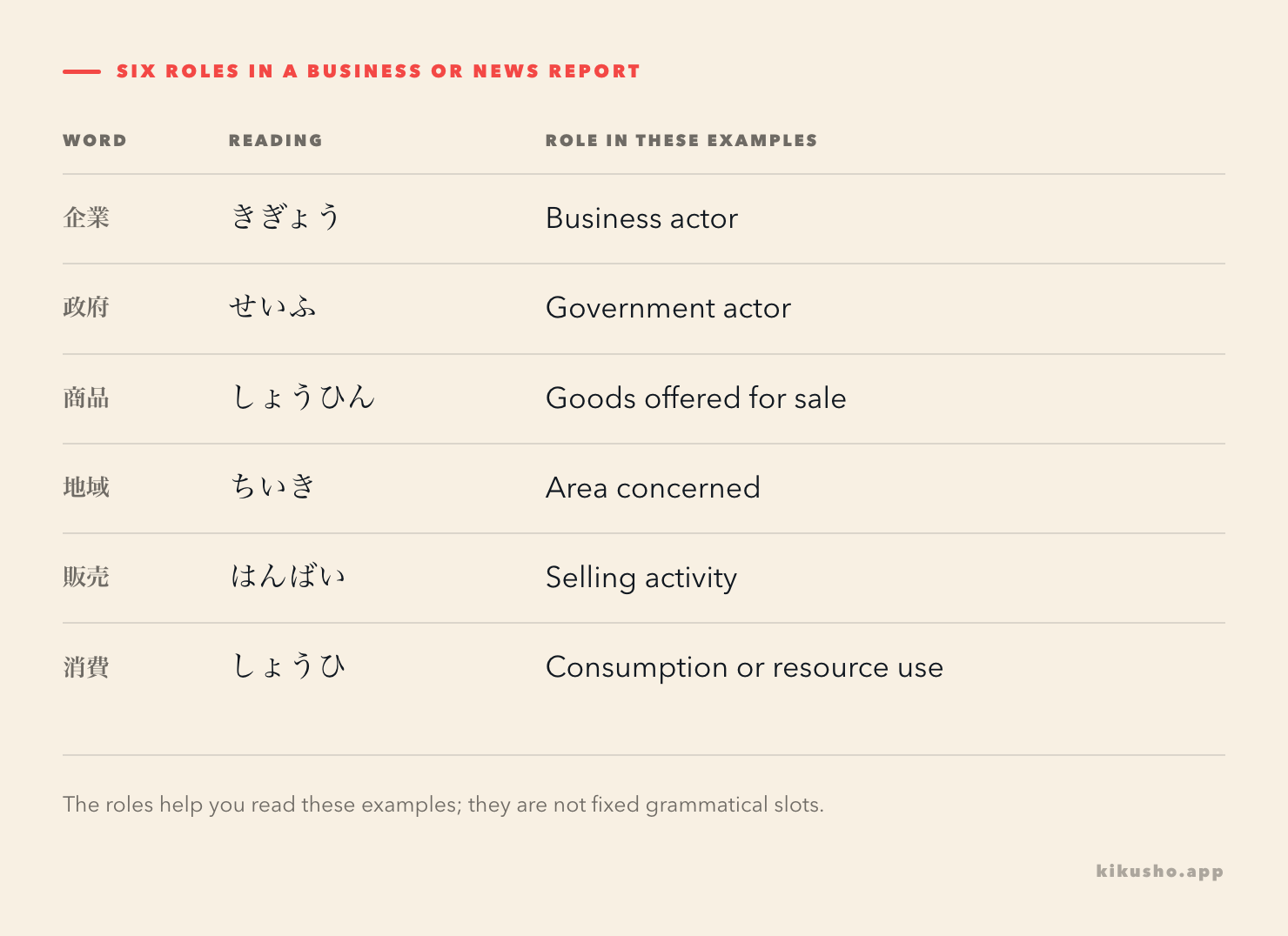
These roles are reading aids for the examples, not permanent grammatical slots. A business can act, be described, or receive support; an area can be the topic of a sentence too.
Keep the organisation, the goods and the area apart
企業 identifies a business organisation in the selected modern use. The dictionary also includes its business activity, so not every occurrence names a particular incorporated company. Do not automatically substitute “industry” as though the sentence meant an entire economic sector:
この企業は海外でも商品を販売している。
This business also sells goods overseas.
商品 identifies what is offered for sale. It need not be something the seller manufactured. The dictionary's broader definition includes services sold as products, so a physical object is a useful example rather than the word's absolute limit:
この店には、新しい商品が並んでいる。
New goods are on display in this shop.
政府 gives a different kind of actor:
政府は企業を支援している。
The government is supporting businesses.
The government and businesses occupy different roles here: 政府 supports, and 企業 receive that support. In Japanese usage, 政府 commonly refers to the cabinet and the administrative machinery it oversees; the dictionary also records a broader governing-system sense. The word does not identify a particular minister or establish that a proposal has become law. For those distinctions, the later legal and administrative vocabulary set separates public administration, proposed legislation and court events.
地域 supplies an area whose extent comes from the text. It can be your local area or a larger region; it does not automatically mean the whole country or an official administrative unit:
この地域には小さな企業が多い。
There are many small businesses in this area.
The phrase 地域の企業 then identifies businesses associated with that area. It does not tell you how many businesses exist nationally, nor whether they all sell the same 商品.
Selling and consumption describe different activities
You can use both action words as nouns or with する:
| Construction | What it expresses |
|---|---|
| 商品の販売 | The selling of goods, as a noun phrase |
| 商品を販売する | Sell goods, as an action |
| 電力の消費 | Electricity consumption, as a noun phrase |
| 電力を消費する | Consume or use electrical power, as an action |
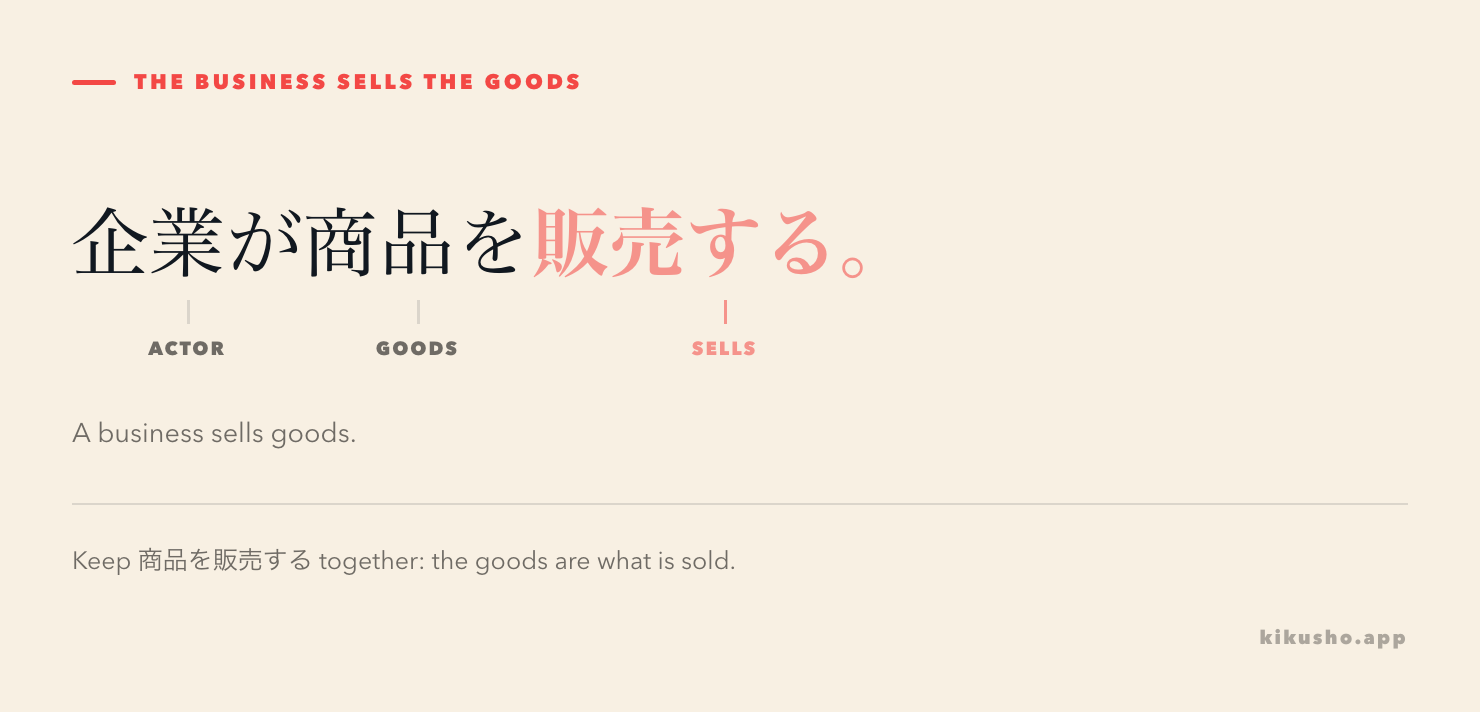
販売 reports selling, including ordinary full-price selling. English “sale” can suggest a price reduction, but that implication is absent from 販売 alone:
この店では、野菜を販売しています。
Vegetables are sold in this shop.
Nothing in this sentence says the vegetables are cheaper than usual. It also does not say when they first went on the market. Keep the actual selling claim separate from assumptions about the price or launch date.
消費 can report a resource being used:
この機械は電力を消費する。
This machine consumes electrical power.
This is about electricity use, not a shop making a sale. Meshclass's 消費 lesson independently illustrates the energy-use sense. The dictionary includes money, materials, energy and time among the resources that can be consumed.
In economic reporting, 個人消費 concerns individual or household consumption. The Kyodo news glossary's 消費 entry explains the spending-on-goods-and-services use. A report about 消費 is therefore not necessarily about people eating something or using up a physical product immediately. Read what is being consumed and which economic context the writer supplies.
Three sentences do not establish a cause
Here is a short invented report for reading practice:
地域の企業が新しい商品を販売している。
Businesses in the region are selling new goods.政府はこの地域の企業を支援している。
The government is supporting businesses in this region.電力の消費も増えている。
Electricity consumption is increasing too.
The first sentence puts the businesses in the actor role and the goods in the object role. The second names a different actor, 政府, and makes the businesses the recipients of support. The third makes electricity consumption what is increasing. It does not name a cause or say whose electricity use increased.
You can understand all three without concluding that government support caused new sales, or that those sales caused higher electricity use. Those may be questions to ask of a longer article. They are additional claims, not meanings built into these six words. The N3 formal-noun lesson adds words for checking information and expressing requests when you need to ask for that detail.
Use the N3 labels as a study order
The reference inventory assigns all six spelling-and-reading records to N3. Its two Waller-derived lists are one source family. Meshclass's inspected lesson pages also label 企業, 商品, 政府, 地域 and 販売 N3, as well as 消費 in the page linked above. No level disagreement was found for these selected records in the inspected references.
These are editorial study estimates, not an official exhaustive JLPT syllabus. Basic noun phrases, が・を・で and plain する are prerequisites. The lesson adds six words; it does not claim new advanced grammar for those familiar patterns.
A business report, a shop's product notice and a local-area announcement each give you reasons to recognise part of this set. A word's N3 label is not a promise that every sentence containing it will be easy. The N2 newsroom set follows a different topic: the reporter, article and activities involved in producing coverage.
If you meet 電力の消費 in a report on your iPhone, the share sheet can start a Kikusho capture. Before saving, edit the draft card so its example retains that electricity context and check しょうひ as the reading. Keeping “uses electrical power” helps the card test this encounter's meaning rather than leaving “expenditure” to suggest shopping when the report was about energy.
Practice
Attempt all eight prompts first. The numbered solutions sit together after the last prompt.
Question 1
What is the reading of the area noun 地域?
A. ちき
B. ちいき
C. ちえき
D. じいき
Question 2
Choose しょうひん meaning goods or merchandise offered for sale.
A. 賞品
B. 商晶
C. 商品
D. 商口
Question 3
Which noun names the business organisation that is doing the selling in “a business sells goods”?
A. 政府
B. 販売
C. 地域
D. 企業
Question 4
Choose the meaning of この店では、野菜を販売しています。
A. Vegetables are sold in this shop.
B. Vegetables are necessarily sold at a reduced price here.
C. The shop buys every vegetable it sells.
D. The shop consumes electricity but sells no vegetables.
Question 5
In この機械は電力を消費する, what does 消費する express?
A. The machine offers electricity for sale.
B. The machine is a government organisation.
C. The machine uses electrical power.
D. The machine is the name of a geographic area.
Question 6
A report needs to name the area containing several businesses. Which noun gives that geographic area in この( )には企業が多い?
A. 販売
B. 地域
C. 消費
D. 商品
Question 7
Which noun names the government actor in ( )は企業を支援している, when the intended meaning is “The government is supporting businesses”?
A. 商品
B. 消費
C. 地域
D. 政府
Question 8
Which sentence uses 販売する to report that this shop currently sells new goods, rather than a wish, denial or plan?
A. この店は、新しい商品を販売している。
B. この店は、新しい商品を販売したい。
C. この店は、新しい商品を販売していない。
D. この店は、新しい商品を販売する予定だ。
Make your final selections before reading on.
Answers and explanations
Answer 1. B. 地域 is ちいき. A drops one い, C substitutes え and D changes the initial consonant. The two い sounds belong to this word's reading.
Answer 2. C. 商品 names goods or merchandise offered for sale. 賞品 is a real homophone, しょうひん, meaning a prize. 商晶 and 商口 are not this headword's standard spelling. The commercial meaning decides between 商品 and 賞品.
Answer 3. D. 企業 names the business organisation. 販売 names its selling activity; 地域 the area; 政府 a government actor. Those nouns could occur in the same report without identifying that business.
Answer 4. A. 販売しています reports selling. B adds a reduced price, C adds an unreported claim about where the goods were obtained, and D denies the selling that the sentence states.
Answer 5. C. 電力を消費する describes using electrical power. It does not report a sale, classify the machine as a government body or identify an area. 消費 can concern energy, not only shopping or food.
Answer 6. B. 地域 names the area. 販売 and 消費 are activities; 商品 the goods. この地域には企業が多い says there are many businesses in this area without making a national claim.
Answer 7. D. 政府 names the government doing the supporting. The statement presents 企業 as what receives support. The other options do not supply the government actor required by the prompt.
Answer 8. A. 商品を販売している states current or ongoing selling. B says the shop wants to sell, C that it is not selling, and D that it plans to sell. All four are natural uses of the verb; only A makes the actual-selling claim requested here.
Common questions
Does 販売 mean a discounted sale?
販売 means selling. A sentence saying that a shop 販売している a product reports that it sells the product; the word alone does not establish a reduced price.
Is 消費 only about shopping?
No. 消費 can describe using resources such as electricity, fuel, money or time. In economic reports it can describe consumption of goods and services, with household spending a common focus. The surrounding noun tells you which use applies.
Is 地域 a fixed administrative unit?
In the ordinary area or region sense taught here, 地域 does not by itself name a city, prefecture or another fixed administrative unit. The report or surrounding phrase identifies the area concerned.