On this page
弟に手伝ってほしい means “I want my younger brother to help.” The speaker has the wish, but 弟, marked by に, is the person who performs the action: person に + verb て-form + ほしい.
That division is the key to the whole pattern. Before choosing a particle, ask two questions: who wants it, and who acts?
Put the actor before the action you want
The full frame is:
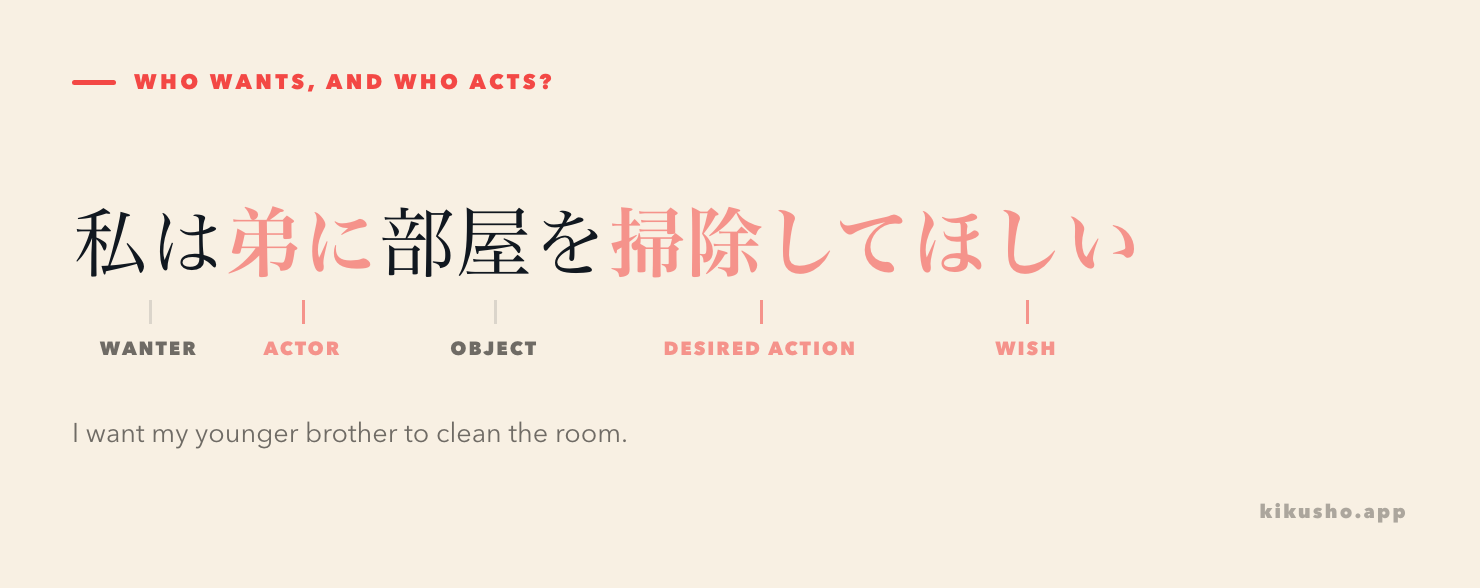
[wanter は] + [actor に] + [object を] + verb て-form + ほしい
私は弟に部屋を掃除してほしい。
わたしはおとうとにへやをそうじしてほしい。
I want my younger brother to clean the room.
The roles do not follow English word order automatically. 私は is the person who wants; 弟に is the person expected to act; 部屋を is the object of 掃除する.
The actor often disappears when the speaker is talking directly to that person:
もう少し待ってほしい。
もうすこしまってほしい。
I want you to wait a little longer.
Context supplies both the unspoken 私は and the listener marked by an unspoken あなたに. Japanese normally avoids saying あなた when the listener is already obvious, so the short sentence is more natural than filling every slot.
Do not move に onto a noun simply because that person appears near the verb. In 弟を手伝ってほしい, 弟を is the object of 手伝う: “I want you to help my brother.” In 弟に手伝ってほしい, 弟に is the actor: “I want my brother to help.” One particle changes who does the helping.
Separate three kinds of “want”
Japanese chooses a different shape depending on what is wanted and who would act.
| Meaning | Pattern | Example |
|---|---|---|
| want a thing | noun + がほしい | 水がほしい。 |
| want to do something yourself | verb stem + たい | 私は帰りたい。 |
| want another person to act | actor に + Vてほしい | 弟に来てほしい。 |
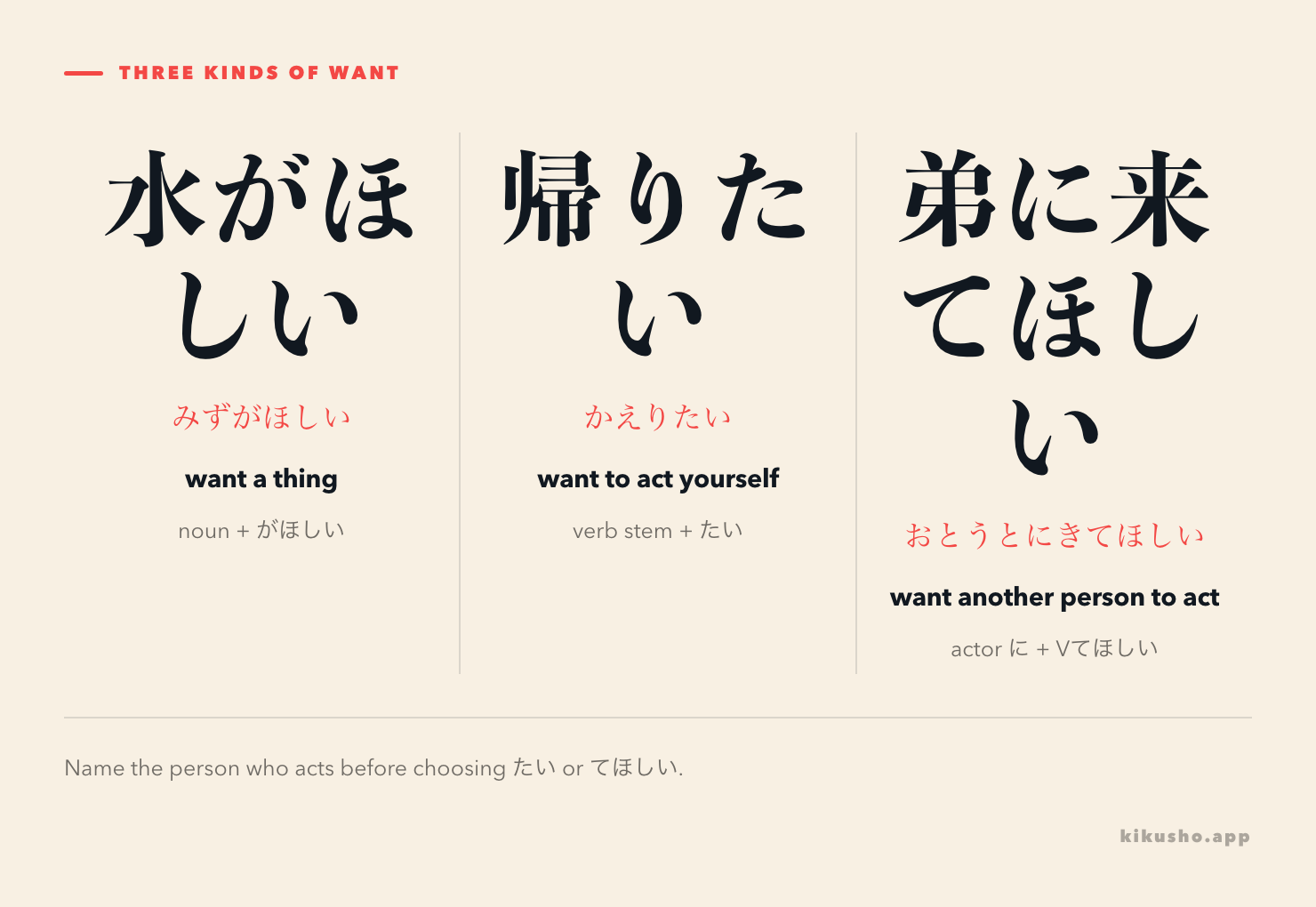
The ほしい and たい comparison establishes the first two rows. The ~たい lesson also explains why another person's desire cannot normally be asserted as though you had direct access to it. ~てほしい adds a different relationship: it still reports the speaker's wish, but the desired action belongs to someone else.
Compare the subjects of desire:
田中さんは来たいです。
たなかさんはきたいです。
Tanaka wants to come. (A report that needs context or evidence.)
私は田中さんに来てほしいです。
わたしはたなかさんにきてほしいです。
I want Tanaka to come.
The second sentence makes no claim about Tanaka's feelings. It reports the speaker's own wish and names Tanaka as the actor.
ほしい changes like an い-adjective
The verb before ほしい stays in the て-form. Tense and negation attach to ほしい, which follows the ordinary い-adjective pattern.
| Form | Japanese | Meaning |
|---|---|---|
| non-past affirmative | 来てほしい | want someone to come |
| non-past negative | 来てほしくない | do not want someone to come |
| past affirmative | 来てほしかった | wanted someone to come |
| past negative | 来てほしくなかった | did not want someone to come |
もっと早く教えてほしかった。
もっとはやくおしえてほしかった。
I wanted you to tell me sooner.
The past form locates the wish in the past. In context, this sentence often carries disappointment because the person did not tell the speaker sooner, but the grammar itself marks a past wish rather than proving what happened.
Adding です makes the ending grammatically polite: 来てほしいです. It does not turn the sentence into an honorific request, because the speaker is still presenting a personal desire directly.
Choose where the negative goes
Two negative forms are grammatical, and their scope differs.
ここには来ないでほしい。
ここにはこないでほしい。
I want you not to come here.
来ないで makes “not coming” the desired action. This is the clearest everyday pattern when you want someone not to do something: 触らないでほしい, “I want you not to touch it”; 忘れないでほしい, “I want you not to forget.”
ここには来てほしくない。
ここにはきてほしくない。
I do not want you to come here.
Here 来て remains positive and ほしい becomes ほしくない. The speaker denies having a wish for the person's coming. The practical result may be similar, but the grammar puts the negative in a different place. Do not build ✗来なくてほしい by joining the two patterns.
That distinction explains a frequent learner question without inventing a rigid English difference. Context and intonation can make the two sentences overlap. For reliable production, use Vないでほしい when the action itself should not happen, and recognize Vてほしくない as the negated-wish form.
A situation can be the thing you wish for
The desired event does not have to be a deliberate human action. With weather, availability or another state of affairs, が commonly marks the situation you hope will happen.
雨が早くやんでほしい。
あめがはやくやんでほしい。
I want the rain to stop soon.
駅の近くに店があってほしい。
えきのちかくにみせがあってほしい。
I hope there will be a shop near the station.
The rain is not a person receiving a request. 雨が belongs inside the wished-for event 雨がやむ, just as 店が belongs inside 店がある. This is why mechanically replacing every subject with に fails: use に for the person expected to act, but preserve the natural particles inside a desired event.
Direct wish or considerate request?
~てほしい describes what the speaker wants. In a close relationship, that can function naturally as a request:
明日、電話してほしい。
あした、でんわしてほしい。
I want you to call tomorrow.
It can also sound demanding when the listener has little freedom to refuse. 電話してほしいんだけど gives the listener more conversational space, but it still centers the speaker's wish. A question such as 電話してもらえますか, “Could I have you call?”, presents the action as a favor and explicitly asks about possibility.
| Relationship and purpose | Possible wording | Effect |
|---|---|---|
| close, direct | 少し待ってほしい。 | states the wish plainly |
| close, softened | 少し待ってほしいんだけど。 | leaves the sentence open for a response |
| neutral request | 少し待ってもらえますか。 | asks whether the favor is possible |
| formal request | ご確認いただきたいのですが。 | frames receiving the action humbly |
The favor-verb lesson explains why ~てもらう puts the receiver of the favor in the subject seat. That makes ~てもらいたい close in meaning to ~てほしい, but its viewpoint highlights receiving an action as a favor. With a superior, ~てほしいです can still sound like a polite-looking demand; choose a request form that fits the relationship and situation.
For a third person's observed desire, Japanese often uses ~てほしがっている, or reports the person's words with ~てほしいと言っている. At N4, the safest productive use is the speaker's own wish. Do not automatically put ~てほしい after someone else's name and treat their inner feeling as directly known.
Save the relationship, not just the ending
A flashcard containing only てほしい = want someone to hides the choice that causes mistakes. In Kikusho, save a complete line such as 私は弟に部屋を掃除してほしい, then keep the actor, action and relationship editable. Changing 弟に to 弟を should force a meaning check; changing a request to a teacher should force a register check.
That gives one captured sentence several useful reviews: identify who wants, mark who acts, form the て-form, and decide whether direct ほしい suits the listener. The stored sentence remains the evidence; your alternate versions become practice rather than unsupported translations.
Practice
Complete all seven questions before opening the answer block below.
Question 1. Choose the particle: 私は弟__部屋を掃除してほしいです。
- ア. が
- イ. に
- ウ. を
- エ. で
Question 2. Which sentence means “I want Tanaka to come”?
- ア. 田中さんが来たいです。
- イ. 田中さんに来てほしいです。
- ウ. 田中さんが来てあげます。
- エ. 田中さんを来てほしいです。
Question 3. Use 言う to write: “I want you not to say that.”
Question 4. Put the parts in order to mean “I wanted my friend to help me.”
- 手伝って
- 友達に
- ほしかったです
Question 5. You are writing a careful request to a department manager. Which option best fits?
- ア. これを確認してほしい。
- イ. これを確認してほしいです。
- ウ. これを確認しろ。
- エ. こちらをご確認いただきたいのですが。
Question 6. Choose the natural wish about the weather: “I want the rain to stop soon.”
- ア. 雨に早くやんでほしい。
- イ. 雨が早くやんでほしい。
- ウ. 雨を早くやみたい。
- エ. 雨が早くやんでたい。
Question 7. Choose the best expression for the connected text.
妹は来週引っ越します。私は妹に新しい住所を教えて__。手紙を送りたいからです。
- ア. たいです
- イ. ほしいです
- ウ. ほしがります
- エ. くれます
Answers and explanations
Answer 1. イ. に. The speaker marked by 私は has the wish, and the younger brother is the person expected to clean. 部屋を already marks what is cleaned.
Answer 2. イ. 田中さんに来てほしいです. The speaker wants, and Tanaka is the actor marked by に. ア attributes a desire to Tanaka; ウ describes a favor Tanaka will do; エ incorrectly marks the actor with を.
Answer 3. それを言わないでほしい. 言う becomes the negative 言わない, then adds でほしい. This makes “not saying that” the desired action. 言ってほしくない is also grammatical, but it negates the wish for saying it rather than building the requested negative-action form.
Answer 4. 友達に手伝ってほしかったです. 友達に marks the actor, 手伝って names the desired action, and ほしかった places the speaker's wish in the past.
Answer 5. エ. こちらをご確認いただきたいのですが. It frames the superior's checking as an action the speaker would humbly receive and leaves room for a response. イ has a polite ending but still states “I want you to check” directly; ア is casual and ウ is a command.
Answer 6. イ. 雨が早くやんでほしい. 雨が belongs to the desired event 雨がやむ. Rain is not a human actor being asked to do something, so actor に is unsuitable.
Answer 7. イ. ほしいです. The speaker wants the younger sister to provide her new address so a letter can be sent. 妹に is the actor and 教えて is her desired action. たい would make the speaker want to do the telling, while ほしがる would describe the sister's observed desire.
Why some sources place it at a different level
The Kikusho inventory follows the N4 placement used by JLPT Sensei and Bunpro. Some teaching sites group ~てほしい with N3 material instead. The official JLPT does not publish a complete grammar-point list, so these labels are study-guide classifications rather than official boundaries.
The construction itself is stable across the independently checked explanations from Tofugu and Mango Languages: attach ほしい to a verb's て-form, normally mark a human actor with に, and handle negative action, tense and register deliberately. Kikusho keeps the planned N4 placement while treating the て-form, い-adjective conjugation and basic ほしい/たい distinction as prerequisites.
Codex, an AI agent, checked the forms, particles, readings, translations, register contrasts and exercise answers against those sources and the saved curriculum inventory. No human language review is claimed.
Common questions
What does ~てほしい mean?
Verb て-form + ほしい means that the speaker wants another person to do that action, or wants an event to happen. 弟に来てほしい means “I want my younger brother to come.”
Which particle marks the person who should act with ~てほしい?
The actor normally takes に: 私は弟に手伝ってほしい. The speaker who has the wish is usually the topic, and can be omitted when context makes that person clear.
What is the difference between 来ないでほしい and 来てほしくない?
Both can reject someone's coming. 来ないでほしい directly presents “not come” as the desired action; 来てほしくない negates the wish for “come.” The first is usually the clearest way to ask or say that someone not come.
Is ~てほしい polite enough for a boss?
Adding です is grammatically polite, but the sentence still states your own wish directly. With a superior, a request such as ~てもらえますか or a context-appropriate ~ていただきたいのですが is often more considerate.