On this page
Use AなりBなり to offer A and B as workable examples, often with the message “pick one of these or something similar and act.” Use AもしくはB to connect explicit alternatives in formal Japanese without adding that open-ended push.
分からなければ、先生に聞くなり辞書で調べるなりしてください。
わからなければ、せんせいに きくなり じしょで しらべるなり して ください。
If you do not understand, ask the teacher, look it up in a dictionary, or take some such step.
質問は、電話もしくはメールで受け付けます。
しつもんは、でんわ もしくは メールで うけつけます。
We accept questions by phone or email.
The first speaker supplies examples of an adequate response and cares that something gets done. The second sentence formally names two contact methods. English “or” covers both, but their sentence roles and tone differ.
Ask whether the choices are examples or the stated alternatives
| Form | Status of A and B | Frequent continuation | Register |
|---|---|---|---|
| AなりBなり | representative, workable options; others may also fit | advice, request, command, suggestion | standard but can sound offhand |
| AもしくはB | the alternatives named by the statement | rule, description, instruction, classification | formal and mainly written |
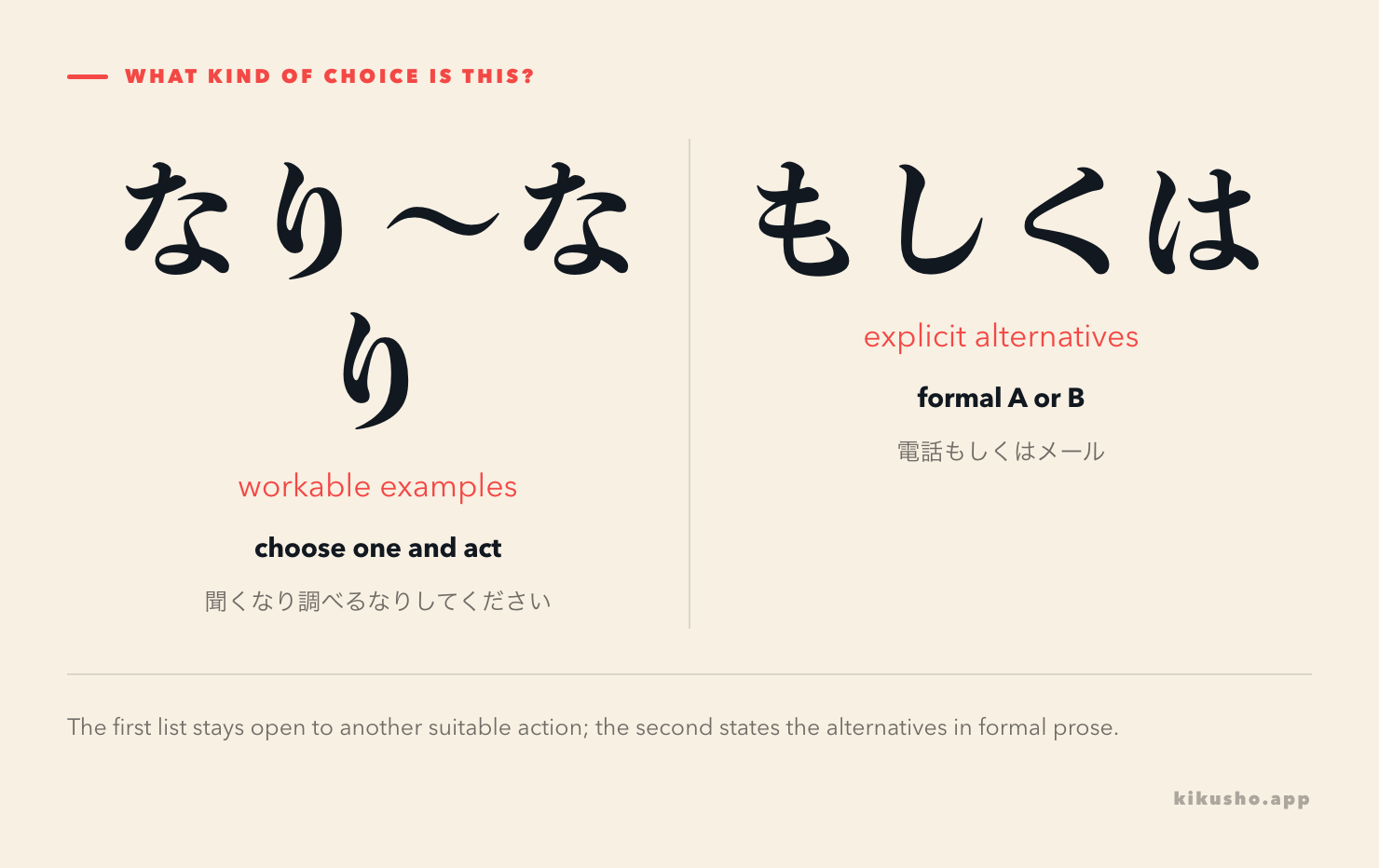
Try a deletion test. If the real message is “do something useful; these are two ideas,” なり~なり fits. If removing an option would change the choices allowed by a form, notice or definition, もしくは fits.
なり~なり offers workable examples
The paired pattern presents two examples from a broader set. The main clause often tells someone to choose a course of action.
疲れているなら、少し寝るなり散歩するなりしたらどうですか。
つかれているなら、すこし ねるなり さんぽするなり したら どうですか。
If you are tired, why not sleep for a while, take a walk, or do something along those lines?
Sleeping and walking are suggestions, not an exhaustive menu. The listener could choose another reasonable way to recover. The repeated なり carries the sense that either example would be acceptable.
使わない本は、売るなり人に譲るなりしてください。
つかわない ほんは、うるなり ひとに ゆずるなり して ください。
Please sell the books you do not use, give them to someone, or otherwise deal with them.
The speaker's priority is that the books stop sitting unused. This practical pressure explains why the form often appears with してください, しなさい, したらどうですか, すればいい or another directive.
Nouns attach directly; verbs use dictionary form
The two dependable shapes are NなりNなり and V dictionary form + なり + V dictionary form + なり.
| Option type | Pattern | Example |
|---|---|---|
| nouns | N1なりN2なり | 電話なりメールなり |
| actions | V1るなりV2るなり | 電話するなりメールするなり |
| list used as a means | N1なりN2なり + で | 電話なりメールなりで連絡する |
| action list before する | V1るなりV2るなり + する | 電話するなりメールするなりする |
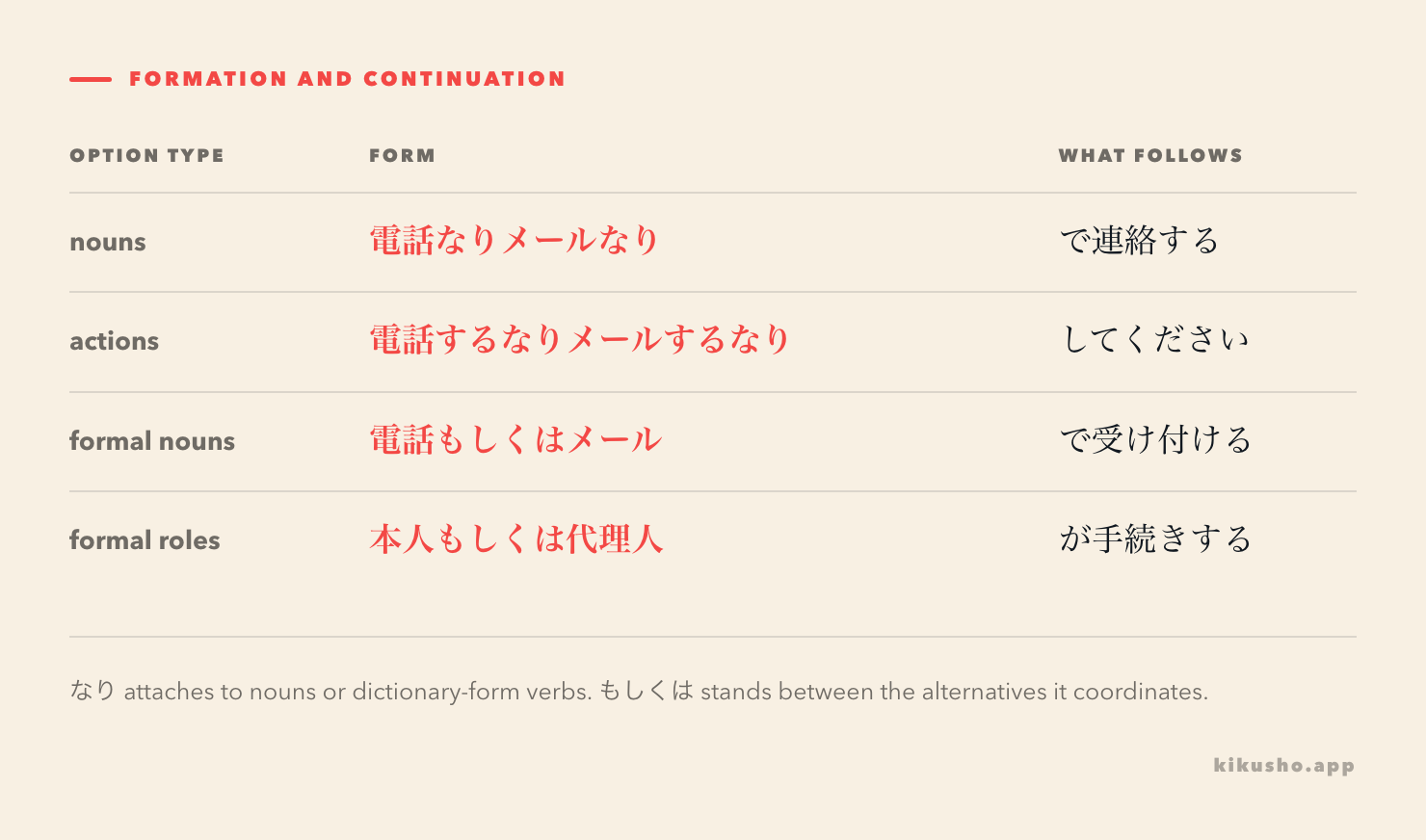
連絡は、電話なりメールなりでお願いします。
れんらくは、でんわなり メールなりで おねがいします。
Please contact us by phone, email, or another suitable method.
The means particle で follows the completed list. With verbs, keep the dictionary form: 聞くなり調べるなり, not ×聞いたなり調べたなり for this alternatives pattern.
Adjectives do not normally fill the two option slots. If you need to choose between qualities, use nouns or clauses with か, もしくは, または or another structure that matches the sentence.
The open list creates an interpersonal tone
Because なり~なり treats A and B as examples and often implies “anything appropriate is fine,” it can sound impatient:
何もしないで、手伝うなり片付けるなりしなさい。
なにも しないで、てつだうなり かたづけるなり しなさい。
Do not just stand there; help, tidy up, or do something.
The grammar is neutral about which option is selected, but the command is not neutral about inaction. This makes it natural from a parent to a child or among people who can speak directly. It is risky upward:
× 社長、電話するなりメールするなりしてください。
The sentence can sound as if the employee does not care which crude option the president chooses. A respectful request should name the acceptable route without that dismissive edge:
電話もしくはメールでご連絡いただけますでしょうか。
Would you be able to contact us by phone or email?
MLC explicitly notes that the “anything is fine, but do something” implication makes なり~なり difficult to direct at a superior. The hierarchy comes from the pragmatic frame, not from a special honorific rule inside なり.
もしくは states a formal alternative
もしくは is a conjunction meaning “or.” It can connect nouns, phrases or larger alternatives in careful writing.
申請者本人もしくは代理人が窓口にお越しください。
しんせいしゃ ほんにん もしくは だいりにんが まどぐちに おこしください。
The applicant or a representative should come to the counter.
参加費は現金もしくはクレジットカードで支払えます。
さんかひは げんきん もしくは クレジットカードで しはらえます。
The participation fee can be paid in cash or by credit card.
The connector does not imply that these are merely examples, and it does not tell the reader to take action by itself. The surrounding predicate supplies the rule, permission or instruction.
In ordinary conversation, か is lighter:
電話かメール、どっちがいい?
Which is better, phone or email?
もしくは belongs more naturally in forms, rules, contracts, formal descriptions and deliberately careful speech. または is also common in written instructions and often feels less marked. The でも, または, とか and など lesson separates explicit または alternatives from open suggestions and example lists.
Legal documents use もしくは as a grouping signal
In general prose, learners can read もしくは as a formal “or.” Statutes and contracts may apply a stricter drafting convention. When alternatives have two levels, 若しくは joins the smaller groups and 又は joins the larger groups.
The distinction is visible in a schematic structure:
(A若しくはB)又はC
A and B form the tighter pair; that pair is then offered as an alternative to C. Shogakukan's dictionary guidance records this large-group 又は versus small-group 若しくは convention. It is a reading aid for legal text, not a reason to manufacture nested legal syntax in an ordinary email.
Outside such drafting, AもしくはB simply presents a formal choice. The hiragana spelling is normal in general prose; legal text often uses the kanji 若しくは.
A formal connector does not automatically make the choice exclusive
もしくは presents alternatives, but context determines whether only one may be selected. A form that says いずれか一つ explicitly requires one choice. A notice that says questions are accepted by phone or email may merely list two available routes; using one does not make the other logically impossible forever.
Do not read English programming-language “OR” rules into every sentence. The document's instruction, the predicate and words such as どちらか, いずれか, 一つ or 両方 settle whether one or both can apply.
The same caution applies to なり~なり. It often expects one practical response, but its defining contribution is representative choice, not mathematical exclusivity.
The same options reveal the difference
Compare phone and email in three settings:
分からないことがあれば、電話するなりメールするなりしてください。
If something is unclear, call, email, or use another suitable way to ask.
The speaker proposes examples and wants the listener to make contact.
ご質問は、電話もしくはメールで受け付けます。
Questions are accepted by phone or email.
The institution formally names its channels.
電話またはメールでご連絡ください。
Please contact us by phone or email.
This is also an explicit instruction, with the more general written connector または. The difference between もしくは and または is mostly register in ordinary prose. In legislation, their grouping roles become precise.
The あるいは, 及び and それなら lesson adds another written “or” and separates choice from formal addition. If the list carries irritation or quotation-like attitude rather than proposing options, だの~だの and やれ~やれ organize it differently.
Do not confuse paired なり with immediate なり
The surface form also appears in V dictionary + なり, meaning that another event occurs immediately:
彼は帰宅するなり、ソファに横になった。
As soon as he got home, he lay down on the sofa.
That pattern has one initial action and one following event. Alternatives なり~なり repeats the marker around parallel options:
帰宅したら、休むなり食事するなりしてください。
When you get home, rest, eat, or do something appropriate.
The や否や, が早いか and なり lesson covers the immediate-sequence use. Count the option slots and inspect the main clause before translating.
N1 placement and reference evidence
JLPT Sensei, Bunpro, MLC and 日本語教師のN1et place the paired alternatives pattern at N1. These sources independently support direct noun or dictionary-form verb attachment, representative options and its frequent use before a directive.
JLPT Sensei's もしくは lesson places the connector at N1. Shogakukan's dictionary entry for 若しくは independently confirms its selection meaning, while its synonym guide identifies it as written language and distinguishes it from conversational か. N1 is a shared study estimate; the exam authority publishes no exhaustive grammar-item list.
For a Kikusho card, preserve the continuation after なり~なり so the card tests the push toward action. For もしくは, keep the surrounding rule or heading that establishes the alternatives. “Or” alone cannot train the difference between an open suggestion and a document's stated choice.
Practice
Decide first whether A and B are examples that prompt action or the formal alternatives named by the sentence. Then answer all seven tasks before opening the panel.
Question 1
Choose the pattern that offers two example actions and urges the listener to do something.
分からなければ、先生に( )辞書で( )してください。
ア. 聞くなり / 調べるなり
イ. 聞くもしくは / 調べるもしくは
ウ. 聞いたなり / 調べたなり
エ. 聞くなりに / 調べるなりに
Question 2
Complete the formal notice.
申請者本人__代理人が窓口にお越しください。
ア. なりに
イ. もしくは
ウ. なりの
エ. てから
Question 3
Which sentence places the means particle after the completed noun list?
ア. 電話でなりメールでなり連絡してください。
イ. 電話なりメールなりで連絡してください。
ウ. 電話なりでメールなり連絡してください。
エ. 電話もしくはでメールを連絡してください。
Question 4
Rewrite this impatient instruction with なり~なり: “Do not sit there doing nothing; help or tidy up.”
何もしないで、____。
Question 5
Which sentence is safer as a formal request addressed to a company president?
ア. 社長、電話するなりメールするなりしてください。
イ. 社長、電話なりメールなりしなさい。
ウ. お電話もしくはメールでご連絡いただけますでしょうか。
エ. 社長、何なり連絡してください。
Question 6
In a statute, how does (A若しくはB)又はC group the alternatives?
Question 7
Read the two sentences and explain why the forms are not interchangeable.
迷ったら、家族に相談するなり専門家に聞くなりしてください。
相談窓口は、電話もしくはオンラインで利用できます。
Answers and explanations
1.
ア. 聞くなり / 調べるなり. Alternatives なり~なり takes dictionary-form verbs and supplies representative actions before してください. もしくは is not attached separately after both verbs, and the past forms do not build this pattern.
2.
イ. もしくは. The notice formally coordinates the applicant and a representative as the people who may come. なり~なり would normally repeat and would add an open, offhand alternatives frame unsuitable here.
3.
イ. 電話なりメールなりで連絡してください. 電話なりメールなり forms the example list, and で then marks that complete list as the means of contact.
4.
One natural answer is 何もしないで、手伝うなり片付けるなりしなさい。 Both actions use dictionary form, and the directive makes the demand clear: choose a useful action rather than remain inactive.
5.
ウ. The polite predicate and formal もしくは state two contact routes without suggesting that any rough option will do. The two なり~なり commands sound offhand or directly authoritative toward the addressee.
6.
A and B form the smaller group; that group is the alternative to C. Legal drafting uses 若しくは inside the tighter choice and 又は for the larger connection. This specialized hierarchy is not required in ordinary prose.
7.
The first sentence gives consulting family and asking a specialist as workable examples; the central request is to seek help somehow. The second formally states the channels through which the service is available. Replacing もしくは with repeated なり would make an official access rule sound like an open suggestion, while a single もしくは in the first sentence would lose the “do one of these useful things” stance.
Common questions
What is the difference between なり~なり and もしくは?
AなりBなり gives workable examples and often urges the listener to choose one and act, while leaving other suitable options open. AもしくはB formally connects the stated alternatives and does not itself add a suggestion or command.
What forms can appear before なり~なり?
Use nouns directly or verbs in dictionary form: 電話なりメールなり and 電話するなりメールするなり. The following case particle commonly marks the completed list, as in 電話なりメールなりで連絡する.
Is もしくは used in conversation?
It is understandable in speech but sounds formal and written. Everyday conversation usually uses か, while instructions and ordinary formal writing often use または.
Can なり~なり sound rude?
Yes. It often implies that any workable option will do and appears with advice, requests or commands. Directed at a superior, that offhand framing can sound dismissive, so a direct polite request with か or もしくは is safer.