On this page
The twelve words in this N3 geography set are 泉(いずみ), 岩(いわ), 丘(おか), 沖(おき), 岸(きし), 砂漠(さばく), 大陸(たいりく), 谷(たに), 地平線(ちへいせん), 土(つち), 波(なみ) and 湾(わん). Learn them as a route: water rises from the ground, land rises and falls, then the route reaches the shore and looks out to sea.
Twelve nouns make one journey from land to sea
Every entry is a noun. 湾 also follows a place name as a noun-like suffix, as in 東京湾. The phrase in the last column is the smallest useful unit to keep with each word.
| Word | Reading | Core sense | Anchor phrase |
|---|---|---|---|
| 泉 | いずみ | natural spring; source | 泉から水が湧く, water wells from a spring |
| 岩 | いわ | rock; boulder | 大きな岩, a large rock |
| 丘 | おか | hill; raised ground | 丘の上, on the hill |
| 沖 | おき | offshore; open water | 沖に出る, head offshore |
| 岸 | きし | shore; bank | 岸に着く, reach the shore |
| 砂漠 | さばく | desert | 砂漠を横断する, cross a desert |
| 大陸 | たいりく | continent; large landmass | ユーラシア大陸, the Eurasian continent |
| 谷 | たに | valley | 深い谷, a deep valley |
| 地平線 | ちへいせん | land horizon | 地平線に沈む, set below the land horizon |
| 土 | つち | soil; earth; ground material | 土を掘る, dig the soil |
| 波 | なみ | wave | 波が高い, the waves are high |
| 湾 | わん | bay; gulf | 湾を囲む, surround a bay |
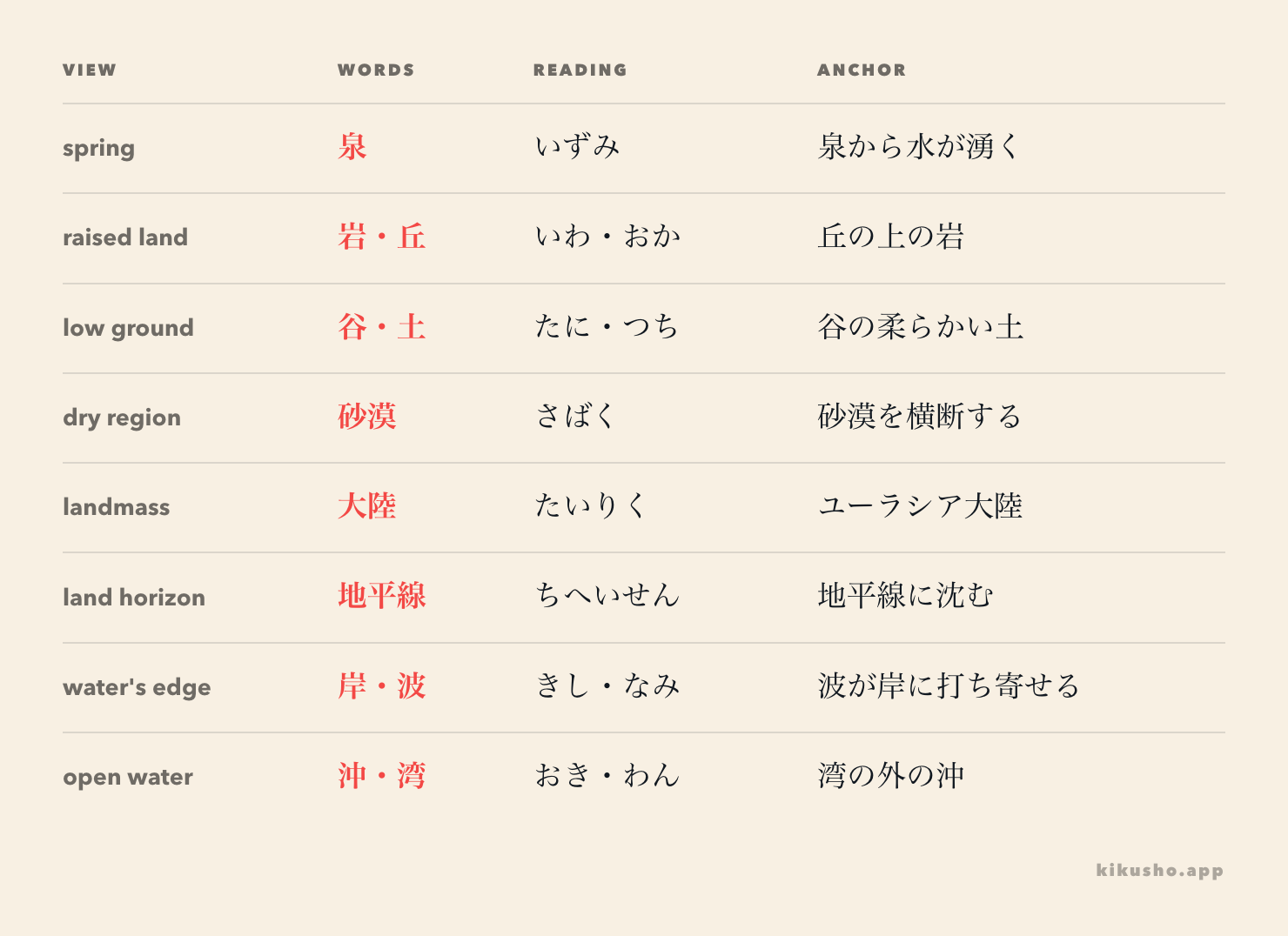
The readings above belong to these complete words. Place names can voice a reading or preserve another one, so 谷 may appear as だに in a name and 岸 as ぎし in 向こう岸(むこうぎし). Memorise the established name rather than applying a standalone reading mechanically.
The two open reference lists behind this curriculum place all twelve records at N3. Independent estimates overlap without drawing the same boundary: Bunpro places 泉, 岩, 丘, 岸, 谷, 大陸 and 湾 at N3, but puts 波 at N4 and leaves 沖 and 地平線 outside its numbered JLPT decks. Japanese Compass includes 大陸 and 砂漠 in its N3 geography group. The JLPT does not publish an exhaustive word-by-word syllabus. Here “N3” marks this lesson's study sequence; the verified reading and use of each noun are the durable part.
泉, 岩, 丘 and 谷 give the inland scene its shape
泉 is a place where groundwater naturally comes to the surface, or the water that emerges there. Kotobank's 泉 entry gives that physical sense and also records figurative sources such as 知識の泉, “a fountain of knowledge.” For a constructed fountain that sprays water, 噴水(ふんすい) is the ordinary precise noun.
森の中の泉から、冷たい水が湧いている。 もりの なかの いずみから、つめたい みずが わいている。 Cold water is welling from a spring in the forest.
岩 is a mass of hard rock, often large enough to be part of the landscape. 石(いし), taught in the N4 landscape lesson, more readily names a separate stone that you can pick up. The boundary is a tendency, not a measurement. A large 石 can appear in an established name, while a broken piece of 岩 does not change vocabulary at a fixed diameter.
谷の入口に大きな岩がある。 たにの いりぐちに おおきな いわが ある。 There is a large rock at the entrance to the valley.
丘 is gently raised ground, lower and less imposing than the usual image of 山. 丘の上 is the stable phrase to learn. 谷 is the long depression between higher areas, often cut or occupied by a river. The Geospatial Information Authority's landform guide describes shallow valleys as land lower than their surroundings and valley-bottom plains as flat land shaped by river deposition.
丘の上から、川が流れる谷を見下ろした。 おかの うえから、かわが ながれる たにを みおろした。 I looked down from the hill at the valley through which a river flows.
The geometry is simple: a 丘 rises; a 谷 lies between higher ground. The words can occur in the same view without being opposites in every technical classification.
土 is material, while 地面 is a surface
土 is soil or earth as a material. You dig it, put plants in it, get it on your shoes and describe it as wet or dry. It can also mean the land under you, but the material sense is the clearest anchor.
雨の後で土が柔らかくなった。 あめの あとで つちが やわらかく なった。 The soil became soft after the rain.
地面(じめん), covered in the N2 continuation, presents the physical surface underfoot. You can therefore say 地面の土, “the soil on the ground,” without repeating one idea. Kotobank's 土 entry records both soil and the surface of the land, but ordinary collocations still reveal which view matters.
| If the sentence focuses on... | Prefer | Example |
|---|---|---|
| soil as material | 土 | 土を掘る, dig the soil |
| the surface underfoot | 地面 | 地面に座る, sit on the ground |
| a geographic area | 土地 | 土地を買う, buy land |
砂漠 is not simply “a place made of sand.” It is an extremely dry region where little vegetation grows; exposed rock and gravel can dominate. Kotobank's geographic definition explicitly includes sandy, gravel and rocky deserts. The alternative spelling 沙漠 exists, but 砂漠 is the form to recognise first.
この砂漠では、昼と夜の気温差が大きい。 この さばくでは、ひると よるの きおんさが おおきい。 In this desert, the temperature difference between day and night is large.
大陸 and 地平線 require a wider field of view
大陸 names a vast landmass. It is larger in scale than an island or peninsula and appears in proper names such as アフリカ大陸 and 南極大陸. Kotobank's 大陸 entry notes that geography conventionally counts six continents in Japanese reference works; the way some school systems divide Europe and Asia is a classification convention, not a change in the word's reading.
飛行機で大陸を横断するのに十時間以上かかった。 ひこうきで たいりくを おうだんするのに じゅうじかん いじょう かかった。 It took more than ten hours to cross the continent by plane.
地平線 is the apparent line where open land meets the sky. 水平線(すいへいせん) is the corresponding line across water. Kotobank defines 地平線 through open land and 水平線 through the sea and sky. In astronomy, the terminology can be broader, but the land-versus-water test is reliable for everyday description.
砂漠の地平線に太陽が沈んだ。 さばくの ちへいせんに たいようが しずんだ。 The sun set on the desert horizon.
At the coast, the visible line changes with your viewpoint. Looking over the water gives you 水平線. Looking across a broad plain gives you 地平線. 海岸線(かいがんせん) is different again: it is the coastline traced where land and sea meet on a map or in the landscape.
岸, 波, 沖 and 湾 divide the coastal view
Stand on the edge of the water and the four nouns occupy different places.
- 岸 is the land at the water's edge. It can border a sea, river or lake.
- 波 is the moving rise and fall on the water's surface.
- 沖 is the water away from the shore, viewed from land or measured offshore.
- 湾 is a body of sea that curves into and is partly enclosed by land.
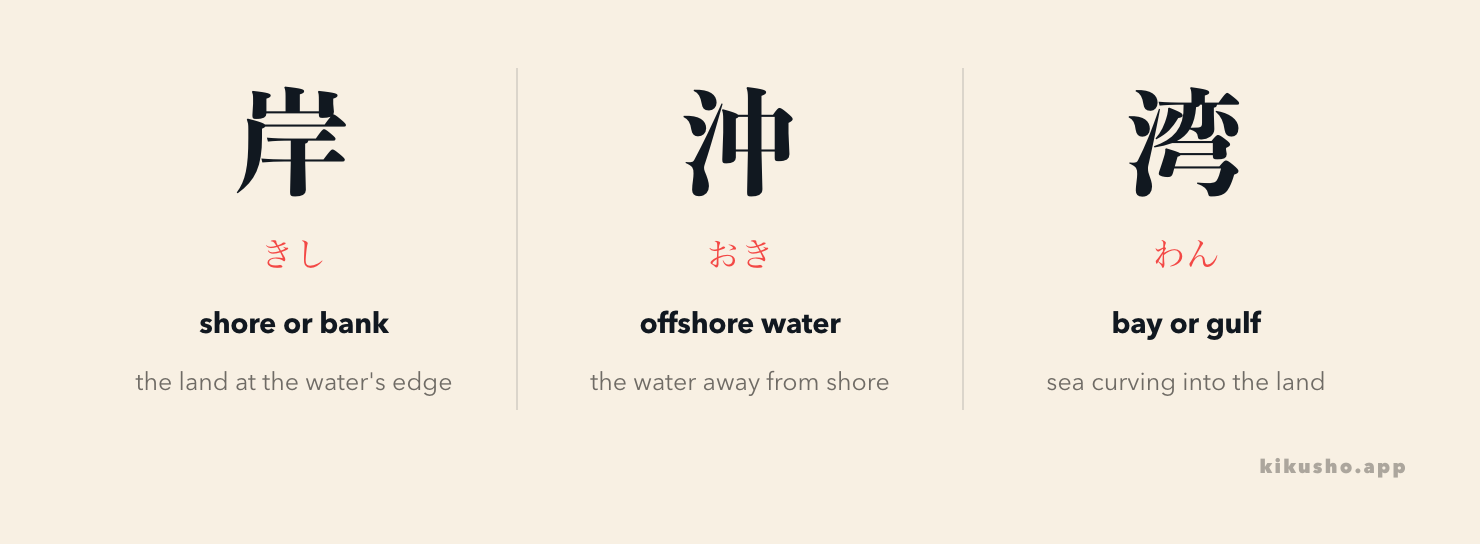
Kotobank defines 岸 as land touching a sea, river or lake. Its 湾 entry defines a bay as sea extending into the land. That makes 岸 an edge and 湾 an area of water; they are not two sizes of the same feature.
船は岸を離れ、沖に出た。 ふねは きしを はなれ、おきに でた。 The boat left the shore and headed offshore.
湾の内側は波が比較的穏やかだった。 わんの うちがわは なみが ひかくてき おだやかだった。 The waves inside the bay were relatively calm.
沖 often follows a distance: 海岸から五キロ沖, “five kilometres offshore.” 岸 combines with direction and arrival: 向こう岸, the opposite bank, and 岸に着く, reach shore. 波 combines with height and motion: 波が高い, 波が岸に打ち寄せる. These frames make the map recoverable even when English uses the broad words “sea” and “coast.”
The N1 geography lesson adds 河川, 崖, 山脈, 地形 and 浜 for technical descriptions of the same system. Keep the levels connected without treating any estimate as a ban on learning a useful earlier word.
A route sentence makes every boundary visible
Read this short description once for the journey, then again for the nouns.
大陸の内陸部には広い砂漠があり、遠くの地平線まで乾いた土が続いている。丘を越えると、岩の多い谷に泉が湧いていた。川に沿って岸まで進むと、湾の外の沖には高い波が見えた。
たいりくの ないりくぶには ひろい さばくが あり、とおくの ちへいせんまで かわいた つちが つづいている。おかを こえると、いわの おおい たにに いずみが わいていた。かわに そって きしまで すすむと、わんの そとの おきには たかい なみが みえた。
Inside the continent lies a broad desert, and dry soil continues to the distant horizon. Beyond a hill, a spring wells up in a rocky valley. Following the river to the shore, high waves can be seen offshore beyond the bay.
The passage does not use twelve interchangeable labels. 土 is what covers the desert surface. 地平線 closes the land view. 岸 is the point reached, 湾 is the enclosed water nearby, and 沖 lies beyond it. The relationships do the remembering.
For a Kikusho card, capture the link that places the noun on the map: 泉から水が湧く, 丘から谷を見下ろす, 船が沖に出る. The predicate becomes a retrieval cue for both meaning and position.
Practice without revealing the route
Question 1 · say the compound
Read 地平線 aloud. Select the established form.
- A. じへいせん
- B. ちひらせん
- C. ちへいせん
- D. じひらせん
Question 2 · spelling
Which spelling matches さばく, “desert”?
- A. 砂漠
- B. 砂湾
- C. 土漠
- D. 沙岸
Question 3 · inland context
Fill the blank: 山と山の間に深い( )がある。
- A. 湾
- B. 谷
- C. 沖
- D. 岸
Question 4 · material or surface
You are repotting a plant and need to add more soil. Choose the line a gardener could say.
- A. 鉢に土を入れます。
- B. 鉢に地平線を入れます。
- C. 鉢に沖を入れます。
- D. 鉢に湾を入れます。
Question 5 · the coastal sequence
A boat leaves the shore and travels into open water. Which sentence expresses that movement?
- A. 船は沖を離れて岸に出た。
- B. 船は岸を離れて沖に出た。
- C. 船は湾を掘って土に着いた。
- D. 船は波を越えて丘に湧いた。
Question 6 · the horizon test
You are looking across a broad desert at the line where land seems to meet the sky. Which word fits?
- A. 水平線
- B. 海岸線
- C. 地平線
- D. 岸
Question 7 · paraphrase
Which statement best paraphrases 湾の内側は波が穏やかだ?
- A. The soil inside the valley is dry.
- B. The waves inside the bay are calm.
- C. A spring rises beyond the continent.
- D. The opposite bank is a desert.
Question 8 · connected passage
Read: 丘を越えると岩の多い谷があり、その奥の泉から水が流れていた。 What is the scene?
- A. Beyond a hill is a rocky valley, with water flowing from a spring farther in.
- B. A boat crosses a bay while waves reach the shore.
- C. Dry soil extends across a continent to the horizon.
- D. A river disappears into the open sea five kilometres offshore.
Answers and explanations
Answer 1. Choose C, ちへいせん. The first kanji is read ち in this compound, and 平線 becomes へいせん. None of the other strings is an established reading of 地平線.
Answer 2. Choose A, 砂漠. 沙漠 is an attested alternative spelling, but that option is not present. The other choices combine characters into words that do not mean “desert.”
Answer 3. Choose B, 谷. A valley lies between higher ground. 湾 is a bay, 沖 is offshore water, and 岸 is the edge of land beside water.
Answer 4. Choose A, 鉢に土を入れます. 土 is soil as material, which can be put into a plant pot. The other nouns name a horizon, offshore water and a bay.
Answer 5. Choose B, 船は岸を離れて沖に出た. 岸 supplies the shore that the boat leaves; 沖 supplies the offshore water it enters. Choice A reverses the route, while C and D assign impossible actions to the geography nouns.
Answer 6. Choose C, 地平線. Open land meets the sky at the 地平線. 水平線 belongs to the view across water, 海岸線 is the coastline, and 岸 is the waterside edge itself.
Answer 7. Choose B. 湾 is the bay, 内側 locates its inside, 波 names the waves, and 穏やか describes them as calm. No soil, valley, spring, continent or opposite bank appears in the sentence.
Answer 8. Choose A. 丘 is the hill crossed, 岩の多い describes a place with many rocks, 谷 is the valley, and 泉 is the spring from which water flows. The other choices introduce coastal or desert details absent from the passage.
Common questions
How do you read 泉, 岩, 丘, 沖, 岸, 砂漠, 大陸, 谷, 地平線, 土, 波 and 湾?
The readings are 泉(いずみ), 岩(いわ), 丘(おか), 沖(おき), 岸(きし), 砂漠(さばく), 大陸(たいりく), 谷(たに), 地平線(ちへいせん), 土(つち), 波(なみ)and 湾(わん).
What is the difference between 沖 and 岸?
岸 is the edge of the land beside a sea, river or lake. 沖 is the water away from that edge, viewed from the shore or measured offshore. A boat can leave 岸 and head 沖へ or 沖に出る.
What is the difference between 地平線 and 水平線?
地平線 is the apparent boundary between land and sky across open ground. 水平線 is the corresponding line across a sea or other broad body of water. Both can translate as horizon, so the surface in view decides the word.
Does 砂漠 mean a desert must be covered in sand?
No. 砂漠 is a very dry region with little vegetation; its surface may be sand, gravel or exposed rock. 砂 is present in the spelling, but sand is not a requirement for every desert.