On this page
The eight N4 landscape words in this lesson are 石(いし), 砂(すな), 坂(さか), 林(はやし), 森(もり), 湖(みずうみ), 島(しま) and 海岸(かいがん). Together they let you follow a route from stones and slopes inland to woods, a lake, an island and the coast.
The complete eight-word route
These are all nouns. Keep each reading with one short collocation so that the word already has a place in a sentence.
| Word | Reading | Core sense | Natural phrase |
|---|---|---|---|
| 石 | いし | stone | 石を拾う, pick up a stone |
| 砂 | すな | sand | 砂の上, on the sand |
| 坂 | さか | slope; hill road | 坂を上る, go up a slope |
| 林 | はやし | woods; stand of trees | 林を通る, pass through the woods |
| 森 | もり | forest | 森に入る, enter a forest |
| 湖 | みずうみ | lake | 湖のほとり, by the lake |
| 島 | しま | island | 島に渡る, cross over to an island |
| 海岸 | かいがん | coast; seashore | 海岸を歩く, walk along the coast |
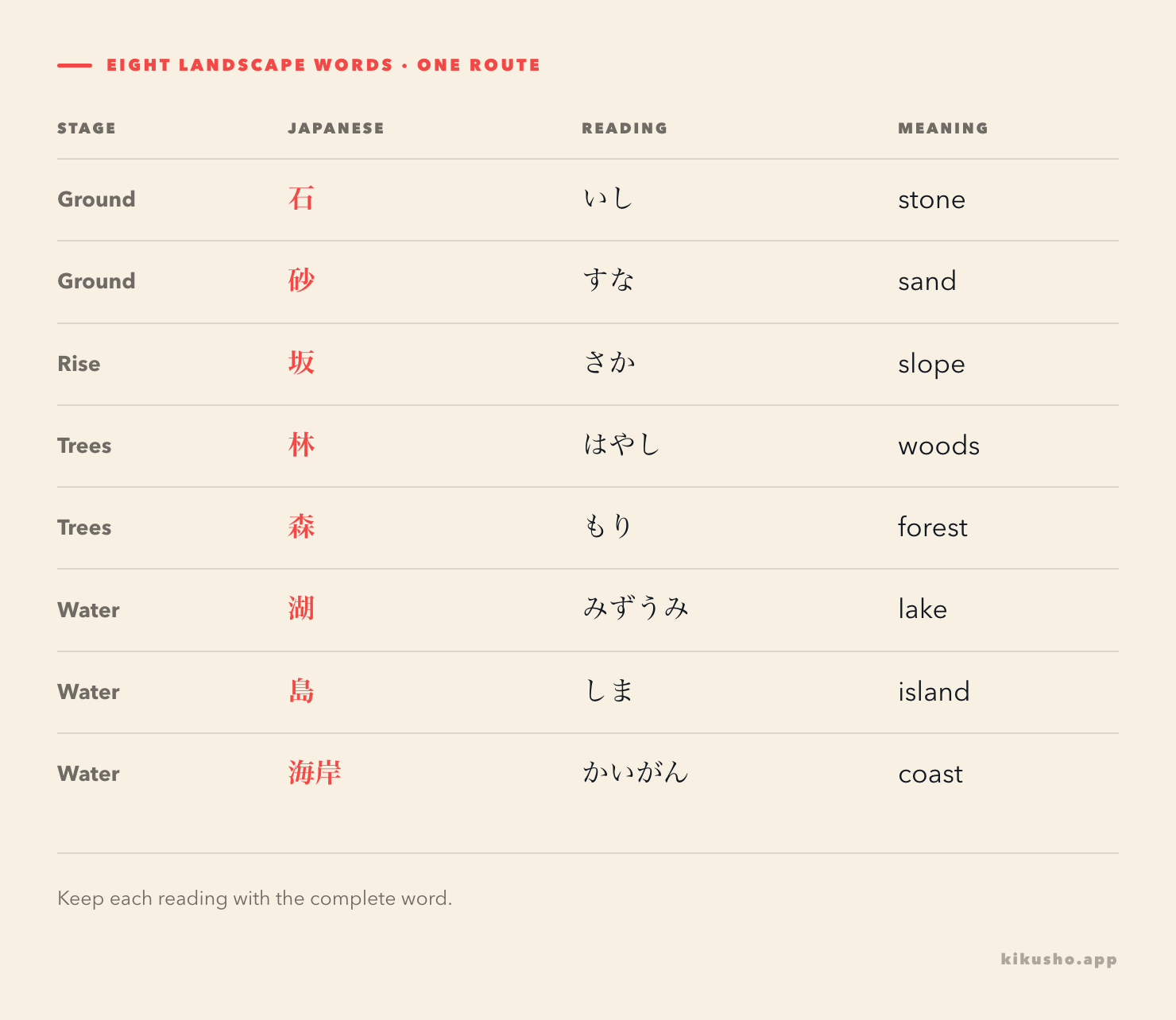
The readings above are standalone vocabulary readings. A kanji may sound different in another word or name: 島 is しま by itself, but it can become じま in a place name. Learn the complete name rather than forcing the standalone reading into it.
The open JLPT reference lists behind this curriculum place these eight records at N4. Japanesetest4you independently confirms the headwords 石(いし), 海岸(かいがん) and 森(もり). Because the test makers provide no complete word-by-word syllabus, “N4” here is a practical study placement rather than an official boundary.
石, 砂 and 坂 describe the ground
石 is a stone: a separate hard piece you can see, touch or pick up. 砂 is the mass of tiny grains underfoot. The nouns can meet in the same place without becoming interchangeable.
海岸で白い石を拾いました。 かいがんで しろい いしを ひろいました。 I picked up a white stone on the coast.
靴の中に砂が入りました。 くつの なかに すなが はいりました。 Sand got inside my shoes.
坂 names an incline or sloping road. It does not name the whole mountain. Use 坂を上る for going up the slope and 坂を下る for going down it.
この坂を上ると、湖が見えます。 この さかを のぼると、みずうみが みえます。 When you go up this slope, you can see the lake.
The noun after を is the space traversed in these phrases. The same pattern appears in 林を通る and 海岸を歩く.
林 and 森 overlap, but the picture changes
Both 林 and 森 can be translated as “forest.” In ordinary descriptions, 林 often brings to mind woods or a stand of trees, while 森 more readily suggests thick growth or a forest. That tendency helps you form a first picture, but it is not a scientific size test.
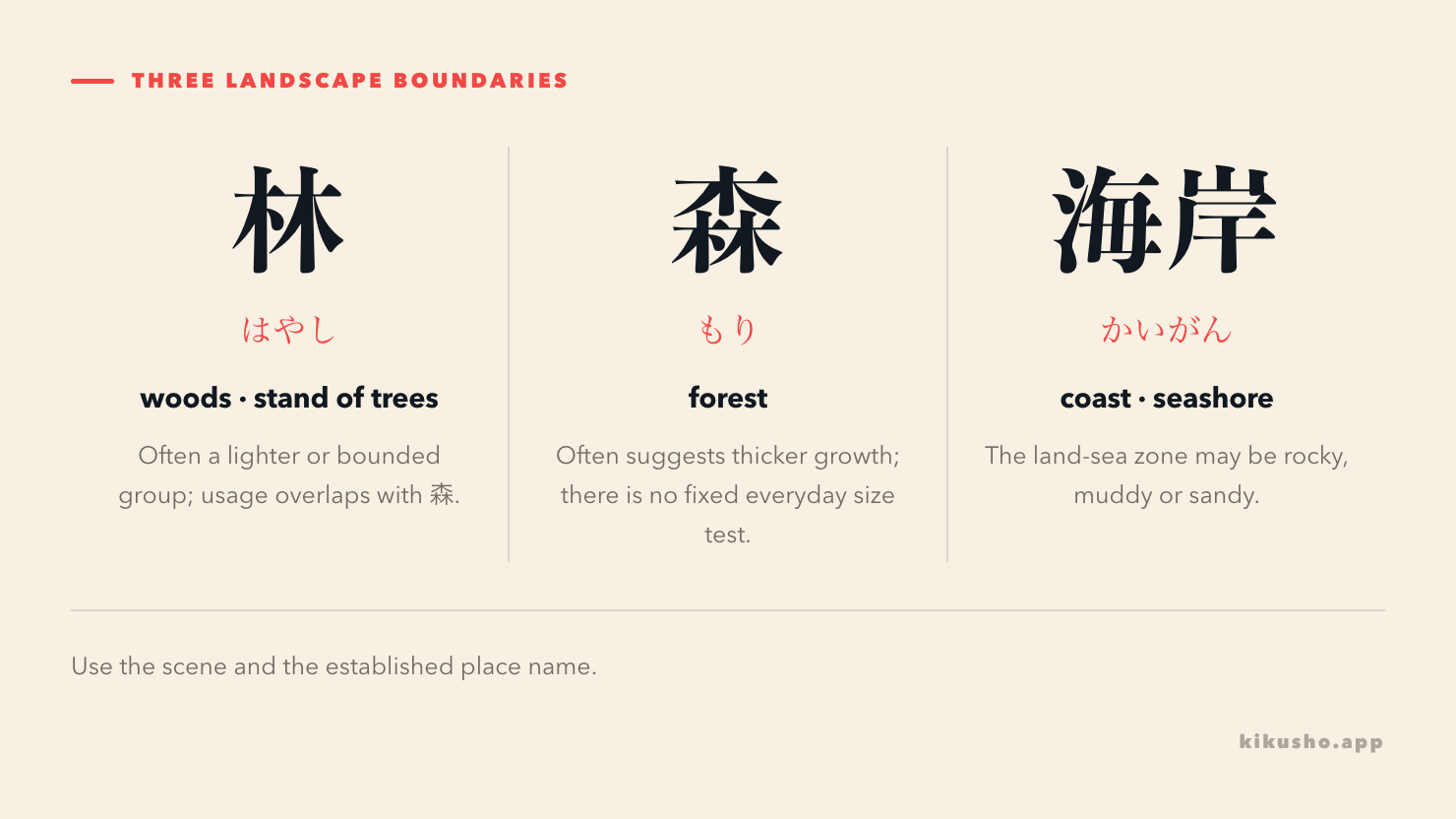
Kanjipedia defines 林 as a place where trees grow together over a broad area. Kotobank's 森 entry describes a place where trees grow thickly and also records historical distinctions between 森 and 林. Modern names and technical compounds do not obey one simple bigger-versus-smaller rule, so choose from the scene and the established name.
駅の後ろに小さな林があります。 えきの うしろに ちいさな はやしが あります。 There is a small wood behind the station.
朝早く森に入りました。 あさ はやく もりに はいりました。 I entered the forest early in the morning.
The earlier lesson on N4 animals, plants and living things supplies the creatures and plants you might find in these places. Here the focus stays on the landscape itself.
湖, 島 and 海岸 locate water and land
湖 is a lake: water held in a depression and surrounded by land. It is ordinarily larger and deeper than 池(いけ), the N5 word for a pond. Kanjipedia's 湖 entry states that everyday contrast directly, while the N5 nature lesson reviews 池 together with river, sea and mountain.
湖のほとりで昼ご飯を食べました。 みずうみの ほとりで ひるごはんを たべました。 We ate lunch by the lake.
島 is land surrounded by water. With a movement verb, 島に渡る means to cross over to an island. The Japan Foundation's Irodori materials use both この島には、大きい森があります and island descriptions in beginner travel contexts, showing how naturally these words combine.
海岸 is the coastal zone where land meets the sea. It does not promise sand. Kotobank defines 海岸 as the area where land touches the sea and notes rocky, muddy and sandy kinds of coast. Use 砂浜(すなはま) when a sandy beach is the point.
島の海岸をゆっくり歩きました。 しまの かいがんを ゆっくり あるきました。 We walked slowly along the island's coast.
One connected landscape
Read the whole route once without stopping at every noun.
朝、坂を上って林を通りました。森を出ると、大きな湖が見えました。午後は船で島に渡り、海岸を歩きました。砂の上にきれいな石があったので、一つ拾いました。
あさ、さかを のぼって はやしを とおりました。もりを でると、おおきな みずうみが みえました。ごごは ふねで しまに わたり、かいがんを あるきました。すなの うえに きれいな いしが あったので、ひとつ ひろいました。
In the morning, I went up a slope and passed through some woods. When I came out of the forest, I could see a large lake. In the afternoon, I crossed to an island by boat and walked along the coast. There was a pretty stone on the sand, so I picked one up.
The passage changes each noun's role. 坂, 林 and 海岸 are routes marked by を; 湖 is what becomes visible; 島 is the destination marked by に; and 砂の上 locates the stone. The location and direction lesson gives more practice with spatial relationships.
When one of these words appears on a map, travel page or sign, save the full phrase in Kikusho. A card for 森に入る recalls a destination, while 林を通る recalls a route. That small piece of context makes two overlapping English glosses easier to keep apart.
The N1 geography lesson moves from these everyday scene words to the technical register of 河川, 山脈 and 地形, and also compares a flat 浜 with a steep 崖.
Practice the landscape route
Question 1 · reading
How do you read 湖 when it means “lake”?
- A. みずうみ
- B. うみ
- C. しま
- D. はやし
Question 2 · spelling
Which kanji is すな, “sand”?
- A. 石
- B. 坂
- C. 島
- D. 砂
Question 3 · choose the landscape
Complete the sentence: 木がたくさんある( )を通りました。 The speaker passed through some woods.
- A. 海岸
- B. 林
- C. 湖
- D. 砂
Question 4 · choose the precise word
A guide says the entire zone where land meets the sea is rocky. Which word still fits?
- A. 海岸
- B. 砂
- C. 湖
- D. 坂
Question 5 · route meaning
What movement does 島に渡りました describe?
- A. I crossed over to an island.
- B. I went down a slope.
- C. I walked around a lake.
- D. I entered a forest.
Question 6 · use 坂
Which sentence naturally means “When you go up this slope, you can see the lake”?
- A. この石を拾うと、湖が見えます。
- B. この坂を上ると、湖が見えます。
- C. この森に入ると、砂が見えます。
- D. この島に渡ると、林を拾います。
Question 7 · follow the route
The sentence is 林を通って湖へ行き、そのあと島の海岸を歩きました。 Select its route.
- A. Woods → lake → island coast
- B. Island → slope → sandy beach
- C. Lake → stone → forest
- D. Coast → pond → woods
Question 8 · contrast
Which explanation is accurate?
- A. Every 海岸 is a sandy beach.
- B. 林 and 森 have a fixed legal size boundary in ordinary speech.
- C. 湖 ordinarily names a larger, deeper body of water than 池.
- D. 坂 names an entire mountain.
Answers and explanations
Solution 1
The correct reading is A, みずうみ. This is the standalone noun “lake.” うみ is 海, しま is 島, and はやし is 林.
Solution 2
D. 砂. 砂 is すな, “sand.” 石 is stone, 坂 is a slope, and 島 is an island.
Solution 3
B. 林. 林を通る means to pass through woods or a stand of trees. 海岸 is the coast, 湖 is a lake, and 砂 is sand.
Solution 4
A. 海岸. A 海岸 is the coastal zone where land meets the sea, whether its surface is rocky, muddy or sandy. 砂 names the material sand; 湖 and 坂 describe different landforms.
Solution 5
A. I crossed over to an island. 島 is “island,” and に marks it as the destination of 渡りました. The other choices require 坂, 湖 or 森 and different verbs.
Solution 6
B. この坂を上ると、湖が見えます。 坂を上る is “go up a slope,” and 湖が見える is “the lake is visible.” The other choices either change the landscape or combine a noun with an unsuitable action.
Solution 7
A. Woods → lake → island coast. The route first passes through 林, goes to 湖, then walks along the 海岸 of an 島. No slope, stone or pond appears.
Solution 8
C. 湖 ordinarily names a larger, deeper body of water than 池. 海岸 is not limited to sand, 林 and 森 overlap without a fixed everyday measurement, and 坂 is a slope rather than a whole mountain.
Common questions
How do you read 石, 砂, 坂, 林, 森, 湖, 島 and 海岸?
The standalone readings are 石(いし), 砂(すな), 坂(さか), 林(はやし), 森(もり), 湖(みずうみ), 島(しま)and 海岸(かいがん). Readings can change inside compounds and place names, so learn each complete word you meet.
What is the difference between 林 and 森?
Both can describe a place where many trees grow. 林 often suggests woods or a stand of trees, while 森 commonly suggests denser growth or a forest. Actual names and technical terms overlap, so this is a useful tendency rather than a fixed size rule.
What is the difference between 湖 and 池?
湖(みずうみ)is a lake surrounded by land and is ordinarily larger and deeper than 池(いけ), a pond. The everyday distinction is useful, although it is not a universal numerical boundary.
Does 海岸 always mean a sandy beach?
No. 海岸(かいがん)is the coast or seashore where land meets the sea. A coast may be rocky, muddy or sandy; 砂浜(すなはま)is the more precise word for a sandy beach.