On this page
These thirteen N3 Japanese conflict, danger and security words separate opposition from battle, a frightening quality from the feeling of fear, and a military force from the objects and events described around it. The set ends with 平和, because news and history writing use the same vocabulary to describe conflict, its effects and efforts to stop it.
Thirteen records divide people, actions, objects and outcomes
| Word | Reading | Word class | Meaning here | Phrase to remember |
|---|---|---|---|---|
| 争う | あらそう, arasou | transitive/intransitive godan verb | dispute; contest; compete | 優勝を争う: compete for the championship |
| 恐ろしい | おそろしい, osoroshii | i-adjective | frightening; terrible; astonishing | 恐ろしい事故: a terrible accident |
| 核 | かく, kaku | noun; compound element | nucleus; core; nuclear | 核兵器: nuclear weapon |
| 恐怖 | きょうふ, kyōfu | noun; suru verb | fear; terror | 恐怖を感じる: feel fear |
| 軍 | ぐん, gun | noun; compound element | army; military force | 軍が撤退する: the force withdraws |
| 軍隊 | ぐんたい, guntai | noun | organised armed force; troops | 軍隊を派遣する: dispatch troops |
| 攻撃 | こうげき, kōgeki | noun; transitive suru verb | attack; offensive; criticism | 攻撃を受ける: come under attack |
| 銃 | じゅう, jū | noun | gun; firearm | 銃を持つ: carry a gun |
| 戦う | たたかう, tatakau | intransitive godan verb | fight; battle; struggle | 敵と戦う: fight an enemy |
| 弾 | たま, tama | noun | bullet; shot; shell | 銃に弾を込める: load a gun |
| 爆発 | ばくはつ, bakuhatsu | noun; intransitive suru verb | explosion; eruption; sudden outburst | ガスが爆発する: gas explodes |
| 武器 | ぶき, buki | noun | weapon; a powerful means | 武器を捨てる: lay down weapons |
| 平和 | へいわ, heiwa | noun; na-adjective | peace; harmony | 平和を守る: protect peace |
Kikusho's September 2026 audit maps these thirteen written forms and readings to this N3 lesson. Eleven have no internal level conflict. 争う appears at N3 and N2, while 核 appears at N3 and N1; the disagreeing files share Waller/Tanos ancestry, so they show uncertain placement within one source family. A current N3 emergencies and safety list confirms recurring demand for this territory. The JLPT publishes item types but no exhaustive current word list, so these levels organise study rather than certify future exam content.
The N4 conflict and safety lesson provides 戦争, 危険, 怖い, 逃げる, 安全 and 安心. This lesson adds the actors, actions and objects that occur in more detailed reports.
争う contests a claim or result; 戦う faces an opponent
争う(あらそう) presents two sides in opposition. They may argue over ownership, challenge a claim or compete for one result. Common frames include:
- 優勝を争う: compete for the championship
- 遺産をめぐって争う: dispute an inheritance
- 法廷で争う: contest a matter in court
- 一秒を争う: every second counts; time is critical
二つのチームが最後まで優勝を争った。
ふたつのチームがさいごまでゆうしょうをあらそった。
The two teams competed for the championship until the end.
戦う(たたかう) frames direct fighting, battle or a sustained struggle. The opponent commonly takes と: 敵と戦う, fight an enemy; 強い相手と戦う, face a strong opponent. Abstract difficulties can also become adversaries: 病気と戦う, fight an illness.
選手たちは強い相手と戦い、決勝に進んだ。
せんしゅたちはつよいあいてとたたかい、けっしょうにすすんだ。
The athletes fought against strong opponents and advanced to the final.
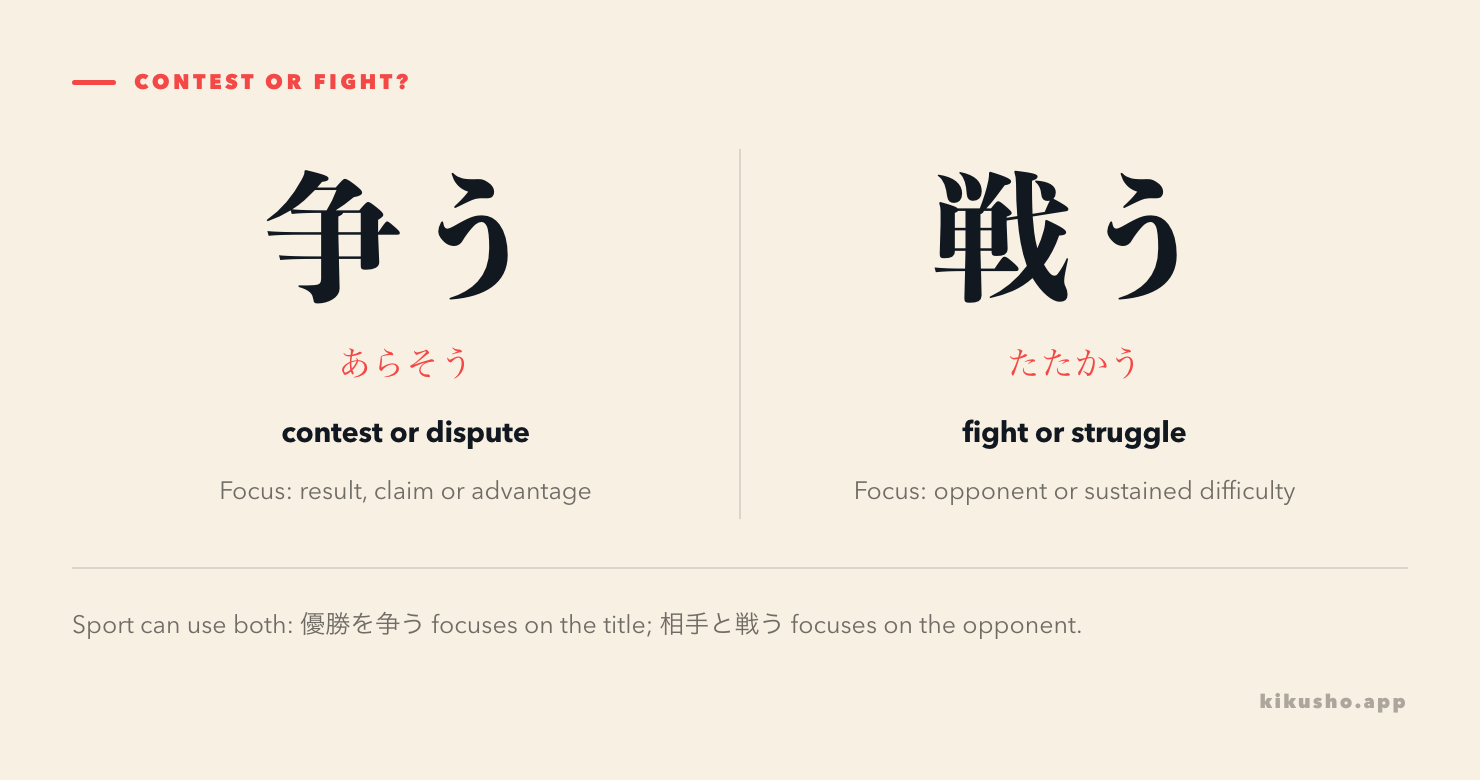
The 争う entry covers conflict, quarrelling and competition, while 戦う covers physical battle, competition and struggle for an aim. The boundary can overlap in sport: teams 優勝を争う when the title is at stake and 相手と戦う when the opponent is in focus. The spelling 闘う is also common for a personal or nonmilitary struggle, but the assigned record here is 戦う.
恐ろしい describes; 恐怖 names the fear
恐ろしい(おそろしい) is an i-adjective. It can describe something that causes fear or something terrible in scale: 恐ろしい音, a frightening sound; 恐ろしい事故, a terrible accident. Like other i-adjectives, it becomes 恐ろしくない, not frightening, and 恐ろしかった, was frightening.
遠くから恐ろしい爆発音が聞こえた。
とおくからおそろしいばくはつおんがきこえた。
A frightening explosion sound was heard from far away.
The word also marks an astonishing degree, even without literal fear: 恐ろしいほど正確だ, astonishingly accurate. The dictionary entry records both danger-based fear and an extreme degree.
恐怖(きょうふ) is the noun fear or terror. It fits actions that a feeling can undergo or cause:
- 恐怖を感じる: feel fear
- 恐怖を与える: cause fear
- 恐怖に耐える: endure fear
- 恐怖を乗り越える: overcome fear
住民は突然の攻撃に恐怖を感じた。
じゅうみんはとつぜんのこうげきにきょうふをかんじた。
Residents felt fear at the sudden attack.
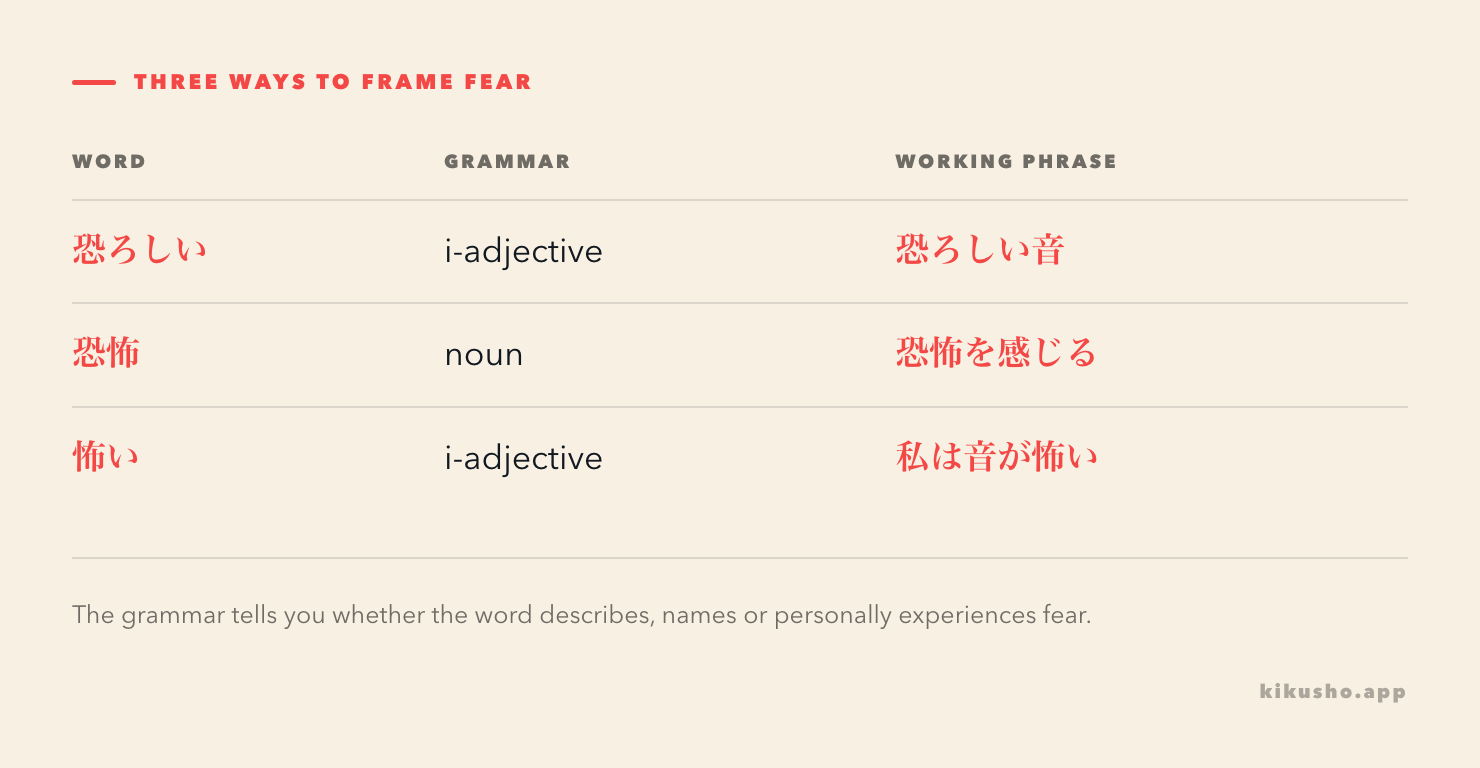
The N4 word 怖い(こわい) often expresses an immediate personal reaction: 私は銃の音が怖い, I am afraid of gunfire. 恐ろしい more readily evaluates the thing as dreadful or formidable, and 恐怖 packages fear as a noun. These are tendencies rather than three sealed meanings.
軍 is compact; 軍隊 explicitly names the organisation
軍(ぐん) can stand alone for an army or military force: 軍を率いる, lead an army; 軍が撤退する, the force withdraws. It also builds many compounds: 軍人, service member; 軍事, military affairs; 陸軍, army; 海軍, navy. It can even label a side or team outside war, as in 東軍, eastern team.
軍隊(ぐんたい) explicitly names an organised armed force or its troops. 軍隊に入る means join the armed forces; 外国の軍隊, a foreign military force. The 軍 reference includes the force, armed conflict and competitive team senses, while the 軍隊 entry centres on the organised armed body.
両国の軍は国境付近から撤退し、軍隊の衝突は避けられた。
りょうこくのぐんはこっきょうふきんからてったいし、ぐんたいのしょうとつはさけられた。
Both countries' forces withdrew from the border area, and a clash between the armed forces was avoided.
The nouns overlap when they point to the same organisation. 軍 is shorter and more productive inside compounds; 軍隊 makes the organisational meaning explicit.
武器, 銃 and 弾 move from category to component
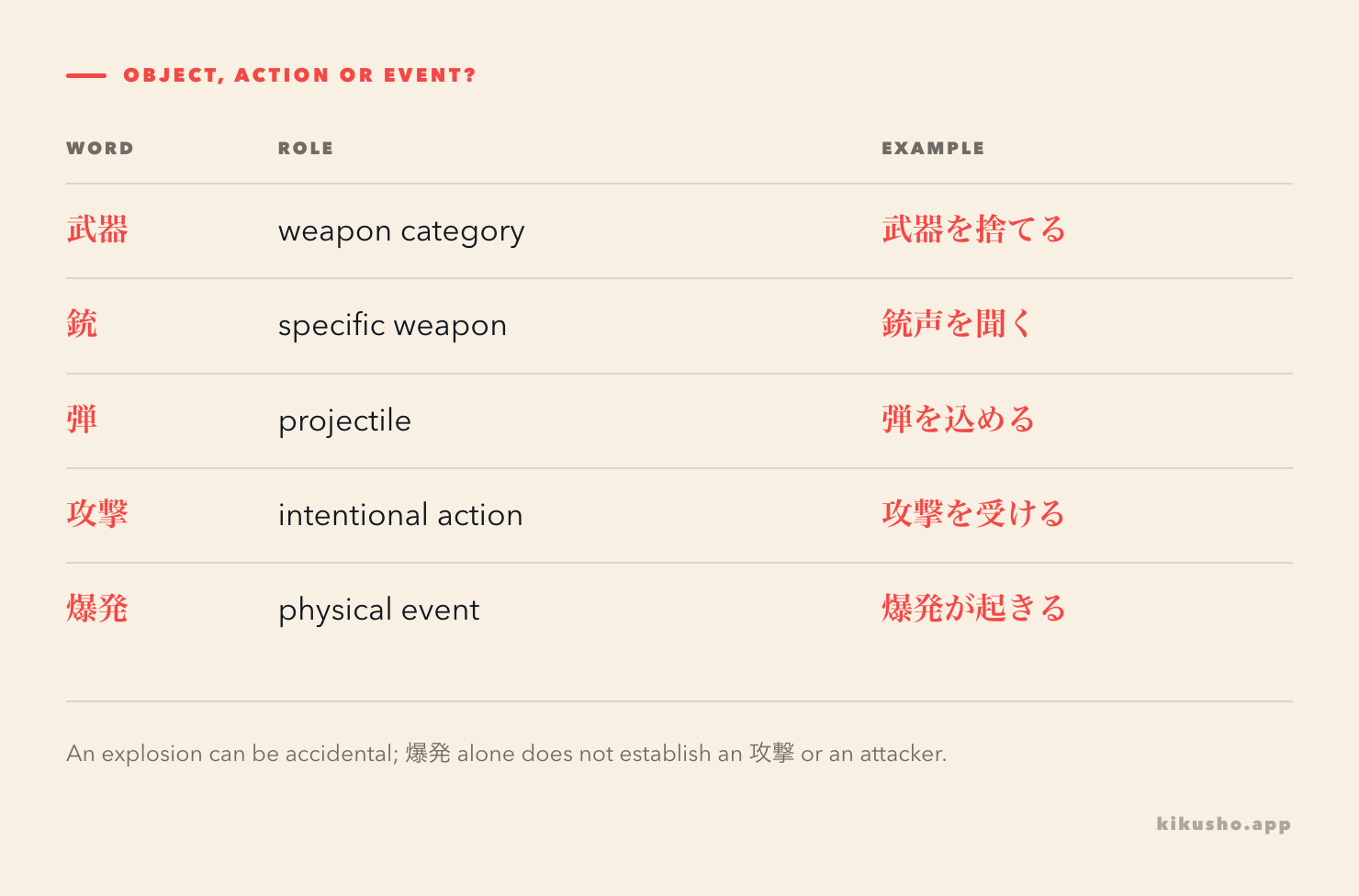
武器(ぶき) is the broad category: an object used to attack or defend. It includes more than firearms. The word also extends metaphorically to an effective skill or advantage: 語学力を武器にする, use language ability as a strength. The 武器 definition records both the literal weapon and powerful-means senses.
銃(じゅう) is a gun or firearm, one kind of 武器. Common compounds include 拳銃(けんじゅう), handgun, and 小銃(しょうじゅう), rifle. 銃を撃つ means fire a gun; 銃声 is the sound of gunfire.
弾(たま) is a bullet, shot or shell: the projectile fired rather than the weapon. The native reading appears in 弾を込める, load ammunition, and 弾が当たる, a bullet hits. The same kanji changes to だん in compounds such as 弾丸(だんがん), bullet, and 爆弾(ばくだん), bomb. The dictionary record lists both たま and the on-reading だん.
博物館には、昔の武器や銃、使われなかった弾が展示されている。
はくぶつかんには、むかしのぶきやじゅう、つかわれなかったたまがてんじされている。
Old weapons, guns and unfired ammunition are displayed in the museum.
This context keeps the three nouns visible without treating them as synonyms.
核 means a centre before context selects “nuclear”
核(かく) begins with a core or nucleus. Science uses 細胞核, cell nucleus, and 原子核, atomic nucleus. Groups can have 組織の核, the core of an organisation. In security reporting, 核 often abbreviates the nuclear sense in compounds such as 核兵器, nuclear weapon; 核実験, nuclear test; and 核廃絶, nuclear abolition.
各国の代表は核兵器を減らすための会議に参加した。
かっこくのだいひょうはかくへいきをへらすためのかいぎにさんかした。
Representatives from several countries attended a conference to reduce nuclear weapons.
The 核 entry records fruit stones, cell and atomic nuclei, nuclear weapons, geographical cores and figurative centres. Translate it only after reading the compound: 核 alone does not always mean a weapon.
攻撃 is an action; 爆発 is an event
攻撃(こうげき) is an attack carried out against a target. It can be military, verbal or competitive: 敵を攻撃する, attack the enemy; 個人攻撃, personal attack; 攻撃に転じる, go on the offensive. The target takes を with 攻撃する, while the receiving side 攻撃を受ける, comes under attack. The dictionary records military attack, criticism and sports offence.
爆発(ばくはつ) is an explosion or sudden outburst. It can be caused deliberately, accidentally or naturally, so the noun alone does not name an attacker: ガスが爆発する, gas explodes; 火山が爆発する, a volcano erupts; 爆発が起きる, an explosion occurs. Emotion can also burst out: 不満が爆発する, frustration erupts. The 爆発 entry records both the physical event and the emotional extension.
工場で爆発が起きたが、警察は攻撃ではなく事故だと発表した。
こうじょうでばくはつがおきたが、けいさつはこうげきではなくじこだとはっぴょうした。
An explosion occurred at the factory, but police announced that it was an accident, not an attack.
The event is 爆発; its cause remains a separate question. The N3 law and public-order lesson supplies 事件, 捜査 and 被害 for reports that continue into an investigation.
平和 can describe a world, a period or an ordinary day
平和(へいわ) means peace or harmony. In public language, 世界平和, world peace; 平和を守る, protect peace; and 平和条約, peace treaty, concern the absence or ending of war. As a na-adjective, it can also describe calm daily life: 平和な町, a peaceful town; 平和な一日, an uneventful peaceful day.
市民は武器のない平和な社会を願った。
しみんはぶきのないへいわなしゃかいをねがった。
Citizens hoped for a peaceful society without weapons.
The 平和 definition includes calm harmony and the condition in which there is no war. Context decides whether the word describes international relations, social harmony or simply a quiet day.
A news summary connects all thirteen records
国境付近で二つの軍が争い、軍隊どうしの戦いに発展した。住民は恐ろしい銃声と爆発音を聞き、強い恐怖を感じた。一方の軍は攻撃を停止し、兵士に武器を置くよう命じた。現場では銃や弾が回収された。各国は核兵器を使用しないよう求め、平和を取り戻すための交渉を始めた。
Two forces came into conflict near the border, and it developed into fighting between their troops. Residents heard frightening gunfire and explosions and felt intense fear. One force stopped its attack and ordered its soldiers to lay down their weapons. Guns and ammunition were recovered at the scene. Other countries called for nuclear weapons not to be used and began negotiations to restore peace.
The summary uses 争う for the conflict between sides and 戦い for the resulting fight. 恐ろしい modifies sounds, 恐怖 names the feeling, and 軍, 軍隊, 武器, 銃 and 弾 move from organisation to equipment. 核 appears inside 核兵器, while 平和 gives the negotiations their goal.
The N1 conflict and security lesson continues with 争い, the いくさ reading of 戦/軍, three threat-and-fear verbs, crisis response, public security, defence and evacuation.
Complete every question before revealing the solutions
1 · Reading. Select the pronunciation of 恐怖.
A. きょうぶ
B. きょうふ
C. こうふ
D. きょふ
2 · Standalone reading. In 銃に弾を込める, how is 弾 read?
A. だん
B. ひき
C. たま
D. がん
3 · Orthography. Choose the kanji for ばくはつ in ガスがばくはつした。
A. 爆発
B. 暴発
C. 爆髪
D. 暴髪
4 · Contest or fight. Complete: 二つのチームは優勝を___、決勝で強い相手と___。
A. 戦い / 争った
B. 争い / 戦った
C. 攻撃し / 爆発した
D. 恐怖し / 平和だった
5 · Adjective or noun. Choose the natural pair: ___音を聞き、___を感じた。
A. 恐怖な / 恐ろしい
B. 恐ろしい / 恐怖
C. 恐ろしな / 恐怖い
D. 恐怖の / 恐ろしさを
6 · Force vocabulary. Which statement is accurate?
A. 軍隊 only means a sports team.
B. 軍 cannot appear inside compounds.
C. 軍 is compact and productive in compounds, while 軍隊 explicitly names an organised armed force.
D. 軍 and 軍隊 both mean a bullet.
7 · Category and component. Which sequence moves from broad category to specific weapon to projectile?
A. 武器 → 銃 → 弾
B. 弾 → 平和 → 軍
C. 攻撃 → 軍隊 → 恐怖
D. 核 → 争う → 銃
8 · The many senses of 核. Which sentence does not require the nuclear-weapons meaning?
A. 核兵器を減らす。
B. 核実験に反対する。
C. 彼はチームの核として活躍した。
D. 核廃絶を求める。
9 · Action or event. A gas leak causes an accidental explosion. Which description is safest before an investigation establishes a cause?
A. 攻撃が爆発を命令した。
B. 爆発が起きた。
C. 軍隊が平和を弾した。
D. 恐怖が銃を争った。
10 · Extended meaning. What does 語学力を武器にする mean here?
A. use language ability as a powerful advantage
B. turn a dictionary into ammunition
C. attack everyone who speaks another language
D. join an armed force to study languages
11 · Peace. Which phrase naturally means “protect peace”?
A. 平和を守る
B. 平和を爆発する
C. 平和に弾を込める
D. 平和が軍を恐ろしい
12 · Connected meaning. 攻撃を停止し、平和を取り戻すための交渉を始めた。 What happened?
A. They began an attack after peace talks ended.
B. They stopped the attack and began negotiations to restore peace.
C. They loaded ammunition because the town was quiet.
D. They treated an accidental explosion as a sports contest.
Answers and explanations
- 恐怖 matches B: きょうふ; the noun means fear or terror.
- C. Standalone 弾 is read たま here. The reading だん appears in compounds such as 弾丸 and 爆弾.
- A. 爆発 is ばくはつ. The distractors replace one or both kanji with characters that share part of the sound.
- B. The teams contest the championship with 優勝を争う and face an opponent with 相手と戦う.
- B. 恐ろしい is an i-adjective modifying 音; 恐怖 is a noun that takes を with 感じる.
- C. 軍 can stand alone and forms compounds such as 軍事 and 海軍. 軍隊 explicitly presents the organised armed force.
- A. 武器 is the broad weapon category, 銃 is one kind of weapon, and 弾 is the projectile fired from it.
- C. チームの核 means the core or central member of a team. The other three compounds select the nuclear-weapons sense.
- B. 爆発が起きた states the observed event without assigning an attacker or intention before the cause is known.
- A. The figurative 武器 is an effective skill or advantage, not a literal object.
- A. 平和を守る is the established transitive pattern for protecting peace.
- B. 攻撃を停止する is to stop the attack; 平和を取り戻す is to restore peace; 交渉を始める is to begin negotiations.
Common questions
What is the difference between 争う and 戦う?
争う(あらそう) centres on opposition over a result, claim or advantage: people argue, contest or compete. 戦う(たたかう) presents a fight, battle or sustained struggle against an opponent or difficulty. Their uses overlap when competition becomes a struggle.
What is the difference between 恐ろしい and 恐怖?
恐ろしい(おそろしい) is an i-adjective meaning frightening, terrible or astonishing in degree. 恐怖(きょうふ) is the noun fear or terror, used in patterns such as 恐怖を感じる and 恐怖を与える.
What is the difference between 軍 and 軍隊?
軍(ぐん) can stand for an army or force and is productive in compounds such as 軍事, 海軍 and 軍人. 軍隊(ぐんたい) explicitly names an organised armed force or its troops. They overlap when both refer to the same force.
How is 弾 read when it means a bullet?
The assigned standalone word 弾 is read たま. The same kanji commonly takes the on-reading だん inside compounds such as 弾丸(だんがん) and 爆弾(ばくだん).