On this page
Use し to attach one supporting fact or reason to another clause, それに to begin a new statement that adds support in the same direction, and それでも to say the next result holds despite what came before. The choice depends on both the grammatical boundary and the logical direction.
Compare one evaluation of a flat:
家賃が安いし、駅から近いです。
The rent is low, and it is close to the station.
家賃が安いです。それに、駅から近いです。
The rent is low. Besides, it is close to the station.
家賃が高いです。それでも、ここに住みたいです。
The rent is high. Even so, I want to live here.
The first two add compatible points. The third keeps a decision alive against an obstacle.
The test that decides
Ask two questions:
- Does the expression attach directly to the first predicate? Choose し.
- Does a complete new statement add support or resist an expectation? Choose それに for addition and それでも for resistance.
| Form | Grammatical position | Relationship | Working translation |
|---|---|---|---|
| ~し | after a predicate | another fact or reason in a list | and; plus; because |
| それに | start of a following statement | added support in the same direction | besides; moreover |
| それでも | start of a following statement | outcome maintained despite the first point | even so; nevertheless |
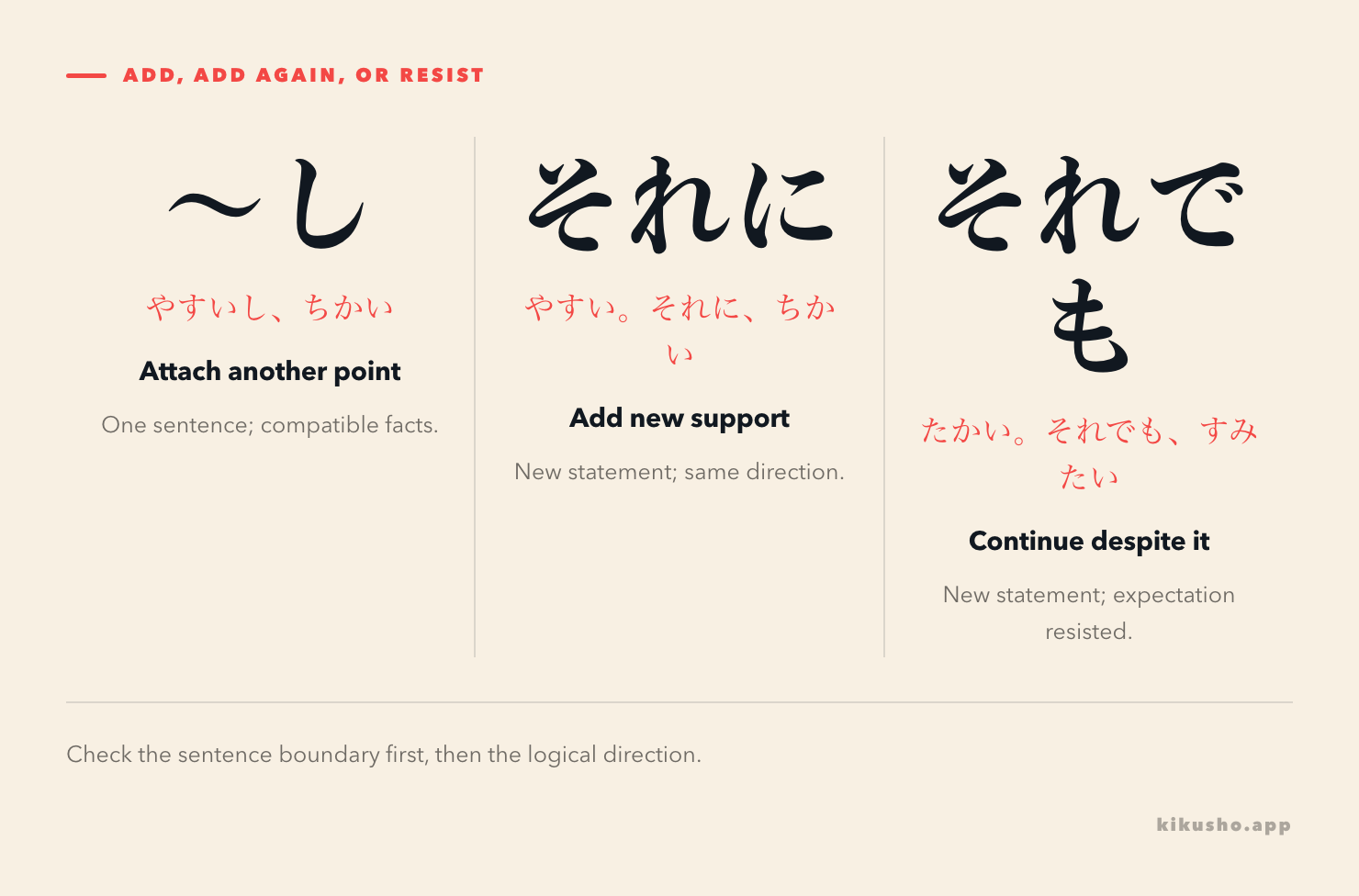
Tokyo University of Foreign Studies classifies し as a connective particle used to enumerate situations in its connective-particle reference. Bunpro's し~し lesson likewise describes compatible facts listed together. These sources are independent of the curriculum's JLPT Sensei inventory.
し attaches to the predicate it follows
The form before し is complete enough to state a fact:
| Predicate type | Plain attachment | Polite attachment |
|---|---|---|
| verb | よく寝るし | よく寝ますし |
| い-adjective | 安いし | 安いですし |
| な-adjective | 静かだし | 静かですし |
| noun | 学生だし | 学生ですし |
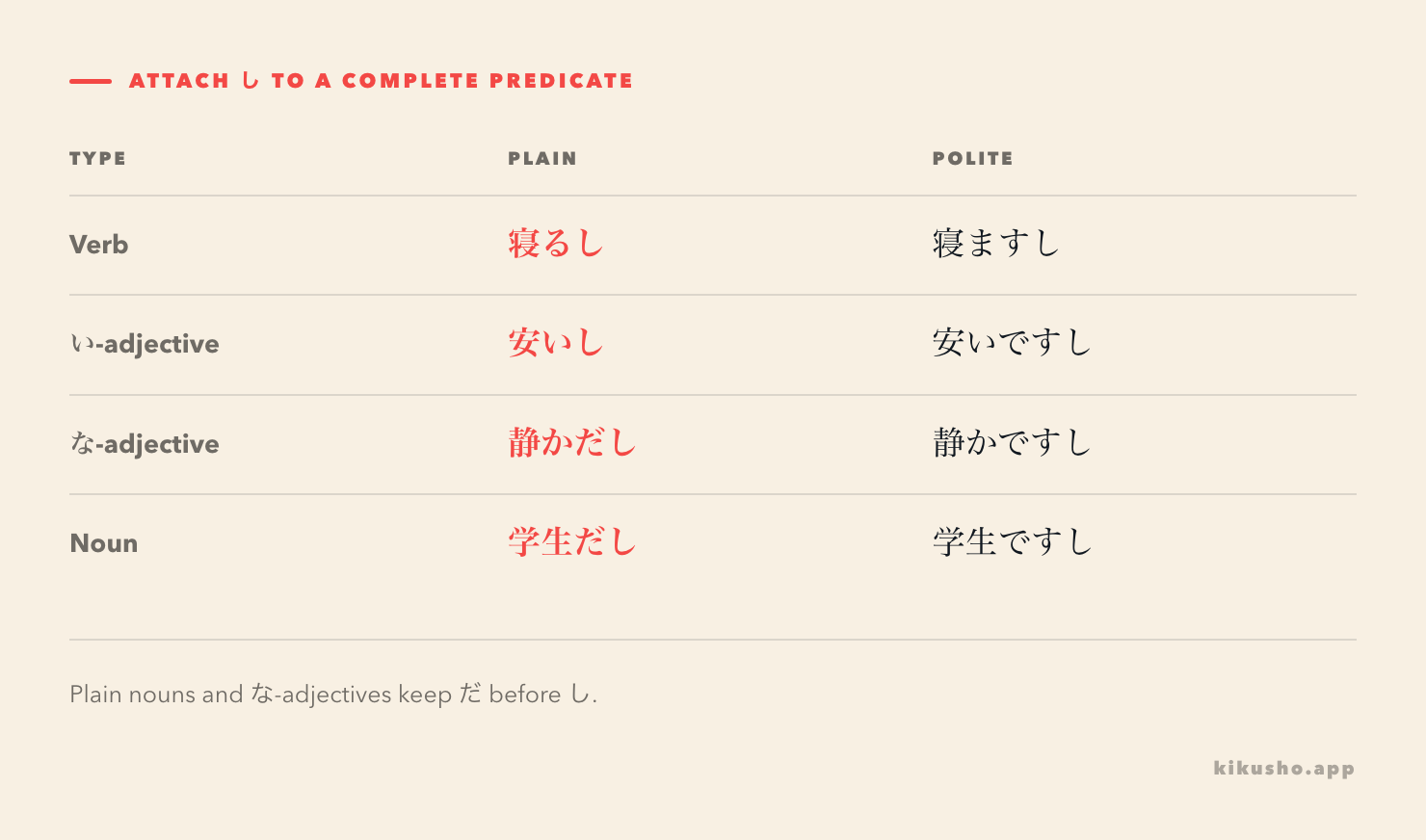
The だ matters after a noun or な-adjective in plain style: 静かだし, not 静かし; 学生だし, not 学生し. Polite predicates can precede the particle too, as in 便利ですし、使いやすいです.
この町は静かだし、買い物も便利です。
この まちは しずかだし、かいものも べんりです。
This town is quiet, and shopping is convenient too.
Both facts support the same favourable description. Repeating し makes the accumulation clearer:
この町は静かだし、駅から近いし、住みやすいです。
This town is quiet, close to the station, and easy to live in.
The final conclusion can also be understood from context:
A:どうしてこの部屋にしたんですか。
B:広いし、明るいし。
A: Why did you choose this room?
B: Well, it is spacious, and bright...
The unfinished sound suggests that these are sufficient reasons or part of a longer list. One し can do the same more lightly: 今日は雨だし、家にいます, “It is raining, so I will stay home.” The first clause is presented as one supporting reason, without claiming it is the only one.
それに starts another supporting statement
それに does not attach to the preceding predicate. It points back to the completed statement and adds another fact that supports the same description, judgment, or decision.
このかばんは軽いです。それに、丈夫です。
この かばんは かるいです。それに、じょうぶです。
This bag is light. Moreover, it is durable.
Lightness and durability both count in the bag's favour. Bunpro's それに entry describes this additive connection, and the Kotobank dictionary entry records the same “in addition” function.
You can often express almost the same content with し, but the sentence architecture changes:
このかばんは軽いし、丈夫です。
This bag is light and durable.
このかばんは軽いです。それに、丈夫です。
This bag is light. Besides, it is durable.
The first keeps the facts inside one sentence. The second completes one statement, then deliberately adds another. The wider N4 connector map compares それに with result, sequence and conclusion connectors.
それでも pushes through an obstacle
それでも turns the logic. The first statement creates an obstacle or a reason to expect a different result; the second statement remains true anyway.
薬を飲みました。それでも、熱が下がりません。
くすりを のみました。それでも、ねつが さがりません。
I took medicine. Even so, my fever has not gone down.
Taking medicine creates an expectation of improvement. The fever resists it.
外は寒いです。それでも、子どもたちは遊んでいます。
そとは さむいです。それでも、こどもたちは あそんでいます。
It is cold outside. Nevertheless, the children are playing.
JapaneseTest4You's N4 reference verifies the “even so / and yet” relationship across two statements. Bunpro independently lists それでも at N4.
Replacing it with それに reverses the intended reading:
雨が降っています。それに、風も強いです。
It is raining. In addition, the wind is strong.
雨が降っています。それでも、出かけます。
It is raining. Even so, I will go out.
The first accumulates bad weather. The second acts despite it.
The overlap is in topic, not direction
All three forms can keep talking about the same topic, which is why translation alone can blur them. Their directions remain different.
Suppose a friend asks whether a restaurant is a good choice:
安いし、おいしいです。
It is inexpensive and good.
This bundles two reasons into one answer.
安いです。それに、駅から近いです。
It is inexpensive. Besides, it is near the station.
This adds another favourable point after a complete sentence.
いつも混んでいます。それでも、行きたいです。
It is always crowded. Even so, I want to go.
This acknowledges a drawback without changing the decision.
Do not choose それでも merely because the first sentence is negative. 高くないです。それに、おいしいです adds two favourable points: “It is not expensive. Moreover, it is good.” What matters is whether the second statement defies an expectation, not whether the first contains ない.
Where these forms stop
し lists compatible facts, but context decides whether they function as reasons. 海にも行ったし、山にも登りました simply lists two summer activities. In 雨だし、疲れているし、今日は出かけません, the list supports the decision not to go out.
それに adds rather than causes. If the second statement is a consequence of the first, それで is usually the clearer connector: 電車が止まりました。それで、遅れました, “The train stopped. Because of that, I was late.”
それでも is not the clause-attached ~ても form. Compare 雨が降っても行きます, “Even if it rains, I will go,” with 雨が降っています。それでも、行きます, “It is raining. Even so, I will go.” The concession is related, but the sentence boundary differs.
JLPT Sensei places し, それに and それでも at N4. Bunpro agrees on all three. The official JLPT FAQ explains that no exhaustive grammar list is published, so these remain source-based study placements.
When a real message uses one of these links, save both sides in Kikusho. An isolated それでも card loses the obstacle it pushes against; the full pair preserves the inference you need to recall.
Practice: identify the boundary and direction
Complete the seven choices and compositions before checking how each relationship works.
Question 1 — grammar choice. Complete the plain-form attachment: この町は静か( )、駅から近いです。
- ア. し
- イ. だし
- ウ. それに
- エ. それでも
Question 2 — grammar choice. Add another positive feature in a new sentence: このホテルは安いです。( )、部屋も広いです。
- ア. それでも
- イ. それに
- ウ. し
- エ. ので
Question 3 — text grammar. The medicine should have helped, but did not: 薬を飲みました。( )、まだ頭が痛いです。
- ア. それに
- イ. だから
- ウ. それでも
- エ. それから
Question 4 — attachment. Which sentence correctly lists two properties?
- ア. この店は便利し、安いです。
- イ. この店は便利だし、安いです。
- ウ. この店は便利それに、安いです。
- エ. この店は便利それでも、安いです。
Question 5 — sentence composition. Make one sentence meaning “This bag is light and durable” with このかばん, 軽い, 丈夫だ, and し.
Question 6 — relationship. Which continuation accumulates another reason not to go out? 雨が降っています。( )、風も強いです。
- ア. それに
- イ. それでも
- ウ. すると
- エ. しかし
Question 7 — boundary. Which sentence means “Even if it rains, I will go,” using a clause-attached form rather than the independent connector それでも?
- ア. 雨が降るし、行きます。
- イ. 雨が降っています。それに、行きます。
- ウ. 雨が降っても行きます。
- エ. 雨が降っています。それでも、行きません。
Answers and explanations
Answer 1. イ: だし. Plain 静か needs copular だ before the connective particle, producing 静かだし. ア drops だ. ウ and エ are independent connectors and cannot attach directly in this slot.
Answer 2. イ: それに. The second positive feature supports the first after a complete sentence. それでも would signal an outcome that survives an obstacle. Bare し does not open a separate statement this way.
Answer 3. ウ: それでも. Taking medicine creates an expectation that the pain will improve, but the headache remains. それに would add a compatible fact; だから would present the pain as a conclusion from taking medicine; それから only advances time.
Answer 4. イ. The な-adjective predicate is 便利だ, followed by し. ア omits だ. The independent connectors in ウ and エ cannot be inserted directly after 便利 without completing the statement.
Answer 5. One model is このかばんは軽いし、丈夫です。 The い-adjective attaches directly as 軽いし. The final predicate uses polite 丈夫です; matching every clause to the same politeness level is possible but not required for this neutral sentence.
Answer 6. ア: それに. Rain and strong wind accumulate in the same unfavourable direction. それでも would need a continuation that holds despite the rain, such as 出かけます.
Answer 7. ウ: 雨が降っても行きます. ~ても attaches to the rain clause and means the decision holds even under that condition. Independent それでも would require a completed preceding statement. エ instead says that despite the rain, the speaker will not go.
Common questions
What is the difference between し and それに?
し attaches to a predicate and lists a fact or reason inside the sentence: 安いし、近いです. それに is an independent connector that begins another supporting statement: 安いです。それに、駅から近いです.
What does それでも mean?
それでも means “even so” or “nevertheless.” It introduces a result that still holds despite the obstacle or expectation created by the preceding statement: 雨です。それでも、行きます.
Does し always need to appear twice?
No. Repeating し makes a list explicit, but one し can imply that the stated point is one reason among others. 今日は忙しいし、行けません gives busyness as a supporting reason without requiring a second し.
Are し, それに and それでも N4 grammar?
JLPT Sensei places all three at N4, and Bunpro also places し~し, それに and それでも at N4. These are study classifications because the JLPT does not publish an exhaustive official grammar list.