On this page
~させてください (sasete kudasai) asks someone to allow your action: 少し考えさせてください means “Please let me think for a moment.” Build the verb in the causative, change that causative to its て-form, and add ください.
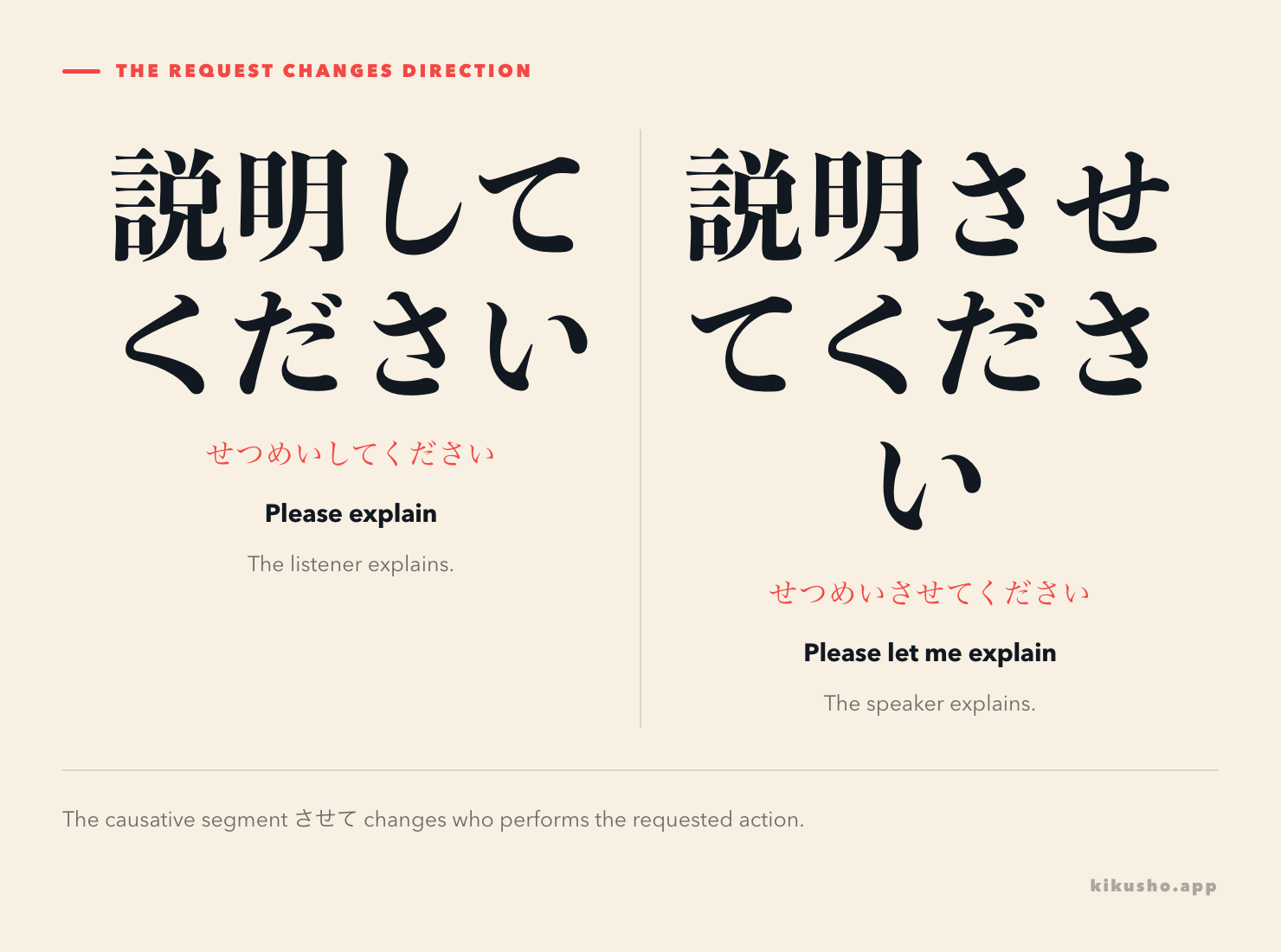
The extra causative segment changes the direction of the request. 説明してください asks the listener to explain. 説明させてください asks the listener to let the speaker explain. That difference is the centre of this N4 construction.
The rule: causative て-form plus ください
The full pattern is:
verb in the causative て-form + ください
Please let me do the verb.
The University of Texas at Austin's JOSHU causative reference identifies this attachment as a request for permission. Tofugu's causative guide independently explains the same causative formation and its permissive use. Both begin from the ordinary causative: one person permits or causes another person's action.
In this request pattern, the listener controls the permission and the speaker normally performs the action:
返事をする前に、少し考えさせてください。
へんじを する まえに、すこし かんがえさせてください。
Please let me think for a moment before I answer.
The sentence does not need 私. The conversation already makes the speaker the person who wants time to think. When contrast matters, 私に can make that actor explicit: 今度は私に説明させてください, “This time, please let me explain.”
Form the causative first, then change る to て
This construction has two steps. First make ~せる/~させる. That causative behaves like an ichidan verb, so its final る becomes て before ください.
| Dictionary form | Causative | Permission request | Meaning |
|---|---|---|---|
| 話す(はなす) | 話させる | 話させてください | please let me speak |
| 読む(よむ) | 読ませる | 読ませてください | please let me read |
| 待つ(まつ) | 待たせる | 待たせてください | please let me wait |
| 買う(かう) | 買わせる | 買わせてください | please let me buy it |
| 帰る(かえる) | 帰らせる | 帰らせてください | please let me go home |
| 食べる(たべる) | 食べさせる | 食べさせてください | please let me eat it |
| する | させる | させてください | please let me do it |
| 来る(くる) | 来させる(こさせる) | 来させてください(こさせてください) | please let me come |
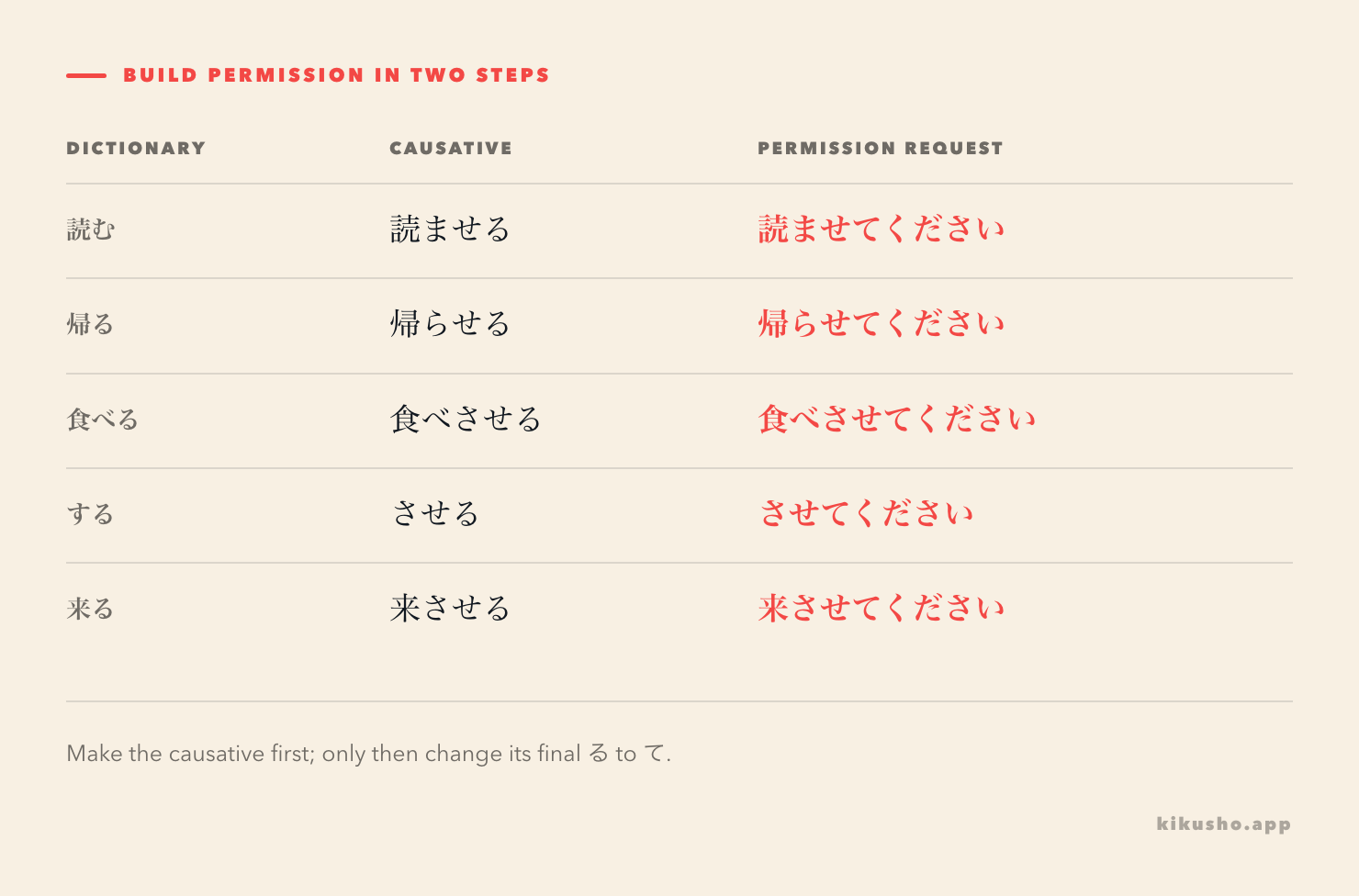
For a godan verb, move its final kana to the あ-row and add せる: 読む → 読ませる, 帰る → 帰らせる. Final う changes to わ, as in 買う → 買わせる. For an ichidan verb, remove る and add させる: 食べる → 食べさせる. The irregular pair is する → させる and 来る → 来させる(こさせる).
If those first-step changes are unfamiliar, use the complete N4 causative lesson. The present lesson starts after that form has been built. It then applies the same て + ください attachment taught in the basic request lesson.
One causative segment reverses who acts
Compare the requests as complete scenes:
| Request | Person who acts | Natural translation |
|---|---|---|
| もう一度説明してください。 | the listener | Please explain once more. |
| もう一度説明させてください。 | the speaker | Please let me explain once more. |
| この写真を見てください。 | the listener | Please look at this photo. |
| 写真を撮らせてください。 | the speaker | Please let me take a photo. |
In 説明させてください, 説明する first becomes causative 説明させる. The resulting 説明させて means “allow the explaining,” and ください directs that request to the listener. The speaker remains the one who explains.
The object still takes を. In 写真を撮らせてください, the speaker takes the photo, and 写真を is the object of 撮る. The listener's role is understood as granting or refusing permission; you do not add an object particle merely to mark that role.
This direction also explains why 話してください cannot substitute for 話させてください. The shorter form gives the speaking task to the other person. Politeness alone does not decide who performs the verb; the causative does.
Give the listener a reason they can evaluate
A permission request often becomes clearer when the sentence states why the action is needed:
まだ決められないので、もう少し考えさせてください。
まだ きめられないので、もう すこし かんがえさせてください。
I cannot decide yet, so please let me think a little longer.
今日は具合が悪いので、早く帰らせてください。
きょうは ぐあいが わるいので、はやく かえらせてください。
I am not feeling well today, so please let me go home early.
The ので clause does not create the permission meaning. It supplies the circumstances. The causative request still carries the grammar, while the reason helps the listener understand what they are being asked to allow.
You can also name the action as a する-expression:
最初に自己紹介させてください。
さいしょに じこしょうかいさせてください。
Please let me introduce myself first.
Here 自己紹介する → 自己紹介させる → 自己紹介させてください follows the irregular する path. Do not insert another する after させて.
Polite and direct are separate questions
~させてください is polite in form, yet it is still a direct request. That directness can be suitable when the requested action is routine and the situation is already clear. A student may ask for time to think; a participant may ask to explain a point; an employee who feels ill may request to leave early.
For more distance, Japanese can frame the permission as a question:
| Form | What it asks |
|---|---|
| ~させてください | Please let me do it. |
| ~させてもらえませんか | Could I receive permission to do it? |
| ~させていただけませんか | Could I humbly receive permission to do it? |
JOSHU gives ~させていただけないでしょうか as a more polite request for permission. Tofugu likewise distinguishes ~させてもらう/いただく from the direct ください request. The longer forms are choices of register and viewpoint. They do not repair a poorly formed causative.
Avoid treating ~させていただきます as a universal replacement for “I will.” It presents the action as something done with another person's allowance or benefit. When no such permission matters, a plain polite statement may say exactly what is needed. This lesson keeps the core N4 target at ~させてください; the receiving constructions deserve their own treatment.
JLPT Sensei places ~させてください at N4. This is a teaching estimate rather than an official exhaustive syllabus: the JLPT FAQ explains that the test no longer publishes a fixed list of grammar, vocabulary and kanji items.
Where the pattern stops
Use ~させてください when permission for the actor's action is the point. It is the wrong direction when you simply want the listener to do something. 窓を開けてください asks the listener to open the window; 窓を開けさせてください asks to be allowed to open it yourself.
The usual actor is the speaker, but context can name someone else: 弟も参加させてください asks “Please let my younger brother participate too.” This is no longer a request for the speaker's own action, so identify the intended actor before translating mechanically as “let me.”
Do not confuse this pattern with the causative-passive. 帰らせてください asks permission to leave. 帰らせられました reports that someone was made to leave. The causative-passive lesson follows the experience of the person compelled to act.
If you meet 考えさせてください in a message or hear it in a conversation, save the whole line in Kikusho rather than only the ending. The editable card can keep the reason before the request and the register note beside it. That context is what separates a calm request for time from a command aimed at somebody else.
Practice: track the actor before choosing the form
Answer all seven questions before opening the explanations. The exercises are original and use grammar-choice, sentence-composition and text-grammar formats.
Question 1 — grammar choice. You need a moment before answering. Which sentence means “Please let me think a little”?
- ア. 少し考えてください。
- イ. 少し考えさせてください。
- ウ. 少し考えられてください。
- エ. 少し考えるください。
Question 2 — grammar choice. Which is the standard permission request built from 読む?
- ア. 読んでください。
- イ. 読みさせてください。
- ウ. 読ませてください。
- エ. 読まれてください。
Question 3 — actor check. A presenter says 最初に自己紹介させてください. Who will introduce someone?
- ア. The listener introduces the speaker.
- イ. The speaker introduces themself.
- ウ. A third person introduces the listener.
- エ. Nobody is asking permission.
Question 4 — sentence composition. Ask to be allowed to go home early because you feel unwell today. Use 今日は, 具合が悪い, ので, 早く, and the permission-request form of 帰る.
Question 5 — text grammar. Complete the exchange.
学生:すみません。もう一度( )。
先生:はい、どうぞ。
The student wants permission to explain the point again.
- ア. 説明してください
- イ. 説明させてください
- ウ. 説明しました
- エ. 説明させられました
Question 6 — contrast. Which sentence asks the listener to open the window?
- ア. 窓を開けてください。
- イ. 窓を開けさせてください。
- ウ. 窓が開いています。
- エ. 窓を開けさせられました。
Question 7 — register. You need to make a burdensome request to a senior person. Which choice most clearly frames the permission as a deferential question?
- ア. させるください。
- イ. させていただけませんか。
- ウ. させてくださいでした。
- エ. していただきましたか。
Answers and explanations
Answer 1. イ: 少し考えさせてください. The speaker asks for permission to think. ア asks the listener to think; ウ uses a passive shape that does not form this request; エ attaches ください directly to the dictionary form.
Answer 2. ウ: 読ませてください. Godan 読む changes to causative 読ませる, then to 読ませて before ください. ア is a valid request, but it asks the listener to read. イ wrongly attaches させる to the ます-stem. エ resembles a passive request and does not mean “let me read.”
Answer 3. イ. 自己紹介する is the speaker's intended action. The causative request asks the listener to allow it. The omitted subject is recovered from the interaction, and 自己 inside 自己紹介 refers back to the person making the introduction.
Answer 4. One model is 今日は具合が悪いので、早く帰らせてください。 帰る is godan: 帰る → 帰らせる → 帰らせてください. The reason clause explains the request but does not change its formation.
Answer 5. イ: 説明させてください. The student wants to perform the explanation, and the teacher's はい、どうぞ grants permission. ア would ask the teacher to explain. ウ is a past statement. エ says the student was made to explain.
Answer 6. ア: 窓を開けてください. The plain て-form request assigns 開ける to the listener. イ asks the listener to allow the speaker to open the window. ウ describes the window's open state; エ reports compulsion in the past.
Answer 7. イ: させていただけませんか. Its negative potential question asks whether the speaker could receive permission to act. ア uses the causative dictionary form before ください. ウ combines endings incorrectly. エ asks about a completed favour and does not form the intended permission request.
Common questions
What does ~させてください mean?
It asks the listener to allow an action: “please let me do.” The speaker is normally the person who will act, unless the sentence explicitly names somebody else. 少し考えさせてください means “Please let me think for a moment.”
How do you form ~させてください?
Make the standard causative form, change its final る to て, and add ください. 読む becomes 読ませる, then 読ませてください. 食べる becomes 食べさせる, then 食べさせてください. する becomes させてください.
What is the difference between ~てください and ~させてください?
~てください asks the listener to perform the verb. ~させてください asks the listener to permit the speaker to perform it. 説明してください means “Please explain”; 説明させてください means “Please let me explain.”
Is ~させてください polite enough for a boss or teacher?
It is polite but direct. It may fit a routine request whose reason is clear. When the request is burdensome or the relationship calls for more deference, ~させていただけませんか or ~させてもらえませんか frames the permission as a question.