On this page
Add さ to an adjective stem when you need a noun for the quality or its degree. 高い becomes 高さ “height,” and 便利 becomes 便利さ “convenience,” so the new word can be measured, compared, noticed or discussed like any other noun.
さ gives a quality the grammar of a noun
Compare two sentences about the same suitcase:
このスーツケースは重いです。
この スーツケースは おもいです。
This suitcase is heavy.
このスーツケースの重さは二十キロです。
この スーツケースの おもさは にじゅっキロです。
The weight of this suitcase is 20 kilograms.
The first sentence makes 重い the predicate and describes the suitcase. The second needs “weight” as a thing that can be given a number. Removing the final い and adding さ creates the noun 重さ.
Once formed, a さ noun takes ordinary noun particles:
| Particle | Example | What the noun does |
|---|---|---|
| は | 高さは十メートルです | becomes the topic |
| が | 部屋の広さが違います | becomes the subject |
| を | 荷物の重さを量ります | becomes the object |
| に | 道の狭さに驚きました | marks the target of a reaction |
| の | 橋の長さの違い | modifies another noun |
MIT OpenCourseWare's Japanese grammar notes teach adjective-stem + さ with 重さ, 高さ, 速さ and 便利さ, then use those nouns with ordinary particles. Bunpro independently lists both い-adjective and な-adjective stems and marks the form as standard-register N4 grammar.
Remove い, but do not add な
The two adjective classes reach the suffix differently.
| Adjective type | Start | Change | さ noun |
|---|---|---|---|
| い-adjective | 高い | remove い, add さ | 高さ(たかさ) |
| い-adjective | 難しい | remove い, add さ | 難しさ(むずかしさ) |
| な-adjective | 便利 | add さ to the stem | 便利さ(べんりさ) |
| な-adjective | 静か | add さ to the stem | 静かさ(しずかさ) |
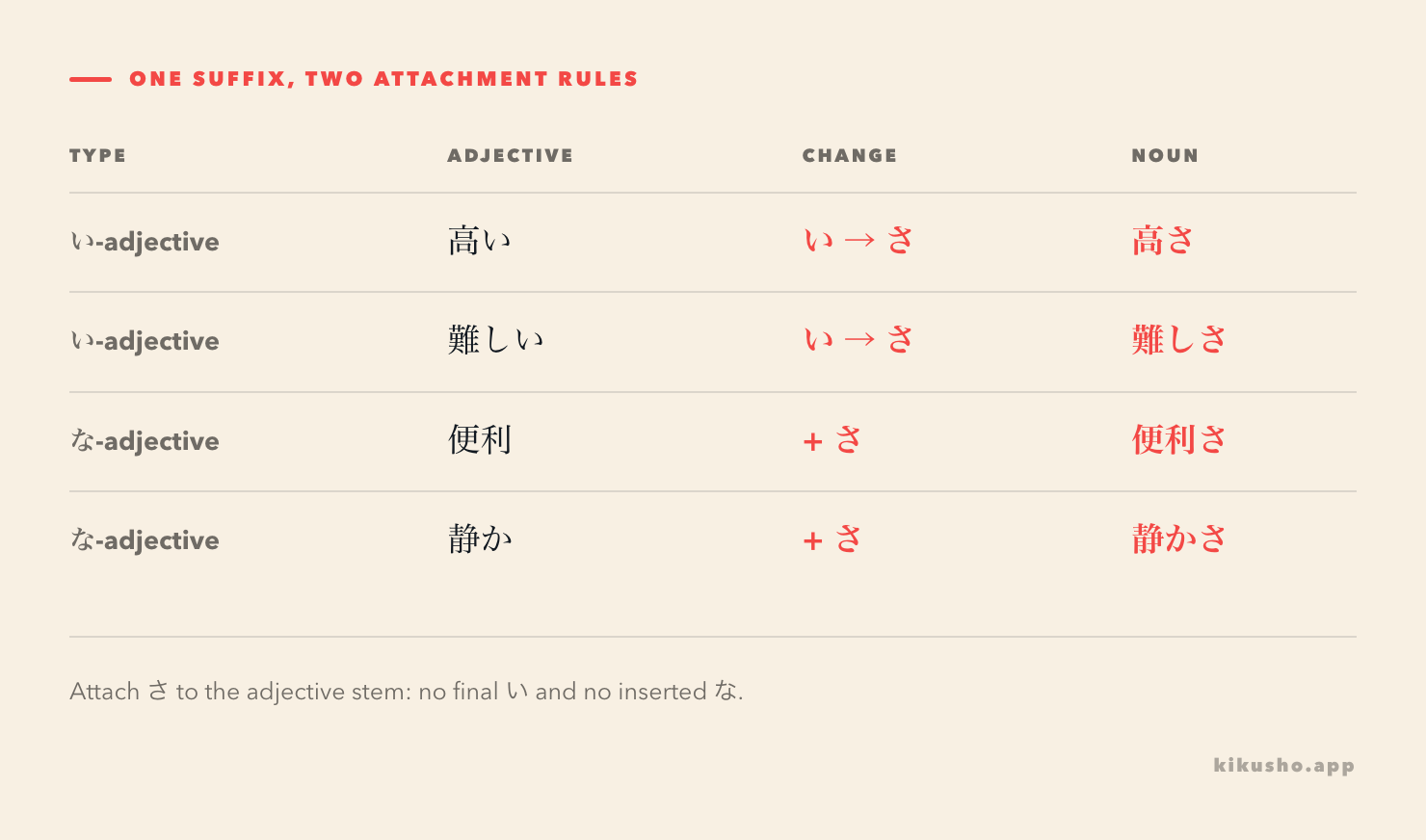
With an い-adjective, do not keep い: 長さ, not 長いさ. With a な-adjective, the dictionary form is the stem you see before だ or です. The な appears only when that adjective directly modifies a noun, as in 静かな部屋. It does not enter 静かさ.
このアプリの便利さに慣れました。
この アプリの べんりさに なれました。
I have become accustomed to the convenience of this app.
夜の町の静かさが好きです。
よるの まちの しずかさが すきです。
I like the quietness of the town at night.
The N5 adjective guide establishes which class a word belongs to. That class decides what disappears before さ.
いい becomes よさ
The common adjective いい uses its older stem よ- before most endings. Its noun is therefore よさ, not いさ or いいさ.
住んでみて、この町のよさが分かりました。
すんでみて、この まちの よさが わかりました。
After living here, I came to understand what is good about this town.
Here よさ is more natural in English as “good points,” “merit” or “appeal” than as the literal “goodness.” The suffix creates a Japanese noun; it does not promise that English will always use -ness.
The same stem appears in よく, よかった and よければ. Learning よさ as part of that family makes it an ordinary form rather than a one-word exception.
A positive scale word often names the whole measurement
Some さ nouns from one end of a scale become the ordinary name for the complete measurement.
| Adjective | さ noun | Usual measurement | Opposite quality |
|---|---|---|---|
| 大きい | 大きさ | size | 小ささ, smallness |
| 長い | 長さ | length | 短さ, shortness |
| 高い | 高さ | height | 低さ, lowness |
| 速い | 速さ | speed | 遅さ, slowness |
| 深い | 深さ | depth | 浅さ, shallowness |
大きさ does not mean that the object is necessarily big. 箱の大きさを比べる means “compare the sizes of the boxes,” and either box may be small. By contrast, 小ささ specifically directs attention to how small something is.
この二つの箱は大きさが同じです。
この ふたつの はこは おおきさが おなじです。
These two boxes are the same size.
新しい机の高さを調整できます。
あたらしい つくえの たかさを ちょうせいできます。
You can adjust the height of the new desk.
Tofugu's adjective さ reference documents this scale behavior and distinguishes the neutral measurement named by 大きさ or 速さ from the marked qualities 小ささ or 遅さ.
Measurable is the center, not a strict limit
Height, length and weight make the pattern easy to see, but さ also works with qualities that have no ruler or scale.
この説明の分かりやすさに驚きました。
この せつめいの わかりやすさに おどろきました。
I was surprised by how easy this explanation was to understand.
問題の難しさは人によって違います。
もんだいの むずかしさは ひとによって ちがいます。
The difficulty of the problem differs from person to person.
The speaker treats clarity or difficulty as a quality that can be singled out and evaluated. That is why “objective” is a useful tendency but a poor absolute rule. 優しさ, “kindness,” and 楽しさ, “enjoyment,” can describe experiences and judgments even though they are not physical measurements.
Adjective-forming suffixes can also feed into さ. 使いやすい becomes 使いやすさ, “ease of use,” and 読みにくい becomes 読みにくさ, “difficulty of reading.” The やすい and にくい lesson shows how to build those adjective forms before you replace their final い with さ.
み is lexical and often felt from the inside
Both さ and み can create nouns from adjective stems, but they are not freely interchangeable.
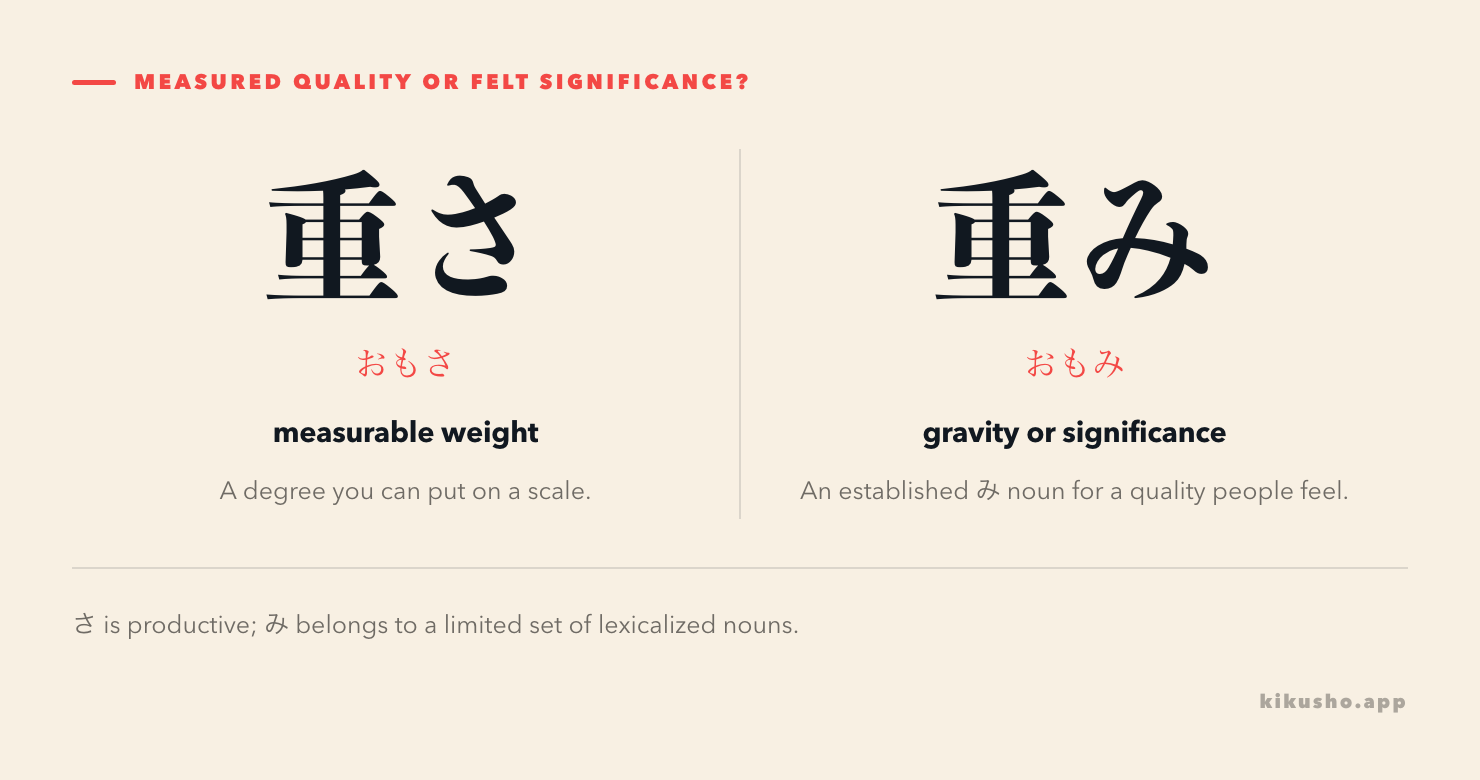
| Pair | さ noun | み noun |
|---|---|---|
| 重い | 重さ, weight as a measure | 重み, weightiness or significance |
| 深い | 深さ, measured depth | 深み, richness or profundity |
| 強い | 強さ, degree of strength | 強み, a strong point |
| 楽しい | 楽しさ, how enjoyable something is | 楽しみ, pleasure or something anticipated |
この荷物の重さを量ってください。
この にもつの おもさを はかってください。
Please weigh this luggage.
先生の言葉には重みがあります。
せんせいの ことばには おもみが あります。
The teacher's words carry weight.
Use さ as the productive pattern. Learn み nouns as vocabulary because only a limited set is established, and their meanings may have developed beyond a simple suffix translation. 難しさ is ordinary; inventing 難しみ from the same rule is not.
さ names the quality; の may stand for a thing or a clause
The suffix さ and the nominalizer の can both place adjective material where a noun might appear, but they preserve different information.
赤いのをください。
Please give me the red one.
Here 赤いの stands for an omitted thing, such as a red bag or shirt. 赤さ means “redness,” the quality or degree of being red.
この問題が難しいのは分かっています。
I know that this problem is difficult.
Here の packages the whole clause この問題が難しい. この問題の難しさ instead names the problem's difficulty as a quality:
この問題の難しさが分かりました。
I understood how difficult this problem is.
The English translations can overlap, so ask what the Japanese sentence needs. If it needs a quality that takes a measure, comparison or reaction, さ is likely. If の replaces a missing thing or packages a complete clause, keep the adjective intact before の.
There is also a sentence-ending さ used in conversation. It does not turn an adjective into a noun. The sentence-final さ, わ, ぞ and ぜ lesson separates those endings by stance and register.
When saving a さ noun in Kikusho, keep the particle and the noun it describes: 荷物の重さを量る gives more useful information than 重さ alone. The complete phrase preserves the physical sense, the reading and the verb that naturally follows it.
N4 is a study placement, not a border around the suffix
Kikusho's reference inventory, JLPT Sensei and Bunpro place nominalizing さ at N4. A Coto Japanese Academy lesson labels the same adjective-to-noun pattern N3. That difference concerns course sequencing rather than a different attachment rule.
The official JLPT FAQ explains that the organizers stopped publishing itemized vocabulary, kanji and grammar specifications after the 2010 revision. Learn this productive form when you need it; treat the level label as a supported study estimate rather than an official exhaustive assignment.
Turn each description into the noun the sentence needs
Complete all seven tasks before checking the shared answer section.
Question 1: grammar choice. Complete “the length of this river”: この川の__.
- A. 長いさ
- B. 長さ
- C. 長なさ
- D. 長いのさ
Question 2: formation. Turn 便利 into the noun meaning “convenience.”
Question 3: noun syntax. Choose the natural sentence meaning “We measured the depth of the pool.”
- A. プールが深いを測りました。
- B. プールの深さを測りました。
- C. プールの深いさが測りました。
- D. プールは深みをメートルでした。
Question 4: さ or の. At a shop, you point to two shirts and say “Please give me the expensive one.” Which phrase completes __をください?
- A. 高さ
- B. 高いの
- C. 高み
- D. 高いさ
Question 5: さ or み. You mean that a short statement carries emotional gravity and significance. Complete その一言には__があります.
- A. 重さ
- B. 重いさ
- C. 重み
- D. 重いの
Question 6: sentence composition. Put the chunks in order to say “I weighed this bag”: 量りました / このかばんの / 重さを / 。
Question 7: grammar in context. Read: この二つの部屋は大きさが同じですが、静かさは違います。私は静かなのが好きなので、奥の部屋を選びました。 Which interpretation fits the forms?
- A. The rooms have different sizes, and 静かなの means “quietness as a measurement.”
- B. The rooms are equally quiet, and 大きさ means only “bigness.”
- C. The rooms are the same size but differ in quietness; 静かなの stands for the quiet one.
- D. Both さ nouns are sentence-ending particles.
Answers and explanations
Answer 1. B, 長さ. Remove the final い from 長い and add さ. A keeps the discarded い, while C and D combine unrelated endings.
Answer 2. 便利さ. A な-adjective takes さ directly on its stem. Do not insert な: 便利なさ is not the form taught here.
Answer 3. B, プールの深さを測りました. 深さ is the noun “depth,” marked by を as the thing measured. A leaves an adjective in a noun slot, C retains い, and D uses 深み for a different, usually nonliteral sense and lacks a grammatical measurement predicate.
Answer 4. B, 高いの. の stands for the omitted shirt, so the adjective remains complete. 高さ would mean height or the degree of being high or expensive, not “the expensive one.”
Answer 5. C, 重み. In this collocation, 重み presents the felt gravity or significance of the statement. 重さ normally names physical weight as a measurable quality.
Answer 6. このかばんの重さを量りました。 The bag modifies 重さ with の, and the noun takes を as the object of 量りました.
Answer 7. C. 大きさ names the neutral measurement “size,” while 静かさ names the degree or quality of quietness. In 静かなの, の stands for the chosen room, so な remains because 静か directly modifies that nominalizer.
A さ noun lets a sentence handle a quality as an object of thought. The particle that follows shows what happens next: measurement, comparison, discovery or reaction.
Common questions
How do you add さ to an い-adjective?
Remove the final い and add さ: 高い becomes 高さ, 長い becomes 長さ and 難しい becomes 難しさ. The result is a noun, so it can take particles such as は, が, を and に.
How do you add さ to a な-adjective?
Add さ directly to the adjective stem without な: 便利 becomes 便利さ, 静か becomes 静かさ and 大切 becomes 大切さ. Forms such as 便利なさ are incorrect for this nominalizing pattern.
Why does いい become よさ?
いい uses the stem よ- before endings other than its plain い, so its さ noun is よさ. In context, よさ often means the good quality, merit or appeal of something.
What is the difference between さ and み?
さ is productive and usually presents a quality as a degree or aspect that can be examined. み forms a limited set of established nouns and often presents a felt quality or substance. 重さ is measurable weight, while 重み can be gravity or significance.