On this page
けれど marks a contrast, すると moves to the next event, それで gives a result, それに adds another point, and だから draws a conclusion. These five words can all connect ideas, but they do not make the same relationship.
Most often, すると, それで, それに, and standalone だから open a new sentence or turn. けれど is more flexible: it can join two clauses inside one sentence or begin a new one. The useful question is therefore not simply “Does this start a sentence?” Ask what logical link the reader should make.
Match the connector to the relationship
| Connector | Reading | Main link | A question it answers | Typical continuation |
|---|---|---|---|---|
| けれど | けれど | contrast or qualification | What differs from the expectation? | but; however |
| すると | すると | next event or inference | What happened next? | then; at that point |
| それで | それで | factual or natural result | What resulted from that? | so; because of that |
| それに | それに | addition in the same direction | What else supports the point? | besides; moreover |
| だから | だから | speaker's conclusion or judgment | What follows from that reason? | so; therefore |
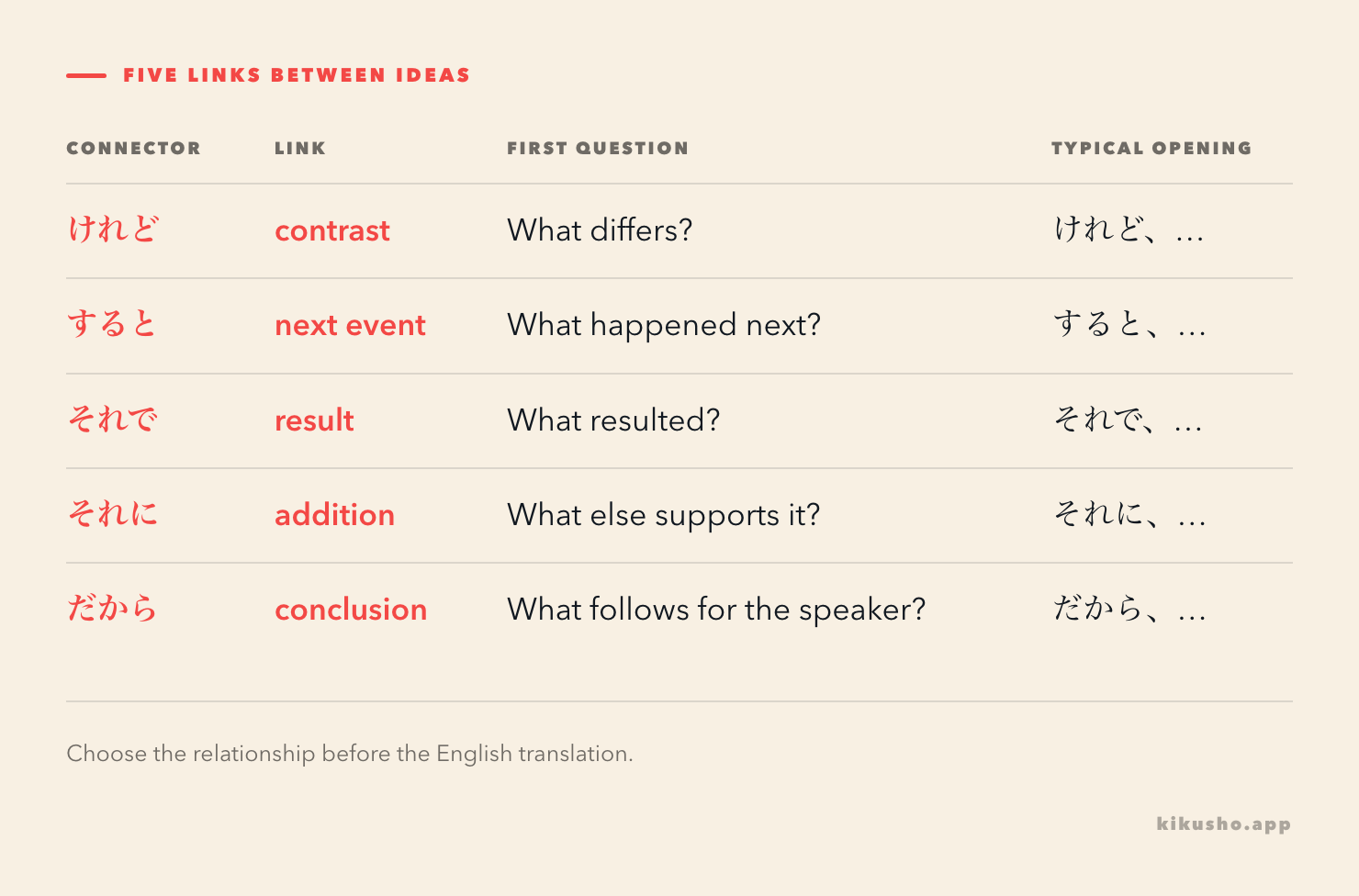
The translations overlap. English “then” can describe either the next event or a result, and “so” can introduce either a factual consequence or the speaker's decision. The Japanese connector makes that relationship more explicit.
けれど can join clauses or start a sentence
けれど introduces information that contrasts with, limits, or qualifies what came before.
このかばんは高いけれど、丈夫です。
This bag is expensive, but it is durable.
Here けれど attaches directly to the plain-form clause このかばんは高い. The second clause supplies a positive fact that contrasts with the price.
You can separate the same two ideas:
このかばんは高いです。けれど、丈夫です。
This bag is expensive. However, it is durable.
Both structures are grammatical. Shogakukan's dictionary entry for けれど records it both as a particle that follows a clause and as a conjunction that links one sentence to the next. The shorter けど is common in casual speech; けれど is neutral, and けれども sounds somewhat more formal.
In conversation, けれど can also leave the real request unsaid:
ちょっと聞きたいことがあるんですけれど……
There is something I would like to ask, but…
The listener understands that more is coming. This softening use is related to contrast, but its social job is to avoid making the approach too abrupt.
すると opens the next scene
すると commonly introduces what happened immediately after the first event, especially a discovery or development that was not presented as the speaker's deliberate next step.
ドアを開けました。すると、猫が飛び出しました。
I opened the door. Then a cat leapt out.
The first event creates the scene; すると reveals what happened next. The dictionary entry for すると also records an inferential use: given the information just stated, something else follows.
A:田中さんは今日、休みです。
B:すると、会議は三人ですね。
A: Tanaka is off today.
B: Then that means there will be three people at the meeting.
Do not use this narrative すると merely to list your own planned actions. For “I finished breakfast, and then I studied,” それから is the ordinary chronological connector. すると is a better fit when the next fact appears, is discovered, or is inferred.
それで presents a result
それで tells the reader that the next statement is the natural or factual result of the earlier situation.
電車が止まりました。それで、会議に遅れました。
The train stopped. Because of that, I was late for the meeting.
The train problem functions as the cause, and the lateness is its result. The National Institute for Japanese Language and Linguistics distinguishes this logical result from それから and そして, which continue a sequence or add events. Kyoto University's Japanese learning materials likewise teach それで as the connector for a reason followed by its consequence.
In conversation, それで? can mean “And then?” The speaker asks for the result or continuation rather than supplying one.
A:昨日、駅で山田さんに会いました。
B:それで?
A: I met Yamada at the station yesterday.
B: And then?
それに adds another reason or feature
それに does not move time forward and does not say that one event caused another. It adds a point that supports the same description, evaluation, or argument.
この店は安いです。それに、おいしいです。
This restaurant is inexpensive. Besides, the food is good.
Both facts support a favourable view of the restaurant. Kyoto University's explanation describes それに as adding new information to what has already been said, and the dictionary entry for それに records this additive use as its central modern function.
Compare the relationships:
この店は安いです。それに、おいしいです。
It is inexpensive. Moreover, it is good. Addition
この店は安いです。それで、いつも混んでいます。
It is inexpensive. As a result, it is always crowded. Result
The facts can belong to the same topic in both examples. The connector tells us whether the second fact is another supporting point or a consequence.
だから draws a conclusion from a reason
Standalone だから presents the previous statement as the reason for the speaker's conclusion, decision, judgment, or advice.
雨が降っています。だから、傘を持っていってください。
It is raining. So please take an umbrella.
The request is not a physical event that rain automatically produces. It is the speaker's conclusion about what the listener should do. The dictionary entry for だから describes this conjunction as presenting the preceding matter as a reason and leading to the conclusion that naturally follows.
だから also appears inside a sentence:
学生だから、安く買えます。
Because I am a student, I can buy it cheaply.
Here the shape is 学生 + だ + から. The だ belongs to the noun predicate, and causal から joins that reason to the rest of the same sentence. It is visually identical to standalone だから, but its grammatical position differs.
This gives だから two useful frames:
- reason sentence。**だから、**conclusion sentence。
- noun or な-adjective + **だから、**result clause。
それで, だから, and すると answer different questions
All three can follow a first event, but they guide the reader in different directions.
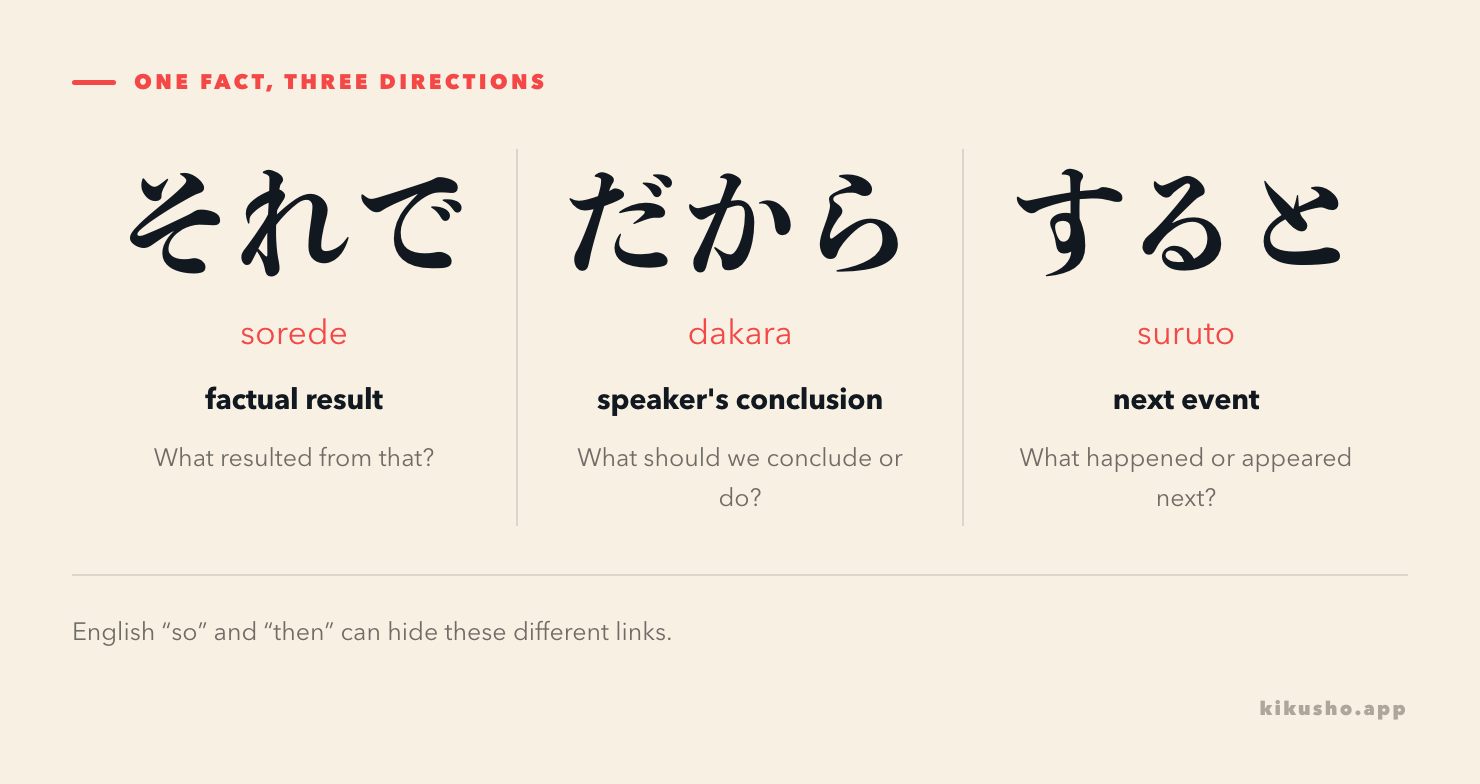
Take one starting fact: 電車が止まりました, “The train stopped.”
電車が止まりました。それで、会社に遅れました。
The train stopped. As a result, I was late for work.
The second statement reports a consequence.
電車が止まりました。だから、タクシーで行きましょう。
The train stopped. So let's go by taxi.
The second statement is a decision or proposal.
電車が止まりました。すると、みんなホームに降りました。
The train stopped. Then everyone got off onto the platform.
The second statement is the next observed event. These are tendencies, not mechanical bans. Real speakers can choose a different connector when they frame the same situation differently.
Punctuation helps the reader, but does not create the grammar
At the start of a sentence, a comma after すると, それで, それに, だから, or けれど is common and easy to read. It is not obligatory in every short sentence. The full stop before a connector is also not the only possible boundary in dialogue: speakers can pause, change turns, or continue after a comma.
The crucial boundary is grammatical. けれど can attach directly to a plain clause. The other four items in this lesson usually operate over the preceding statement as a whole when used as discourse connectors. And the surface form だから requires a second check because it may be either the standalone connector or だ plus causal から.
At higher levels, the same logical links appear in a more formal register. The lesson on formal written connectors extends result and contrast into forms such as したがって and しかし. Mastering these five everyday links first makes that register change easier to see.
Practice: choose all ten before checking
Question 1. Choose the connector that marks contrast. この部屋は狭いです。__、明るいです。
a) それで
b) けれど
c) すると
d) だから
Question 2. A cat unexpectedly appears after the door opens. ドアを開けました。__、猫が入ってきました。
a) それに
b) だから
c) すると
d) けれど
Question 3. Choose the connector for a factual result. 昨日は熱がありました。__、学校を休みました。
a) それで
b) それに
c) けれど
d) すると
Question 4. Add a second positive feature. このホテルは駅に近いです。__、部屋も静かです。
a) だから
b) すると
c) それで
d) それに
Question 5. The speaker gives advice based on the weather. 外は寒いです。__、コートを着てください。
a) だから
b) それに
c) すると
d) けれど
Question 6. Which two sentences are grammatical ways to express “It is expensive, but I will buy it”?
a) 高いけれど、買います。
b) 高いです。けれど、買います。
c) 高いそれで、買います。
d) 高いすると、買います。
Question 7. In 学生だから、図書館を無料で使えます, what is だから?
a) A standalone sentence connector
b) だ after 学生 plus causal から
c) A marker of contrast
d) A marker of unexpected sequence
Question 8. In a conversation, what does それで? most naturally ask the other person to do?
a) Repeat the first sentence more politely
b) Give an opposing opinion
c) Continue with what happened or resulted
d) Add an unrelated fact
Question 9. Which continuation best fits a deliberate proposal rather than a factual consequence? バスがもうありません。__、歩いて帰りましょう。
a) すると
b) だから
c) それに
d) けれど
Question 10. Which connector best adds a second reason? この町が好きです。海がきれいです。__、食べ物もおいしいです。
a) それで
b) すると
c) それに
d) けれど
Answer all ten questions before continuing. The complete solution set begins below.
Answers and explanations
Answer 1: b) けれど. A narrow room creates one expectation, and its brightness supplies a contrasting positive fact. Sentence-initial けれど connects those two statements.
Answer 2: c) すると. The cat's entrance is the next event revealed after the door opens. The context presents a small narrative discovery.
Answer 3: a) それで. Having a fever is the reason, and missing school is the factual result. それで explicitly carries that cause-to-result link.
Answer 4: d) それに. Proximity to the station and a quiet room are two features supporting the same favourable description of the hotel.
Answer 5: a) だから. The cold weather gives the speaker a reason to advise wearing a coat. The second sentence is a recommendation, not an automatic physical result.
Answer 6: a) and b). けれど can follow the plain clause 高い or begin a new sentence after 高いです. The punctuation changes the packaging, not the core contrast.
Answer 7: b) だ after 学生 plus causal から. 学生 is a noun predicate. Its copula だ combines with から to mean “because I am a student” inside the sentence.
Answer 8: c) Continue with what happened or resulted. As a short conversational prompt, それで? asks “And then?” or “So what happened?”
Answer 9: b) だから. Walking home is the speaker's proposal based on the lack of buses. だから naturally introduces that conclusion.
Answer 10: c) それに. The good food adds another reason for liking the town in the same direction as the beautiful sea.
Keep a small question beside each connector: contrast, next event, result, addition, or conclusion? That question preserves a distinction that a single English translation cannot.
Common questions
What is the difference between それで and だから?
それで presents the next statement as a factual or natural result of what came before. だから often presents the speaker's conclusion, judgment, or advice. Both can translate as "so," and context sometimes allows either.
Can けれど start a sentence?
Yes. けれど can attach to a clause, as in 高いけれど、買います, or work as a sentence connector, as in 高いです。けれど、買います. It can also soften an unfinished sentence in conversation.
Does だから always begin a new sentence?
No. Standalone だから can introduce a conclusion, but in 学生だから、安く買えます, だから is だ plus the causal particle から inside one sentence.